• Following Us

  • Categories

  • Check out the Archives


  • Awards & Nominations

Star Trek: Voyager – Eye of the Needle (Review)

This September and October, we’re taking a look at the jam-packed 1994 to 1995 season of Star Trek, including Star Trek: Deep Space Nine and Star Trek: Voyager. Check back daily for the latest review.

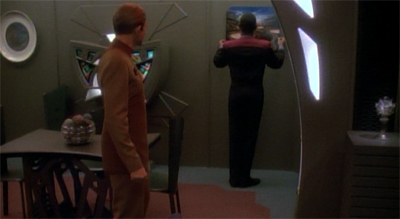
Eye of the Needle really should be a bigger deal than it is.

Looking at the basic premise of Star Trek: Voyager, a story like Eye of the Needle should be an “event.” It should, at the very least, be a mid-season finalé. Ideally, the episode would serve as the season finalé, bringing a sense of closure to year of adventuring by our crew, suggesting that there is some measure of hope for them. Perhaps home is not as far away as it might seem.

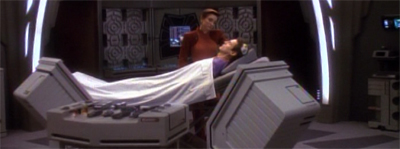
"Hm. You appear to have beamed me up in my pyjamas..."

“Hm. You appear to have beamed me up in my pyjamas…”

Voyager is a show about a ship stranded on the far side of the galaxy. The crew are isolated from friends and family. The return journey will take seventy years. It is quite possible that this will be a generational voyage. The Voyager crew will return home to a world that has changed without them. It’s heartbreaking even to think about.

So the ship’s first chance to get home should be something to get excited about. It should be cause for celebration; it should feel like a lifeline dangling just within the reach of our characters. There should be a sense that this sort of think might only happen once, and everybody best be prepared for it. Instead, it happens six episodes into the season, and the audience spends forty-five minutes waiting for the other shoe to drop.

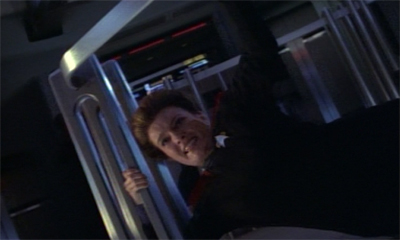
Thoughtful Janeway pose #452...

Thoughtful Janeway pose #452…

Continue reading

Doctor Who: The Caretaker (Review)

Why do I keep you around?

Because the alternative would be developing a conscience of your own?

It is interesting to look at the development of the way that the writers on Doctor Who have developed during Steven Moffat’s tenure as executive producer. Although the show does not maintain a “writers’ room” in the literal sense of the phrase, there is a sense that certain writers have recurred often enough to develop and distinguish their own voices on the show. There is enough precedent to firmly identify Robot of Sherwood as a Gatiss script, and Time Heist as a Thompson script.

As such, The Caretaker definitely feels like a Gareth Roberts script. It shares a very clear thematic throughline with Roberts’ other scripts for the Moffat era – The Lodger and Closing Time. The idea is that the Doctor has waded into the normal world and finds himself dealing with situations that normally affect normal people. In The Lodger, the Doctor rented a room. In Closing Time, the Doctor got job. In The Caretaker, the Doctor imposes himself upon his companion’s everyday life.

Watch the man...

Watch that man…

As with Roberts’ other scripts, there is a sense of fun to the adventure. Doctor Who is frequently a show about the Doctor wandering into different kinds of stories – from horrors to science-fiction to period pieces to westerns. Throwing the Doctor out of a more conventional story and into something resembling the real world is always a source of fun, even if the Moffat era has touched on this quite a bit. While The Caretaker is similar to The Lodger and Closing Time, it is perhaps closer in theme to The Power of Three.

However, Peter Capaldi’s performance is distinct enough from that of Matt Smith that The Caretaker never feels like a retread. Watching the Twelfth Doctor intersect with the real world is very different from watching the Eleventh Doctor, because he is a fundamentally different character. The Caretaker is one of the highlights of the season, marking a clear transition between the first and second halves of Peter Capaldi’s first year in the title role.

Robot!

Robot!

Continue reading

Star Trek: Deep Space Nine – Destiny (Review)

This September and October, we’re taking a look at the jam-packed 1994 to 1995 season of Star Trek, including Star Trek: Deep Space Nine and Star Trek: Voyager. Check back daily for the latest review.

The biggest problem with Destiny is that it doesn’t feel fully-formed. The show plays more like a series of vignettes than a single story. There are some nice character beats, and a sense that Star Trek: Deep Space Nine is an ensemble show, but Destiny meanders far too much. It seems like it wanders around without any singular purpose, any strong central point to tether it.

Is it about Sisko’s relation to the title of “Emissary”? Is about peace between Bajor and Cardassia? Is it about O’Brien and flirty Cardassians? Is it about Kira’s faith and her position on Deep Space Nine? Is it about end time prophecies?

It seems to be about all these things, but with no real commitment to any of them above the others. The end result is that it’s not about any of them particularly well.

Picture perfect...

Picture perfect…

Continue reading

Star Trek: Voyager – The Cloud (Review)

This September and October, we’re taking a look at the jam-packed 1994 to 1995 season of Star Trek, including Star Trek: Deep Space Nine and Star Trek: Voyager. Check back daily for the latest review.

The Cloud feels more like a first season episode than Time and Again and Phage did. Star Trek: Voyager has ploughed fairly effectively into its first season, primarily by treating it as the eighth season of Star Trek: The Next Generation. However, the first season has been falling into a regular pattern so fast that pausing for forty-five minutes to do some awkward and ill-defined character work doesn’t feel like a bad idea.

The Cloud is an awkwardly constructed piece of television that feels like it’s interested in building up this ensemble. As such, the pacing suffers, and the episode makes a number of awkward mistakes along the way, but it still feels like it is at least trying to do something worthwhile.

Shaking things up around here...

Shaking things up around here…

Continue reading

Star Trek: Deep Space Nine – Heart of Stone (Review)

This September and October, we’re taking a look at the jam-packed 1994 to 1995 season of Star Trek, including Star Trek: Deep Space Nine and Star Trek: Voyager. Check back daily for the latest review.

Heart of Stone feels quite similar to Life Support. Once again, there’s a main plot that doesn’t involve Kira quite as much as it should. Once again, this is supplemented by a subplot involving Quark’s mischievous nephew, Nog. And yet – while still flawed in a number of ways – Heart of Stone works a lot better than Life Support did, primarily because it’s a lot more thoughtfully constructed. The lack of focus on Kira is explained as part of the plot; Nog isn’t holding down an unfunny comedy subplot, he’s getting some nice character development.

Heart of Stone is occasionally a little heavy-handed in its character beats, but it works well because it pitches its plot at the right level, focusing on the characters at the heart of these stories.

A rock and a hard place...

A rock and a hard place…

Continue reading

Star Trek: Deep Space Nine (Malibu Comics) – The Rules of Diplomacy (Review/Retrospective)

The September and October, we’re taking a look at the jam-packed 1994 to 1995 season of Star Trek, including Star Trek: Deep Space Nine and Star Trek: Voyager. Check back daily for the latest review.

One of the more interesting aspects of Star Trek: Deep Space Nine is the way that the cast actively involved themselves in the mythology of the show. Armin Shimerman originally pitched The 34th Rule as an episode of the show, along with Eric A. Sitwell and David R. George III. Andrew Robinson published A Stitch in Time, a novel based on notes he had been making about Garak during the production of the series. Even J.G. Hertzler co-wrote the Left Hand of Destiny duology.

Of course, this was not a unique occurrence. Walter Koenig had written an episode of Star Trek: The Animated Series, an issue of Marvel’s on-going Star Trek comic and even The Machiavellian Principle, a play performed at the Ultimate Fantasy convention. John DeLancie had co-written The Gift, a story published in DC’s Star Trek: The Next Generation comics. Ethan Phillips and Robert Picardo would lend their names to tie-in Star Trek: Voyager books.

However, it seems reasonable to observe that the supporting cast on Deep Space Nine were particularly interested in fleshing out and developing their characters. So it seems appropriate that Aron Eisenberg should co-write The Rules of Diplomacy, a special about Nog earning some credits before shipping off to Starfleet Academy.

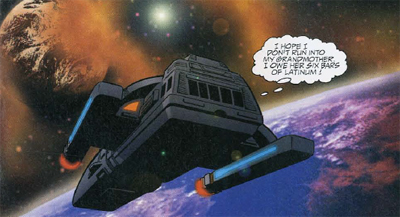
You can't go home again...

You can’t go home again…

Continue reading

Star Trek: Voyager – Phage (Review)

This September and October, we’re taking a look at the jam-packed 1994 to 1995 season of Star Trek, including Star Trek: Deep Space Nine and Star Trek: Voyager. Check back daily for the latest review.

Phage is far from perfect. It is very far from perfect. However, there’s something rather endearing about this cheesy B-movie throwback written by Brannon Braga from a pitch by Timothy DeHass and first draft by Skye Dent. The Vidiians are probably the most memorably and effective aliens from the first three seasons of Star Trek: Voyager, feeling like they could have wandered into the show from some trashy late-night horror movie on another channel.

There’s a pulpy quality to the episode that makes it more enjoyable than many of the surrounding Voyager episodes, albeit one undermined by some of the more awkward resonances in the script.

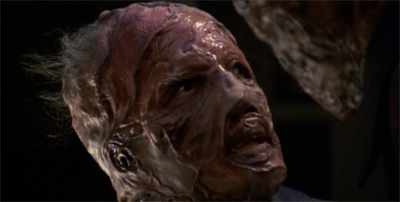
The Vidiians survive by the skin of their teeth...

The Vidiians survive by the skin of their teeth…

Continue reading

Star Trek: Deep Space Nine – Life Support (Review)

This September and October, we’re taking a look at the jam-packed 1994 to 1995 season of Star Trek, including Star Trek: Deep Space Nine and Star Trek: Voyager. Check back daily for the latest review.

Life Support is the first episode of Star Trek: Deep Space Nine to air after Star Trek: Voyager went on the air. It’s amazing how quickly Deep Space Nine settled back into the role of “the other Star Trek show on television.” A lot of attention was focused on launching Voyager, with the show put in the awkward position of launching (and, in the years ahead, supporting) the new television network UPN. As a result, Voyager got a lot of press and a higher profile.

Deep Space Nine fell back into familiar routines. Life Support is far from an exceptional piece of Deep Space Nine. In fact, it’s a deeply flawed piece of television. However, it feels free of the identity crisis that dominated the first half of the third season. This is Deep Space Nine free of the expectations of being “the only Star Trek on television”, and allowed the freedom to just keep doing whatever it wants to do.

It doesn’t do any of the things that it wants to do particularly well, but it does them in its inimitable way.

Dead air...

Dead air…

Continue reading

Star Trek: Deep Space Nine – Prophecy & Change: The Orb of Opportunity by Michael A. Martin and Andy Mangels (Review/Retrospective)

The September and October, we’re taking a look at the jam-packed 1994 to 1995 season of Star Trek, including Star Trek: Deep Space Nine and Star Trek: Voyager. Check back daily for the latest review.

It is fun to imagine the negative space that exists between various episodes of Star Trek: Deep Space Nine. In its third season, the show was making nods towards serialisation, but there was never really a point where the series could not be broken down into reasonably well-defined episodic units. Even during the ten-hour series finalé, each of the constituent elements had its own narrative thrust and its own clear purpose. So it is fun sometimes to try to connect these threads together.

The ordering of episodes in a season of television is very interesting. It creates a fascinating connective tissue in the minds of fans. Although each episode is its own story, they come together to form something larger and more intriguing. On The X-Files, for example, placing Never Again directly after Leonard Betts changed the whole context of the episode. There are threads that do not necessarily exist within the individual episodes, but can be implied by the sequencing of the shows.

Placing Heart of Stone directly after Life Support is an interesting choice in several respects. It creates all sorts of interesting implications and developments, contradictions and possibilities. It is weird to have an episode about Odo’s attraction to Kira air directly after an episode focusing on the death of Kira’s long-term love interest; give her a week or two of space, guys. Similarly, it is strange to go from Nog’s characterisation in Life Support to his development in Heart of Stone.

The Orb of Opportunity is very clearly intended to bridge the gap between those two episodes, explaining how and why Nog developed in the way that he did.

ds9-prophecyandchange

Continue reading

Doctor Who: Time Heist (Review)

Why? There’s no immediate threat?

Warning, intruder alert!

I should really stop saying things like that.

After the ambition of Listen, Time Heist feels like a return to the general narrative conservatism that marks the first half of the season. Introducing the Twelfth Doctor, the first six episodes of the season are all written by veteran writers. With the exception of Listen, they all play it relatively safe. Five episodes into the Twelfth Doctor’s tenure, the approach is starting to grate just a little bit. The training wheels are still on, but there is a sense that the show is itching to remove them.

Indeed, without the ambition that tempers the many flaws with In the Forest of the Night, Time Heist is probably the weakest episode of the season. However, there is something to be said about that; Time Heist may not be a particularly memorable piece of television, but that alone is enough to mark it as much stronger than misfires like Fear Her or Night Terrors or Evolution of the Daleks

or Curse of the Black Spot.

... and they lived happily ever after...

… and they lived happily ever after…

Continue reading