• Following Us

  • Categories

  • Check out the Archives


  • Awards & Nominations

Star Trek: Deep Space Nine – Distant Voices (Review)

This September and October, we’re taking a look at the jam-packed 1994 to 1995 season of Star Trek, including Star Trek: Deep Space Nine and Star Trek: Voyager. Check back daily for the latest review.

Poor Julian Bashir. Even at two-and-a-half seasons in Star Trek: Deep Space Nine, the character is still a blank slate. Distant Voices is a story that takes us inside the character’s head, but it winds up feeling very generic. It turns out that Bashir is afraid of getting old, as awkwardly pointed out in the opening scene. He also might have some self-esteem issues. For an episode that journeys into Bashir’s brain, Distant Voices is really pretty bland. There’s really not too much going on there.

Indeed, the most interesting thing about this glimpse inside Bashir’s mind is that it is so generic that it manages to avoid conflicting at all with the character-shattering revelation that Ronald D. Moore proposes in Doctor Bashir, I Presume. While it’s a nice piece of trivia, it’s hardly a compelling hook.

"So this is what a 100,000th episode party looks like..."

“So this is what a 100,000th episode party looks like…”

Continue reading

Star Trek: Voyager – State of Flux (Review)

This September and October, we’re taking a look at the jam-packed 1994 to 1995 season of Star Trek, including Star Trek: Deep Space Nine and Star Trek: Voyager. Check back daily for the latest review.

Prime Factors and State of Flux form something of a duology in the middle of the first season of Star Trek: Voyager. The two episodes might be far from perfect, but they seem to be the closest that the first season of Voyager comes to outlining its vision and ambitions. Taken together, they offer a demonstration that life in the Delta Quadrant might be significantly more complicated than life in the Alpha Quadrant – that everything might not be as it appears to be, that Voyager might not be the perfect Federation vessel.

While both episodes are flawed, they do demonstrate a willingness to take advantage of the basic premise of Voyager to tell stories that simply wouldn’t be possible on Star Trek: The Next Generation or Star Trek: Deep Space Nine. In that respect, they stand apart from surrounding stories like Ex Post Facto or Heroes and Demons, both of which feel like re-worked stories from an aborted eighth season of The Next Generation. These are adventurous and ambitious episodes. They lack the skill necessary to completely realise that vision; but that skill could come in time.

Unfortunately, these two episodes wind up feeling like exceptions – a flash of what might have been, rather than what would be.

Kazon development has hit a wall...

Kazon development has hit a wall…

Continue reading

Star Trek: Voyager – Prime Factors (Review)

This September and October, we’re taking a look at the jam-packed 1994 to 1995 season of Star Trek, including Star Trek: Deep Space Nine and Star Trek: Voyager. Check back daily for the latest review.

Prime Factors has some great ideas, but blunders awkwardly in the execution. In that respect, it genuinely feels like a first season episode of a new show in the same way that The Cloud did – there’s a sense that the series is trying to expand its own comfort zone in a way that offers potential for future storytelling opportunities. Prime Factors might make a few pretty serious missteps along the way, and often seems a little too timid to commit to its bolder ideas directly, but at least it feels more ambitious than Time and Again or Ex Post Facto.

Make way for Janeway...

Make way for Janeway…

Continue reading

Doctor Who: Kill the Moon (Review)

I don’t like people being sick in my TARDIS. No being sick. And no hanky-panky.

If The Caretaker began the transition into the second half of the season, Kill the Moon completes it. The Twelfth Doctor is established. Peter Capaldi has found his footing. The audience has a clear grasp of what distinguishes his take on the character from the iterations played by David Tennant or Matt Smith. The orderly transition of lead actors is complete; the show can no go about its business. Along with The Caretaker, Kill the Moon marks the point at which the season starts building clearly and concretely towards Death in Heaven.

This is the point at which the show feels free to get a little experimental. With the exception of Listen, the first six stories of the season were all relatively conservative. Deep Breath returned to the Paternoster Gang in order to ease the transition to the new lead. Into the Dalek was the obligatory “Dalek episode.” Although it featured a fictional celebrity, Robot of Sherwood was a throwback to the old school celebrity historical. Time Heist was a light run-around. The Caretaker was the “dump the Doctor into the real world” story.

"Yes, I'm wearing my One Direction shirt. Wanna make something of it?"

“Yes, I’m wearing my One Direction shirt. Wanna make something of it?”

In contrast, the second-half of the season is more bold and experimental. Steven Moffat is not credited as a co-writer, suggesting that the training wheels are coming off. While the first six episodes were all written by established Doctor Who writers, the four episodes between The Caretaker and Dark Water are all credited to newbies. More than that, there is a spirit of experimentation. Kill the Moon and In the Forest of the Night are perhaps two of the most divisive and controversial episodes of the show since it returned in 2005. Only Love and Monsters comes close.

Kill the Moon is bold, provocative, insane and more than a little twisted.

David Tennant has the same tumblr photo...

David Tennant has the same tumblr photo…

Continue reading

Star Trek: Voyager – Emanations (Review)

This September and October, we’re taking a look at the jam-packed 1994 to 1995 season of Star Trek, including Star Trek: Deep Space Nine and Star Trek: Voyager. Check back daily for the latest review.

Emanations has a pretty effective set-up and solid premise. It is very clearly one of Star Trek: Voyager‘s “planet of the week” stories – like the show directly before it and the show directly following it – but it’s build around some vaguely interesting ideas. It’s very clearly an episode designed to function as social commentary in the grand Star Trek tradition, hitting on big ideas and bold concepts.

Unfortunately, it’s not the type of script that Brannon Braga is best suited to handle. It doesn’t feel so much an exploration of an important issue as a social treatise. It’s simplistic and heavy-handed while dealing with ideas that require a bit of nuance and sophistication. It feels under-developed, contrived and a little shallow. Despite an attempt at ambiguity in its closing scene, it feels like an episode driven primarily by an agenda rather than a strong story.

Emanations is a misfire, another example of the weird tendency in the first season of Voyager to assign the wrong writers to the wrong scripts.

Harry really got wrapped up in local culture...

Harry really got wrapped up in local culture…

Continue reading

Star Trek: Deep Space Nine – Visionary (Review)

This September and October, we’re taking a look at the jam-packed 1994 to 1995 season of Star Trek, including Star Trek: Deep Space Nine and Star Trek: Voyager. Check back daily for the latest review.

Visionary confirms that “O’Brien must suffer” is to become an annual tradition on Star Trek: Deep Space Nine. The second season of the show had made a good start with episodes like Whispers and – to a lesser extent – Armageddon Game, but Visionary confirms that this will really be O’Brien’s niche in the ensemble from this point on. Visionary sees O’Brien randomly jumping forward through time, inevitably glimpsing some horrible tragedy that must be avoided. (Boy, it sure is lucky that he started jumping at this point, isn’t it?)

Visionary should feel contrived and convenient, hinging on a pretty flimsy plot hook. That said, the episode ultimately works quite well, even if it doesn’t stand out as a classic piece of Star Trek. Watching Visionary, there’s very much a sense that Visionary only really works as well as it does because Deep Space Nine has built up a larger mythology of characters and long-form plotting that can support what might otherwise be a fairly flimsy premise.

"Why the hell doesn't this ever happen to Julian?!"

“Why the hell doesn’t this ever happen to Julian?!”

Continue reading

Star Trek: Deep Space Nine (Malibu Comics) – Blood and Honour (Review)

The September and October, we’re taking a look at the jam-packed 1994 to 1995 season of Star Trek, including Star Trek: Deep Space Nine and Star Trek: Voyager. Check back daily for the latest review.

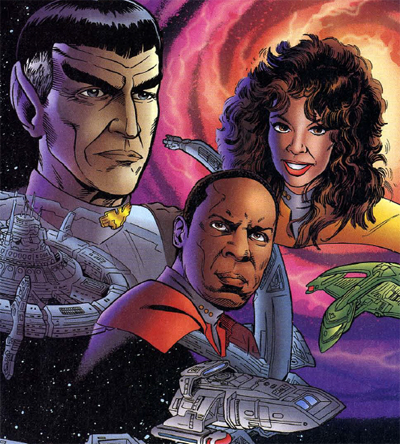
Whatever is to be done about the Romulans?

In space, all warriors are cold warriors...

In space, all warriors are cold warriors…

Continue reading

Star Trek: Voyager – Ex Post Facto (Review)

This September and October, we’re taking a look at the jam-packed 1994 to 1995 season of Star Trek, including Star Trek: Deep Space Nine and Star Trek: Voyager. Check back daily for the latest review.

Ex Post Facto has a lot of problems.

It has logical problems. It has plot problems. It has character problems. It is difficult to fit within the framework of Star Trek: Voyager. It feels like a retread of A Matter of Perspective, a less-than-successful effort from the first season of Star Trek: The Next Generation that Michael Piller produced. It is a bit of a mess, a bit too casual about everything, a bit too contrived.

And yet, despite all this, it almost works. Almost.

"This isn't the head massage I asked for!"

“This isn’t the head massage I asked for!”

Continue reading

Star Trek: Deep Space Nine – Prophet Motive (Review)

This September and October, we’re taking a look at the jam-packed 1994 to 1995 season of Star Trek, including Star Trek: Deep Space Nine and Star Trek: Voyager. Check back daily for the latest review.

Now that Star Trek: Voyager is on the air, there’s a sense that Star Trek: Deep Space Nine can be more relaxed. The show was undeniably contrarian during the short period when it was the only Star Trek on the air, presenting a series of uncompromisingly cynical episodes to assure viewers that it would not be trying to fill the void left by Star Trek: The Next Generation. At the same time, there’s also a sense that show was acutely aware of it potentially wider audience watching during that window.

During that first half of the season, a new adversary was pushed to the fore, the show did a story about Klingons and featured three guest stars from The Next Generation – although not necessarily the guest stars anybody would have chosen. More than that, though, the show seemed to consciously avoid its more controversial types of episodes. Even by the show’s third year, it had become clear that certain “types” of episodes appeared a few times a year – a couple of “old favourites” for the writing team to fall back on while constructing a twenty-six episode season.

'Ear me out 'ere...

‘Ear me out ‘ere…

As such, it’s telling that the most divisive parts of any Deep Space Nine season were pushed into the second half of the season.  So Ira Steven Behr and Robert Hewitt Wolfe’s two Ferengi-centric scripts came after Voyager had premiered. Sure, Quark got to be the focus of the season’s third episode, House of Quark, but he shared that with the popular Klingons. The season’s two big Bajoran plot lines (Life Support and Shakaar) were positioned towards the end of the year.

Prophet Motive feels like the kind of Star Trek episode that could only be produced on Deep Space Nine as part of Ira Steven Behr’s unique vision for the show. It’s the kind of weird script that the show seemed to get away with by virtue of being “the other Star Trek on television.” That doesn’t mean that it’s particularly good, mind you, just that it’s distinctly a Deep Space Nine story.

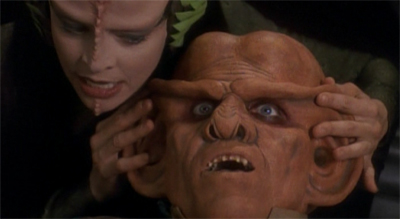
Quark is a by-the-book Ferengi...

Quark is a by-the-book Ferengi…

Continue reading

Star Trek: Deep Space Nine – The 34th Rule by Armin Shimerman & David R. George III (Review)

This September and October, we’re taking a look at the jam-packed 1994 to 1995 season of Star Trek, including Star Trek: Deep Space Nine and Star Trek: Voyager. Check back daily for the latest review.

The 34th Rule is a particularly notable piece of Star Trek fiction. It is the first Star Trek novel credited to a main cast member while their show was still on the air. Armin Shimerman, Eric A. Sitwell and David R. George III had pitched the idea for The 34th Rule as an episode of Star Trek: Deep Space Nine. When the producers were not interested in developing the idea, Shimerman and George decided to expand the idea out into a full-length novel. The 34th Rule was released during the seventh season of Deep Space Nine.

Shimerman was not the first actor to be credited on a Star Trek novel. William Shatner had already launched his own “Shatner-verse” series of novels following the “resurrection” of James Tiberius Kirk after his death in Star Trek: Generations. However, Shatner was pretty much done with the franchise at this point – having officially passed the torch to his successors as part of Generations. However, Shimerman was the first to publish a novel while the show was on the air.

The 34th Rule is a decidedly ambitious piece of work. It is clumsy in places, perhaps a little heavy-handed and on the nose. Nevertheless, it is a well-constructed and thoughtful Star Trek epic – one the feels in keeping with the mood of Deep Space Nine, even if it occasionally veers a little too far.

the34thrule

Continue reading