• Following Us

  • Categories

  • Check out the Archives


  • Awards & Nominations

Star Trek – Catspaw (Review)

The first Star Trek pilot, The Cage, was produced in 1964. To celebrate its fiftieth anniversary, this December we are reviewing the second season of the original Star Trek show. You can check out our first season reviews here. Check back daily for the latest review.

Catspaw was the first episode to enter production for that second season of Star Trek. However, it was not the first to air. Amok Time served as the season opener. Instead, Catspaw was produced as something of a rarity – a Star Trek holiday special. Produced in May, it was eventually broadcast during the last week of October. Given the subject matter and trappings of the episode, that seems highly appropriate.

We are, after all, looking at what amounts to a Star Trek Halloween Special.

Bones joins the cast...

Bones joins the cast…

Continue reading

Space: Above and Beyond – Pearly (Review)

This November (and a little of December), we’re taking a trip back in time to review the third season of The X-Files and the first (and only) season of Space: Above and Beyond.

Richard Whitley is one of the more promising writers on Space: Above and Beyond.

While Pearly does not benefit (and indeed actively suffers) from the same loose structure that made Dear Earth work so well, it is an episode very much in touch with what the show wants to be about. It is very much a science-fiction version of a classic Second World War story, to the point where Whitley himself has described it as an adaptation of the classic Humphrey Bogart movie Sahara. It is a nice glimpse at several facets of the conflict that we have not seen yet, but which make sense in context.

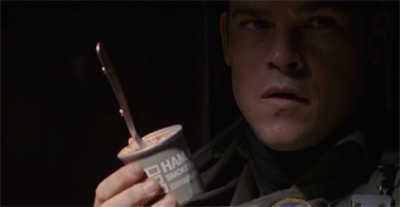
Canned ham...

Canned ham…

That said, there are serious problems with Pearly. It is very clear that the production managed to get ahold of a tank for filming, and sought to capitalise on that. The episode’s structure feels rather forced and unstructured in places, full of contrived coincidences that seem a little strange when considered as a whole. Not all of the character interactions feel genuine, and not all the episode’s big moments feel entirely earned. These are legitimate problems, and they do hold Pearl back.

At the same time, Pearly is an episode simmering with potential and ambition. It is hard to hate.

Crossed wires...

Crossed wires…

Continue reading

Star Trek (Gold Key) #1 – The Planet of No Return! (Review)

The first Star Trek pilot, The Cage, was produced in 1964. To celebrate its fiftieth anniversary, this December we are reviewing the second season of the original Star Trek show. You can check out our first season reviews here. Check back daily for the latest review.

The Star Trek comics published by Gold Key are somewhat infamous additions to the Star Trek canon. The company began publishing comic book tie-ins in July 1967, in the gap between the first and second seasons of the original Star Trek show. They continued to publish those tie-ins until 1978, when the license passed to Marvel. These early comics have become the source of much derision over the years, with fans dismissing them as hollow cash-ins produced by people with little understanding of the franchise itself.

However, recent years have seen something of a reappraisal of these early comic books. Once IDW Publishing secured the rights to produce tie-in Star Trek comic books, they devoted considerable effort to archiving and releasing classic and little-seen material from the franchise’s history. They released the Star Trek newspaper strips in a two-volume set, before turning their attention to the classic Gold Key comic books. It is a very worthwhile attempt to provide fans with a glimpse of oft-overlooked chapters in the franchise’s history.

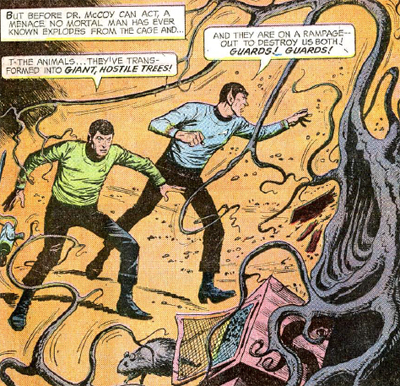
Plant life...

Plant life…

The Gold Key Star Trek comics are messy. A lot of the criticisms hold true. There are all manner of continuity errors in the production of the comic. Artist Alberto Giolitti takes quite some time to figure out what Scotty looks like, and the colourists take a bit of time to figure out what uniforms various cast members should be wearing. The writing is similarly clunky, with characters sounding a little out of sort as the basic plot details seem to stand at odds with still-relatively-small Star Trek canon had been established by the closing credit of Operation — Annihilate!

And yet, despite all these considerable flaws, these comics do make for an interesting time capsule. They don’t feel quite like Star Trek so much as an impression of what Star Trek would look described to somebody who has never seen it, filtered through the lense of fifties and sixties science-fiction comics. The early issues feel like three blind men describing an elephant, and it is glorious.

Branching out...

Branching out…

Continue reading

The X-Files – Teso Dos Bichos (Review)

This November (and a little of December), we’re taking a trip back in time to review the third season of The X-Files and the first (and only) season of Space: Above and Beyond.

It happens.

Every once in a while, there is a misfire. This is especially true when producing a genre television series churning out over twenty episodes a year. Inevitably, some of those episodes will fail; a few will fail spectacularly. Such is the way of things. It is hard to think of a twenty-odd episode season of anything that managed to maintain consistent levels of brilliance for a full season. All you can really hope is that the eventual and inevitable misfire is mostly technical.

No bones about it...

No bones about it…

Teso Dos Bichos is a terrible episode of The X-Files. It is a terrible episode of television in general. However, it is terrible in ways that are mostly banal. This isn’t a failure of overreaching ambition, like Fearful Symmetry. It isn’t a missed opportunity, like 3. It isn’t even a racist and sexist nightmare, like Excelsis Dei. Instead, Teso Dos Bichos is just bad television. It is an episode that probably didn’t work on paper, containing elements that were unlikely to work on film either.

Given how strong the third season has been, there’s a desire to brush past Teso Dos Bichos, and pretend it simply did not happen.

Cat people!

Cat people!

Continue reading

Space: Above and Beyond – Dear Earth (Review)

This November (and a little of December), we’re taking a trip back in time to review the third season of The X-Files and the first (and only) season of Space: Above and Beyond.

In many respects, Dear Earth serves as a mirror to Toy Soldiers.

Both stories are based around familiar wartime story beats. Both are very sentimental hours of television. Both are firmly anchored in the idea that Space: Above and Beyond is largely about reworking the narratives of the Second World War for a futuristic outer space setting. There is a lot of overlap between Dear Earth and Toy Soldiers, with the episodes feeling like two peas in a pod. They both appeal to the same aspects of Space: Above and Beyond.

You've got mail...

You’ve got mail…

However, Dear Earth works a lot better than Toy Soldiers did. It is dealing with a similar collection of iconic imagery and ideas associated with the Second World War, touching on many of the same themes and ideas; it is just that the execution is considerably stronger. Dear Earth is a show that not only has a lot more charm than Toy Soldiers did, but a lot more humanity. It is an episode that does a lot to remind viewers why they have come to care for the show’s ensemble.

Dear Earth is a very well-made piece of television.

Astro-turf...

Astro-turf…

Continue reading

The X-Files (Topps) #13 – One Player Only (Review)

This November (and a little of December), we’re taking a trip back in time to review the third season of The X-Files and the first (and only) season of Space: Above and Beyond.

After a twelve-issue opening mega-arc of interconnected stories about conspiracies-within-conspiracies and wheels-within-wheels, author Stefan Petrucha and artist Charles Adlard step back a little bit to close out their run with a series of standalone stories. The four issues (and three stories) that make up the rest of their run on Topps’ X-Files comic stand alone. They are connected by themes and subtext, but very clearly stand apart from what came before. Indeed, they play out almost like a postscript to the main body of work, a series of smaller bite-sized chunks.

In that light, it is interesting that One Player Only feels – superficially, at least – a lot more in step with the television show. The early issues of the comic had seen Petrucha and Adlard creating their own supporting cast and their own conspiracy, so as to avoid stepping on the toes of the production company. The Cigarette-Smoking Man was largely reduced to a number of cameos, with Skinner popping up once or twice along the way.

Ghosts in the machines?

Ghosts in the machines?

Not only does One Player Only feature a guest appearance from supporting characters like Mr. X or yhe Lone Gunmen, it also harks back to the structure and format of the first season of the show. On the most basic of levels, One Player Only feels like a more cyberpunk take on Ghost in the Machine, right down to the fact that Mulder is drawn into a murder at a tech company by an acquaintance from his days in the Violent Crimes Division. At one point, Mulder and Scully stumble on a ransacked house, for Mulder to deadpan, “Hm. Nothing new.”

However, if one peels back the layers, One Player Only is a fascinating piece that sets the tone for Petrucha and Adlard’s last three issues on the series, while infusing the comic with a host of fascinating cyberpunk stylings and body horror that seem to call forward to William Gibson’s future writing for the show.
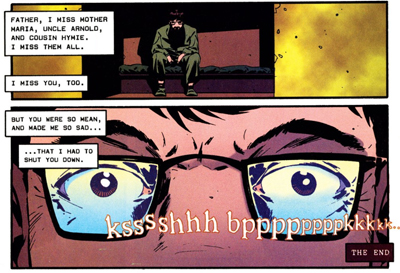
Coding out...

Coding out…

Continue reading

The X-Files – Pusher (Review)

This November (and a little of December), we’re taking a trip back in time to review the third season of The X-Files and the first (and only) season of Space: Above and Beyond.

Pusher is perhaps one of the most effective stand-alone “monster of the week” stories that the show ever did.

It is no wonder that the episode is frequently cited among the best episodes of The X-Files ever produced, but it is telling that it was identified by Slate as the perfect “gateway” episode of the show. If you want to give someone a taste of The X-Files without burdening them with continuity or back story, this is a good choice. It may not be the best episode that Vince Gilligan ever wrote, and it may not even be the best episode of the third season, but it is one the strongest demonstrations of what the show does on a weekly basis.

Mano a mano...

Mano a mano…

Pusher is the first episode that Vince Gilligan wrote after joining The X-Files writing staff. It is the only episode credited to Gilligan in the show’s third season. He had been offered a position on staff after turning in Soft Light at the end of the second season, but had hesitated before accepting the job. When he did accept the job, he came down with a dose of infectious mononucleosis. As a result, Gilligan only wrote one script for the third season, despite becoming one of the show’s most prolific writers.

Pusher is a pulpy delight, a spectacularly constructed standalone that perhaps points the way to Gilligan’s later work.

Gift of the gab...

Gift of the gab…

Continue reading

Space: Above and Beyond – Toy Soldiers (Review)

This November (and a little of December), we’re taking a trip back in time to review the third season of The X-Files and the first (and only) season of Space: Above and Beyond.

The Never No More and The Angriest Angel two-parter represented a moment when Space: Above and Beyond seemed to gel, when the show seemed to realise what it wanted to be and how it wanted to be about it. Written by showrunners Glen Morgan and James Wong, they presented a demonstration of just how well the show could work, and why it had been an absolutely ingenious idea to do the premise of “World War II… IN SPACE!”

So, naturally, Toy Soldiers shows up to demonstrate that we have yet to reach a point where we can do this consistently.

Oh, brother...

Oh, brother…

Continue reading

The X-Files – Apocrypha (Review)

This November (and a little of December), we’re taking a trip back in time to review the third season of The X-Files and the first (and only) season of Space: Above and Beyond.

Eyes are a major recurring motif in Apocrypha.

To be fair, eyes were a frequently recurring motif throughout The X-Files. Rob Bowman managed a couple of beautiful shots of reflections and peeping in 731, for example. It makes sense that The X-Files should place such emphasis on eyes – it is a saga about truth and belief and faith, all of which must be explored through perception. “I want to believe,” Mulder’s iconic poster proclaims. As the cliché goes, seeing is believing.

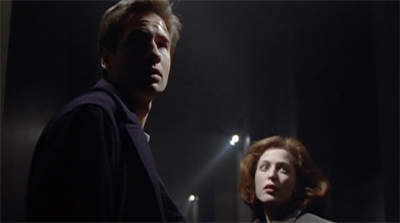
Iconic Mulder/Scully pose!

Iconic Mulder/Scully pose!

That is definitely the case here, with Apocrypha built to a climax where both the audience and the characters are explicitly refused the opportunity to see key moments. Mulder and Scully are escorted out of the North Dakota silo before they can see anything incriminating. The audience doesn’t even get to see the space ship taking off. Even the death of Luis Cardinal takes place off-screen, with Mulder revealing it in a throwaway line in the show’s penultimate scene.

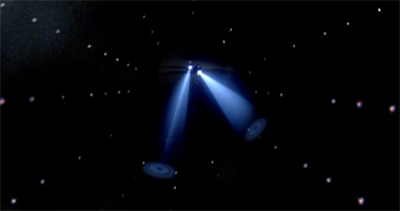
With all of this going on, it makes sense that so much of the imagery in Apocrypha should be built around eyes – with the black oil infection manifesting in its hosts’ eyes, the shooting of the silo as a giant eye staring into space, and even the design of the alien space ship evoking the Eye of Providence.

Up in the sky!

Up in the sky!

Continue reading

Space: Above and Beyond – The Angriest Angel (Review)

This November (and a little of December), we’re taking a trip back in time to review the third season of The X-Files and the first (and only) season of Space: Above and Beyond.

Existentialism is something of a recurring theme in the work of Glen Morgan and James Wong.

It echoes through their work. Mulder’s choice of action ultimately serves to define him in One Breath, in contrast to the other more senior male characters in the narrative. The duo’s second script for Millennium, 5-2-6-6-6, opens with a quote from existentialist philosopher Jean Paul Sartre. Even the pair’s feature film work – The One and the Final Destination films – touch broadly on existentialist themes.

Pressed (up) on the issue...

Pressed (up) on the issue…

However, The Angriest Angel is perhaps the most candid of their scripts, with McQueen explicitly explaining how his actions are serving to define his identity. In his power-house opening monologue, McQueen describes these defining moments as make-or-break points. “Everyone, everyone in this life knows when the moment is before them. To turn away is simple. To ignore it assures survival. But it is an insult to life. Because there can be no redemption.”

This is perhaps the most elegant and effective summary of Morgan and Wong’s approach to character development. McQueen articulates it clearer than any of their characters, but the philosophy applies just as much to Scully in Beyond the Sea or Never Again as it does to Tyrius Cassius McQueen. Indeed, it would come to define their work on Millennium, with the second season repeatedly suggesting that the end of the world was as much a personal event as a massive social occurrence.

Slice of life...

Slice of life…

Continue reading