• Following Us

  • Categories

  • Check out the Archives


  • Awards & Nominations

Non-Review Review: A Star is Born (2018)

At one point in A Star is Born, Bobby Maine outlines his brother’s approach to music for the benefit of Ally.

According to Bobby, Jackson believes that all music can be broken down to “twelve notes between an octave.” By Jackson Maine’s logic, Bobby explains all musical expression is “those same twelve notes, played over and over again. All any artist can offer the world is how they see those twelve notes.” It is a strange moment, one that comes very close to self-awareness from writer and director Bradley Cooper, suggesting something very close to a mission statement for his directorial debut.

Ain’t playin’.

A Star is Born is the fourth major American motion picture with that name and that premise. There are countless other stories built around the same basic concept, which has itself been translated into various settings and contexts across the globe. The story of A Star is Born is familiar. An older man discovers a talented young woman and elevates her to stardom, while his own grip on celebrity slips away between his fingers. It is an archetypal Hollywood story, and perhaps a defining American fairytale. All Cooper can do is tell that familiar story in his own way.

There are certainly moments when A Star is Born seems to take this idea to heart. In terms of basic trappings and mechanics, A Star is Born gestures towards modernity, understanding that it needs to update its core premise in the way that each of its three forerunners did. There are any number of details within A Star is Born that position the film within the modern cultural context. This is a twenty-first century take on a familiar story, and it looks distinct enough from the earlier three iterations.
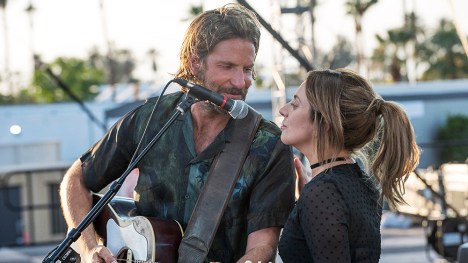
Has a nice sing to it.

However, there’s a recurring anxiety within A Star is Born, a sense of trepidation. In terms of style and sensibility, Cooper’s adaptation hews closest to the country-and-western infused seventies remake with Barbara Streisand and Kris Kristofferson, which is a canny choice; it is probably the least seen and the least iconic iteration of the story, making it ripe for reinvention. However, there is also a strong sense that A Star is Born is reluctant to cross the four decades that have passed since that particular iteration of the familiar story.

The result is a film that feels at odds with itself. A Star is Born is inherently a metafictional text, suggesting a rebirth of Lady Gaga from a pop star to a credible leading actor in a prestige piece. Gaga acquits herself well in the role, but A Star is Born feels uncertain and untrusting of her. Repeatedly, A Star is Born seems to refuse to let Gaga be Gaga, instead adhering to a very fixed and very nostalgic seventies ideal of “authenticity.” This is a film that ends with the assertion that a modern pop star can only find herself when using her voice to deliver an ageing rocker’s words.

Doesn’t quite hit all the right notes.

Continue reading

New Podcast! Scannain Podcast (2018) #36!

It’s time for the latest Scannain podcast!

This week, I join Jason Coyle, Grace Duffy and Ronan Doyle to discuss the week in film. As usual, we talk about the top ten and the new releases, as well as what we’ve watched this week. In this episode, we discuss the appeal of Tony Scott’s (arguably) underrated late film Domino, which Jay claims as a cinematic classic and Ronan watched while hung over. We talk about the true horror lurking in Ghost Stories. We debate whether Karyn Kusama’s The Invitation is a Sacha Baron Cohen show as a horror movie.

We also talk about the films that the “young ones” will be watching as part of the back-to-school programme at the Irish Film Institute, the ongoing Dublin Festival of History and the first look deal between Element Pictures and Fox Searchlight that speaks to the viability of Irish film as award fare.

In terms of the top ten, there’s in-depth discussions of both Black ’47 and The Little Stranger, all four panelists having seen those films.

The top ten:

  1. Hotel Transylvania 3: A Monster Vacation
  2. The Predator
  3. Christopher Robin
  4. The Little Stranger
  5. Mile 22
  6. The Nun
  7. A Simple Favour
  8. Crazy Rich Asians
  9. Black ’47
  10. The House With A Clock In Its Walls

New releases:

You can download the episode here, or listen to it below.

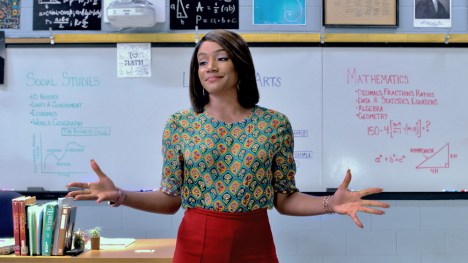
Non-Review Review: Night School

Night School works better than it probably should, while never quite escaping its fundamental flaws.

Night School suffers from a lot of the structural issues that affect modern studio comedies. Most obviously, the film feels over-extended. It’s not just the run time, which clocks in at a muscular one-hundred-and-ten minutes, which is asking a lot for a broad comedy with a very simple premise. It is the individual jokes within the comedy, which are often stretched to breaking point and beyond. Perhaps the most egregious example is an early gag about finding hair in food at a restaurant, which goes on for what feels like five minutes built around the same standard social set-up.

To teach’s own.

There are very few major surprises in Night School. There are a few small and smart ideas buried in the mix, but they often feel crowded out by the broad jokes and the familiar clichés. There’s a recurring sense that Night School doesn’t always play to its strengths, at least below the headline. At the same time, the film understands that it lives or dies by the chemistry between its two leads, offering a conventional persona-driven conflict of manners that places Kevin Hart and Tiffany Haddish in opposition to one another before inevitably moving them into alignment.

Night School is diverting, if unsatisfying. It manages a passing grade, if little more.

Hart to Hart.

Continue reading

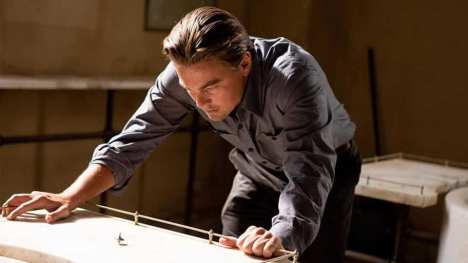
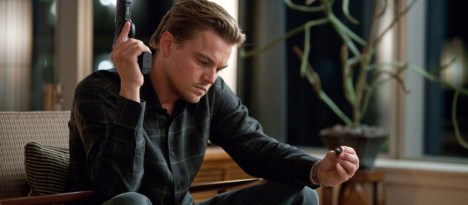
The Great Inception, and the Movies that Made Us…

This week, the podcast I host, The 250, will be marking its one hundredth episode with a look at Christopher Nolan’s “Inception.” I’m very much looking forward to it. It’ll be available on Saturday from 6pm UTC. I also have a book coming out on Christopher Nolan, titled “Christopher Nolan: A Critical Study of the Films.” This is a much more personal (and much less detailed) discussion of Inception than the one in the book. So, if you like this piece, it might be worth a look.

I’ve always been somewhat wary of Inception.

I mean, Inception is a fantastic movie. There is a reason that it is so beloved and so highly regarded. It is perhaps one of the four core Christopher Nolan films, along with Memento, The Prestige and The Dark Knight. It is the rare big budget blockbuster with no longstanding association to established intellectual property, and one of the few to succeed on that sort of level. Indeed, the only other comparable examples on a similar scale are Interstellar and Dunkirk, both directed by Christopher Nolan.

More than that, Inception has permeated the popular consciousness. It is a film that has become part of the broader conversation. It seems that barely a few months can go by without another hot take on that closing scene, with news coverage of commencement speeches or interviews with actors. More than that, the film itself has become something of a critical and popular shorthand. It is a stock comparison for any movie or television show with a vaguely similar concept. Maniac is the most recent example, even inviting the comparison with an elaborate hallway action scene in its penultimate episode.

And yet, in spite of that, Inception is a movie of which I’ve had a somewhat strained relationship. I still adore it, as I adore most of Nolan’s filmography. I think its reputation is well-earned, and I think it excels by every measure that it sets itself. It delivers on just about every front, showcasing Nolan as a director with incredible command of both the form itself and the audiences watching these films. Inception is a big and broad crowdpleaser that is also a surprisingly intimate and personal film, which works as both a story and as a showcase. It is thrilling, it is engaging, it is compelling.

However, there’s something underneath the surface that makes me feel a little uncomfortable. A large part of this is simply down to the fact that it’s a movie that is fundamentally about movies. This is nothing new of itself. All of Nolan’s movies are about stories, whether personal or cultural. In fact, it could be argued that the central trilogy of Nolan’s work is actually The Prestige, The Dark Knight and Inception, a trilogy of films that seem to be about the challenges of constructing and maintaining spectacle, arriving at a point in the director’s career where Nolan was transitioning from smaller films to high-profile epics.

Inception is the most transparent of these films, exploring most directly the mechanics of how storytelling works within a cinematic framework. There are even scenes of characters discussing in relatively clinical terms the mechanics of catharsis and how best to emotional manipulate their target audience. Inception feels very much like Nolan is stopping and deconstructing his stopwatch storytelling for the benefit of the audience, revealing how the trick is done and how the pieces fit together. As with everything Nolan does, he does this with a great deal of skill and nuance. However, it can’t help but feel a little cynical.

Continue reading

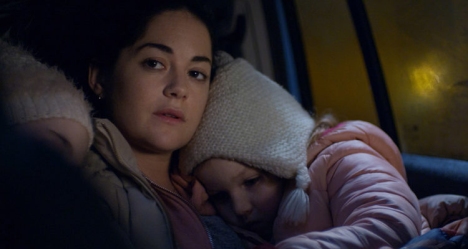
Non-Review Review: Rosie

Rosie is a a very timely piece of Irish cinema, but one that never loses sight of the humanity of this national crisis.

From beginning to end, Rosie is infused with an endearing humanity. Writer Roddy Doyle and director Paddy Breathnach keep the story tightly focused on one particular family caught in the midst of the homeless crisis. Breathnach often literalises this, with a handheld camera that keeps the film literally centred on the face of the eponymous protagonist. Even in wide open spaces, even in public, even when she’s the only adult crossing a green or a schoolyard, Rosie is so tightly focused that it feels claustrophic and almost suffocating.

This is the point, of course. Rosie is a very visceral film, and with good reason. Doyle and Breathnach work hard to ensure that the audience feels ever minor crisis, and that it understands precisely how precarious the situation facing this family happens to be. A delayed lunch break seems catastrophic, a child spending time with a friend seems like a disaster. Time is fleeting, and always slipping through the fingers of its protagonist. When life seems to unfold moment to moment, there is no opportunity to catch her breath or to worry about the bigger picture.

Rosie is a fascinating piece of Irish cinema, both timely and intimate, both reflecting contemporary culture and telling its own story within that framework. It’s an impressive piece of work.

Continue reading

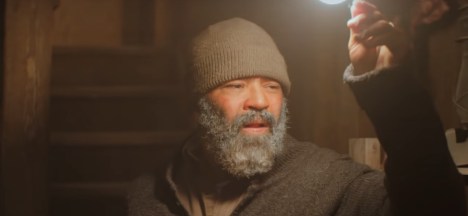
Non-Review Review: Hold the Dark

“Do you have any idea what’s outside these windows? How black it gets?”

An enlightening piece of work.

In the American consciousness, the frontier is a haunted place.

In some ways, it is a concept distinct to the United States, at least in contrast to Europe. The boundaries within Europe were established centuries ago; although they might shift and bend, the contours of the continent have been known to the people who inhabited it for millennia. In contrast, to the settlers who arrived from Europe, the North American frontier was a mystery and an enigma. The frontier is distinct a border space. A border implies a point of collision that might be crossed, the neatly delineated boundary between one place and another.

Let Bisons be Bisons.

The frontier is something entirely different. It represents the edge of reason, and limit of what is knowable. To reach the end of the frontier is to reach the end of “the West.” In geographical terms, off the western shore of the North American continent lies “the East.” In more abstract terms, the American frontier is an imaginary space rather than a literal one. After all, Jeremy Saulnier’s previous film – Green Room – suggested that the frontier could be found somewhere  surprisingly close to urbanity, only a few hours away from the familiar comforts of Portland.

Hold the Dark takes place in a decidedly more remote environment, against the snow backdrops of Alaska. Saulnier goes to great lengths to illustrate the isolation of that environment, paying particular attention to how long it takes Russell Core to reach the small Alaskan town that serves as the starting point of the story before venturing out into the real wilderness. At another point, Vernon Slone stops by an old hostel on his travels. Asked for his point of origin, he’s informed that there was no road connecting the two places. “Not directly,” he clarifies.

Shedding some light on the matter.

As with the snow-covered western wilderness in Wind River, there is a sense that Hold the Dark unfolds against the very limit of the American frontier, at the point where the continent has ceased to provide for the settlers and instead has become something harsh and unforgiving. It is a place that has been settled by humans, but is perhaps untouched by humanity. If Green Room allowed Saulnier to explore the vipers coiled underneath familiar rocks, then Hold the Dark is a story about the animals that hunt at the very edge of civilisation.

Green Room was effectively a cynical and grim take on the familiar horror plot that warned of the dangers lurking off the backroads, just out of sight. Hold the Dark is the story of a hunt for a dangerous predator in a harsh environment. In both films, the monster looks very familiar.

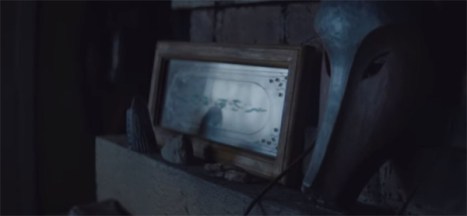
Mask appeal.

Continue reading

New Podcast! Scannain Podcast (2018) #35!

It’s time for the latest Scannain podcast!

This week, I join Jason Coyle and Ronan Doyle to discuss the week in film. As usual, we talk about the top ten and the new releases, as well as what we’ve watched this week. In this episode, the celebration of Agnès Varda continues, dovetailing into the release of her new film Faces Places. We also discuss the Toronto International Film Festival, the masculinity of Clint Eastwood, the strange reception of A Wrinkle in Time and the appeal of the classic Disney animated canon.

We also mark the passing of Irish film critic Stephen Coffey (who wrote under the name of Gar Cremona). Details of the memorial service can be found here, and his books are available for sale here.

The top ten:

  1. King of Thieves
  2. Hotel Transylvania 3: A Monster Vacation
  3. Mamma Mia: Here We Go Again
  4. Christopher Robin
  5. BlacKkKlansman
  6. The House With A Clock In Its Walls
  7. The Predator
  8. Crazy Rich Asians
  9. The Nun
  10. Black ’47

New releases:

You can download the episode here, or listen to it below.


Non-Review Review: The Land of Steady Habits

“You’re mean,” observes a potential romantic partner of Anders Hill, around the halfway point of The Land of Steady Habits.

It would be reductive to suggest that this is the most bracing or cutting piece of character work in The Land of Steady Habits, but it is not entirely unfair. The Land of Steady Habits is very much a story of upper-class social anxiety, of wealthy characters without any real problems in their lives who instead fixate on the kinds of problems that less well-off people probably wish that they had. Anders Hill is a prime example. A solemn and depressive figure who has become alienated from his previously idyllic existence, Anders is a character who is entirely responsible for his current predicament.

Going steady.

In some ways, this is very typical of the work of writer and director Nicole Holofcener, who has adapted The Land of Steady Habits from a novel by Ted Thompson. The film’s status as an adaptation accounts for some of the details that distinguish the film from Holofcener’s other work, most notably the focus on a male (rather than a female) protagonist, but The Land of Steady Habits is very much of a piece with Holofcener’s other work. It is a wry and acerbic study of people who have everything except what they actually need, and who stumble around causing emotional carnage while looking for that something.

With that in mind, Holofcener’s films live and die based on the charm of the leading characters – on how much the audience is drawn into the hollow void at the centre of their existence. By that measure, The Land of Steady Habits is a mixed bag at best. Ben Mendelsohn is great as the pathetic and contemptible Anders Hill, an impotent affluent man-child who seems capable of mustering charm for only a few scarce minutes at a time. However, Anders himself is not anybody that it seems particularly interesting or exciting to spend ninety-eight minutes with.

Sofa, so good.

Continue reading

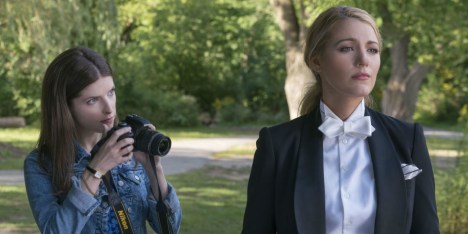
Non-Review Review: A Simple Favour

At one point around the two-thirds mark of the film, an insurance claims investigator offers a recap of all the twists and turns of A Simple Favour to that point. “It’s bananas!” she observes.

She’s not wrong. A Simple Favour is modern film noir with a pitch black sense of humour, populated with two femme fatales and driven with an infectious enthusiasm. It is not a parody or a deconstruction of the genre, but instead a demented celebration. This is a film that revels in the tropes and the conventions of these sorts of layoured labyrinthine narratives, processing all the sharp turns and wacky reveals with an eager (and effectively disconcerting) smile on its face.

Picture perfect.

A Simple Favour often feels like an extended homage to the work of Gillian Flynn, filtered through the lens of Paul Feig. This combination works very well, going down like the kind of martini served in a freezing glass with ice-cold gin. Both Flynn and Feig share an acerbic sense of humour, and tendency to pick at the gender roles usually assigned by society. A Simple Favour might share some of its DNA with Gone Girl or Sharp Objects, but it also feels like the vicious and biting younger sibling of Bridesmaids or Spy.

A Simple Favour does suffer a little bit from the comparisons to Flynn’s work, and occasionally veers slightly too far into broad comedy, but it is powered by a sophisticated charm threaded with a pitch black sense of humour.

Red flags.

Continue reading

To Catch a Predator: Why Is It So Hard to Franchise the Predator?

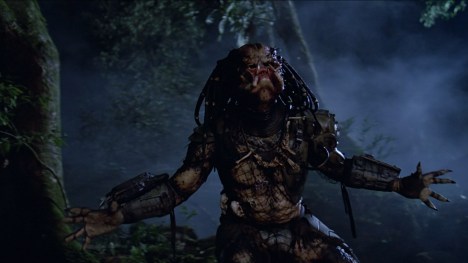
The Predator is one of the most iconic creations of the past thirty-odd years.

The creature created by Stan Winston for John McTiernan’s 1987 action blockbuster is instantly recognisable. It is striking and distinctive. Even people who have never sat down and watched a movie featuring the creature are familiar with the design. This is especially notable given that it could have been a disaster. The original design for the creature is something of an internet urban legend, part of the pop cultural folklore. Predator narrowly averted disaster when Stan Winston redesigned the monster from scratch, so it is all the more impressive that it became such a classic.

It is no surprise that the Predator was quickly franchised. After all, that is how the film industry works. Although modern prognosticators decry the modern era as one defined by sequels and remakes and reboots, but they have always been a feature of the landscape. So the Predator became the cornerstone of an impressive multimedia franchise; even outside of games and comic books, the creature anchored Predator 2, Alien vs. Predator, Aliens vs. Predator: Requiem, Predators and The Predator. That’s an impressive list, in terms of quantity and variety.

However, it is decidedly less impressive in terms of quality. Of those five sequels, Predators is the only one with a positive score on Rotten Tomatoes. Similarly, Predators is the only sequel with a vaguely positive rating on MetaCritic, scraping just over fifty percent. This is the kind of showing that audiences and critics expect from low-rent horror sequels like those starring Freddie Kreuger or Jason Voorhees. (Indeed, the latest sequel starring Michael Myers is critically outpacing The Predator.) It is not exactly an impressive track record for a reasonably big budget mainstream high-profile science-fiction franchise.

Indeed, the stock comparison for the Predator is the Alien franchise, and for good reason. The xenomorph from Alien is another iconic late twentieth-century alien design housed within an R-rated science-fiction action-horror franchise. Both properties are owned by Twentieth Century Fox, allowing them to intersect and crossover within a shared universe. Both have spawned a variety of sequels, and are loosely linked in the popular mind in the way that the Universal Studios films linked Dracula and Frankenstein’s monster with the Mummy or the Invisible Man.

However, this stock comparison does not flatter the Predator. After all, the xenomorph has been at the centre of a franchise that is consistently interesting and at best innovative. There are sequels to Alien that are rightly regarded as classics such as Aliens, while other have launched great careers such as Alien³, and some still cause fierce debates. For all the criticism of films like Prometheus and Alien: Covenant, they at least engender passion in their audiences, in a way that the sequels to Predator do not. Why is it so hard to make a good Predator sequel?

Continue reading