• Following Us

  • Categories

  • Check out the Archives


  • Awards & Nominations

Non-Review Review: Da 5 Bloods

Da 5 Bloods argues that the wounds inflicted by the Vietnam War never truly healed.

The basic plot of Da 5 Plots is standard war movie stuff, recalling the set up of the classic Simpsons episode Raging Abe Simpson and His Grumbling Grandson in “The Curse of the Flying Hellfish”, which itself drew upon a variety of inspirations including episodes of M*A*S*H and Barney Miller. The film follows four veterans who return to Vietnam ostensibly to repatriate the remains of their lost squad commander “Stormin’ Norman.” However, it quickly becomes clear that these former soldiers also have their eyes on a more lucrative prize.

The past never stays buried.

Co-writer and director Spike Lee uses the familiar trappings of war movies – and specifically of Vietnam War movies – to interrogate the legacy of the conflicts and the scars that it left on the national psyche. Indeed, one of the most interesting structural choices in Da 5 Bloods is to effectively invert the basic structure of BlacKkKlansman, which opened as a pointed genre tribute before seguing into actual contemporary news footage during its final act. Da 5 Bloods starts by offering a glimpse of the chaos of the early seventies before diving into the story that it wants to tell.

The result is to contextualise both Da 5 Bloods and its statement on contemporary American identity, drawing a strong line from the unrest and horror of the Vietnam era to the madness of the present moment. Da 5 Bloods was obviously written and filmed well before the latest crisis in the United States, but Lee is a shrewd filmmaker with his finger on the pulse. Da 5 Bloods feels like a movie that is both about the nightmare of this particular moment and the tragic inevitability of that moment as the outcome of unprocessed trauma that has been festering for decades.

Normcore.

Continue reading

Non-Review Review: The King of Staten Island

The King of Staten Island is very much a typical late Judd Apatow project, in the style of Funny People, This is 40 or Trainwreck.

It is a serio-comic character study that essentially tries to wed the juvenile comedic sensibility that Apatow brought to the mainstream with films like Knocked Up and The 40-Year-Old Virgin with the more earnest adult coming-of-age stories that were popular in the early nineties. The results are sporadically funny and affecting, often built around a single or multiple star personas. In each cause, the quality of the film largely comes down to the quality of the star anchoring it, with Trainwreck standing out due to strong turns from both Amy Schumer and Bill Hader.

“King of One of the Boroughs of New York!”

The King of Staten Island tries this approach with Pete Davidson, the stand-up comedian who is currently best known for his work on Saturday Night Live that often involved him directly addressing his own personal controversies. As with Trainwreck, the film is driven by Davidson who shares a co-writing credit and whose character is transparently modelled on Davidson himself. As such, Davidson’s star persona exerts a strange gravity on The King of Staten Island, all the more notable for the fact that this is really Davidson’s first proper starring role of itself.

The King of Staten Island is occasionally moving and engaging, but it never manages to escape from Davidson’s shadow. Simultaneously, there’s something slightly frustrating in the way that for all The King of Staten Island transparently draws from Davidson’s own experiences and history, its narrative structure is painfully generic. Its central character arc is so routine as to undermine any real sense of personality or intimacy. This is the central paradox of the film. The King of Staten Island is both unable to escape Davidson’s gravity and unable to bring itself to look directly at him.

Fighting firemen.

Continue reading

New Escapist Column! On “Wonder Woman” and What It Means to Be a Hero In a World Where Men Are Not Always Good…

I published a new In the Frame piece at Escapist Magazine this evening. Wonder Woman celebrated its third anniversary this weekend, and Wonder Woman 1984 was originally scheduled for release this weekend.

Wonder Woman is a fascinating film, in large part because it manages to feel like a decidedly old-fashioned story of heroism that reflects the anxieties of a modern world. Too many modern superhero films divorce themselves from even the idea of heroism, embracing the power fantasy of superheroism as an end of itself. In contrast, Wonder Woman asks what it means to try to be a good person in a world that is not.

You can read the piece here, or click the picture below.

New Escapist Column! On David as the Monster in “Prometheus” and “Alien: Covenant”…

I published a new piece at Escapist Magazine this evening. This week, Ridley Scott explained that he wanted to “re-evolve” the central monster from the Alien franchise.

This is an interesting argument, particularly given Scott’s long-standing criticism about the xenomorph, and his argument that the creature has perhaps outlived its relevance. Indeed, one of the most interesting facets of Prometheus and Alien: Covenant is the way in which David essentially updates many of the core thematic elements of the xenomorph. David takes the creature’s threat of sexual violence, and updates it for the twenty-first century.

You can read the piece here, or click the picture below.

Non-Review Review: The Vast of Night

The Vast of Night is a loving fifties homage, with more than a few contemporary resonances.

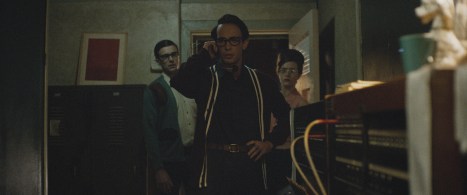
The film is structured so as to evoke pulpy science-fiction, opening on a slow push in on an old black-and-white television set airing Paradox Theatre, a show clearly designed to evoke the various fantastical anthology shows modelled after The Twilight Zone. Director Andrew Patterson keeps reminding audiences of this framing device, occasionally pushing out of his narrative on to the grainy distorted television screen and even occasionally cutting to black to underscore the fact that the narrative the audience is watching is being controlled.

Zero to fifties in only ninety minutes!

The premise of The Vast of Night is remarkably straightforward. One summer evening late in the fifties, something strange happens in a New Mexico town. As the bulk of the town gathers for a big basket ball game, only a handful of residents remain at home. Fay dutifully mans the town switchboard, while the charming DJ Everett handles the radio broadcast for the benefit of “the five of you out there listening.” However, his radio show is briefly interrupted by a strange noise, sparking an investigation that leads to somewhere very strange indeed.

The Vast of Night doesn’t really have too many surprises. After all, the basic premise all but suggests an inevitable conclusion: what could possibly be causing strange signals in New Mexico in the late fifties? However, The Vast of Night is elevated by a number of key factors. Patterson brings a very confident and assured direction to the story, making The Vast of Night a very compelling watch given its relatively low budget and tight focus.

Radio gaga.

However, writers James Montague and Craig W. Sanger deserve a great deal of credit for the script. The Vast of Night is a film that takes great pleasure in the trappings of its late fifties setting, and is keenly aware of the context in which its characters operate. “I am not now, nor have I ever been a member of the communist party,” Fay jokingly records into a microphone early in the film, while later events include accounts of the horror of radiation. The Vast of Night is a loving homage to the era in which it is set.

However, more than that, The Vast of Night understands the strange tethers that tie that idealised past to the more complicate present. By its nature, The Vast of Night is a film about hearing and listening. More than that, though, it is a story about the choices that people make in what they choose to hear and who they choose to listen to. It is a film about conversation, about signal, about noise, about cross talk, and about decay. The Vast of Night is a story about the breakdown of communication, and the horrors that unfold in what society tunes out as white noise.

Interview to a kill.

Continue reading

Non-Review Review: Dating Amber

Dating Amber is a sweet, if perhaps overly familiar, coming of age story.

Dating Amber has a pretty compelling hook. Eddie and Amber are both gay teenagers growing up in rural Ireland during the mid-nineties. The country has just decriminalised sodomy, and finds itself in the midst of a highly divisive and contentious referendum on divorce. Against this backdrop, Amber hits on a clever idea to avoid the scrutiny of her classmates. She and Eddie will pretend to be a couple, so that they can both present as heterosexual long enough for Amber to escape this suffocating environment.

Vicious cycles.

It’s a very straightforward but compelling premise. It evokes the set-up of something like Easy A, tapping into the youthful anxieties of teenage life, and combines it with the increasingly progressive and diverse entries into the genre like Love Simon or Handsome Devil. Writer and director David Freyne draws from his own teenage experiences to add a level of authenticity, and the film is elevated by two winsome performances by Lola Petticrew and Fionn O’Shea.

The film lacks the delicate tonal balance that is necessary to elevate a teenage coming of age story from a charming affair to a classic of the genre, swerving too dramatically from its playful and cheeky opening premise to an overly earnest and sincere final stretch. It allows suffers slightly from a heavy reliance on formula, hitting most of the marks expected of a story like this, but never really finding a way to push past those conventions into something more profound or insightful. However, Dating Amber is an appealing and engaging entry into the genre.

Couple of friends.

Continue reading

New Escapist Column! On Clint Eastwood’s Complex American Masculinity…

I published a new In the Frame piece at Escapist Magazine this evening. Clint Eastwood turned ninety years old yesterday, so it seemed like the perfect opportunity to write about the American icon.

For decades, Eastwood has embodied a certain ideal of American masculinity. However, he has also used his career to offer a more nuanced and sophisticated exploration of that masculinity than many observers will readily acknowledge. Eastwood is the rare movie star who completely understands his screen persona and the audience’s relationship with it, and uses that to engage in interesting discussions about what that says about American machismo.

You can read the piece here, or click the picture below.

New Escapist Column! On How “The Snyder Cut” Went From Impossibility to Inevitability…

I published a new In the Frame piece at Escapist Magazine this evening. The big news this past week has been that Zack Snyder has been given $30m to finish his cut of Justice League.

This is quite a complicated matter. There’s a lot of discussion and debate around it, about what this means for the future of Hollywood. However, the news about the release of The Snyder Cut is down to a number of unique factors aligning in completely unpredictable ways, meaning that a project like this one went from being the last thing that Warners would want to being exactly what they needed. In the course of a few months, the Snyder Cut morphed from seeming impossibility to inevitability. That is an incredible turnaround.

You can read the piece here, or click the picture below.


Non-Review Review: The High Note

The High Note doesn’t quite manage to hit the peak that it title suggests, but it hits most of the notes that it needs to.

The basic plot of The High Note concerns a personal assistant named Maggie who works for Grace Davis. Davis is a singer in the twilight years of her career, working hard to remain relevant and to stay afloat in an industry that seems ready to cast her aside. Maggie is convinced that her boss (and her idol) is capable of delivering so much more than her management and her record label expect of her, but finds herself trapped in an uphill battle to prove that she has a vision that is worth listening to.

She’s got the juice.

There are any number of obvious comparisons to be made with The High Note. The classic underappreciated-working-stiff-is-finally-recognised-as-a-prodigious-talent narrative unfolding against a Hollywood backdrop obviously evokes any of the myriad (official and unofficial) versions of A Star is Born. However, the emphasis within that template on a demanding ageing female star and the younger woman working under her feels like it is somewhat carried over from Nisha Ganatra’s previous film, Late Night.

The High Note is tremendously predictable, but it’s to the credit of Flora Greeson’s screenplay that the movie understands this. There are very few surprises nestled in the story, but The High Note leans into that. It is a surprisingly and endearing gentle movie about the path to stardom, one that keeps its stakes low and which tempers its formula with just enough self-awareness to avoid feeling stale or rehashed. The High Note is solid, sturdy and appealing – even if it seems to reflect the Grace Davis that audiences see, rather than the one that Maggie aspires towards.

Tune in for more…

Continue reading

New Escapist Column! On “The Clone Wars” and the “Star Wars” Prequels…

I published a new In the Frame piece at Escapist Magazine this evening. The Clone Wars wrapped up recently, and so I had occasion to binge the series.

The Clone Wars is an interesting artifact, existing largely space between the prequel and sequel trilogies, although briefly resurrected after the release of the sequels for an abridged final season. Watching the show, what was most striking about it was the way in which it felt true to the prequels, embracing and embodying the myriad complexities and contradictions of that divisive and polarising era of Star Wars output. This was reflected in everything from the kind of stories that The Clone Wars told to the ways in which it opted to tell them.

You can read the piece here, or click the picture below.