• Following Us

  • Categories

  • Check out the Archives


  • Awards & Nominations

New Escapist Column! The Real Paradox at the Heart of the Post-“Judgment Day” Terminator Sequels…

I published a new In the Frame piece at Escapist Magazine on Monday. This one is taking a look at Terminator: Dark Fate, the latest effort to produce a faithful and worthy sequel to Terminator 2: Judgment Day.

However, there’s an abiding irony to the four attempted sequels to James Cameron’s blockbuster classic. The four films all hope to position themselves as worthy successors to Judgment Day, while their very existence serves as a repudiation of its core themes. There is an inherent contradiction there, in that any attempt to honour or homage Judgment Day must – by its mere existence – invalidate the central thematic point. None of the four attempts to produce a workable sequel to Judgment Day have managed to square that particular circle.

You can read the piece here, or click the picture below.

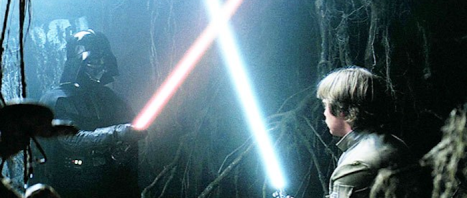
New Escapist Column! The Flawed Redemption at the Heart of “Return of the Jedi”…

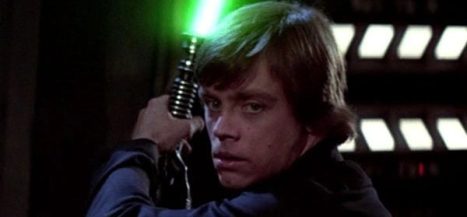
I published a new In the Frame piece at Escapist Magazine on Monday. This one has been kicking around inside my head for a little while, but came to the fore with the recent trailer for Star Wars: Episode IX – The Rise of Skywalker. Primarily, the flawed redemption at the heart of Star Wars: Episode VI – The Return of the Jedi.

Look, everybody knows the basic arc of the Star Wars saga. Luke discovers that Darth Vader is his father, sets out to redeem him, manages to turn Vader away from the dark side before Vader dies. However, that’s never been quite how it works. The actual arc is a lot messier and more complicated, and a lot less conventionally heroic than it is remembered. Return of the Jedi never actually bothers to redeem Vader, instead focusing on redeeming Luke’s idea of Vader. At its core, Return of the Jedi is a story about how hard Luke wants to believe his father was a good man, in spite of all evidence to the contrary.

Along the way, Luke gambles the entire future of the Rebel Alliance and his sister’s fate on the assumption that there is goodness in Vader, while the film never actually bothers to demonstrate that there is any. It’s a fascinating incomplete arc, and one that hints at a gaping moral void at the heart of the larger Star Wars saga. It’s a story about how an individual’s redemption doesn’t matter, only other people’s idea of that redemption. In its own way, it marks Return of the Jedi as a quintessentially eighties movie; it is a story about how the most important thing to Luke is not the fate of the galaxy, but his own self-image.

You can read the piece here, or click the picture below.

New Escapist Column! “Watchmen” and the Limits of Textual Fidelity…

I published a new In the Frame piece at Escapist Magazine last Friday. With the release of Damon Lindelof’s Watchmen, it seemed appropriate to cast an eye back to Zack Snyder’s cinematic adaptation.

I have a huge amount of admiration for Snyder’s version of Watchmen, even if I don’t think it actually works. It is a Herculean effort to bring the story to the screen, one committed to directly transposing as much of the source material from page to screen, but often without really stopping to think about what the dialogue or imagery actually means. It is in many ways a demonstration of the limits of slavish devotion in adaptation. It is a counterpoint to the argument that all it takes to adapt a major work from one medium to another is literalism.

You can read the piece here, or click the picture below.

New Escapist Column! “Gemini Man”, and the Battle Between Hollywood’s Past and Future…

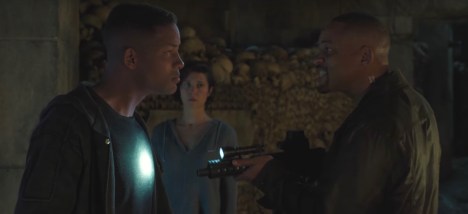
I published a new In the Frame piece at Escapist Magazine on Friday. This one takes a look at Gemini Man.

Ang Lee’s latest is a very strange beast, a nineties action movie throwback wrapped in modern technology. It pits nineties action movie icon (and one of the last surviving movie stars) Will Smith against a young computer-generated replacement, while allowing Ang Lee to embrace both a strange fascination with nineties era John Woo and his enthusiasm for technology literally so advanced that no cinema in the United States could show the film as intended. And this tension between old and new plays through Gemini Man in interesting ways.

You can read the piece here, or click the picture below.

“Someone Who Hides Behind a Mask.” “Joker”, Superheroes, Vigilantes, and Pulp Friction…

A lot of digital ink has been spilled about Joker.

This makes sense. After all, it entered the discussion as a source of moral panic. It then emerged as a box office smash. It is a potential awards contender. And it provides an interesting intersection of genre. It is a hybrid of the dominant genre at the contemporary blockbuster with more ambitious and abstract awards fare. As such, it is not a surprise that Joker has dominated public attention in the way that it has. It seems almost tailor-made to generate discussion and debate, even if that can occasionally feel deafening.

That said, one of the most interesting and frustrating aspects of Joker is the way in which the film deliberately and consciously avoids crossing any particularly provocative lines. The film sidesteps a lot of potentially thorny issues of race and gender, perhaps wary of the potential internet blow back. If the film is making a point about anything, it seems to be a self-aware acknowledgement of the desire to imbue objects with symbolic weight and meaning even when they have not been designed to bear the weight. “I’m not political,” Arthur Fleck asserts, as political meaning is imposed upon him.

That said, there is something very interesting at the heart of Joker, something that likely emerged almost entirely by accident. Joker provides an interesting genre hybrid of the seventies and eighties vigilante thriller with the contemporary superhero blockbuster. And, in doing so, suggests an interesting throughline. Joker suggests that the superhero blockbuster isn’t as far removed from these urban power fantasies as the audience might like to believe.

Continue reading

New Escapist Column! “Deadwood: The Movie”, “El Camino” and Closure In The New Age of Television…

I published a new In the Frame piece at Escapist Magazine yesterday. This one looks at the recent releases of Deadwood: The Movie and El Camino: A Breaking Bad Movie as an illustration of how much the television landscape has changed in recent years.

These belated capstones to beloved series – Deadwood and Breaking Bad – are interesting because they afford the creative talent the opportunity to wrap up their story free from the production constraints of television, the urgent desperate churn of the conveyor belt that demands workable solutions in insanely short periods of time. These epilogues arrive years after the fact, and are the product of careful consideration and reflection. They allow their creators to tie a little bow around their work. After all, sometimes it is nice to have distance.

You can read the piece here, or click the picture below.

New Escapist Column! “Ad Astra” and What We Carry with Us…

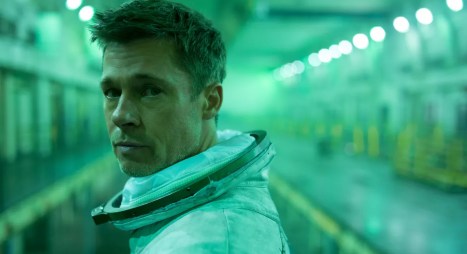
I published a new In the Frame piece at Escapist Magazine yesterday. This one has been kicking around for a little while, discussing James Gray’s Ad Astra.

In particular, it takes a look at a broader trend in modern space movies – what might be dubbed the “sad astronaut” genre. In contrast to the sixties utopian fantasies of shows like Star Trek or 2001: A Space Odyssey, these films tend to offer a more introspective portrait of space travel. Films like Gravity or Interstellar or First Man are as much about the baggage that the protagonists bring with them on their journey as they are about what the character in question might find out there.

You can read the piece here, or click the picture below.

New Escapist Column! “Joker” as a Perverted Superhero Origin Story…

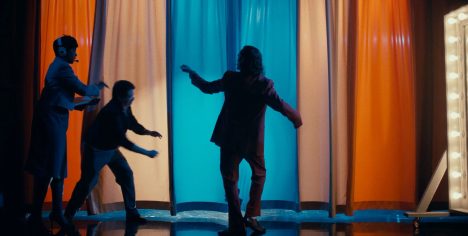
I published a new In the Frame piece at Escapist Magazine yesterday. Naturally, it tackled the big release of the moment, Todd Phillips’ Joker.

Joker has been the source of a lot of controversy and attention. However, one of the most interesting debates around it has been the discussion over whether it counts as a superhero story at all – director Todd Phillips and actor Marc Maron have been quick to distance the film from the genre. However, despite these claims, Joker actually works very well as a perversion of the archetypal superhero origin story. In doing so, it suggests something interesting about the state of the genre at the current cultural moment.

You can read the piece here, or click the picture below.

New Escapist Column! How “The Empire Strikes Back” Invented the Modern Sequel and Franchise…

I published a new In the Frame piece at Escapist Magazine late last week, hopefully one a little bit less contentious than discussions of Star Wars: Episode VIII – The Last Jedi.

The piece takes a look at Star Wars: Episode V – The Empire Strikes Back, and the impact that it had on shaping a lot of modern blockbusters. We tend to think of Jaws and Star Wars as the cornerstones of the modern blockbuster movie, and that’s certainly fair. However The Empire Strikes Back has arguably had an even greater impact on the way in which franchise movies are built – from ballooning budgets to the idea of the perpetual second act.

You can read the piece here, or click the picture below.

“I’m Ready to Communicate With You Now”: The Millennial Anxieties of “The Sixth Sense”, and Feeling Alone in the City of Brotherly Love…

This Saturday, I’ll be discussing The Sixth Sense on The 250, the weekly podcast that I co-host discussing the IMDb’s Top 250 Movies of All-Time. However, I had some thoughts on the film that I wanted to jot down first.

What do you think these ghosts want when they talk to you? I want you to think about it, Cole. I want you to think about it really carefully. What do you think they want?

Just help.

That’s right. That’s what I think too. They just want help, even the scary ones. I think I might know a way to make them go away.

How?

Listen to them.

The Sixth Sense is a remarkable film, for many reasons.

These days, The Sixth Sense is perhaps best known for its central twist. The film’s powerhouse emotional ending has become a pop cultural touchstone, anchoring jokes in everything from Fifty First Dates to the viral video sensation Jizz in my Pants. Of course, this also complicates the legacy of The Sixth Sense by serving as ground zero for director M. Night Shyamalan’s subsequent dependence upon these sorts of twists in movies like The Village or The Happening. Nevertheless, The Sixth Sense has endured in the popular memory as one of the rare twist-driven films that stands up to repeat viewings.
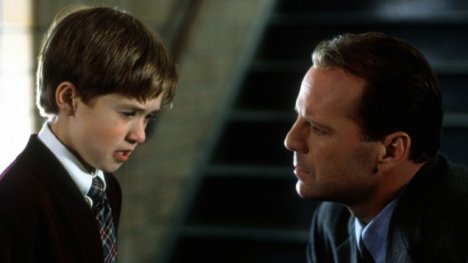
A Cole’d open.

However, it is much more than that. Even beyond that, The Sixth Sense is a lavish production that looks beautiful. Of course, Shyamalan’s ego has done his reputations few favours, from his own cameo as a writer-messiah in The Lady in the Water to his role in a Sci-Fi Channel documentary The Buried Secret of M. Night Shyamalan to the famous Newsweek cover crowning him “the next Spielberg.” Still, The Sixth Sense is visually stunning. Although it is tempting to think of The Sixth Sense as a “small” movie by modern standards, it was actually produced on a budget of $40m.

Rewatching The Sixth Sense twenty years later, it is amazing how much of the film’s visual storytelling lingers. Shyamalan might not have been the next Spielberg, but he had a wonderful eye for composition; that shot of a red balloon drifting up the inside of a spiral staircase, those eerie sequences of Malcolm and Cole wandering through a surprisingly quiet Philadelphia, even the conversations at that church with Cole towering over Malcolm from the balcony as he plays with his toy soldiers.
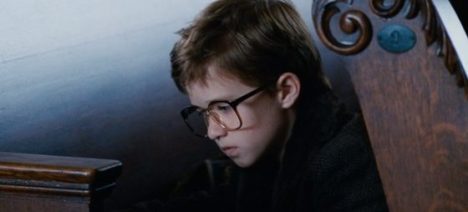
Pew pew!

However, even more than all of that, The Sixth Sense remains the rare film that is both specifically rooted in its cultural moment and profoundly universal. The story that drives The Sixth Sense is surprisingly straightforward – helpfully encapsulated in Cole’s trailer-friendly assertion that he sees “dead people.” However, Shyamalan understands that ghost stories are about more than just the recently deceased. Ghost stories translate a sense of longing and regret, of disconnect and isolation. The Sixth Sense is fundamentally a story about how difficult it is to meaningfully communicate in the modern world, with or without a pulse.

The Sixth Sense is a story of existential ennui, wrapped up in a set of late nineties anxieties.
M. Night Shyamalan had to eat Crowe on his next few films.

Continue reading