• Following Us

  • Categories

  • Check out the Archives


  • Awards & Nominations

Non-Review Review: Dawn of the Planet of the Apes

Constructing a satisfying sequel is an artform unto itself. It is something that requires a great deal of skill. As with any aspect of filmmaking, building off an earlier film is a very difficult thing to do. Producing a sequel comes with its own set of artistic risks and challenges, its own obstacles and hurdles. Navigating those potential problems and finding a way to meet (and even surpass) expectations without straying too far from the framework of the original film is difficult.

As with making any movie, there are existing frameworks and structures that do a little help make navigating those problems a little easier. Perhaps the structure of Star Wars: The Empire Strikes Back is the most obvious example. Using the trust established by the first film, the ensemble are split up to carry different strands of the plot, revealing scattered pieces of a larger whole, before reuniting for an epic finalé. Bryan Singer used this approach for X-Men II and How to Train Your Dragon 2 also followed it.

Playing him for a chimp, eh?

Playing him for a chimp, eh?

Dawn of the Planet of the Apes is in an interesting position. It is a sequel to a remake; a remake of a film franchise that was originally iconic and influential, before dying a slow and humiliating public death as the series diminished and collapsed. Not only does Dawn of the Planet of the Apes come with the expectations of Rise of the Planet of the Apes, it comes with the revived expectations of the entire Planet of the Apes franchise; expectations restored by Rise of the Planet of the Apes.

Dawn of the Planet of the Apes chooses a very clever structure for this sequel, loosely following the sequel framework typified by Christopher Nolan’s work on The Dark Knight. This is a very clever approach, and it pays dividends. Dawn of the Planet of the Apes is an ambitious and exciting sequel, a wonderful post-apocalyptic epic and an engaging moral parable.
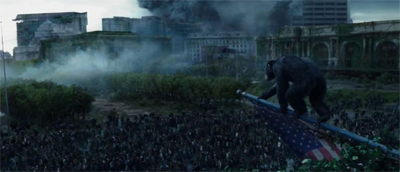
Going ape for it...

Going ape for it…

Continue reading

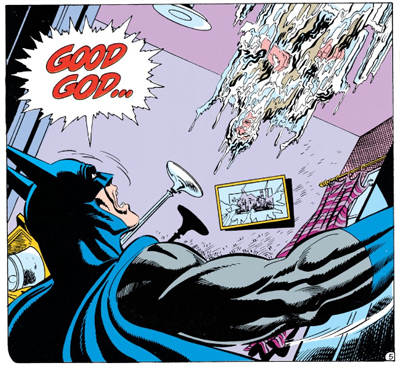
Mike W. Barr and Alan Davis’ Run on Detective Comics (Review/Retrospective)

23rd July is Batman Day, celebrating the character’s 75th anniversary. To celebrate, this July we’re taking a look at some new and classic Batman (and Batman related) stories. Check back daily for the latest review.

When DC comics published Crisis on Infinite Earths, it was a brave new world. Everything was new again. Nothing could be taken for granted. The company had the opportunity to start again with its characters and properties, offering a new beginning to iconic heroes that would hopefully welcome new readers while learning from prior successes and past failures. It was an exciting time in the industry, one bristling with potential.

In many respects, the defining Batman story in the immediate aftermath of Crisis on Infinite Earths was Batman: Year One. Even today, Year One remains a foundational text for Batman, one of the best (and most influential) stories ever told using the character. It defined Batman for the eighties and nineties, and beyond. Frank Miller offered readers a new and updated origin for the Caped Crusader that teased a new way of looking at Gotham City and its inhabitants.

"It's a trap!"

“It’s a trap!”

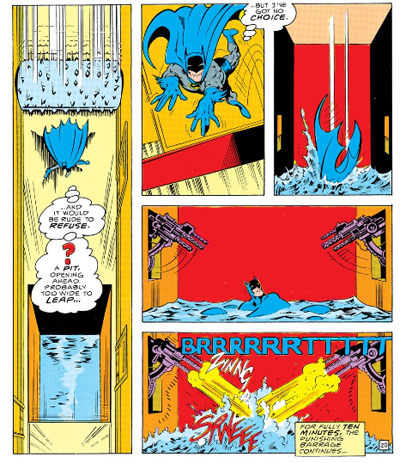
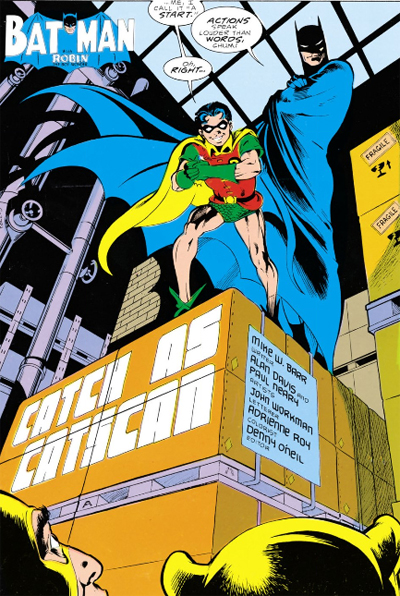
Meanwhile, a more quiet revolution was in progress over on Detective Comics. Writer Mike W. Barr and Alan Davis began their run on Detective Comics in the immediate aftermath of the now-all-but-forgotten Legends crossover. Although the duo were lucky enough to work on the book over the fiftieth anniversary of Detective Comics, their work was somewhat overshadowed by the publication of Year One in their sister publication – to the point that their run culminates in Year Two, a sequel to Year One.

Still, while it never got the attention that it deserved, Barr and Davis did a lot to offer an alternative to Miller’s gritty and grounded reimagining. Featuring death traps and puns and brainwashing and dodgy jokes, Barr and Davis seem almost subversive. It is as if the duo are working hard to import all the stuff that might otherwise be washed away by Crisis on Infinite Earths, reminding readers that with world of Batman has always been absurd, and that is not necessarily a bad thing.

Talk about making an entrance...

Talk about making an entrance…

Continue reading

Scott Snyder & Greg Capullo’s Run on Batman – Death of the Family (Review/Retrospective)

23rd July is Batman Day, celebrating the character’s 75th anniversary. To celebrate, this July we’re taking a look at some new and classic Batman (and Batman related) stories. Check back daily for the latest review.

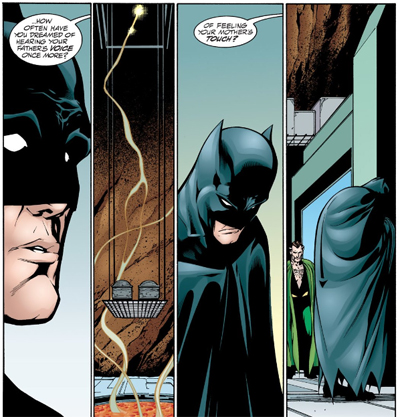
In many respects, despite the massive hype that it received and the gigantic crossover that it spawned, Death of the Family is structured as an anti-epic. The triumphant return of the Joker to the world of Batman over a year into the “new 52” instead turns into a deconstruction and criticism (and arguably a rejection) of the character. Sandwiched between Scott Snyder and Greg Capullo’s much larger and more ambitious epic Batman stories, Death of the Family is a story about how small the Joker really is.

In many respects, Death of the Family reads best as the story of a collapsing relationship, where one partner refuses to deal with the fact that the other has outgrown them.

Ever dance with the devil in the pale moonlight?

Ever dance with the devil in the pale moonlight?

Continue reading

Mark Waid’s Run on Justice League of America – Tower of Babel (Review/Retrospective)

23rd July is Batman Day, celebrating the character’s 75th anniversary. To celebrate, this July we’re taking a look at some new and classic Batman (and Batman related) stories. Check back daily for the latest review.

Although actually published in 2000, Tower of Babel is the third definitive Batman story of the nineties. Running only four issues instead of a massive sprawling crossover across an entire line of comic books, Tower of Babel is certainly more condensed than either Knightfall or No Man’s Land, hitting on many of the same themes and concepts. It is very much constructed as a cautionary tale – a warning about taking a particularly cynical approach to Batman to its logical extreme.

Due to his stand-off-ish nature, the nineties iteration of Batman is sometimes affectionately (or not so affectionately) referred to a “Batjerk.” This version of the character has a wonderful knack of pushing his friends and allies away, making enemies, and escalating problems due to arrogance and ego. In many respects, Tower of Babel is a quintessential “Batjerk” story, where Batman’s anti-social tendencies lead to the humiliation and defeat of the entire Justice League using his own plans.

The last temptation of Batman...

The last temptation of Batman…

Continue reading

Batman: Shadow of the Bat – The Last Arkham (Review)

23rd July is Batman Day, celebrating the character’s 75th anniversary. To celebrate, this July we’re taking a look at some new and classic Batman (and Batman related) stories. Check back daily for the latest review.

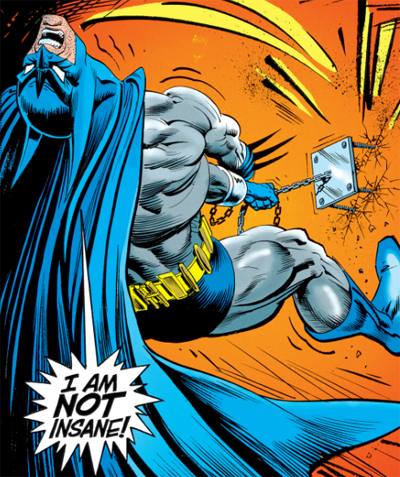
In 1992, DC comics launched Shadow of the Bat. It ran for eight years and ninety-two issues. Alan Grant wrote most of those issues, before his creative relationship with the publisher eventually broke down. (Grant is still upset about the manner of his dismissal.) As the driving force behind the book, Grant was able to give Shadow of the Bat its own unique flavour, focusing on the madness of Gotham, and the strangeness of its inhabitants.

The opening four-part story, The Last Arkham, remains perhaps the most definitive of Grant’s contributions to the Batman mythos, teaming up with artist Norm Breyfogle to offer a rather creepy and unnerving exploration of the city’s ever-slipping sanity.

Me thinks the Batman doth protest too much...

Me thinks the Batman doth protest too much…

Continue reading

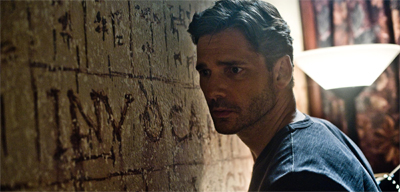
Non-Review Review: Deliver Us From Evil

Deliver Us From Evil is a film where ambition seems to outpace ability. A wonderfully surreal blend of cop action movie with exorcism horror, the movie manages to score a few clever juxtapositions – even if it never seems to decide whether it’s gloweringly serious or wryly ironic. While Deliver Us From Evil never finds the right balance of po-faced gravitas and witty self-awareness, it is a surprisingly enjoyable ride.

After all, it is very hard to hate a film where a demonic presence seeks to establish itself upon the world using the music of The Doors as a recurring motif.

The writing's on the wall...

The writing’s on the wall…

Continue reading

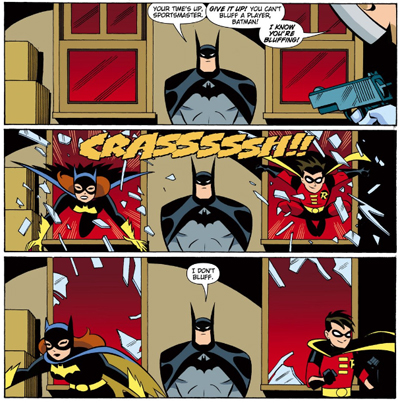
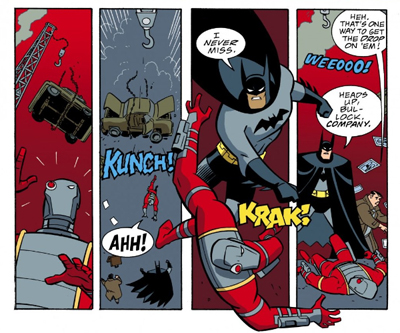
Dan Slott, Ty Templeton and Rick Burchett’s Run on The Batman Adventures (Review/Retrospective)

23rd July is Batman Day, celebrating the character’s 75th anniversary. To celebrate, this July we’re taking a look at some new and classic Batman (and Batman related) stories. Check back daily for the latest review.

More than two decades after its original broadcast, Batman: The Animated Series remains one of the most insightful and most elegant distillations of the Batman mythos. While the show was on the air, DC published a variety of tie-in comic books featuring a variety of talent. Some of these count among the best Batman stories of the nineties, and it is a shame that DC has not done more work to keep these in print.

Indeed, it is a surprise that DC has never thought to produce a suitably deluxe or high-profile collected edition of the work that Mark Miller did on the tie-in to Superman: The Animated Series. However, it is worth noting that DC did make a nice gesture by offering the first issue of The Batman Adventures as their free comic book day issue in 2003. It is much more appealing free comic book day than a collection of promotions or previews.

Batman. In a nutshell.

Batman. In a nutshell.

The Batman Adventures was a tie-in comic published within the animated continuity while the animated Justice League was still on the air. However, it was written after the end of The New Batman Adventures. As a result, it had a lot more freedom than the comic books that had been published in tandem with the animated series. The Batman Adventures was no longer a supplement to a television show set in Gotham, it was the only continuing glimpse at this version of Gotham.

The Batman Adventures was a wonderful inclusive comic book – it was appropriate for children, it was accessible to people with only a casual familiarity with the world of Batman. In many respects, it was the perfect “free comic book day” comic. A light, fun read with a clever take on Batman and his world. The Batman Adventures is a fantastic little book that ended far too soon – a demonstration that comics don’t need to be “adult” or “mature” in order to be smart or fun.

Deadshot is dead to the world...

Deadshot is dead to the world…

Continue reading

Peter Milligan’s Run on Detective Comics (Review/Retrospective)

23rd July is Batman Day, celebrating the character’s 75th anniversary. To celebrate, this July we’re taking a look at some new and classic Batman (and Batman related) stories. Check back daily for the latest review.

Peter Milligan’s run on Detective Comics was cut unfortunately short. After writing six issues of Detective Comics, the writer felt a little over-stretched, and so decided to concentrate on more personal projects. While that’s entirely understandable, it’s also a little unfortunate. Milligan’s work on Batman is rather underrated and often overlooked. Grant Morrison’s decision to build some of his extended Batman run off Milligan’s Dark Knight, Dark City helped bring some exposure to Milligan’s work on the character.

Despite the brevity of his run, Milligan is incredibly influential when it comes to the character of Batman. His work prefigures a great deal of the nineties. The way that Milligan seems to play Detective Comics as an existential horror story feels like it sets the stage for the extended collaboration between Doug Moench and Kelley Jones on the main Batman book during the mid-nineties. Although he didn’t stay to see the idea through, Milligan did play a (very) small part in the development of Knightfall.

Hanging on in there...

Hanging on in there…

Even outside of the general mood of Milligan’s work on the title, and demonstrating that a Batman comic could work as a horror story, even Milligan’s individual stories are influential. Dark Knight, Dark City is major influence on Grant Morrison’s work on the character. Perchance to Dream on Batman: The Animated Series seems to owe a debt to Milligan’s Identity Crisis, imagining a version of Bruce Wayne who is not Batman. (Something Morrison revisited during Final Crisis.)

However, perhaps Milligan is most influential in his portrayal of Gotham itself, offering us a damaged Batman protecting a haunted Gotham.

Knight clubbing...

Knight clubbing…

Continue reading

Scott Snyder & Greg Capullo’s Run on Batman – The Court of Owls, Night of the Owls & The City of Owls (Review/Retrospective)

23rd July is Batman Day, celebrating the character’s 75th anniversary. To celebrate, this July we’re taking a look at some new and classic Batman (and Batman related) stories. Check back daily for the latest review.

The “new 52” was a rather polarising experiment.

Claiming to restart their entire universe from scratch after the events of Flashpoint, DC comics claimed the initiative would make comic books more accessible to the masses. Without decades of continuity to block access, new readers would be more likely to try to get into these sorts of comics. The decision to effectively start from scratch has been controversial – arguably compounded by the fact that writers like Geoff Johns or Grant Morrison were allowed to carry their work across the continuity reboot.

Swinging into action...

Swinging into action…

The team of Scott Snyder and Greg Capullo are among the longest serving of the “new 52” creators. The pair have remained on the flagship Batman book for three years, longer than the vast majority of creators recruited to help relaunch the DC universe back in September 2011. There’s a wonderful consistency and enthusiasm to their work, and it seems like the two have a very clear vision of where they want to take Batman, one of the characters with the most complex relationship to the re-launch.

In many ways, The Court of Owls can be read as a meta-commentary on Batman’s position in the wake of Flashpoint, reflecting on the awkward relationship between the potential for novelty and the demand for familiarity.

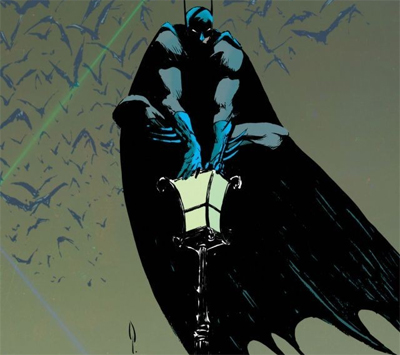
Everything burns...

Everything burns…

Continue reading

Star Trek – Debt of Honour (Review)

This June, we’re taking a look at some classic Star Trek movie tie-ins and other interesting objects. Check back daily for the latest reviews and retrospectives.

By all accounts, Debt of Honour should be an unqualified success.

It’s a prestige graphic novel from DC comics, produced around the twenty-fifth anniversary of Star Trek and the release of Star Trek VI: The Undiscovered Country. It is written by celebrated comic book scribe Chris Claremont, fresh off his career-defining stint on Uncanny X-Men. An avowed Star Trek fan and comic book veteran, this should be in his wheel house. The art is provided by Adam Hughes, one of the most celebrated and respected artists of his time.

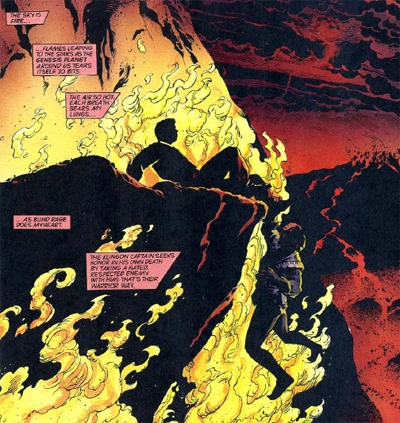
Talk about kicking off a comic...

Talk about kicking off a comic…

By any measure, Debt of Honour should count as some sort of hallmark for DC Comics’ Star Trek tie-ins. Unfortunately, that isn’t quite the case. A rather muddled storyline that is hopelessly devoted to Star Trek continuity while awkward interfacing with it,  Debt of Honour is just packed a little too tight. Charting a story from the earliest days of Kirk’s career to the aftermath of Star Trek IV: The Voyage Home, Claremont bites off more than he can chew.

Over the course of Debt of Honour, Claremont introduces a vague alien threat that has apparently been haunting Kirk for his entire career, a new arch-foe or love interest for Kirk, and even a supporting role for Kor. Along the way, he packs in cameos and shout-outs to various parts of Star Trek lore. He even explains why Klingons suddenly had ridges around the time of Star Trek: The Motion Picture. Ultimately, Debt of Honour is ambitious, but a little over-stuffed and quite over-cooked.

Warp speed ahead!

Warp speed ahead!

Continue reading