• Following Us

  • Categories

  • Check out the Archives


  • Awards & Nominations

The X-Files – Paper Clip (Review)

This November (and a little of December), we’re taking a trip back in time to review the third season of The X-Files and the first (and only) season of Space: Above and Beyond.

And now we return to your scheduled viewing.

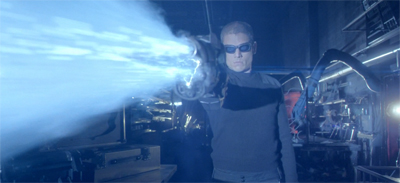
In many respects, Paper Clip feels like the real third season premiere. It establishes a lot of the recurring themes and ideas for the mythology of the season, from Krycek-on-the-run through to collaboration in the wake of the Second World War. It builds on the successful multi-part formula established by episodes like Ascension or End Game during the show’s second season. It moves things along in a way that The Blessing Way simply refused to. (It even resolves the cliffhanger from the last episode on screen.)
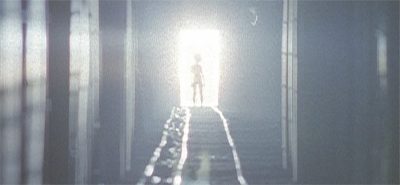
The light at the end of the tunnel...

The light at the end of the tunnel…

Paper Clip demonstrates the strengths of the third season of The X-Files. The third season was the point at which the show really pushed the mythology out, building on earlier implications that there was form to be found in the shadows. The third season also looked to the second season to determine what had worked and what had not worked. Paper Clip is very clearly modelled on the successful aspects of second parts like Ascension or End Game.

It moves. The power of Paper Clip comes from an incredible forward momentum that allows the show to maintain tension and excitement while refusing to allow the audience to catch their breath. Instead of resolving the bigger plot threads from the first episode, questions and hints are thrown out with reckless abandon as the script just drives through set pieces and emotional beats and suspenseful sequences. It is a very meticulously, very cleverly constructed piece of television.
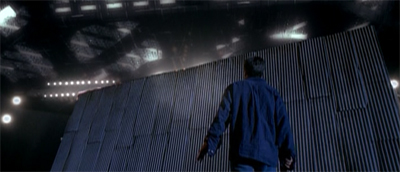
Watching the skies...

Watching the skies…

Continue reading

Star Trek: Voyager – Non Sequitur (Review)

This September and October, we’re taking a look at the jam-packed 1994 to 1995 season of Star Trek, including Star Trek: Deep Space Nine and Star Trek: Voyager. Check back daily for the latest review.

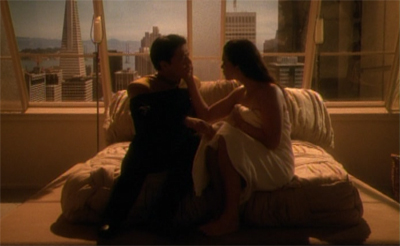
Non Sequitur is a Brannon Braga script touching on familiar Brannon Braga concepts – big ideas like time and space and reality and existence. Harry Kim wakes up to find himself in bed with his girlfriend, Libby. The two are living in San Francisco on Earth. Ensign Harry Kim never served on Voyager, instead working in Starfleet Engineering on Earth. Unable to explain what has happened, Kim finds himself struggling to cope with the situation.

Luckily, in true Star Trek: Voyager fashion, everything is conveniently reset at the end of the episode.

Feels like going home...

Feels like going home…

Continue reading

The X-Files (Topps) #8-9 – Silent Cities of the Mind (Review)

This November (and a little of December), we’re taking a trip back in time to review the third season of The X-Files and the first (and only) season of Space: Above and Beyond.

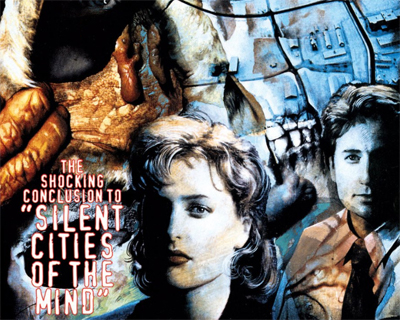
Silent Cities of the Mind is a very “comic book” story – it’s a story that might easily seem outlandish or ridiculous if committed to film, but which works very well within its medium. After all, the plot centres around a bunch of ancient Aztec priests who built an elaborate underground city that could project itself above ground as a mirage. Indeed, the story seems to accept this as a given, with Scully instead spending most of the adventure questioning whether memories can be transmitted via cannibalism.

It’s a concept that could easily seem ridiculous, and it’s a testament to writer Stefan Petrucha and artist Charles Adlard that it works as well as it does. Silent Cities of the Mind is a decidedly pulpy adventure, but that lends the story an undeniable charm. It’s a story packed to the brim with clever and fascinating ideas – from ancient aliens to ritual cannibalism to hidden cities to crystal skulls. All this is crammed tightly into two issues, meaning that everything moves so fast there’s no real time to stop and nitpick it all.

It's all in the mind...

It’s all in the mind…

Mulder is negotiating with survivalists! There are memories transferred through the act of ritual cannibalism! Mulder and Scully are shot down over Alaska! Mulder is trapped with a cannibal! There’s a hidden Aztec city buried underground! Mulder has discovered ancient Aztec mythology! There’s an army rescue team that isn’t a rescue team! There’s a macguffin that allows its wearer to commune with the gods! There’s a stand-off!

It’s all rather exhausting, but in a fun and exciting sort of way. Silent Cities of the Mind is perhaps the best example of how Petrucha and Adlard were writing The X-Files as a comic book, positioning the show’s tropes and iconography within the framework of comic book conventions.

Bonfire of the vanities...

Bonfire of the vanities…

Continue reading

Space: Above & Beyond – Pilot (Review)

This November (and a little of December), we’re taking a trip back in time to review the third season of The X-Files and the first (and only) season of Space: Above and Beyond.

Space: Above and Beyond made a great deal of sense in the context of the mid-nineties. Fox had begun its life as a scrappy little network that had trouble producing seven nights of broadcasting, but had rapidly solidified itself into a credible alternative to the big three networks. There were lots of reasons for this. The X-Files was one reason, but the network had also solidified itself with a slate of popular young dramas like Beverly Hills 90210, Melrose Place and Party of Five. Securing the NFL rights in 1993 didn’t hurt.

By late 1995, Fox was largely past the growing pains stage of its evolution. The network had been announced in late 1985, and first hit the airwaves in late 1986. It was approach the end of its first decade by the time Space: Above and Beyond was broadcast. Fox was no longer a small network fighting for scraps, but a viable challenger to the so-called “big three.” This change in outlook would lead to great success in the twenty-first century, but would also lead to change in how Fox did business.

Everything burns...

Everything burns…

The X-Files had been the right show at the right time in a number of ways. It landed at the perfect point to speak to a generation that grew up in the shadow of Watergate, but also to tap into millennial anxieties and insecurities. From a commercial perspective, The X-Files launched towards the end of the period where Fox could take chances on young shows struggling to find an audience. The first season of The X-Files was a cult hit, but not a breakout success story. The network had faith in the show, and that faith paid off.

It is interesting to wonder whether The X-Files would have received a second season if it débuted even two years later. After all, Fox would develop a reputation as a network with a ruthless tendency towards cancellation and plug-pulling. If The X-Files had first appeared in September 1995, would it have enjoyed the same fate as Space: Above and Beyond?

Distant sands...

Distant sands…

Continue reading

Non-Review Review: The Drop

It is suggested that hell is other people. Perhaps not so much. Perhaps hell is the absence of other people. Towards the end of The Drop, a character ruminates on the idea of eternal damnation – suggesting that hell is nothing but eternal emptiness, a cosmic echo chamber where the damned are left with nothing but their own sense of isolation. Maybe that is what damnation is, nothing but an individual’s own loathing and self-doubt reflected back them, amplified through the darkness.

The Drop is a tense and claustrophobic thriller. The bulk of the action unfolds around the small world as Bob knows it. Bob is a simple man. He works at a small dive, “Cousin Marv’s Place.” When asked tough questions, he simply answers, “I just tend bar.” As Bob explains, the dive bar occasionally serves as a “drop” for all the money laundered through local crime. Bob doesn’t know where it comes from or where it goes. He is only aware of it when it comes into his care and when it leaves.

It's a dog's life...

It’s a dog’s life…

The Drop is a story about isolation and loneliness. Characters reflect on their place in the world, trying to make sense of what unfolds around them. Most are unknowable to each other, mysteries and enigmas. Asked a personal question, Bob replies, “That’s my business.” When his friend Nadia asks why Bob never inquired about her own very obvious scars, Bob simply answers, “I figure that’s your business.” The world as Bob knows it is a small place. Maybe it’s constantly getting smaller.

Adapted by Dennis Lehane from his own short story Animal Rescue, The Drop wallows in its own sense of lost direction and impending doom. Michaël R. Roskam’s direction never rushes the story or the actors, allowing the film time to take in the emptiness and hollowness in this small world that briefly intersects with something much bigger and more unpleasant. Perhaps a little too stately and relaxed in places, The Drop is nevertheless an atmospheric delight.

Just Cous...

Just Cous…

Continue reading

Star Trek: Voyager – Elogium (Review)

This September and October, we’re taking a look at the jam-packed 1994 to 1995 season of Star Trek, including Star Trek: Deep Space Nine and Star Trek: Voyager. Check back daily for the latest review.

Elogium is the first script from writer Kenneth Biller, even if it was his second script produced and his third script to air. Adapted from a script by Jeri Taylor from a freelance pitch from Jimmy Diggs, Elogium has gone through quite a few sets of hands before reaching the screen. In many respects, Biller’s script went through the opposite approach of many writers working on Star Trek for the first time.

Ronald D. Moore’s script for The Bonding and René Echevarria’s teleplay for The Offspring both went through story editor Melinda Snodgrass and executive producer Michael Piller for varying amounts of re-writes before their ideas reached the screen. In contrast, Biller’s début assignment is re-writing a script written by an executive producer from a freelance pitch. It’s no wonder that Elogium turned into such a mess.

Love in a turbolift...

Love in a turbolift…

The episode was produced towards the tail end of the first season of Star Trek: Voyager, and it’s almost a shame that it was held back into the second season. While hardly an episode deserving of repeat airing over the summer, it was also a pretty poor way of welcoming viewers into the show’s second season. It’s a problem with all of the hold-overs, except for Projections. The other three episodes carried over are among the weakest episodes of a troubled season. Elogium might not be quite as dull as Twisted or as unfocused as The 37’s, but it is a deeply creepy episode of television.

The two episodes produced during the second season to air in the first six weeks – Initiations and Non Sequitor – might not represent franchise high-points, but they are well-produced hours of television that suggest Voyager might be finding its feet. The hold-overs from the first season undermine that sense of progress.

Neelix was shocked to discover that Ocampan children were not found under cabbage patches...

Neelix was shocked to discover that Ocampan children were not found under cabbage patches…

Continue reading

The X-Files (Topps) – Circle Game (Review)

This November (and a little of December), we’re taking a trip back in time to review the third season of The X-Files and the first (and only) season of Space: Above and Beyond.

There are any number of events that suggest The X-Files was on the cusp of exploding into a phenomenon. The show was spawning conventions and merchandise. It was becoming a hot property in international markets, moving from BBC 2 up to BBC 1 and then across to Sky. It was quickly becoming compelling water-cooler television. The first season had been lucky to avoid cancellation. The second season had rocketed up the ratings. The third was going to be a pretty big deal.

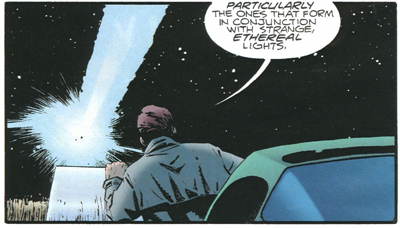
In light of all of this going on around it, a five-page comic doesn’t seem like that big a deal. Written by Stefan Petrucha and illustrated by Charles Adlard, Circle Game would almost seem as business-as-usual for Topps’ popular X-Files tie-in comic. The only significant difference was that Circle Game had been written and illustrated specifically for the July 15th issue of TV Guide. As part of their “stellar summer sci-fi issue!”, the magazine had given over five pages to Petrucha and Adlard to tell an entire X-Files story.

X marks the spot...

X marks the spot…

Even ignoring the narrative challenges posed by such an assignment, that’s a pretty big deal. Even in the age of the internet, time-shifted viewing and multi-channel television, TV Guide still has a circulation of over two million readers. To give a sense of scale, the biggest-selling contemporary comic books would have a readership of less than a tenth of that. To give it a more relevant sense of scale, the July 1995 issue of The X-Files comic book – the version on the stands at this point – sold approximately 72,000 copies.

All of this is just to stress that giving The X-Files comic book five pages of TV Guide was a pretty big deal.

Lights in the sky...

Lights in the sky…

Continue reading

The X-Files – The Blessing Way (Review)

This November (and a little of December), we’re taking a trip back in time to review the third season of The X-Files and the first (and only) season of Space: Above and Beyond.

The Blessing Way is the first mythology episode of The X-Files that doesn’t really work.

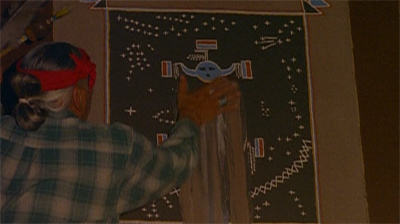
And it doesn’t really work for a lot of the same reasons that some of the later mythology episodes don’t really work. Its pacing is terrible. It wallows in new age mysticism, allocating characters thoughtful monologues that awkwardly state themes and render subtext as supratext. It plays into the deification of Mulder, trying to bend Mulder’s story to fit into an archetypal “chosen one” narrative. More than that, it is very clearly a holding pattern, an effort to eat up time without moving forward.

Wiping it all out...

Wiping it all out…

However, despite the fact that The Blessing Way really doesn’t work, it is still a fascinating episode. It’s a wonderful demonstration of how The X-Files has developed a fleshed-out world inhabited by compelling characters. The best moments in The Blessing Way are character-focused, with Skinner caught between his duty to the government and his loyalty to his agents, the Cigarette-Smoking Man revealed to be middle-management at best, and the implication that even vast sinister government conspiracies are hostage to chaos.

The Blessing Way is an oddity, a rather strange piece of television that is almost endearing in its stubborn refusal to deliver what the audience wants and expects. That doesn’t make it good, but it does make it interesting.

The truth is up there...

The truth is up there…

Continue reading

The Flash – Going Rogue (Review)

So, I’m considering reviewing this season of The Flash, because the pilot looks interesting and I’ve always had a soft spot for the Scarlet Speedster. I’m also considering taking a storyline-by-storyline trek through the 1987-2009 Flash on-going series as a companion piece. If you are interested in reading either of these, please let me know in the comments.

One of the more endearing aspects of The Flash is the way that it embraces the stock superhero clichés. It is a television show that seems completely unashamed of its genre trappings, occasionally basking in its cheesiness. The dialogue is occasionally corny, the set-ups occasionally forced, the plot beats a little melodramatic – but that is a large part of the appeal. The Flash feels like something of a live action comic book.

Going Rogue is an episode that basks in its pulpy four-colour roots. Not only does the episode find a bright design for Leonard Snart that hues close to the character’s roots, not only does the show bask in various “cold” puns, not only does it lean heavily on the “save the innocent or catch the guilty” moral dilemma, it even throws in a nice crossover love triangle to keep things interesting. Going Rogue is silly and goofy, but in all the right ways. Endearing and charming, it is a demonstration of how well the show can work.

Chill out.

Chill out.

Continue reading

Doctor Who: Dark Water (Review)

I presume you have stairs?

I’m not a Dalek.

Dark Water is downright provocative in places, and rather ingenious.

On the surface, Dark Water is the first part of a season-ending two-parter building to the return of two very obvious pieces of Doctor Who continuity. In doing so, it cleverly demonstrates one of the most obvious issues with the two-part structure in contemporary Doctor Who. The episode spends forty-five minutes building to a game-changing cliffhanger that is quite easy to figure out ahead of time. (Not least because the BBC’s publicity department loves Cybermen.) As such, the typical first part of a two-parter ends where the Doctor Who story actually begins.

doctorwho-darkwater9

However, there’s something far shrewder happening beneath the surface. While Dark Water spends most of its runtime affectionately mocking the inevitability of the two revelations at the climax, it is very in keeping with the aesthetic of the Moffat era around it; it is much more interested in the intimate than the epic. The climax beautifully subverts the classic Davies era “global invasion” cliffhanger by dismissing the Doctor as “another mad Scot” while the public look on bemused at the six Cybermen wandering down from St. Paul’s Cathedral.

In contrast, the juicy parts of Dark Water are those defined by the personal relationships at play. For all the iconic visuals and soaring music, the episode doesn’t close on the Cybermen or the Master; it closes on Danny and the reflection of the young child he killed. The episode’s big dramatic beat is that final conversation between Danny and Clara. The reveal that Missy is really the Master is obvious, but it is more interesting for her re-contextualising her relationship with the Doctor as that of a spurned and abandoned lover. It’s all personal.

doctorwho-darkwater13 Continue reading