• Following Us

  • Categories

  • Check out the Archives


  • Awards & Nominations

Star Trek: Voyager – Meld (Review)

This September and October, we’re taking a look at the 1995 to 1996 season of Star Trek, including Star Trek: Deep Space Nine and Star Trek: Voyager. Check back daily for the latest review.

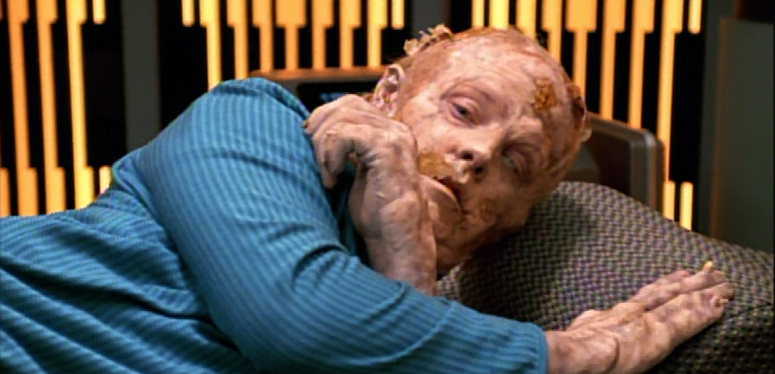
Meld is a masterpiece. It is the best episode of Star Trek: Voyager to date. There is perhaps a reasonable argument to be made that it is one of the best episodes that the series ever produced. It is, in many respects, one of the strongest and most compelling exploration of themes that have been bubbling around in the background since Caretaker, offering a more thoughtful and insightful exploration of the nineties culture of fear and anxiety than anything involving the Kazon. It is certainly the best use of Tuvok that the show managed in its seven year run.

Meld is an episode about violence, in its many forms. It is a story about the horrors and arbitrariness of unprovoked violence, but also about the cycles of violence that such actions can create. In many respects, Meld is a more scathing criticism of the death penalty than Repentance, the seventh season episode explicitly written as a death penalty allegory. Unlike many of the surrounding episodes, Meld actually manages to make good use of the show’s Delta Quadrant setting to heighten the dramatic stakes.

"Where's your head at?"

“Where’s your head at?”

In a way, Meld represents a collision of the franchise’s past and future. Meld may be the last truly great Star Trek script written by Michael Piller, the writer who helped to define the modern iteration of the franchise with his work on the third season of Star Trek: The Next Generation. At the same time, it is also Mike Sussman’s first story credit on the franchise; Sussman would go on to join the show’s writing staff in its final season and would be one of the few writers to serve a full four seasons on Star Trek: Enterprise.

While the script for Meld is exceptionally well-written, the episode is elevated by a combination of factors. Cliff Bole does great work in bringing a very unconventional Star Trek episode to life. Meld could be seen as a continuation of the second season’s b-movie charms. Following on from the robot wars of Prototype and the body horror of Threshold, Meld plays like a Star Trek serial killer thriller. Bole’s directorial choices are consciously stylised, with delightful little touches like the band of light across Tuvok’s eyes when the body is discovered.
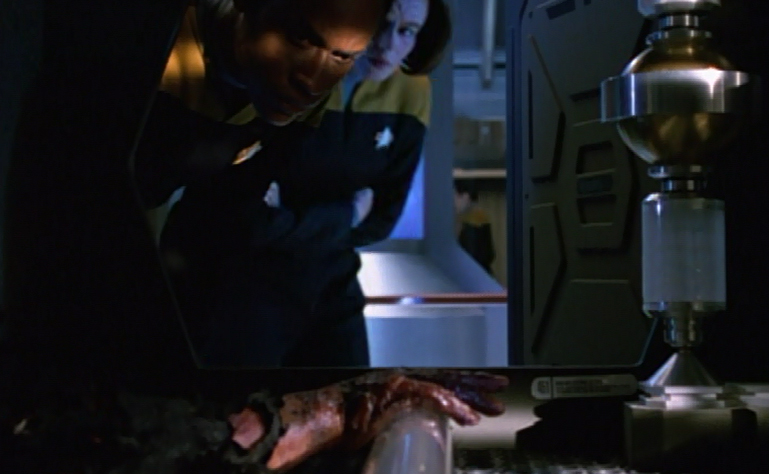
"Funny. I though Braga murdered Darwin last week."

“Funny. I thought Braga murdered Darwin last week.”

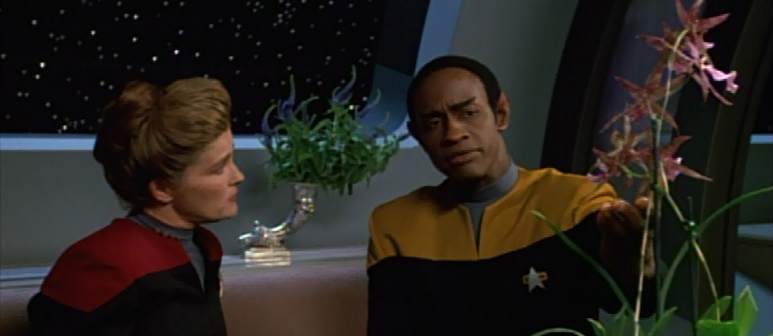
The episode also benefits from two mesmerising central performances from guest star Brad Dourif and Tim Russ. Russ was always one of the more under-utilised members of the Voyager ensemble, particularly when his “obligatory emotionally detached character” role was usurped by Seven of Nine in the fourth season. It is a shame, as Russ has a great deal of fun channeling Nimoy in his portrayal of the franchise’s first full-blooded Vulcan regular. Tuvok (and Russ) deserved more attention than the show afforded him.

That said, it is Brad Dourif who steals the show here. Lon Suder is one of the most fascinating guest characters in the history of the Star Trek franchise, and perhaps the only recurring character member of the Voyager crew who made any impression. A lot of that is down to the novelty of a fundamentally violent character in a Starfleet uniform, but Dourif is absolutely brilliant in the part. Dourif might just be the best guest star ever to appear in Voyager, and one of the franchise’s all-time greats.
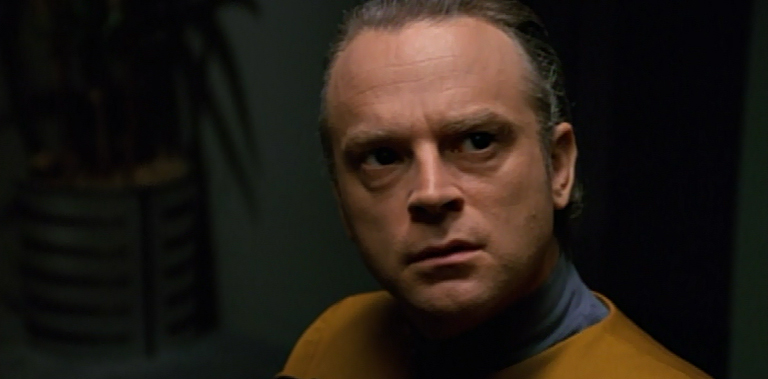
Beta(zoid) male.

Beta(zoid) male.

However, perhaps the most striking aspect of Meld is the way that it feels very much of its time; it is an episode that firmly engages with a cultural context around Voyager. So much of Voyager seems lost in some sort of weird science-fiction neverland where the fifties and sixties never ended that a well-produced episode that feels of its time is a rarity. Meld is an episode that would feel strange ten years earlier or ten years later, but one which aligns perfectly with the wider context of 1996.

It is a overdue triumph from the Voyager team.

Smile!

Smile!

Continue reading

Batman Special #1 (1984) – The Player on the Other Side (Review)

This March sees the release of Batman vs. Superman. To celebrate, we’ll be looking at some iconic and modern Batman and Superman stories over the course of the month.

Mike W. Barr is one of the great Bronze Age Batman writers, a writer with a clear vision of what he expects Batman to be and with a body of work that seems build around that principle.

One of the interesting aspects of Batman is the character’s flexibility and ubiquity. Batman can be virtually anything that a writer needs him to be, and it does little to dilute the brand because there are so many other writers working on the character – often at the same instant. Even when a particular writer is working on the character, they cannot claim exclusivity. Grant Morrison’s version of the Dark Knight is distinct from Scott Snyder’s take on the Caped Crusader, for example.

Long Dark Knight of the soul...

Long Dark Knight of the soul…

Perhaps, as a result of this, there is more freedom for writers to craft their own unique take on Batman. Mike Barr wrote Batman across a variety of different titles over a considerable stretch of time. Barr had written random stories in Detective Comics dating back to the seventies, and had provided occasional scripts to Batman since the start of the eighties. He would continue to work sporadically on the character into the nineties and the new millennium, contributing scripts to stories like In Darkest Knight into the nineties and beyond.

However, Barr’s longest sustained work on the character came in the eighties. He wrote Batman as the headline character of Batman and the Outsiders for the first thirty-two issues of the title, collaborating with artists Jim Aparo and Alan Davis. He enjoyed a sustained run on Detective Comics with artist Alan Davis that overlapped with Frank Miller and David Mazzucchelli’s iconic Batman: Year One run. The run culminated in Batman: Year Two. He and Davis also collaborated on Full Circle. He wrote Son of the Demon and Bride of the Demon.

"Face my Wrath!"

“Face my Wrath!”

Barr had considerable influence on the evolution of the character Batman. Grant Morrison’s creation of Damian Wayne, for example, was heavily influenced by Barr’s work on Son of the Demon. In a larger sense, Barr’s willingness to reintroduce classic Silver Age concepts into continuity following Crisis on Infinite Earths paved the way for more flexible interpretations of the Dark Knight. Barr is frequently overlooked in discussions of the character’s history, which is entirely understandable given that his most high-profile work overlapped with one of the greatest Batman stories ever told.

Still, as influential as Barr was on future depictions of the Dark Knight, it is clear that the writer had an internally consistent vision of the Caped Crusader, with a number of themes and ideas that he would visit time and time again in his work featuring the Dark Knight. Although The Player on the Other Side comes before Barr’s most extended and high-profile solo work on the character, those themes are most definitely present.

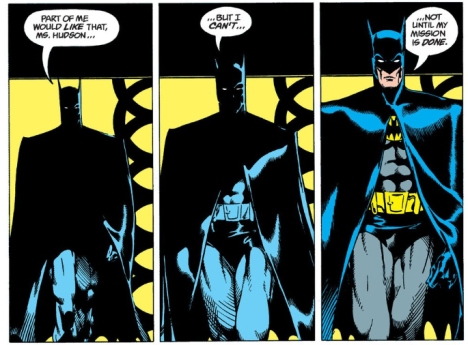
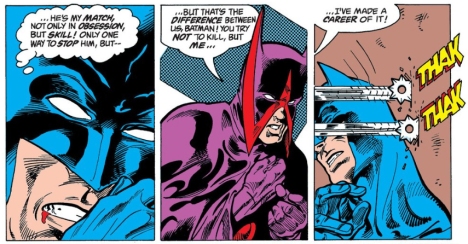
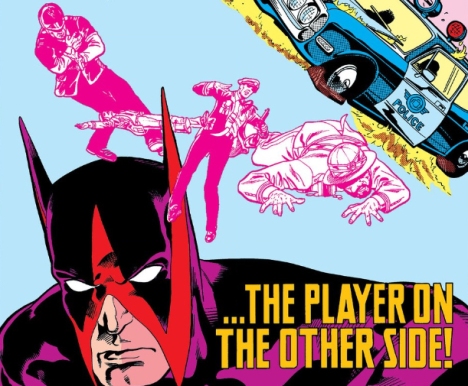
Batman Special I: The Wrath of Wraith.

Batman Special I: The Wrath of Wrath.

Continue reading

Non-Review Review: Divergent – Allegiant

In terms of dystopian young adult science-fiction/fantasy franchises, Divergent is solidly mid-tier. It is in technical and production terms superior to The Maze Runner, but markedly inferior to The Hunger Games. It lacks the sort of spectacular camp that made The Mortal Instruments stand out, for better or worse. It is a reasonable execution of a fairly reliable (although also heavily problematic) central concept, but without anything that really elevates it above its competitors.

Allegiant is the first part of a two-part finalé to the series, as has become the norm for these types of films. However, it all feels rather rote. Allegiant does not feel like the first part of a two-parter, instead feeling like its own story that could support a sequel but alternatively would be a perfectly fine place to wrap up if the studio decide to all it a day. The fact that it is the first of a two-part adaptation of a source material feels like a decision that was made because that is just how you adapt young adult franchises at this point in time.

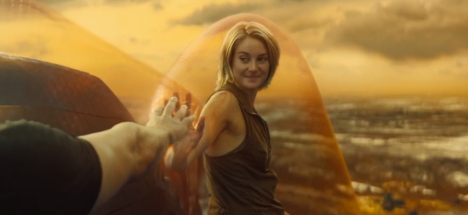
Hate to burst your bubble...

Hate to burst your bubble…

Continue reading

Star Trek: Voyager – Threshold (Review)

This February and March, we’re taking a look at the 1995 to 1996 season of Star Trek, including Star Trek: Deep Space Nine and Star Trek: Voyager. Check back daily Tuesday through Friday for the latest review.

Threshold is hated by fandom.

Veteran reviewer Jamahl Epsicokhan described it as “one of the all-time worst episodes of Star Trek ever filmed.” He is far from the only voice raised in protest. Winston O’Boogie remarked that, watching the episode, “you can’t help but think that something has gone terribly, terribly wrong with the world that allowed this to happen.” Assessing writer Brannon Braga’s contributions to the larger franchise, Jim Wright reflected, “Whatever else he may accomplish, he’s as forever shackled to Threshold as George Lucas to Jar-Jar.”

It's not even the worst episode of the season...

It’s not even the worst episode of the season…

Threshold is terrible. There is no way around that. It is a very stupid episode that is never entirely sure what it is trying to say from one moment to the next. More than that, positioning it as an important Tom Paris arc in the middle of the second season serves to sabotage the already confused character arc running between Alliances and Investigations. There is absolutely no context in which Threshold could be described as a “good” (or even “competent”) hour of television.

At the same time, it is not one of the worst episodes of the franchise ever produced; it is not even one of the worst episodes of the series. Surrounded by episodes like Tattoo or Alliances, the episode cannot even make a particularly confident claim to being the worst instalment of the season. None of this should be confused as an endorsement of Threshold. It is condemnation of everything that exists around Threshold.

The great mutato!

The great mutato!

Continue reading

Non-Review Review: Midnight Special

Midnight Special is a lot of things.

It is a meditation on faith. It is a road movie. It is an indie superhero movie. It is a Spielbergian science-fiction adventure. It is a coming of age tale. It is a film fundamentally about awe and wonder. It is a spectacle that nevertheless remains firmly rooted in the ground even as it looks upwards. It is a tribute to the “lay lines” that serve to tie the United States together, from the dark country roads to the shady motels. Midnight Special is a lot of things, and it is very good at being all those things.

However, Midnight Special is fundamentally a movie about parenting. It is a movie about the unquestioning hope that a parent might be responsible for something that is ultimately more than they were.

Son rising.

Son rising.

Continue reading

Grant Morrison’s Run on Action Comics (Review/Retrospective)

This March sees the release of Batman vs. Superman. To celebrate, we’ll be looking at some iconic and modern Batman and Superman stories over the course of the month.

On paper, Grant Morrison and Rag Morales’ Action Comics should have been a slam dunk.

The title was announced as part of DC’s “new 52” relaunch, a resetting of the comic book giant’s continuity beginning in September 2011. Designed to revitalise the line, shoring up sales numbers and providing a clear point of entry, the “new 52” was clearly intended as a “jumping on” point for new and lapsed comic fans. It was bold and radical, an even greater departure for the company than their reboot following Crisis on Infinite Earths back in 1986. The comic book publisher gave themselves a blank slate.

Wow, he IS more powerful than a locomotive...!

Wow, he IS more powerful than a locomotive…!

In theory, this was a great idea; anything was possible and everything was on the table. In practice, the execution was more muddled; the massive experiment curtailed by a very conservative aesthetic. In many respects, the “new 52” felt like more of the same; familiar mid-tier talent working on familiar mid-tier ideas. The most interesting books were those that dared to do things differently; Scott Snyder inverting Alan Moore’s brilliant twist on Swamp Thing made for iconoclastic reading, as did Brian Azzarello’s ground-up reimagining of Wonder Woman.

In contrast, a lot of the line felt like hedging. Hellblazer was cancelled so that John Constantine could be dragged under the corporate umbrella in Justice League Dark, all in the name of coporate synergy. The Wildstorm characters were ported over into mainstream continuity, in spite of the fact that they were largely redundant or incompatible. Instead of courting either exciting new talent or industry veterans, the company had difficulty drawing top-tier talent. Scott Lobdell and Rob Liefeld were among the relaunch’s heavy hitters.

... And what was that about speeding bullets?

… And what was that about speeding bullets?

To be fair, there were bright spots. But the ideas and concepts that were interesting were frequently hobbled by the demands of the publisher. All-Star Western was diminished by having to tie to Gotham City continuity, while attempts at genre diversity in books like Demon Knights or I, Vampire were under-promoted. Emphasis was placed squarely on monthly print sales numbers, with little patience for books to grow their audiences whether online or through collected editions.

In spite of all the confusion and chaos of the relaunch, Grant Morrison writing Action Comics was the cause of considerable excitement. Morrison was one of few comic book writers who could legitimately be described as a superstar, arguably with a higher profile outside mainstream comics than executives Jim Lee and Geoff Johns. Having Morrison on a monthly book was a big deal, particularly a monthly book as important to the company’s legacy as Action Comics. (Then again, the relaunch also chose to put Tony Daniel on Detective Comics, so there’s that.)

Happily never after...

Happily never after…

More than that, the book represented something of a homecoming for Morrison. Although the character of Superman had struggled with issues of relevance in the twenty-first century, Morrison had been the architect of one of the character’s most beloved stories. All-Star Superman is widely regarded as one of the best Superman stories ever published. Having its author writing a monthly book as part of the relaunch was a big deal. Following high-profile misfires like New Krypton or Grounded, it seemed like the perfect opportunity to put Superman back on the right course.

In many respects, Grant Morrison’s run on Action Comics typifies the sort of push-and-pull at the publisher as part of the relaunch. The great ideas smothered by corporate mandates, the tension between familiarity and novelty, the burden of expectation even while trying to chart a new course. For better or worse, Action Comics could be seen as the flagship of DC’s “new 52” initiative. This seems entirely appropriate, given the title’s historical significance to DC comics.

Running jump...

Running jump…

Continue reading

Star Trek: Deep Space Nine – Crossfire (Review)

This February and March, we’re taking a look at the 1995 to 1996 season of Star Trek, including Star Trek: Deep Space Nine and Star Trek: Voyager. Check back daily Tuesday through Friday for the latest review.

In many ways, Star Trek: Deep Space Nine has aged remarkably well.

Episodes like Homefront and Paradise Lost arguably have greater resonance now than they did on initial broadcast, their commentary on state authority and the erosion of civil liberties packing more punch during the War on Terror than it did during the long nineties. The Way of the Warrior even invites comparison to the invasion of Iraq, despite the fact that the episode aired eight years before the invasion took place. In many respects, Deep Space Nine has aged considerably better than its siblings.

Odo's attempts at redecorating were not going well...

Odo’s attempts at redecorating were not going well…

On the other hand, there are some aspects that have not aged particularly well. There are certain elements of Deep Space Nine that feel ill-judged or ill-advised in hindsight; for example, the thinly-veiled (and awkward) racial politics inherent in the exploration of the Jem’Hadar in The Abandoned. The relationship between Odo and Kira is another such example, the show’s central “will they?”/“won’t they?” dynamic seeded in Necessary Evil and brought to fruition in Heart of Stone.

Taken on its own merits, Crossfire is a spectacular piece of television. It is skilfully written and directed, with a superb central performance from Rene Auberjonois as Odo. The plot of the episode seems to focus on Odo working through his long-simmering crush on Kira, suffering a near breakdown and eventually deciding to work through it. It is, in many ways, the best possible story that could be told using the relationship. However, the problem is that Crossfire is not the end of this particular thread. It is just a hurdle for Odo to pass.

Quark serves some unpalatable truths...

Quark serves some unpalatable truths…

Continue reading

Batman – Vengeance of Bane #1 (Review/Retrospective)

This March sees the release of Batman vs. Superman. To celebrate, we’ll be looking at some iconic and modern Batman and Superman stories over the course of the month.

Bane is a fascinating creation, arguably the most important addition to Batman’s rogues gallery since Denny O’Neil and Neal Adams created Ra’s Al Ghul in the early seventies.

There have been important villains added since. Jeph Loeb and Jim Lee created Hush, a character who has subsequently been developed and expanded by Paul Dini and Dustin Nguyen; Hush has popped up with surprising frequency in various Batman media, even being incorporated into the weekly series Batman Eternal in a major way. It will be interesting to see how Lincoln March and the Court of Owls endure after Scott Snyder and Greg Capullo finish their run on Batman. Still, Bane towers above all of those.

"When Gotham is ashes..."

“When Gotham is ashes…”

Continue reading

Star Trek: Voyager – Alliances (Review)

This September and October, we’re taking a look at the 1995 to 1996 season of Star Trek, including Star Trek: Deep Space Nine and Star Trek: Voyager. Check back daily for the latest review.

One of the more persistent and convincing criticisms of Star Trek: Voyager is the idea that it was very narrative conservative; that the show got comfortable playing out the familiar formula that had been established by Star Trek: The Next Generation, and so never attempted to innovate or experiment in the way that Star Trek: Deep Space Nine (or eventually Star Trek: Enterprise) did. This is a perfectly valid criticism of the show as a whole, but it does ignore some of the weird tensions that played out across the first two seasons.

It is fair to say that Voyager never truly experimented. However, there are several moments in the first two seasons where it looks like the show was considering doing something unique or unprecedented. The show walked up to the edge, looking up and down; it never quite made the leap, but it seemed to weigh the possibility of jumping headlong into uncharted territory. However, it ultimately only dipped its toes in the water before getting cold feet and returning to the comfort of the familiar.

"Everyone liked Godfather III, right?"

“Everyone liked Godfather III, right?”

The sad truth about the second season of Voyager is that the show made a number of attempts to do something different or unique, only to botch each and every one of those attempts so completely that the production team learned not to even try. The second season’s more adventurous creative decisions all ended in humiliation and farce, explaining why the show desperately sought the warm blanket of a familiar format and an established template. After all, it was the more conventional episodes of the second season that had been (relatively) well received.

The second season of Voyager turned the process of trying something moderately ambitious and failing spectacularly into something of an artform. Of course, given the simmering tensions behind the scenes, it often seemed like the show wanted to fail. Michael Piller desperately wanted to do new things, only to meet resistance from his fellow producers and writing staff. Writers like Kenneth Biller would publicly criticise assignments they had been handed, offering a sense of just how much faith the staff had in these ideas.

"You wouldn't like me when I'm angry..."

“You wouldn’t like me when I’m angry…”

Alliances marks perhaps the most ambitious element (and most spectacular failure) of the second season of Voyager. It is the centrepiece of Michael Piller’s attempts to develop the Kazon into a credible (and convincing) alien threat, while also setting up a recurring arc that will allow Piller to push Tom Paris into the role of “lovable rogue” of which Piller was so fond. These were elements that excited Piller a great deal, but left most of the rest of the production team relatively cold.

So there is a great deal of irony in the fact that Alliances is ultimately written by Jeri Taylor, who was increasingly at loggerheads with Piller over the direction of Voyager. In light of that context, it makes sense that Alliances is an episode that aggressively critiques its own existence. Janeway spends most of the episode frustrated at the fact that the story is happening at all, and Alliances builds towards a climax that seems designed to convince the viewer that this whole idea is misconceived on just about every possible level.

Blooming disaster...

Blooming disaster…

Continue reading

Star Trek: Voyager – Prototype (Review)

This September and October, we’re taking a look at the 1995 to 1996 season of Star Trek, including Star Trek: Deep Space Nine and Star Trek: Voyager. Check back daily for the latest review.

In what is becoming a recurring theme for the second season of Star Trek: Voyager, Prototype is a mess.

As with a lot of the surrounding episodes, its production was fraught and tense; tensions seemed to be building among the production team as the season progressed. Prototype was an episode that was largely driven by Michael Piller, and one opposed by Jeri Taylor. Kenneth Biller was responsible for tweaking and rewriting Nicholas Corea’s script, but he does not seem particularly fond of the episode. These tensions and disagreements would build to a climax in the second half of the year.

Bride of 4739...

Bride of 3947…

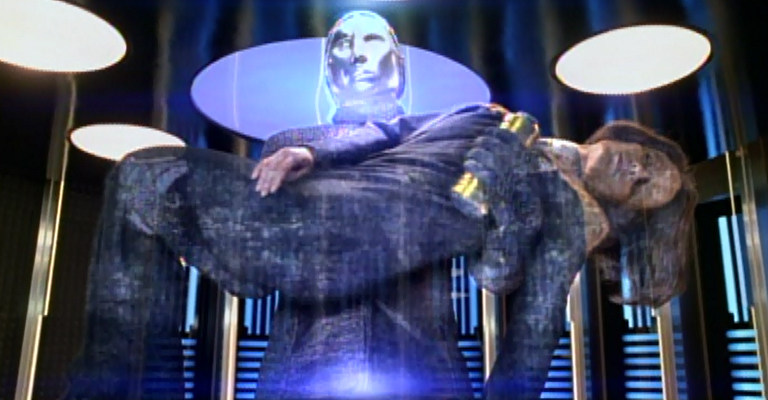
Prototype is not a good episode, by any measure. There are a lot of elements that are interesting on their own terms, but there is also something quite nasty and uncomfortable sitting at the heart of the hour. It is a story about motherhood, but one which suggests that unconventional motherhood must be monstrous and grotesque. Even beyond the awkward subtext of the episode, there are problems. Despite Piller’s attempts to energise storytelling on Voyager, the pacing of Prototype is atrocious.

Prototype is not the biggest misfire of the season. Given the season around it, this should not be misconstrued as an endorsement.

(Warp) core values...

(Warp) core values…

Continue reading