• Following Us

  • Categories

  • Check out the Archives


  • Awards & Nominations

Star Trek: Deep Space Nine – Ties of Blood and Water (Review)

Ties of Blood and Water is a phenomenal piece of television, and a great example of the strengths of Star Trek: Deep Space Nine.

It is an episode that is tied to the personal and the political, a thriller about great powers squaring off against one another set against the more intimate story of a woman nursing her surrogate father in the final hours of his life. Ties of Blood and Water is both intimate and epic, never sacrificing one for the other. Its larger political story beats feel entirely in keeping with the demands of the larger shared universe, but it never loses sight of the story’s emotional centre. There is a very personal aspect to this tale, one firmly grounded in the characters and their relationships.
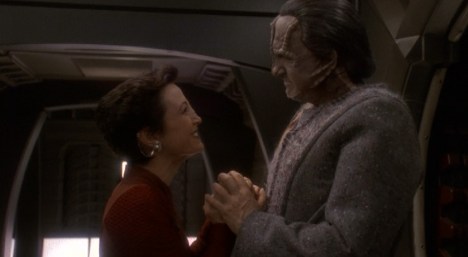
The ties that bind.

The ties that bind.

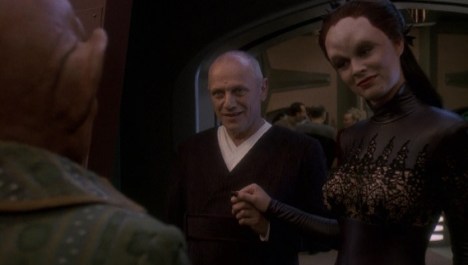
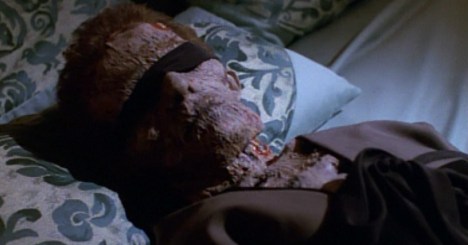
Ties of Blood and Water focuses on Tekeny Ghemor, the Cardassian Legate featured in Second Skin. There, he was convinced that Kira was his daughter who had been sent to infiltrate the Shakaar Resistance. In Ties of Blood and Water, Ghemor returns to the station as the relationship turns a full circle. In Second Skin, Kira Nerys had been a surrogate daughter to Ghemor, standing in for the lost Iliana. In Ties of Blood and Water, Ghemor finds himself cast as a surrogate father to Kira, providing her with a means to work through the loss of her biological father.

Ties of Blood and Water has a certain poetry to it, extending beyond the memorable title.

Greener pastures.

Greener pastures.

Continue reading

10. Annie Hall (#205)

A nervous podcast.

Hosted by Andrew Quinn and Darren Mooney, The 250 is a fortnightly trip through some of the best (and worst) movies ever made, as voted for by Internet Movie Database Users. New episodes are released every second Saturday at 6pm GMT, with the occasional bonus episode between them.

This time, Woody Allen’s Annie Hall.

Woody Allen’s iconic (and influential) romantic comedy portrays a tumultuous romantic relationship between cynical New York comedian Alvy Singer and the eponymous character, featuring an Oscar-winning performance from Diane Keaton.

At time of recording, it was ranked the 205th best movie of all time on the Internet Movie Database.

podcast-anniehall

Continue reading

Star Trek: Voyager – Before and After (Review)

You might be interested in our other reviews from the third season of Star Trek: Voyager:

Before and After is an episode that should be more interesting than it ultimately is.

There is no small irony in the fact that the one future constant suggested by Before and After would be gone by the third episode of the following season, while the generic tone of the episode’s future flashes would prove entirely accurate. In some ways, Voyager was a paradox. It was generally quite professional and sleek, the show’s polished exterior seeming a little too lifeless and sterile at times. However, this was all an elaborate and well-rehearsed illusion. Behind the scenes, Voyager was a turbulent and chaotic piece of television.

voy-beforeandafter22a

Those conversations and would tweak some of the future suggested by Before and After. Jennifer Lien would depart, and Kes would be retired. Jeri Ryan would be hired, and Seven of Nine would join the crew. Much like what had happened with Deep Space Nine, the planned third season cliffhanger would be thwarted and pushed into the fourth season to make way for a much more bankable story. On Deep Space Nine, Homefront and Paradise Lost were shunted for The Way of the Warrior. On Voyager, Year of Hell, Part I would be brushed aside for Scorpion, Part I.

At the same time, it was clear that Paramount was wary and uncertain of what the future might hold for the franchise. Viewing figures had begun a decline that would continue until the end of Enterprise. The writers on Deep Space Nine had been instructed by the studio to add an existing character and focus on the Klingons early in their fourth season, hoping to shore up viewers. Similar discussions were taking place behind the scenes on Voyager, with the network and producers looking to spice things up on the series.

voy-beforeandafter35a Continue reading

New Podcast! The X-Cast – Season 2, Episode 8 (“One Breath”)

Just a quick link to another recent guest appearance over on The X-Cast, a great X-Files podcast run by the prolific Tony Black.

In my final appearance on the show’s second season, I had the pleasure of an extended conversation with Tony about One Breath. Readers of the blog will know that One Breath is (along with Never Again) one of my absolute favourite episodes of the show, so it was an honour and a privilege to be invited to talk about it on the show. We got to talk about all sorts of fun things, from Mister X’s grouchy demeanour to performative masculinity to just how carefully Walter Skinner sets up his stylish dead drops. Check it out the episode here, or click the link below.

podcast-onebreath

Continue reading

Star Trek: Deep Space Nine – Business as Usual (Review)

Business as Usual is, appropriately enough, a very typical Star Trek morality play.

It is a relatively rare example of Star Trek: Deep Space Nine engaging in the sort of pointed social commentary that many fans expect of the genre, the rather straightforward moral lesson couched in science-fiction trappings; The Devil in the Dark as a commentary on “the other”, A Taste of Armageddon as a condemnation of the Vietnam War, Let That Be Your Last Battlefield as a critique of racism in general. There are all but expected in a Star Trek show, but Deep Space Nine rarely plays them particularly straight.

Disarming conversationalists...

Disarming conversationalists…

Deep Space Nine has told issue-driven stories before, with In the Hands of the Prophets serving to explore the gap between creationists and those who believe in evolution or Past Tense, Part I and Past Tense, Part II constructed as a direct commentary on Los Angeles’ plans to lock up their homeless population. However, the series tend to favour broader commentaries about grander themes. The show arguably as a timeless quality because it tends not to dwell too heavily upon specific ideas, instead meditating on particular themes like authority and conflict.

Indeed, Star Trek: Voyager is a lot more traditional in this respect. That writing staff has a clear fondness for the archetypal Star Trek morality play, constructing episodes as metaphors for contemporary issues; Remember explores Holocaust denial, Distant Origin deals with creationism, Displaced offers a reactionary take on immigration. Even non-issue-driven episodes like Darkling and Fair Trade make a point to stress the franchise’s utopian values in a manner much more overt than Deep Space Nine.

The hard sell.

The hard sell.

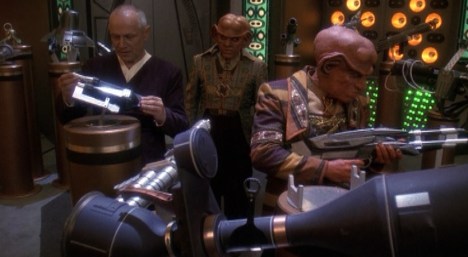
With that in mind, Business as Usual feels strangely old-fashioned. It is very much an episode of Deep Space Nine in terms of setting and character, in that no other Star Trek show would have a lead character knowingly and willingly become an arms dealer. However, it feels very much like an archetypal Star Trek show in that it is an episode about how the arms trade is implicitly immoral and horrific. It is a very worthwhile message, and in no way diminished by its obviousness, but it does feel surprisingly clear cut when compared to episodes like The Ship or Rapture.

Business as Usual is essentially a very conventional Star Trek story that is elevated by one of the best guest casts in the history of the franchise.

"No, Mister Quark, I expect you to buy!"

“No, Mister Quark, I expect you to buy!”

Continue reading

Non-Review Review: Sully – Miracle on the Hudson

Sully: Miracle on the Hudson has a certain Frank Capra quality to it.

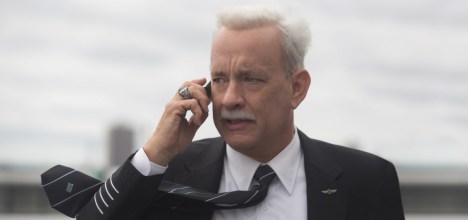
To be fair, a lot of that comes from the casting of Tom Hanks in the title role. Hanks radiates a certain ineffable integrity, a “Hanksian Decency” that informs his performances in films as diverse as Bridge of Spies and Inferno. It is tempting to think of him as “America’s Dad”, particularly given the grey hair and the moustache that he donned for the title role here. However, it is also tempting to think of him as a latter-day Jimmy Stewart, the embodiment of a certain type of fundamental American decency that lends itself to this sort of narrative.

Hanks for the memories.

Hanks for the memories.

Similarly, director Clint Eastwood has a similar philosophy. Eastwood’s films tend to be organised around strong moral principles. Often those principles are articulated in terms of personal responsibility, particularly the responsibility that individuals have for others whether in a professional capacity (J. Edgar) or a personal capacity (Million Dollar Baby) or simply by virtue of being there (Gran Torino). Eastwood’s recurring fascination with individual responsibility makes him a quintessentially American director.

This combination is ideally suited to Sully, which is constructed as something akin to a modern-day American fairytale.

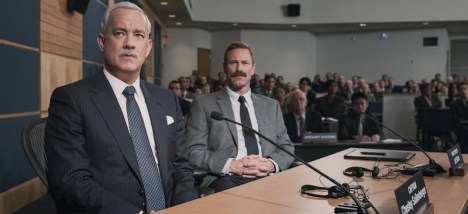
"Mr. Sullenberger goes to the NTSB Debriefing."

“Mr. Sullenberger goes to the NTSB Debriefing.”

Continue reading

Star Trek: Deep Space Nine – A Simple Investigation (Review)

A Simple Investigation is a quiet little episode.

This is particularly true in the context of the crowded second half to the fifth season of Star Trek: Deep Space Nine. In Purgatory’s Shadow and By Inferno’s Light radically upended the status quo and set the fifth season on a march towards A Call to Arms. The threat of war looms large over the second half of the season, following the admission of Cardassia into the Dominion. There is a creeping sense of inevitability to episodes like Blaze of Glory and Soldiers of the Empire.

Strange bedfellows...

Strange bedfellows…

At the same time, Deep Space Nine takes a little while to adjust to that dramatic shift. The Dominion and Cardassia only come back into focus with Ties of Blood and Water, the episode that reintroduces Weyoun to the series. Still, episodes like Doctor Bashir, I Presume and Business as Usual have a sense of weight to them as they offer up high-stakes family drama and arms-dealing morality plays. In contrast, A Simple Investigation feels relatively low key. It is not an episode with profound consequences or shocking revelations.

Instead, A Simple Investigation plays as a small-scale cyberpunk noir romance in which Odo falls head-over-heels in love with a guest star whom he will never see again. With all the chaos unfolding across the length and breadth of the fifth season, A Simple Investigation feels surprisingly… simple. The problems of these little people don’t amount to a hill of beans in this crazy world, but A Simple Investigation still takes the time to fixate upon them.

Star struck.

Star struck.

Continue reading

Non-Review Review: Moana

Moana is a fantastic demonstration of the timeless appeal of the long-standing Disney formula.

At first glance, Moana seems very much like an archetypal animated Disney film. It is the story of a young woman who is forced to adventure outside of her comfort zone, surrounded by adorable animal sidekicks and trickster mentors on an archetypal hero’s journey that is set to a toe-tapping soundtrack. It is a template that has served Disney very well, producing any number of beloved family classics over the year. Moana is very much a celebration of that template, and an example of why it works so well.

Islands in the Pacific... That is what we are...

Islands in the Pacific…
That is what we are…

At the same time, there is a faint layer of self-awareness to the script that serves it well. Moana might appear to be an archetypal Disney fairytale story, but that is largely down to its central character. Moana is a celebration of its title character, to the point that it frequently seems like she is propping up the narrative. This is not to suggest that Moana is a deconstruction or subversion in anyway. Instead, the movie almost as a distillation of the appeal of the classic “princess” narrative. It is a story that trusts its lead character to hold a disorganised story together.

Surrounded by dysfunction and chaos, Moana is an affectionate tribute to these sorts of stories.

Good (demi-)god, man!

Good (demi-)god, man!

Continue reading

9. Stalker (#203)

Why did you take my watch?

Hosted by Andrew Quinn and Darren Mooney, The 250 is a fortnightly trip through some of the best (and worst) movies ever made, as voted for by Internet Movie Database Users. New episodes are released every second Saturday at 6pm GMT, with the occasional bonus episode between them.

This time, Andrei Tarkovsky’s Stalker.

There is a zone. At the centre of the zone, there is a room. An author and a professor wander through the mysterious quarantined zone, guided by a veteran known as a “stalker.”

At time of recording, it was ranked the 203rd best movie of all time on the Internet Movie Database.

podcast-stalker

Continue reading

Star Trek: Voyager – Favourite Son (Review)

Favourite Son feels like the culmination of something that has been festering across the third season of Star Trek: Voyager.

The Star Trek franchise is generally regarded as progressive and forward-thinking. There is some debate to be had about whether this is an accurate summary of the franchise, given some of the creative decisions made over the course of its half-century run. However, there are times at which the franchise feels particularly liberal and points at which it feels particularly reactionary. A product of the mid-nineties, running through to the turn of the millennium, Voyager tends to feel very conservative in places.

This is a little bit what watching the episode feels like.

This is a little bit what watching the episode feels like.

In the second season, this reactionary tendency played out through the treatment of the Kazon in episodes like Initiations and Alliances. In the third season, with the Kazon long gone, it seems that Voyager has turned its reactionary gaze upon its female cast members. To be fair, the show’s first two seasons had any number of unfortunate creative decisions when it came to various female characters. Most notably, the decision to turn Seska into a baby-crazed maniac in Manoeuvres did not bode for the first female-led Star Trek series.

Nevertheless, a misogynist streak has manifested itself across the third season as a whole. In some cases, this has been relatively subtle; like the awkward insistence upon sexualising three-year-old Kes in the eyes of her two mentor figures in Warlord and Darkling. In other cases, this has been the entire point of the plot; like the decision to have Q try to sleep with the franchise’s first female lead and introduce his shrewish wife in The Q and the Grey or to introduce a psycho stalker in Alter Ego.

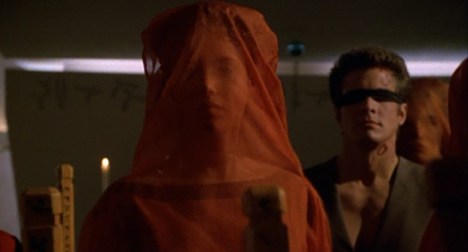
The original red wedding.

The original red wedding.

Other times, this sexist attitude has bubbled through the background of various episodes to the point that it builds to critical mass. Torres is victimised by her male colleagues over the course of three straight episodes, and none of them are held accountable; she is sexually assaulted by Vorik in Blood Fever, stunned by Chakotay in Unity, and tortured by the evil!EMH in Darkling. In each of those cases, the show seems to shrug off the violence committed by male characters against one of the show’s female leads.

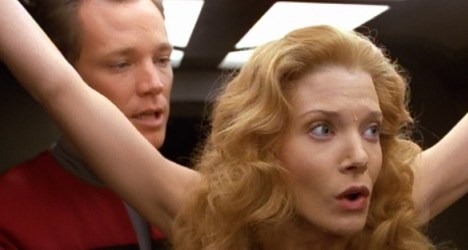
All of these elements come to the fore in Favourite Son, an episode that would have been painfully retrograde had it aired as part of the original series during the sixties. Favourite Son is that most uncomfortable myth dressed up in science-fiction drag, the tale of an island of beautiful women using their sexual prowess to lure men into their clutches to emasculate them. It is terrifying to think that this episode made it to air in the late nineties.

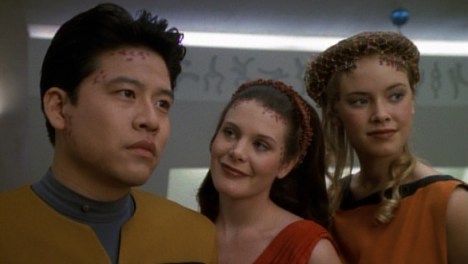
A beautiful dream.

A beautiful dream.

Continue reading