• Following Us

  • Categories

  • Check out the Archives


  • Awards & Nominations

New Escapist Column! On “Star Trek: Picard” and Parental Failure…

I published a new piece at Escapist Magazine yesterday evening. Given that Star Trek: Picard just wrapped up its first season, I had some thoughts expanding on my discussion of Et in Arcadia Ego, Part II on Make It So.

The first season of Picard is undeniably messy and awkward. The pacing is a little off in places, and it pulls several of its most powerful punches. However, at the heart of the series is a story that simmers through a lot of contemporary pop culture, from Star Wars: Episode IX – The Rise of Skywalker to Bad Boys for Life, the idea of a failed parent trying to redeem themselves through their child. It’s a fascinating inversion of the Campbellian archetype embodied by Star Wars, the quintessential story about a son come to terms with his relationship to his father. Stories like Picard invert that dynamic, and look at the responsibilities that parents owe to their children to provide them with a better world.

You can read the piece here, or click the picture below.

175. Contratiempo (The Invisible Guest) – This Just In (#245)

Hosted by Andrew Quinn and Darren Mooney, and this week with special guest Aine O’Connor, The 250 is a (mostly) weekly trip through some of the best (and worst) movies ever made, as voted for by Internet Movie Database Users.

This time, Oriol Paulo’s Contratiempo.

On the eve of his trial for a murder that he insists he didn’t commit, Barcelona business man Adrián Doria meets with trial expert Virginia Goodman. Virginia is there to help Doria explain how he might have woken up in a locked hotel room with the body of his mistress, but no memory of what happened. As the two pry further end further into the case, they become locked in a battle of wits that snakes and turns, where nothing is as it appears to be.

At time of recording, it was ranked 245th on the list of the best movies of all time on the Internet Movie Database.

Continue reading

New Podcast! Make It So – Season 1, Episode 10 (“Et in Arcadia Ego, Part II”)

I binged Star Trek: Picard over the course of the previous week, and so was thrilled to join the wonderful Kurt North on Make It So: A Star Trek Universe Podcast to discuss the first season finale, Et in Arcadia Ego, Part II.

I have somewhat complicated feelings about Picard. There are parts of it that I love, and parts of it that I am a bit more skeptical about. One of the joys of coming into the podcast to discuss the season finale was getting the chance to talk about the season as a whole, given how its various arcs were set up and how they paid off. It’s a nice, broad and comprehensive discussion of a sprawling, ambitious and complicated conclusion to the larger season. I feel really bad that I talked as long as I did on the episode, but there was a lot to dissect and discuss. For all the criticisms of Picard as shallow or superficial, there’s clearly a lot of meat on the bones.

Anyway, it was a huge honour to be invited on, and I hope you enjoy. You can listen to the episode here, or click the link below.

New Escapist Column! On the Underrated Appeal of “Iron Man 3″…

I published a new In the Frame piece at Escapist Magazine this evening. Given some online debates raging last week, I thought it was worth taking a look back at Iron Man 3.

Iron Man 3 remains a fascinating film, seven years after its release. What is particularly interesting is how fan and general audience opinions are polarised on it. This is not a coincidence. What audiences and critics love about Iron Man 3 is what alienates fans. Iron Man 3 is the rare film in the Marvel Cinematic Universe that seems conflicted about superheroes as they exist in contemporary pop culture, and anxious about the implications of approaching them as an expression of the military-industrial complex. The result is the relatively rare Marvel Studios film that is genuinely and engagingly introspective, willing to ask play with expectations and ask questions about the genre’s place in the contemporary pop cultural landscape.

You can read the piece here, or click the picture below.

Non-Review Review: Lady and the Tramp (2019)

Lady and the Tramp represents a new frontier for Disney’s reimaginings of their animated classics.

The studio has had great success adapting those older films for younger audiences with a hybrid of live action and computer-generated remakes, with Aladdin and The Lion King ranking among the highest grossing movies of last year. Mulan looked like it might have been on course to continue the trend, and the studio is working away on a new version of The Little Mermaid. However, what makes Lady and the Tramp so interesting is that it is not going to be one of those theatrical blockbusters. Instead, it was released directly on Disney+, the company’s streaming service.

A completely identical meatball game.

There are two ways of looking at this. Disney might have been hoping to give Disney+ a bit of a boost by offering an exclusive brand-name and star-driven family-friendly film. Alternatively, the studio might have accepted that Lady and the Tramp was never a viable theatrical release to begin with, whether because it didn’t scratch the right nostalgic itch or because of the quality of the adaptation simply wasn’t up to snuff. In reality, it seems like a combination of the two factors.

Lady and the Tramp is fairly standard as these adaptations go. It is hurt by the push to verisimilitude and by the decision to expand a tight animated story into a bloated live action one. It is also very visually, aurally and tonally flat. It’s a film that seems built around the ethos of “just enough”, often feeling like a television movie that has somehow earned a theatrical special effects budget. Lady and the Tramp is not the worst of the Disney live action adaptations, but it may be the most lifeless.

No far horizons.

Continue reading

Non-Review Review: The Way Back

The Way Back is a paint-by-numbers redemption narrative, anchored in a tremendous central performance from Ben Affleck and enriched by its keen observations.

The basic plot of The Way Back will be familiar to most audience members. Jack is an alcoholic construction worker who is struggling to hold his life together. He has learned to do just enough to remain functional, but not so much that the people around him haven’t noticed his struggles. Jack stubbornly refuses any assistance offer by his family or by his ex-wife, believing that he has found something resembling an equilibrium. His addiction has pushed him into a slow and noticeable decline, but he has yet to implode.

He’s Backfleck.

Almost entirely by chance, Jack finds himself drafted back to his old high school, emotionally blackmailed into coaching their basketball team. Jack had played basketball as a teenager, but gave up on the sport in much the same way that he has recently withdrawn from the world around him. Inevitably, through his coaching, Jack finds himself connected with the lovable misfits that he takes under his wing. Jack guides these young men towards sporting glory, helping them (and himself) to find purpose in what they are doing.

It is all very conventional. There are very few surprises in The Way Back, which feels almost like one of those well-executed manoeuvres that Jack has his team execute out of the court. Everything lines up, all the pieces are moved with purpose, and the end result is never really in doubt. However, The Way Back elevates this well-worn formula with two secret weapons. Most obviously, Affleck finds an intersection of his traditional movie-star charisma with the baggage of his star persona. More subtly, the film is willing to just observe its characters, to let them be themselves.

Team works.

Continue reading

Non-Review Review: Bloodshot

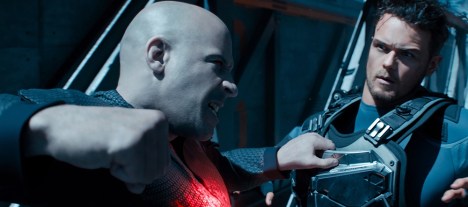
Bloodshot is a deeply dysfunctional movie.

At its core, Bloodshot offers a collision of old-fashioned nineties-era action spectacle with modern superhero genre tropes. There’s certainly a rich vein of material to be mined in the uncanny valley between Hollywood’s recent past and its inescapable present, with the intersection of these two styles of film-making being a larger part of the appeal of the trainwreck theatre of movies like Venom. Unfortunately, Bloodshot finds a way to combine the least appealing aspects of each approach, resulting in a film that feels hollow and unsatisfying.

Pounding excitement?

Bloodshot does get some points for the cleverness of its pivot from stock nineties action movie into modern superhero fare. Indeed, given the character’s origin as one of the most nineties of comic book characters at one of the most nineties of comic book publishers, there’s even something a little wry in trying to transition him from an older style of blockbuster into something a little more modern. Indeed, there’s even some interesting metatext there, with Vin Diesel himself as one of the last nineties action heroes transforming into a straight-up superhero.

Unfortunately, Bloodshot never manages to get these moving parts to line up in an interesting or compelling manner, always following the path of least resistance towards inescapable destinations. The film offers a couple of heavy-handed meditations on free will and self-determinism, but there’s a grim irony in a movie so formulaic arguing for the importance of making one’s own choices.

Diesel powered.

Continue reading

New Escapist Column! On How COVID-19 Will Change The Movies…

I published a new piece at Escapist Magazine this evening, looking at the future of film distribution.

COVID-19 has already had a huge impact on film distribution, from the cancellation of film festivals through to the early arrival of new releases on streaming. However, as the crisis continues and as debates extend over how long the situation will last, it seems fair to wonder about what the long-term implications of this will be in terms of film distribution and movie-watching. After all, there’s a sense in which the massive changes to the industry in the past few weeks are ultimately just the acceleration of trends that studios have been pushing for a while.

You can read the piece here, or click the picture below.

New Escapist Column! On “Mad Max: Fury Road” and Finding Hope Amid the Apocalypse…

I published a new In the Frame piece at Escapist Magazine last week. There’s understandably been a lot of talk about the end of the world lately, understandably, but I thought it was worth unpacking Mad Max: Fury Road.

Fury Road is one of the best blockbusters of the past decade, appearing on countless lists of the best films of the 2010s. However, what distinguishes it from a lot of apocalyptic cinema is that it embraces hope in a very meaningful and practical way. Fury Road is largely about the impulse to retreat from horror and from untenable situations, to abandon a world that appears to be fallen. However, the film argues that such an impulse is ultimately self-destructive, as eventually such a retreat runs out of road. Instead, Fury Road contends that the proper response to a broken world is to turn around and face it head on, to fix it from the inside. It’s a brave and empowering message, and a large part of the film’s appeal.

You can read the piece here, or click the picture below.

Non-Review Review: The Jesus Rolls

The Jesus Rolls is a loaded premise on a number of levels.

Most obviously, it is a film that takes a memorable supporting character from a beloved film and asks them to hold focus for ninety-odd minutes. Not all characters are designed to support a feature film, as the cavalcade of failed Saturday Night Live films will attest. It’s possible to get lucky, as with cases like Wayne’s World, but these happen relatively infrequently. Jesus might be a character who works best as part of the larger wacky ensemble of The Big Lebowski, where he exists in a heightened world of wandering cowboys, conceptual artists, pornographers and nihilists.

The risks are compounded by the change of authorship. Jesus Quintana was a character created by the Coen Brothers, and so makes a great deal of sense in their world of dysfunctional and cartoonish eccentrics. While actor John Turturro has experience as a writer and director, he is very clearly a different sort of filmmaker. Turturro’s last theatrically released feature was Fading Gigalo, released in 2013. There’s little in Turturro’s filmography to suggest that his approach to Jesus will mesh with the character’s origin in a stylised Raymond Chandler homage.

The Jesus Rolls is a strange sort of misfire. It’s a surprisingly flat film, which says a lot considering its gonzo inspirations and its bawdy preoccupations. There’s a hollowness to it all, an emptiness and a lack of focus. It lacks the energy or zeal that might excuse its paper-thin approach to its plot and protagonist, aspiring towards a weightiness that neither its characterisation nor its content can support. The Jesus Rolls often feels like a series of interlocking vignettes rather than a movie, but none of which succeed at holding the audience’s attention.

Continue reading