• Following Us

  • Categories

  • Check out the Archives


  • Awards & Nominations

Luke Cage – They Reminisce Over You (Review)

The queen is dead. Long live the king.

They Reminisce Over You is a fascinating piece of television. Running seventy minutes, it is easily the longest episode of Luke Cage. It is also, despite complaints about the “Netflix bloat”, one of the most tightly plotted. More than that, it exists primarily as a coda to a story that wrapped up in Can’t Front on Me. It exists largely to wrap a little bow around the various plot threads left dangling by that ending, and to set up a springboard from which the next season might build. It is remarkably well constructed, in a way that episodes of these Marvel Netflix series rarely are.
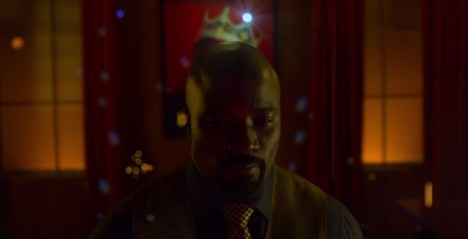
It also marks a clear point of transition. They Reminisce Over You marks the end of Mariah Dillard’s journey. Mariah is one of the most essential aspects of Luke Cage, one of relatively few characters to have made her first appearance in Moment of Truth and remained a constant fixture through the first two seasons. Cornell Stokes is dead. Pops is dead. Bobby Fish has traveled to the other part of the country. Rafael Scarfe is dead. Mariah is one of four major characters with that through line; herself, Luke, Shades and Misty. She is a big part of the show.

As such, the end of her journey is a big deal.

Continue reading

Luke Cage – Can’t Front On Me (Review)

On of the most remarkable things about Luke Cage is just how much it enjoys being a superhero series, particularly compared to the other Marvel Netflix series.

The Punisher felt distinctly uncomfortable with its source material, and so instead tried to position itself as a low-rent 24 knock-off. Jessica Jones largely embraces the superhero genre as a vehicle for metaphors about trauma rather than as something to be enjoyed or appreciated of itself. Iron Fist made a strange choice to tone down both the most outlandish aspects of its character’s back story and the genre elements inherent in a kung-fu exploitation adventure. Daredevil is the only show to give its protagonist a costume, but it skews towards a much more sombre and serious school of superheroics.

All of these series contrast with Luke Cage, which eagerly embraces the trappings of the superhero genre, even as the second season remains deeply ambivalent about the very idea of a superhero. Showrunner Cheo Hodari Coker has described himself “a hip-hop showrunner”, and that sensibility infused the series. Hip-hop is a genre that heavily draws on sampling and remixing, so it makes sense that Luke Cage should draw on that tradition with its own stylistic influences, embracing the opportunity to create a deeply affectionate (and surprisingly traditional) superhero story around its hero.

For a story that inevitably goes to some very grim places, Luke Cage takes a great deal of joy in being a superhero television series.

Continue reading

Luke Cage – The Creator (Review)

Luke Cage has always been engaged with The Godfather.

This was obvious even during the first season. Outside of dialogue accepting The Godfather, Part II as “the sequel better than the original” in Step in the Arena, the portrayal of the Stokes family in flashback owed a lot to Francis Ford Coppola’s generation crime saga. Indeed the sequences of the Stokes family gathered around the family table, unaware of the chaos that would rain down upon them, evokes the closing flashback of The Godfather, Part II. It is an image rich with irony, bringing the tragedy something of a full circle.

This point of comparison makes a great deal of sense. The Godfather is a story about a minority community in America, trying to exist both inside and outside the law. It is an archetypal American fairy tale, one of the great cynical meditations on the American Dream. (After all, the opening line of The Godfather is “I believe in America.”) This fits neatly with what Luke Cage is, an exploration of a particularly distinct subculture within contemporary America that explores the sometimes tumultuous relationship that this community has with the law and with political structures.

The second season of Luke Cage commits to this idea even further, its narrative borrowing liberally from The Godfather and The Godfather, Part II in crafting a generational superhero crime epic.

Continue reading

New Podcast! Scannain Podcast (2018) #24!

We should be back to something resembling a weekly release schedule with the Scannain podcast.

This week, it’s a rather intimate affair with myself, Grace Duffy, and Donnacha Coffey from Filmgrabber. However, the conversation is suitably wide-ranging, discussing everything from the audience-versus-critics conflicts over Hereditary and Gotti to the politics of David Lynch to the sad story of Johnny Depp to the latest surreal controversy involving Star Wars fandom. Along the way, we discuss the usual array of subjects, from the week in film news to the top ten to new releases including Sicario: Day of the Soldado, Dublin OldschoolTag, Escape Plan 2: Hades and Adrift.

Give it a listen at the link, or check it out below.

Luke Cage – The Main Ingredient (Review)

The second season knows what the audience is waiting for.

From the moment it was announced that the lead-up to The Defenders would include standalone series for Luke Cage and Iron Fist, fans anticipated the pairing of Luke Cage and Danny Rand. Even before Luke Cage, let alone Iron Fist, had premiered, fans were clamouring for a team-up miniseries. As early as November 2016, following the release of the first season of Luke Cage, actor Mike Colter was teasing the inevitable collaboration between these two character, “Yeah, we’re getting ready to do Heroes For Hire eventually, come on. We’re gonna do it.”

There’s a credible argument to be made that comic book fans were more excited about seeing Luke Cage and Danny Rand on screen together than they were to see the characters teamed up with Matt Murdock or Jessica Jones. After all, the characters have a long shared history. Both originated as part of Marvel’s engagement with exploitation cinema during the seventies, thrown together into the same comic book as a pairing when neither character could keep a solo title afloat. Iron Fist and Power Man merged together to launch Power Man and Iron Fist in April 1978.

The unlikely combination of grounded bulletproof black man and aloof rich white kung-fu master stuck a chord with audiences, creating a comic book that was utterly unlike anything else on stands. While neither character could sustain a solo book for an extended period, Power Man and Iron Fist sold well enough that it went from a bimonthly title to a monthly book in May 1981. The series ran for seventy-six issues, finally retired in September 1986, reflecting the changes in an industry about to be rocked by Watchmen, The Dark Knight Returns and Crisis on Infinite Earths.

Danny Rand and Luke Cage have a long shared history together. Still, it is remarkable that Luke Cage managed to pull off this minor organisational feat. Barring Luke’s introduction in the first season of Jessica Jones and Frank Castle debut in the second season of Daredevil, Marvel Netflix series generally focus on crossovers of supporting cast members: Jeri Hogarth appearing in A Cold Day in Hell’s Kitchen, Rolling Thunder Cannon Punch, Eight Diagram Dragon Palm and Dragon Plays with Fire or Foggy Nelson appearing in AKA Sole Survivor and All Souled Out.

Still, Danny Rand’s guest appearance in The Main Ingredient might be the best thing that has been done with this iteration of the character.

Continue reading

Non-Review Review: Whitney

Celebrity documentaries can be tricky.

There are so many forces that pull narratives in so many directions; the attempts by those in the celebrity’s orbit to shift the story in order to favour their account of events, the yearning for a tabloid sensationalism to feed the impulses of the public, the difficulty separating personality from persona, and the fact that deceased celebrities cannot speak for themselves. Whitney has to contend with all of these challenges in its attempts to construct a portrait of one of the most vocal artists of the twentieth century.

Director Kevin MacDonald does a remarkably job in structuring his account of the troubled singer’s life and times, of capturing what it was that made Whitney Houston such a compelling figure for so long in the public consciousness, and the forces that contributed to her rise and her eventual implosion. Working with interviews of friends and family, and drawing from a variety of interviews both public and candid, MacDonald manages to sketch an outline of an intriguing figure and to explore a deeply harrowing story of fame and self-destruction.

Whitney is a deeply moving, sincerely soulful and truly heartbreaking piece of documentary cinema.

Continue reading

Collapsing Into One Frame: Miami Vice, Time and Luck…

It’s that time.

Yeah.

Badges get flashed, guns come out. Arrests get made. That’s what we do.

So?

So, fabricated identity and what’s really up collapses into one frame. You ready for that on this one?

I absolutely am not.

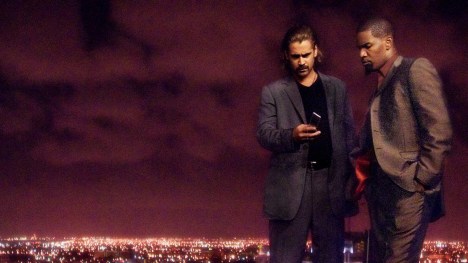
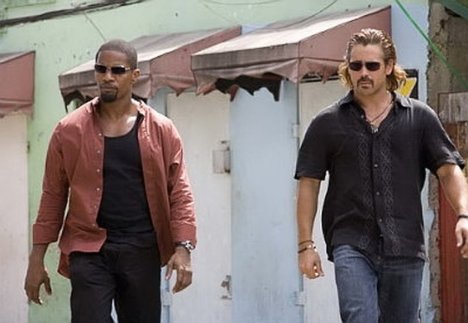
Time and again, Michael Mann’s Miami Vice returns to the idea of images collapsing into a single frame.

It’s a recurring visual and thematic motif in Miami Vice. Around the midway point, the undercover police note the technique that smugglers are using to get past the complex array of checkpoints and scans set up to secure the border. “What’d you spot?” Tubbs asks their source at the Federal Bureau of Investigation. “Go-fast boats running that close?” Crockett muses looking at the footage. “On radar they look like one, not two.” The same technique is used later with the jet, which blurs on radar into a single image. More impressively, Mann accomplishes something similar with the camera. Two become one.

This theme of collapse is core to Miami Vice. Watching the film, there is a sense that everything is falling apart, that boundaries cannot hold. This is true of all barriers; the lines that Crockett and Tubbs try to create between their professional and personal lives, the walls set up among the different groups on the inter-agency taskforce, the borders that nominally exist to separate Miami from Cuba and the Dominican Republic. It arguably even applies to the boundaries that writers and artists try to impose upon story, with Miami Vice constantly threatening to collapse into itself.

The result is a challenging a provocative piece of work, an ethereal dream-like mediation that reads very much as the inevitable climax of Mann’s meditation on the themes of law and order. Mann’s protagonists typically work to maintain some structure on what they do, to prevent the barriers from completely caving under outside pressure. Miami Vice represents the film in which those boundaries come crashing down.

Continue reading

Luke Cage – For Pete’s Sake (Review)

Maybe we don’t all become our parents, but we do live in their shadows.

The second season of Luke Cage engages with the idea of parents and children as a consistent thematic arc across the length and breadth of the season. In Soul Brother #1, Luke is thrown off his game by the arrival of his long-absent father in Harlem, seeking to reconnect. In Straighten It Out, Mariah is informed that one of better chances at going legitimate would be to cultivate a relationship with her own long-estranged daughter. From his introduction, even before his story is articulated in On and On, Jon McIver is clearly seeking justice for his parents.

This is not something that the second season conjures out of thin air. The first season had also hinted at generational tension. The battle between Luke Cage and Willis Stryker in the second half of the first season was largely fought in the shadow of the as-yet-unseen Reverend James Lucas, with Luke even taking Claire home to Georgia in Take It Personal to provide a sense of his history and back story. Similarly, both Cornell and Mariah wrestled with the obligations and the wounds that the Stokes family had inflicted upon them, seen in flashback in Manifest.

However, as all successful sequels and follow-ups tend to do, the second season of Luke Cage works from those small kernels and develops them into a strong central thematic arc for the various characters. Reverend James Lucas actually appears, force Luke to work through his anger and his rage towards his emotionally distant father. Similarly, Mariah is forced by political necessity to reach out to the daughter who has largely been absent from her life, which serves as a catalyst for confronting all of these deep-set issues.

This parental anxiety simmers through the season in interesting ways. The Jamaican restaurant that serves as Bushmaster’s base of operations is called “Gwen’s”, implicitly named for his long-deceased mother and a reminder of what motivates him. At the climax of On and On, the story of the loss of Bushmaster’s mother is cut against Luke remembering the last time that he saw his own mother. Similarly, Tilda’s store is named “Mother’s Touch.” In For Pete’s Sake, she assures Reverend Lucas that she meant “Mother Nature’s Touch”, but it seems a telling choice.

The second season of Luke Cage is all about family. Those that are there, and those that are not.

Continue reading

Luke Cage – If It Ain’t Rough, It Ain’t Right (Review)

The past stays with us.

Part of what is interesting about the second season of Luke Cage is the manner in which it engages with, and builds from, what came before. Continuity is a long-standing fixture of superhero narratives, most obviously in the four-colour source material. Fictional characters accrue a history, as individual issues and appearances add up to create a complex set of interlocking details that define and shape the character. It is in some ways comparable to how individual histories help to forge identities and determine who we are.

Of course, it should be noted that superhero movies and television shows have carried over some of this continuity from the comic books. Although cinema’s first “shared universe” was arguably constructed between the Universal monster movies of the thirties, the modern popularity of the term is driven by the success of the Marvel Cinematic Universe, an elaborate physical construct that ties together everything from Avengers: Infinity War to Daredevil to Agents of S.H.I.E.L.D. to Spider-Man: Homecoming.

The idea is that, in theory, events from one end of this universe might ripple over to another. After all, Misty can drop a casual reference to “the Incident” into an interrogation in Straighten It Out, a nod to the events of The Avengers which can be used to justify the proliferation of advanced technology within this shared universe. Overlap can happen in the strangest places, such as a character mentioned by Misty in For Pete’s Sake turning up a week or so later in an episode of Cloak & Dagger.

At the same time, the Marvel Cinematic Universe has struggled to build a truly interconnected universe, in part due to the commercial of realities of film and television production. As a result, Robert Downey Junior is highly unlikely to pop by Hell’s Kitchen for an homage to Born Again, while the Hulk can only be explicitly referenced as “the big green dude” in AKA It’s Called Whiskey or “the green monster” in All Souled Out. The characters from The Defenders are highly unlikely to ever have to worry about Thanos’ finger snap, after all.

This strange dissonance and discontinuity that exists between the various facets of the live action Marvel Cinematic Universe is part of what makes the strong continuity connections between the first and second seasons of Luke Cage so compelling, the sense of a tightly woven narrative that is expanding in a logical way from earlier events, where characters’ current behaviours are largely shaped and defined by what the audience has already seen. It’s a very effective use of continuity, particularly for a comic book television series.

Continue reading