• Following Us

  • Categories

  • Check out the Archives


  • Awards & Nominations

“Opening The X-Files” is Now Available on Amazon Kindle and Google Books!

Hi guys!

Just a quick update to let you know that my new book, Opening The X-Files: A Critical History of the Original Series, is now available as an eBook from Amazon and Google Books. Links available below.
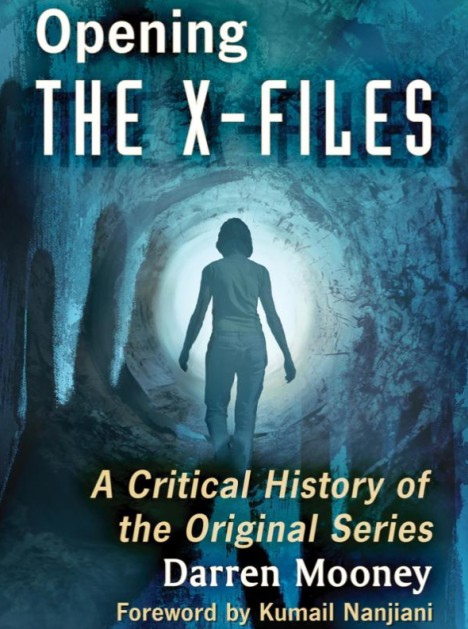
There will also be a print book available, and that will be released in a few weeks. But if you absolutely, positively have to read it now, you can pick it up for your eReader of choice at that links below.

The book has been a labour of love. It is basically the distillation of all of my reviews of The X-Files into a singular linear narrative that charts the show from its origins and influences through to the release of I Want to Believe. It includes sidebars and tangents for particular creators of interest and for the various other tie-ins, spin-offs and other interesting thematic divergences.

(It does not include the revival series, but if it is popular enough, a second edition or follow-up could always be possible.)
It has been a fun project, and I am hugely indebted to those who offered their support along the way. The book was published by McFarland Books and comes with an introduction by actor and comedian Kumail Nanjiani. With a bit of luck, if this project goes well, I might attempt something similar in the near future.

If you need the book right now, here are the links to the places where you can purchase the eBook online:


You are willing to wait a little longer, you can order a hard copy of the book from many of the same places:

If you’d like to support the book, there are a number of things that you could do:

If you want a sample of what the book will cover, in a much more organised manner, there are some sneak peaks online:

If you’re still on the fence, here are come very nice things that some very nice people said about the book:

A welcome, and well-written addition to X-Files lore, by an author who knows his stuff.

John Kenneth Muir, author, The X-FilesFAQ

I get excited about watching the episodes, but I get just as excited about reading Darren afterward.

Kumail Nanjiani, actor, comedian and writer

The truth is in here! If The X-Files were a college class, Mooney’s book would be the essential text. It not only supplements, but greatly enhances one’s enjoyment of the groundbreaking series.

Rod Lott, FlickAttack.com

A massive thank you to everybody who has supported the book so far. If you have any questions, feel free to leave them in the comments and I’ll try to answer all of them.

Non-Review Review: Patti Cake$

Patti Cake$ is intermittently charming, but far too familiar.

Patti Cake$ is a familiar breed of indie movie. It is the story of a young protagonist trapped in a small town and surrounded by eccentric characters who yearns to escape, but finds herself hemmed in by lack of opportunity, by family and by sheer economic pressure. It is a quintessential triumph-over-adversity narrative, albeit approached from the slightly skewed perspective of a young white female rapper in New Jersey.

Let’s get this Patti started in here.

There are some interesting elements of Patti Cake$, especially the performances by actors like Danielle Macdonald and Bridget Everett. There are moments when this familiar template works very well at hitting particular cues, whether the mundanity of Patti’s day-to-day existence, the emotional realism of particular relationships in her life, or even a really good and well-timed joke. However, those moments are largely fleeting. For most of its runtime, Patti Cake$ is a perfectly adequate story of what it feels like to socially strive.

Patti Cake$ doesn’t have any new rhymes, and so settles for some well-worn beats.

She’s got drive.

Continue reading

Star Trek: Voyager – The Disease (Review)

One of the curses of Star Trek is the tendency to saddle the weakest and most ill-defined members of a given ensemble with a generic soul-destroyingly dull love story.

Deanna Troi has Haven, The Price and Man of the People. Geordi LaForge has Booby Trap and Galaxy’s Child. In the first few years of Star Trek: Deep Space Nine, both Bashir and Dax were subjected to such plots. Bashir had Melora, and Second Sight was originally developed with his character in mind. Dax got a similar story in Meridian. Chakotay has Unforgettable, and was shipped with both Janeway and Seven at various points in the run of Star Trek: Voyager. Even Mayweather’s subplot in Demons and Terra Prime was romantic in nature.

Kiss and Tal.

Of course, there are any number of compelling and interesting  romantic episodes built around characters over the history of the franchise. Kirk had The City on the Edge of Forever. Spock had All Our Yesterdays. Tuvok had Gravity. Even the more developed seventh season version of Bashir had Chrysalis. However, it frequently seems like the production team’s go-to plot for an underdeveloped regular character is a romance-of-the-week plotline, perhaps because it is a fairly standard story and because it can be applied to almost any type of character.

However, the problem with building these romantic storylines around undeveloped characters is that they lack any real hook. The audience implicitly understands that the romantic interest is unlikely to stick around, so the story has offer a compelling insight into the regular character. This is understandably difficult if the production team have chosen to tell this story with this character because they really cannot think of any other interesting story to tell. As a result, these episodes can feel like an exercise in boredom, in watching wheels turn.

“Dammit, Harry. I thought we had this conversation after Favourite Son.”

This is particularly true in episodes built around weaker (or more disinterested) members of the ensemble. In a romantic installment of an episodic show, the audience needs to invest in the love story very quickly. This puts a lot of pressure on a performer to sell the romantic attraction. On a weekly schedule, with two performers who may not know one another particularly well, this can be very difficult to accomplish. Robert Beltran is a relatively serviceable performer with the right material, but he would never make a convincing romantic lead.

The Disease is a romantic episode built around Harry Kim. While the script has its own very severe problems, the biggest issue is that Garrett Wang simply cannot sell the intense attraction that is necessary for the episode to work.

Colony ship collapse disorder.

Continue reading

Star Trek: Voyager – Dark Frontier, Part II (Review)

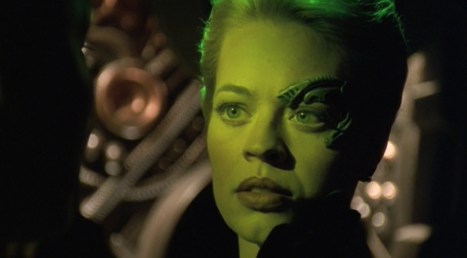
Star Trek: Voyager has a morbid fascination with the Borg. Quite literally.

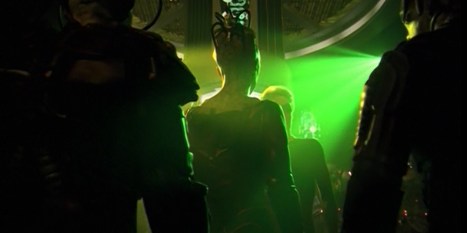
Time and time again, the series returns to the image of the Borg dead and dying. Blood Fever ends with the discovery of a Borg corpse. Unity features the extended autopsy of that corpse. In Scorpion, Part I, Kes is haunted by the image of a grotesque mound of Borg drones, torn apart and reassembled. In Unimatrix Zero, Part I, the Borg Queen tears the heads off her drones and mounts them on spikes. There is a very similar image in Dark Frontier, Part I, where Janeway wanders casually through the wreckage of a Borg ship.

Queen of minds.

Star Trek: The Next Generation worked hard to establish the Borg as a credible threat. If the Borg were associated with death, it was only because they delivered something akin to it. In The Neutral Zone, the Borg scooped an entire outpost off the surface of a planet. In Q Who?, Picard had to literally beg Q to save the Enterprise after the loss of eighteen crewmembers. In The Best of Both Worlds, Part I and The Best of Both Worlds, Part II, the Borg tore through the Federation like it was made of tissue paper. The trauma of that invasion informed Emissary.

In contrast, Voyager seems preoccupied with the destruction and desecration of the Borg Collective. This is an interesting creative choice on a number of levels. Most obviously, it severely undercuts the menace and threat posed by the Borg Collective. Janeway seems to travel through the Delta Quadrant leaving a trail of broken Borg bodies in her wake. It is hard to believe that the Borg are a big deal, when Janeway seems to decorate her ship with their remains. The Kazon, the Vidians and the Hirogen have all taken Voyager at some point. The Borg have never.

Green light for reassimilation.

Perhaps this fascination with Borg corpses and remains simply speaks to their visual aesthetic. With their pale skin and their lack of individual identity, the Borg have always evoked the walking dead; Star Trek: First Contact was essentially a zombie movie in deep space. However, perhaps this desecration of the Borg speaks to something buried deeper within the psyche of Voyager. The Borg are perhaps the most iconic aliens of the Berman era; they represent the moment that The Next Generation came into its own. Perhaps their decay mirrors that of the Berman era itself.

Dark Frontier, Part I and Dark Frontier, Part II represent something of a final frontier for the Borg Collective. While the Borg had been in decline for some time, Dark Frontier, Part I and Dark Frontier, Part II marked a point of no return. Regeneration is an underrated return to form for the iconic cyborgs, but it is too little and too late. Dark Frontier, Part I and Dark Frontier, Part II is effectively a funeral for the most iconic adversaries of the Berman era. However, they would remain shuffling lifeless for another two-and-a-half seasons.

Subject to change.

Continue reading

The Defenders – The Defenders (Review)

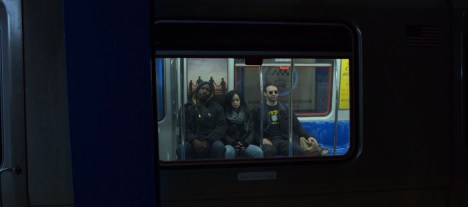
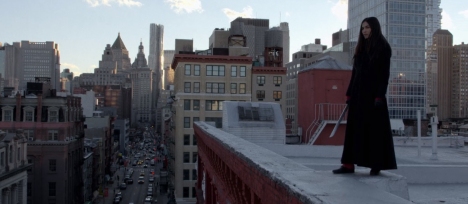
If The Defenders is fundamentally a story about New York, then it seems inevitable that it should return to the city’s defining tragedy.

It is no exaggeration to suggest that the events of 9/11 changed the course of world history. They fundamentally altered the foreign and domestic policies of the United States, the world’s strongest superpower. Inevitably, they also changed New York itself. It could reasonably be argued that the twenty-first century began with the 9/11 attacks, at least culturally; the atrocity brought an end to the global peace and stability that had defined the nineties, ushering in a new world order.

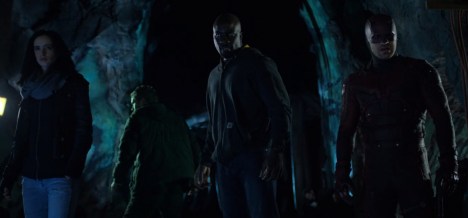
“Um, Danny? Hero shot?”

The Defenders is a story very much invested in New York City, with characters repeatedly referring to New York as “my/your/our city.” Of course, each of the four series leading into The Defenders imagines a different city. Daredevil is set against the backdrop of an early eighties version of Hell’s Kitchen, one never tamed nor gentrified. Jessica Jones unfolds in a vast and anonymous and disconnected city. Luke Cage imagines Harlem as an ideal, a cultural hub. Iron Fist treats Manhattan as the stage on which familial conflicts might play out.

The Defenders is about bringing those separate versions of New York together, of integrating them into a single story set against the backdrop of a single version of the city. Inevitably, that version of the city is the city as it was defined at the start of the twenty-first century, a city united by catastrophe and destruction. However, there is more to it than that. The Defenders embraces the 9/11 subtext seeded through the first season and plays the idea out to its logical conclusion.

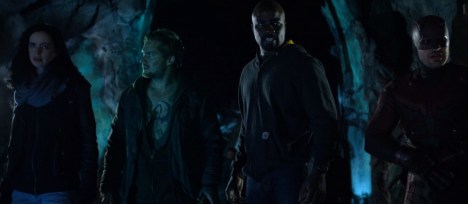
“What? Am I supposed to look serious doing this?”

The season culminates in a bizarre inversion of 9/11, in which our heroes lay siege to an empty skyscraper. They decide that the only way to save Manhattan is to demolish the building. Although the episode is edited in such a way that the audience never sees the collapse of the skyscraper in question, The Defenders is still structured in a way that evokes the most uncomfortable paranoid conspiracy theories about the events of 9/11. With the structure destroyed from the inside with architectural precision, this change to the New York skyline really is “an inside job.”

It plays almost as a grotesque and uncomfortable attempt to reclaim a traumatic image, to take ownership of the atrocity. It is an attempt to construct a heroic iteration of the terrorist attacks that forever changed the city, as if that may somehow provide an opportunity for healing and reconciliation.

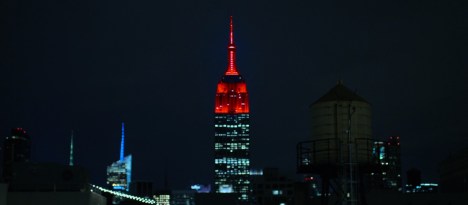
Take it as red.

Continue reading

We Stood Like Kings’ New Soundtrack for Koyaanisqatsi

We Stood Like Kings are releasing a new soundtrack for Godfrey Reggio’s impressionistic documentary Koyaanisqatsi.

Given that Phillip Glass’ iconic soundtrack to Koyaanisqatsi is almost impossible to separate from Reggio’s images and narrative, it is certainly an ambitious project. However, We Stood Like Kings certainly have form in this area. Formed more than a half-a-decade ago in Brussels, We Stood Like Kings have a long history of adapting new soundtracks for classic films.

USA 1982 is the third in a trilogy of such albums; USSR 1926 was a live soundtrack to Dziga Vertov’s A Sixth Part of the World and Berlin 1927 was a live soundtrack to Walther Ruttmann’s Die Sinfonie der Großstadt. The decision to wed USA 1982 to Koyaanisqatsi is intriguing. Reggio’s exploration of contemporary society is a rich visual odyssey, one conveying without dialogue or even title cards.

In many ways, it lends itself to this approach, inviting the audience to interpret the images on their own terms. The use of an alternative soundtrack feels very much like an organic extension of this approach; how might the audience’s interpretation change with soundtrack, how is meaning altered by something other than the image itself?

You can find more information on We Stood Like Kings and USA 1982 on their website. You can also see a short trailer below. It is released September 22 from Kapitän Platte Records.


The Defenders – Fish in the Jailhouse (Review)

The second season of Daredevil hangs over The Defenders.

This is not a surprise. Daredevil was the first Marvel Netflix show, and so it occupies pride of place in the line-up. It was the only series to get a second season before the release of The Defenders. More than that, the showrunners in charge of The Defenders are the same showrunners who oversaw the second season of Daredevil. It makes sense that Matt Murdock would find himself cast as the protagonist of The Defenders, and that the show would like a logical continuation of his arc.

Apparently the Dutch settlers made the mistake of building Manhattan on a load-bearing dragon skeleton.

In many ways, the story of The Defenders is the story of Matt Murdock. In fact, Matt Murdock is the only character to end The Defenders in a markedly different place than he began. He begins the show having retired his costumed life following the death of Elektra in A Cold Day in Hell’s Kitchen. Over the course of the show, he embraces his status as hero. He comes to don the costume again and to lead the nascent team in Take Shelter, just over half-way through the season. He ends The Defenders sacrificing himself to save the city, only to narrowly survive.

While the stars of Iron Fist, Jessica Jones and Luke Cage are all returned to a position where their first and second seasons might flow organically into one another, The Defenders almost feels like a truncated blockbuster season of Daredevil.

“Yeah, Thor: The Dark World did this gag first, but let’s just go with it.”

Continue reading

The Defenders – Ashes, Ashes (Review)

As much as The Defenders is hobbled by the Hand, it is also handicapped by Iron Fist.

It is very clear that the production team heading into The Defenders intended for Iron Fist to be a springboard to the crossover, to move the last pieces into place before the big event miniseries. After all, Iron Fist was heavily marketted as “the Last Defender.” More than that, the series devoted pretty much all of its thirteen-episode runtime to fleshing out the Hand, the secretive ninja cult that would serve as the primary antagonists of The Defenders. There was a clear sense that the production team saw Iron Fist as something of an extended lead-in to The Defenders.

Sorry, Danny. But it’s true.

There was just one problem with all of this. Iron Fist was terrible. By all accounts, the show was the result of a rushed production cycle that explains some of the shoddiness in terms of practical effects and direction, but its biggest problems were more fundamental than that. Finn Jones was the weakest series lead of the Marvel Netflix series by a considerable distance. Scott Buck was the weakest lead writer on a Marvel Netflix series by a considerable distance. The result was a car crash of a television series.

Given that this car crash was intended to serve as the lead-in to The Defenders, this causes significant problems for the sprawling eight-episode crossover.

Luke is a real hero.

Continue reading

Non-Review Review: American Made

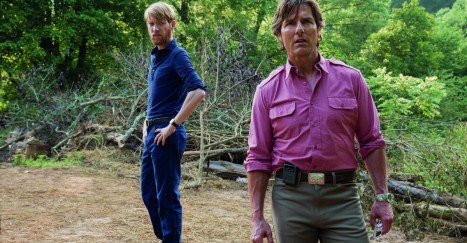
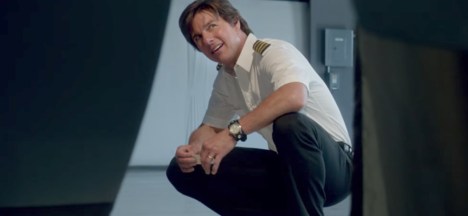
“Sh!t gets really crazy from here,” promises Barry Seal at one point in American Made, as this true story takes another sharp escalation.

Unfortunately, American Made never quite lives up to that promise. Starring Tom Cruise and directed by Doug Liman, American Made is never less than charming and endearing, but it also feels overly familiar. American Made plays like a decidedly old-fashioned crime biography film, one that feels appropriate following the cheekily time-warped production logos that introduce the film. Gary Spinelli’s script feels almost retro in the way that it very neatly and very efficiently fits the life of Barry Seal to the familiar crime movie template.

He can handle the truth.

American Made is a well-made film, one anchored in Tom Cruise’s star power charisma and Doug Liman’s competent direction. It is a film with a clear narrative arc and a very sturdy storytelling structure. American Made hints every beat in a very efficient manner, dividing its time very effectively between charming episodic details and its broader overarching themes. The film never loses track of itself, even if it feels like most of the characters around Barry Seal and his CIA handler “Schaffer” never feel particularly alive.

However, there is a something almost disappointing in this efficiency. American Made is too tightly constructed to ever let itself embrace the absurdity of its central narrative. “Sh!t” is too carefully managed to ever get “really crazy.”

Pilot error.

Continue reading

The Defenders – Take Shelter (Review)

The Hand are an unequivocal disaster, looming large over The Defenders.

To be fair, this an entirely foreseeable problem. When the Hand were teased in the first season of Daredevil, they were at least interesting. Largely carried over from the Frank Miller comics that were a major influence on the series, episodes like Stick and Speak of the Devil suggesting something uncanny lurking in the shadows behind Wilson Fisk. However, as the Hand emerged from the shadows, they became a lot less intriguing. As they became less mysterious, they become more generic. By the end of Iron Fist, the audience had enjoyed enough of the Hand to last a lifetime.

“I’ll tell you where to Stick it.”

A major part of this problem is the fact that the Marvel Netflix shows cannot agree upon a single unifying theory of the Hand. What is the Hand? What are their goals? What are their motivations? What are their methods? It seems like every other episode had a different idea of what the Hand could be, allowing what had been a fairly simple premise of a secret ninja death cult to evolve into something that could be everything to everyone. With every reversal and twist and reinvention, the Hand became less ominous and more frustrating.

As a result, The Defenders suffers from the decision to build its story around the Hand. Much like the series reveals of Manhattan itself, The Defenders is built on a rather shaky foundation.

Homecoming.

Continue reading