• Following Us

  • Categories

  • Check out the Archives


  • Awards & Nominations

New Podcast! The X-Cast – Season 2, Episode 17 (“End Game”)

Just a quick link to a recent (unscheduled) guest appearance over on The X-Cast, a great X-Files podcast run by the prolific Tony Black.

Following on from last week, I had the pleasure of an extended conversation with Tony about End Game. It was a joy, given the my own fondness for the episode and its place in the large X-Files canon. It was a fun to talk through the episode, from what Mulder really wants to whether the show’s popularity drove the mythology or the mythology’s popularity drove the show to Mister X’s appreciation for the fine arts. Check it out the episode here, or click the link below.

Continue reading

Non-Review Review: Going in Style

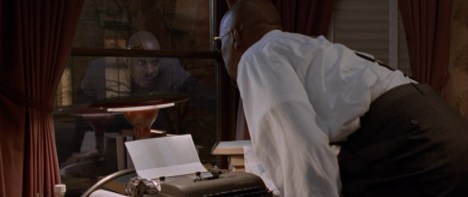
At one point in Going in Style, octogenarian would-be bank robber Albert decides to craft an alibi for an elaborate bank robbery while working at a cotton candy stand.

This image might just encapsulate Going in Style, a very light and fluffy bank robbery film about a trio of senior citizens who embark upon a bank robbery in order to balance the books. The movie is consciously (occasionally suffocatingly) feel good story of a bunch of cynical wise-cracking pensioners embarking upon wish fulfillment revenge against the banks that have taken so much from hard-working and decent Americans. Think of it as Hell or High Water that swaps the moral ambiguity for a clumsy score.

Dinner of champions.

Going in Style is not an especially complicated film. It never pauses to evaluate what is happening, or why. It is anchored in the assumption that people are basically decent, even when pushed to extremes. It goes for as many obvious jokes as it can cram into its ninety-six-minute run-time, from a few cheap laughs about the embarrassment factor of old-age sex to other jokes about bodily functions. But its heart is in the right place, as it goes out of its way to repeatedly assure the audience.

The extent to which Going in Style could be said to work rests in the easy charm of its three leads, in the pleasure of seeing Michael Caine, Morgan Freeman and Alan Arkin play off one another. None of the trio is pushing themselves. All three leads are essentially offering some minor variation on an established schtick, with no nuance or strain. The result is a heist thriller that never feels like it is racing against the clock, more ambling in its own time.

Benched.

Continue reading

Star Trek: Deep Space Nine – Far Beyond the Stars (Review)

I am black, I have spent time in a mental hospital, and much of my adult life, for both sexual and social reasons, has been passed on society’s margins. My attraction to them as subject matter for fiction, however, is not so much the desire to write autobiography, but the far more parochial desire to set matters straight where, if only one takes the evidence of the written word, all would seem confusion.

– Samuel Delany, The Straits of Messina

Keep dreaming.

Continue reading

Trial and Trailer: The Perils of Publicity in the Internet Era

It is a cliché to suggest that trailers are spoiling movies.

Clint Eastwood was complaining about the trend more than a decade and a half ago, lamenting, “Half the time you go and watch a film, you see eight or 10 different trailers and you’ve seen the whole plot line. There’s really no reason to go see the film.” While film fans might look back nostalgically on classic trailers like Alien or Point Blank, the truth is that movie trailers have always been a bit of a haphazard artform. The trailer for Carrie is as spoilery as any modern trailer.

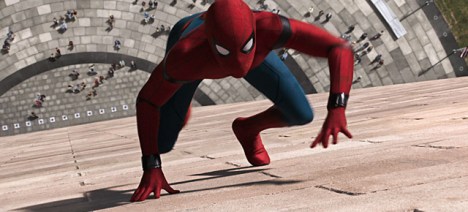
At the same time, there is a definite trend in contemporary trailers – especially for big blockbuster releases – to ensure that the audience knows exactly what they are going to get. This is most obvious in trailers like Alien: Covenant or Spider-Man: Homecoming, which go beyond spoiling the entire plot thread to spoiling big moments from the film; memorable cameos or distinctive sequences. When dealing with spectacle driven films like Kong: Skull Island, there is a conscious effort to load the trailer with spectacle, revealing monsters and set pieces.

To be fair, this is arguably more of a problem with big budget summer releases. These trailers typically belong to blockbusters that have to absolutely saturate the market in order to build hype, releasing trailers more than a half a year before release or even offering trailers for trailers. It is inevitable that this desire to effectively carpet-bomb the media landscape with footage will reveal far too much about the film in question, particularly for those who task themselves with keeping track of this information. The sparse understated trailers for smaller films like Get Out are a blessing.

It is interesting to wonder what drives these creative decisions, why studios are saturating the market with trailers that seem to lay out every beat ahead of time and which effectively promise every twist that will be delivered over the course of the narrative. There is a lot to be said for the joy of seeing a film blind, without knowing exactly what is coming and how it will be delivered. It seems reasonable to argue that the job of a trailer is to tease, to offer the viewer a hint of what is in store, instead of mapping out how they might spend two hours of their lives.

However, while these views are quite common on the internet and among film fans, it is interesting to wonder whether they reflect the opinions and taste of the mass audience. Is this increasing tendency towards spoiler-heavy trailers that plot out the entire arc of a film are driven by the tastes of audiences? Is this how the majority of viewers want their entertainment delivered, even if they would never frame it in those terms?

Continue reading

Star Trek: Voyager – Hunters (Review)

Hunters is a weird episode of Star Trek:Voyager, perhaps most notable for the manner in which it flirts with serialisation.

More than any other episode of the fourth season, with the possible exception of The Gift, this mid-season episode seems to exist primarily in relation to the episodes around it. The script is very consciously a sequel to Message in a Bottle, with the crew discovering the ancient network of space stations is a two-way radio back to the Alpha Quadrant. It also introduces the Hirogen, an alien species that will recur in Prey, The Killing Game, Part I and The Killing Game, Part II. The story also sets up a narrative thread that will pay off in Hope and Fear, the season finale.

“Prey, tell.”

More than that, Hunters is an episode that is very consciously engaged with dangling threads of continuity. It resolves the relationship between Janeway and Mark that has haunted the lead character since Caretaker, offers Tom Paris some hint of reconciliation with the father who seemed so disappointed in Persistence of Vision, and even resolves the Maquis plot thread by tying back to Blaze of Glory. This is an episode that exists as something of a storytelling nexus point, a variety of intersecting threads all tied together as part of a single narrative.

Voyager had largely eschewed any attempt at long-form storytelling, perhaps in response to the trauma of the troublesome Kazon arc in the second season that led to ill-judged misfires like Alliances and Investigations. However, those early attempts at serialisation were heavily plot-driven, a series of stories building towards a number predetermined plot points. In contrast, the serialisation suggested by Hunters is looser; a collection of character beats, some earlier details that had largely been forgotten, some elements that might be useful in the future.

The farthest woman from home.

That said, Hunters seems just as cautious about long-form storytelling as The Gift was. As much as Hunters revives old story lines and character beats, it also makes a conscious effort to close many of them. Hunters makes it very clear that this level of serialisation will not be the default for the series going forward. The episode tidies away more loose threads than it unravels. The relationship between Kathryn Janeway and Mark Johnson is brought back purely so it can be ended. The Maquis are mentioned only to confirm they have been destroyed.

Still, there is something oddly intriguing about Hunters, a mostly quiet episode that exists primarily as both prelude and coda rather than a narrative in its own right. It is a quieter, stranger Voyager episode, even while introducing a race of giant space!hunters.
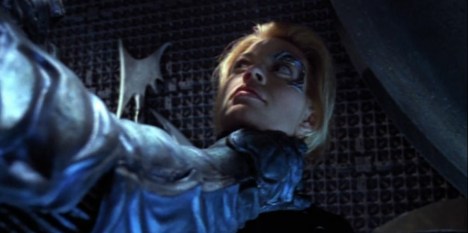
Gripping stuff.

Continue reading

New Podcast! The X-Cast – Season 2, Episode 16 (“Colony”)

Just a quick link to a recent (unscheduled) guest appearance over on The X-Cast, a great X-Files podcast run by the prolific Tony Black.

In the first of a two-parter experience, I had the pleasure of an extended conversation with Tony about Colony. It was a huge honour, given the importance of Colony in the overall mythology of The X-Files. We got to talk about all sorts of fun things, from Chris Carter’s recurring fascination with Frankenstein to nineties television direction to how hard it must be for the Alien Bounty Hunter to shop for clothes. I will also be back next week to talk about End Game with Tony. Check it out the episode here, or click the link below.

Continue reading

25. Gone Girl (#179)

You don’t know what you’ve got ’til it’s…

Hosted by Andrew Quinn and Darren Mooney, The 250 is a fortnightly trip through some of the best (and worst) movies ever made, as voted for by Internet Movie Database Users. New episodes are released every second Saturday at 6pm GMT, with the occasional bonus episode between them.

This time, David Fincher’s Gone Girl.

On their fifth wedding anniversary, Nick Dunne is shocked to discover that his wife Amy has disappeared. As local law enforcement begin their investigation, all clues seem to point towards Nick. But all is not as it appears to be.

At time of recording, it was ranked the 179th best movie of all time on the Internet Movie Database.

podcast-gonegirl

https://them0vieblog.com/wp-content/uploads/2016/11/podcast11.mp3%20itunes:duration=01:51:06%20itunes:explicit=no

Continue reading