• Following Us

  • Categories

  • Check out the Archives


  • Awards & Nominations

X-Men: Schism (Review)

With our month looking at Avengers comics officially over, we thought it might be fun to dig into that other iconic Marvel property, the X-Men. Join us for a month of X-Men related reviews and discussion.

X-Men: Schism is a game-changer. It’s an attempt to realign Marvel’s X-Men line, a series of books that have faltered in recent years. After all, events like Messiah Complex and Second Coming couldn’t propel the line back to prominence, so Schism feels like a manifesto. Collecting the main series written by Jason Aaron, and the X-Men: Regenesis one-shot written by Kieron Gillen, it represents the most recent attempt to bring the some sense of life and purpose back to the X-Men books, which have been increasingly overshadowed by Marvel’s Avengers publishing line. And, to be frank, I can’t help but think that Schism works pretty well as an attempt to brush away the recent past and carve out a new and exciting future.
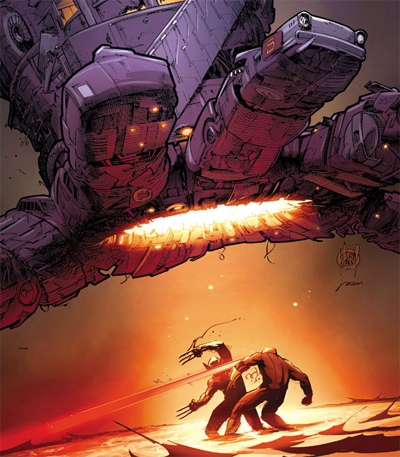
The hand of fate…

Continue reading

X-Statix Omnibus by Peter Milligan & Mike Allred (Review/Retrospective)

With our month looking at Avengers comics officially over, we thought it might be fun to dig into that other iconic Marvel property, the X-Men. Join us for a month of X-Men related reviews and discussion.

There’s been a lot written about how fiendishly clever Peter Milligan and Mike Allred’s X-Statix was when it was published by Marvel in the early part of the last decade. Spanning two titles (beginning in X-Force and then spinning into its own title in X-Statix), it offered a forty-issue re-examination of the core X-Men thesis. Published at approximately the same time, it actually serves as something of a spiritual companion to Grant Morrison’s equally controversial, challenging and provocative New X-Men run. Both series dared to consider that Chris Claremont’s once revolutionary idea, casting mutants as a feared minority because they were inherently “different” might need revision in the early years of the twenty-first century. Both series have been attacked by critics for not conforming to the model that Claremont designed for the franchise three decades earlier. However, I’m going to be controversial, and I’m going to state that both Morrison and Milligan were more faithful spiritual successors to Claremont than any X-Men writers since the nineties.

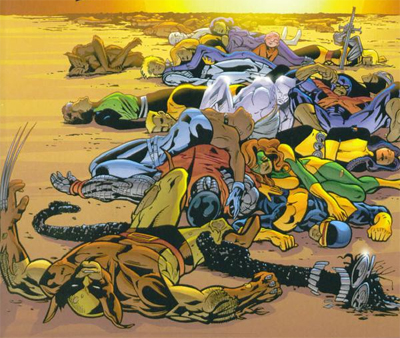
Nobody’s Doop…

Note: You can read my review of Milligan and Allred’s initial X-Force run, collected in the hardcover “Famous, Mutant & Mortal” here. This is a review of the recently-published omnibus, which collects all their work on the characters, so I won’t go into too much depth on that initial run.

Continue reading

Wolverine by Jason Aaron Omnibus, Vol. I (Review)

With our month looking at Avengers comics officially over, we thought it might be fun to dig into that other iconic Marvel property, the X-Men. Join us for a month of X-Men related reviews and discussion.

Wolverine shouldn’t be a tough character to get right. He’s a fairly simple archetype, one often seen in the annals of pulp fiction history. He’s the Man With No Name, the ronin, the warrior who has lived through the war. He’s a man who is a weapon, even if he doesn’t necessarily want to be. He’s badass, he’s a loner, and he doesn’t take any nonsense from anyone or anything. It’s easy to see why the character is one of Marvel’s most iconic fictional creations, right up there with Spider-Man in terms of recognition. However, it seems that many writers struggle in characterising the most famous mutant. Arguably the writer with the best handle on Wolverine since Chris Claremont left Uncanny X-Men was Mark Millar, who wrote two of the character’s more memorable stories (Enemy of the State and Old Man Logan). However, this collection makes a nice argument for Jason Aaron as the logical successor to the writer who defined the bladed Canadian.

It’s hardly cutting edge, but it is good comics…

Continue reading

X-Men: Inferno (Review/Retrospective)

With our month looking at Avengers comics officially over, we thought it might be fun to dig into that other iconic Marvel property, the X-Men. Join us for a month of X-Men related reviews and discussion.

I don’t like Inferno. There, I said it. There have been dry patches in Claremont’s Uncanny X-Men run before, and some would argue that his work following Inferno would be quite esoteric, but Inferno has always represented, to me at least, the creative low-point of Claremont’s Uncanny X-Men run. That doesn’t mean that I can’t appreciate it for what it is, or acknowledge the care with which the writer crafted it, but it is just too much of a big random mess to really enjoy it. It’s a disjointed crossover that resolves the long-running Madelyne Pryor mystery that Claremont had been weaving through the book, but also features demons and goblins for some reason. It’s just a great big mess.

There’s a Storm comin’…

Continue reading

Fall of the Mutants: Uncanny X-Men (Review/Retrospective)

With our month looking at Avengers comics officially over, we thought it might be fun to dig into that other iconic Marvel property, the X-Men. Join us for a month of X-Men related reviews and discussion.

Part of me does feel a little bit sorry for Chris Claremont. After all, his Uncanny X-Men run was trapped in a perpetual second act. He hadn’t introduced the franchise, inheriting it from a bunch of other writers and artists, and he couldn’t resolve it either. So, as a writer, Claremont was charged with keeping readers interested in an on-going narrative that spanned well over a decade. Occasionally, the writer would try to keep things fresh, and Fall of the Mutants represents just such an attempt. Trying to transition his team from one status quo to another, you have to give the writer credit for pitting the team against an enemy who is (effectively) God, even if it does make this chapter in his on-going saga the equivalent of Star Trek V: The Final Frontier.

United we fall…

Continue reading

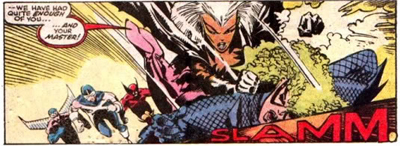
Acts of Vengeance: Uncanny X-Men – Wolverine, Jubilee & Psylocke vs. The Mandarin (Review/Retrospective)

April (and a little bit of May) are “Avengers month” at the m0vie blog. In anticipation of Joss Whedon’s superhero epic, we’ll have a variety of articles and reviews published looking at various aspects of “Earth’s Mightiest Heroes.”

In celebration of the release of The Avengers, this weekend we’re taking a look at the massive 1989-90 crossover “Acts of Vengeance”, which pitted various villains against some unlikely heroes. I’ll be looking at some of the most fun match-ups. This arc is collected in the companion omnibus.

I know that a lot of people would argue that Claremont’s Uncanny X-Men sort of lost the plot a bit after Inferno, when he first sent the team to live in the Outback and then sent them through the Siege Perilous, essentially disintegrating the iconic superhero team and scattering its members to the wind with little idea of who or what they are. I, for the record, actually quite liked that period of Uncanny X-Men history, if only because it was so breathtakingly ambitious and completely unlike anything I ever expected in a superhero team book.

Detractors would, not unreasonably, suggest that there was a very good reason that Claremont’s approach was completely distinct from anything ever tried in a superhero team book. However, most of those who decry that era of Uncanny X-Men will concede that there were some highlights to be found. The Acts of Vengeance tie-ins, featuring the wonderful artwork of Jim Lee, are among the more widely-praised of Claremont’s work in this era, and I find it quite tough to disagree.

Big Trouble in Big China…

Continue reading

Non-Review Review: X-Men III – Last Stand

I’ll confess right off the bat that I don’t share the same honest-to-goodness hatred of this third film in the X-Men series that most on-line commentators do. It isn’t a patch on Bryan Singer’s original two films (and – looking at Superman Returns – it might have been better for all if he’d stayed on here), but it isn’t quite as weak as other third-instalments in other superhero franchises (Spider-Man III and Batman Forever, for example). It’s not a fantastic film, and it’s not the final chapter that the film series deserved, but it’s not a complete disaster.

Weathering the Storm...

Continue reading

Aaronofsky to Wrestle “The Wolverine”: Are Independent Directors the Best Choices for Superhero Cinema?

I’m going to be honest, I like it when relatively obscure film directors are handed the reigns to huge blockbuster properties. It seems that these “cult” film makers tend to bring something fresh from outside the studio system to their work. I might sound more than a bit pretentious, but it reminds me of the way that many of the blockbuster directors of the seventies – including Lucas and Spielberg – originated from outside the studio system before revolutionising it from inside. As a concept, would I rather watch Michael Bay’s Transformers: Revenge of the Fallen or Christopher Nolan’s Batman Begins? No choice there. Any film with the name “Jerry Bruckheimer” attached or Sam Raimi’s Spider-Man? Again, no choice. So, despite the fact that Gavin Hood’s X-Men Origins: Wolverine was a critical failure and an infuriatingly (but, sadly, not unpredictably) disappointing film, am I alone in getting a little excited about Darren Aaronofsky’s The Wolverine.

Against all odds, I might be feeling pretty Jack(man)ed about this...

Continue reading

Brian Michael Bendis’ Avengers – New Avengers Vol. 3-4 (Hardcover) (Review/Retrospective)

This is the eighth in a series of comic book reviews that will look at the direction of Marvel’s continuity (and, in particular at their “Avengers” franchise) over the past five or so years, as they’ve been attempting to position the property at the heart of their fictional universe. With The Avengers planned for a cinematic release in 2012, I thought I’d bring myself up to speed by taking a look at Marvel’s tangled web of continuity.

And now we’re entering a continuity-heavy area. You have been warned. As if we’ve been in a continuity-free zone for the past couple of weeks, remarks you, trusted reader. This is where my little experiment to venture deep into the heart of Marvel’s comic book continuity becomes a little bit more complicated and a little bit more difficult. Whereas the first part of Bendis’ run on New Avengers was relatively stand-alone (while still drawing on decades of events and continuity), it’s at this point the series becomes irrevocably intertwined with the on-going events at the heart of the Marvel Universe. It’s been described as “a spine”, and that’s pretty much exactly what it is: it’s a support structure which ties together the big Marvel events year-on-year, a thread that joins events like Civil War and Secret Invasion and Siege to each other and the greater fictional universe.

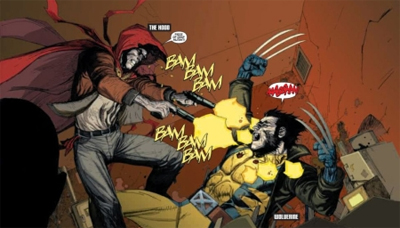
Wolverine learns the hard way not to bring claws to a gun fight...

Continue reading

Brian Michael Bendis’ Avengers – New Avengers Vol. 1-2 (Hardcover) (Review/Retrospective)

This is the first in a series of comic book reviews that will look at the direction of Marvel’s “Avengers” franchise over the past five or so years, as they’ve been attempting to position the property at the heart of their fictional universe. With The Avengers planned for a cinematic release in 2012, I thought I’d bring myself up to speed by taking a look at Marvel’s tangled web of continuity. Get an overview of what I’m trying to take a look at here.

Alright. I figure I sound a bit hypocritical complaining about the impact of big events on Marvel’s storytelling continuity without reading said big events. Well, actually, I don’t think I’m a hypocrite – I think it’s perfectly reasonably that a reader should be able to pick up Ed Brubaker’s Captain America without having to worry about Mark Millar’s massive Civil War crossover which they either don’t know enough to care about or know enough not to care about. However, I feel like maybe – just maybe – I should try to ride this “cross-continuity” thing out just once and see if the story somehow justifies the damage it causes to the cohesion of individual runs.  Yes, I’m going to jump head-first into the event-populated minefield of continuity which is recent Marvel history, and I will be using New Avengers as a checklist to that. I’m going down the rabbit hole, following the arc from Civil War through to Siege.

Sentry is responsible for the Carnage in this run...

Continue reading