• Following Us

  • Categories

  • Check out the Archives


  • Awards & Nominations

The Absolute Authority, Vol. 2 (Review)

With Wildstorm being officially folded into the relaunched DCU (the “DCnU”), I thought I might take a look at some of the more successful and popular Wildstorm titles that the company produced. In particular, The Authority, the superhero saga that spun out of Stormwatch – a series that is getting its own post-relaunch book written by Paul Cornell, easily one of my more anticipated titles.

In many ways, it was The Authority that established Mark Millar and Frank Quitely as talents to watch in their own rights, rather than through their associations with Grant Morrison. As a concept, the series was launched by Warren Ellis and Bryan Hitch, but the duo picked their own replacements. I have to say, I think they chose rather wisely, even if the series has lost a rather considerable amount of its bite nearly a decade after its initial publication. That said, it’s still a highly entertaining superhero book, and one which had more than its fair share of influence on the mainstream titles over the last ten or so years.
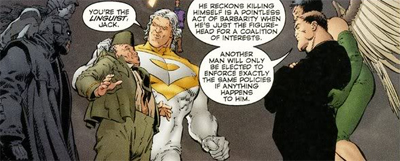
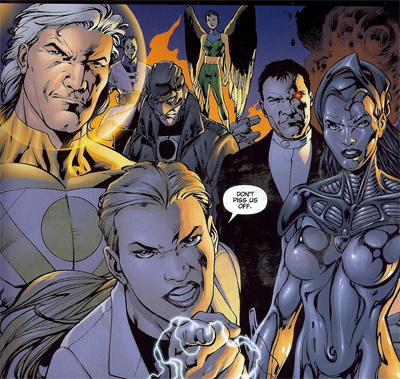
There's a new Authority in town...

Continue reading

Absolute Planetary, Vol. 1 (Review)

With Wildstorm being officially folded into the relaunched DCU (the “DCnU”), I thought I might take a look at some of the more successful and popular Wildstorm titles that the company produced. In particular, Planetary, the which will apparently inspire Paul Cornell’s Stormwatch – easily one of my more anticipated titles of the relaunch.

Planetary, as imagined by Warren Ellis and John Cassidy charts “the secret history” of the fictional Wildstorm Universe, as we follow a team of pulp archeologists attempting to uncover “what’s really been going on this century.”As such, it provides Ellis and Cassidy a chance to dig around and play in the pop culture of the twentieth century, celebrating concepts and ideas as diverse as Japanese monster movies, Hong Kong revenge actioners and American pulp heroes, all with more than a hint of nostalgia and affection.

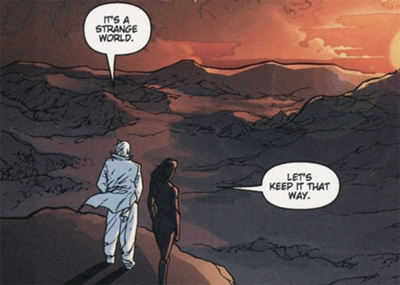
Strange ways...

Continue reading

The Absolute Authority, Vol. 1 (Review)

With Wildstorm being officially folded into the relaunched DCU (the “DCnU”), I thought I might take a look at some of the more successful and popular Wildstorm titles that the company produced. In particular, The Authority, the superhero saga that spun out of Stormwatch – a series that is getting its own post-relaunch book written by Paul Cornell, easily one of my more anticipated titles.

It’s really hard to grasp how much of a revolution Warren Ellis’ run on The Authority was, in hindsight. Sure, the writer had been playing with the idea of a more “real world” superhero team (at least in political and philosophical terms) since his original run on Stormwatch, but it was with The Authority that Ellis and Hitch managed to effectively lay out the design of superhero comics in the twenty-first century. It’s no coincidence that both halves of the creative team behind The Ultimates cut their teeth on the title (albeit at different times).

Was I the only one thinking of Gene Hunt everytime I read the word "superbastards"? "You are surrounded by armed superbastards!"

Continue reading

Non-Review Review: RED

The way that society treats its elderly makes for great fodder for films. After all, what happens to us when we climb over that hill – when we make it all the way to retirement and cease to contribute in the most conventional manner? Will anybody care? Will anybody notice? It’s something that will (hopefully) happen to a lot of us, but it’s not necessarily something we give a lot of thought to – perhaps because we wouldn’t be too comfortable with the answers we’d find. “I never thought this would happen to me,” Joe Matheson confesses at one point as he strolls around “Green Spring Rest Home” with his old colleague, Frank. When Frank asks what he means, Joe elaborates, “Getting old.”

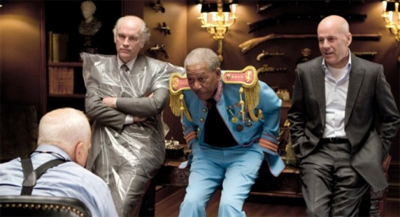
Up to their old tricks...

Continue reading

Mark Millar & Brian Michael Bendis’ Run on Ultimate Fantastic Four – Vol. 1 (Hardcover)

The Fantastic Four, as originally imagined by Stan Lee and Jack Kirby, were an instant overnight success for Marvel. Although perhaps Spider-Man would go on to surpass them as the most recognisable creation from the comic book publisher, the four were intrinsically linked with the spirit of newness and pop science that defined comic books in the sixties – the run was so iconic that I’m even considering placing an order for the two volumes of Lee and Kirby’s Fantastic Four Omnibus, even though I find Silver Age comic books tough to read. So, it comes as a bit of a surprise that the characters were among the last to be coopted into Marvel’s Ultimate line, an experiment designed to essentially start their characters from scratch again to attract a new audience. However, depite the late arrival of Ultimate Fantastic Four – four years after Ultimate Spider-Man and three years after Ultimate X-Men – the talent involed in the launch of the series suggests that Marvel was trying to get this version of the family off to the same flying start as their mainstream counterpart.

That's gonna put a dent in local real estate prices...

Continue reading

Ultimate Galactus Trilogy (Review/Retrospective)

After spending the tail end of last year looking at the tangled inter-continuity crossovers at Marvel, I thought I’d spend January looking at some of the looser “out of continuity” tales at the major companies.

What does a continuity-lite crossover look like? I mean, a relatively self-contained comic book event that isn’t based upon years and years of events? Marvel famously launched their Ultimate line a decade ago to offer a chance to “reimagine” their classic stories – the Avengers became The Ultimates, and monthly issues of Ultimate Spider-Man, Ultimate X-Men and Ultimate Fantastic Four were available on the stands. The goal was to offer tales that would allow new readers to jump on board without having to worry about the weight of half-a-century (or more) worth of back story for the characters. Despite some minor crossover between the books – Mark Millar writing the Ultimates into his Ultimate X-Men run or Ultimate Spider-Man occasionally paying a short visit to the Baxter building – the line largely steered clear of the sort of bombastic big events that Marvel seems to love churning out month-on-month. So, what does an actual “big crossover event” look like when written for these characters? A bit like the Ultimate Galactus Trilogy, I suppose.

He's got the world in the palm of his hand...

Continue reading

Iron Man: Extremis (Review/Retrospective)

John Pillinger says the Iron Man suit is a military application. I told him he was wrong. I’m trying to decide if I was lying. I’ve never sold any element of the Iron Man to the military. It’s used for extraordinary rescue and response situations. Iron Man saves lives. Iron Man used to represent the future.

– Tony Stark considers his legacy

What’s the Iron Man for, Tony?

– Sal cuts straight to the heart of the matter

The more Iron Man stories I read – and the more movies I see as well – it appears that Tony Stark as a lost individual isn’t a metaphor, it’s more of a metaphysical observation. He’s typically well written and carefully considered (of course, there are glaring exceptions), but he rarely seems to find himself involved in any particularly strong narratives. His appeal is centred entirely on the character’s charm, charisma and pride of place as one of fiction’s most famous and prestigious futurists. I don’t mean this as a slight on Extremis by any means – in fact, Warren Ellis’ revised mission statement for the true man of tomorrow may be the best Iron Man story I’ve read.

What is Tony Stark made of?

Continue reading

Ultimate Comics Iron Man: Armour Wars

Iron Man has always been a character better suited to defining character arcs than to defining runs – which is arguably odd, when considered with most iconic characters. When we talk about Daredevil, for example, we talk about Frank Miller and Brian Michael Bendis; when we talk about the X-Men, we talk about Chris Claremont; when we talk about the Green Lantern, we talk about Geoff Johns. On the other hand, when we talk about Iron Man, we talk about Armour Wars or Demon in a Bottle or Extremis. Perhaps that’s a strength when releasing a big budget blockbuster like Iron Man 2 – it’s easy to flood the market with reprints of six or seven issue storylines, rather than having to deal with huge chunks of narrative. It’s also perhaps the reason that this particular miniseries – essentially a modernised continuity-light retelling of a classic story – seems like such a great idea. It’s ridiculous to suggest a retelling of an iconic writer’s tenure, but remaking a single iconic story seems much more reasonable and more than a bit smart – surely it’s a great way to bring readers into step with arguably the most popular comic book character in the world right now?

Par Armor...

Continue reading

Ultimate Human – Ultimate Hulk vs. Iron Man

Well, I guess the Ultimate line is supposed to be a vehicle for redefining old Marvel stories, so it seems appropriate that the Ultimate Hulk has been getting around knocking seven kinds of crap out of various heroes. He was the first opponent Mark Millar’s superteam faced in The Ultimates, he had this themed face-off with Iron Man last year and this year he squared off with Wolverine in the infamously delayed Ultimate Hulk vs. Wolverine series (in a fitting echo: Wolverine originated as a Hulk opponent). The book is an obvious attempt to cash in on Marvel’s two big summer blockbusters last year: The Incredible Hulk and Iron Man. Still, as cash-ins go, it’s reasonably diverting.

ultimatehulk

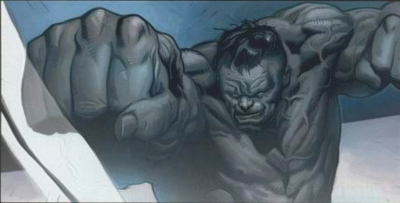
I quite like him when he's angry...

Continue reading