• Following Us

  • Categories

  • Check out the Archives


  • Awards & Nominations

Space: Above and Beyond – And If They Lay Us Down to Rest… (Review)

This November (and a little of December), we’re taking a trip back in time to review the third season of The X-Files and the first (and only) season of Space: Above and Beyond.

The last stretch of episodes of Space: Above and Beyond are quite mournful and introspective.

It is very difficult to tell a war story. There are a host of tightropes that any writer has to navigate. After all, it is very easy for a story about the bonds of warfare and humanity in wartime to be interpreted as militaristic or fascistic. At the same time, it is very easy for an anti-war parable to seem critical of the soldiers fighting the war, to dismiss the bravery and courage on display in that most horrific of environments.
Seeing eye-to-eye...

Seeing eye-to-eye…

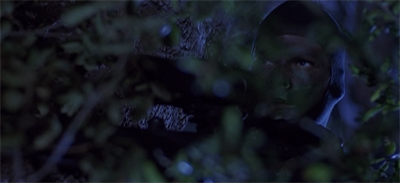
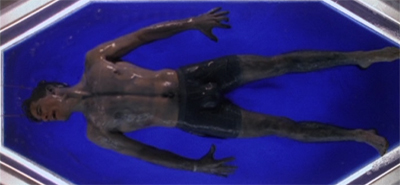
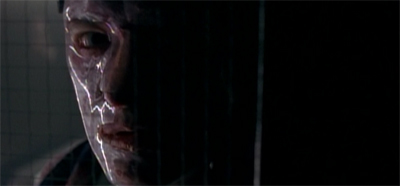
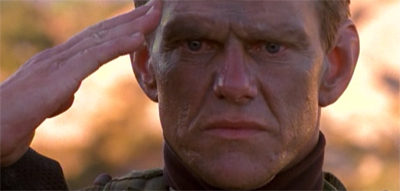
With its futuristic tech and gigantic guns, as well as its fascination with the military apparatus, it is easy to read Space: Above and Beyond as a pro-military piece. Given how much pride it takes in the way that it presents military life, or how much it wallows in the military setting, a casual viewer might be forgiven for assuming the it glorifies warfare. However, this is the most superficial of readings. It ignores a lot of what the show actually has to say about combat and warfare.

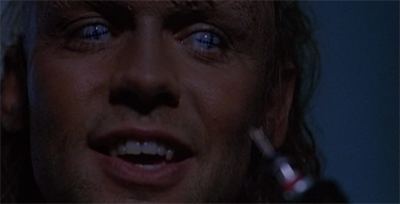
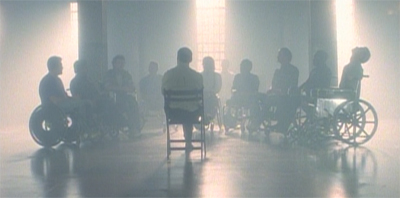
Space: Above and Beyond is by turns cynical and romantic in its portrayal of this futuristic conflict – it clearly respects and appreciates the sacrifices made by those in service of mankind, but is also wary about the motivations of those ordering the sacrifices. It is a very delicate balance to maintain. However, And If They Lay Us Down to Rest… and … Tell Our Moms We Done Our Best seem to lay the cards out on the table, once and for all. This is as anti-war as the show ever gets.

Face of the enemy...

Face of the enemy…

Continue reading

Space: Above and Beyond – Pearly (Review)

This November (and a little of December), we’re taking a trip back in time to review the third season of The X-Files and the first (and only) season of Space: Above and Beyond.

Richard Whitley is one of the more promising writers on Space: Above and Beyond.

While Pearly does not benefit (and indeed actively suffers) from the same loose structure that made Dear Earth work so well, it is an episode very much in touch with what the show wants to be about. It is very much a science-fiction version of a classic Second World War story, to the point where Whitley himself has described it as an adaptation of the classic Humphrey Bogart movie Sahara. It is a nice glimpse at several facets of the conflict that we have not seen yet, but which make sense in context.

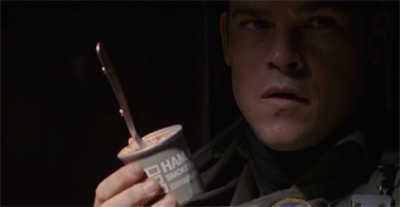
Canned ham...

Canned ham…

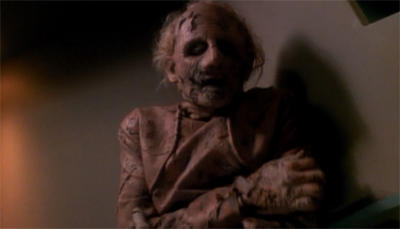
That said, there are serious problems with Pearly. It is very clear that the production managed to get ahold of a tank for filming, and sought to capitalise on that. The episode’s structure feels rather forced and unstructured in places, full of contrived coincidences that seem a little strange when considered as a whole. Not all of the character interactions feel genuine, and not all the episode’s big moments feel entirely earned. These are legitimate problems, and they do hold Pearl back.

At the same time, Pearly is an episode simmering with potential and ambition. It is hard to hate.

Crossed wires...

Crossed wires…

Continue reading

Space: Above and Beyond – The Angriest Angel (Review)

This November (and a little of December), we’re taking a trip back in time to review the third season of The X-Files and the first (and only) season of Space: Above and Beyond.

Existentialism is something of a recurring theme in the work of Glen Morgan and James Wong.

It echoes through their work. Mulder’s choice of action ultimately serves to define him in One Breath, in contrast to the other more senior male characters in the narrative. The duo’s second script for Millennium, 5-2-6-6-6, opens with a quote from existentialist philosopher Jean Paul Sartre. Even the pair’s feature film work – The One and the Final Destination films – touch broadly on existentialist themes.

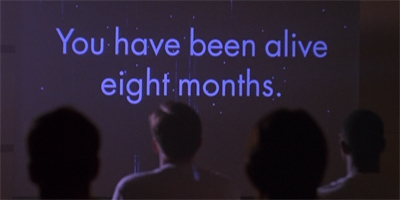
Pressed (up) on the issue...

Pressed (up) on the issue…

However, The Angriest Angel is perhaps the most candid of their scripts, with McQueen explicitly explaining how his actions are serving to define his identity. In his power-house opening monologue, McQueen describes these defining moments as make-or-break points. “Everyone, everyone in this life knows when the moment is before them. To turn away is simple. To ignore it assures survival. But it is an insult to life. Because there can be no redemption.”

This is perhaps the most elegant and effective summary of Morgan and Wong’s approach to character development. McQueen articulates it clearer than any of their characters, but the philosophy applies just as much to Scully in Beyond the Sea or Never Again as it does to Tyrius Cassius McQueen. Indeed, it would come to define their work on Millennium, with the second season repeatedly suggesting that the end of the world was as much a personal event as a massive social occurrence.

Slice of life...

Slice of life…

Continue reading

Space: Above and Beyond – Never No More (Review)

This November (and a little of December), we’re taking a trip back in time to review the third season of The X-Files and the first (and only) season of Space: Above and Beyond.

On the surface, Never No More and The Angriest Angel feel like a companion piece to Hostile Visit and Choice or Chance. Both are two-part episodes airing around sweeps, almost in step with the equivalent two-part episodes of The X-Files. Both push the show’s story arcs forward. Both also draw in recurring guest stars Doug Hutchinson and Michael Mantell, last seen during Choice or Chance. In many respects, Never No More and The Angriest Angel could be seen as a follow-up to that earlier two-part adventure.

However, there are a number of subtle differences that help Never No More and The Angriest Angel feel like a series highpoint – rather than another ambitious misfire. Hostile Visit and Choice or Chance seemed like episodes trying to do too much, and straying into areas where Space: Above and Beyond had always faced difficulty. They were high-concept science-fiction epic adventures that also tried to work in character arcs for the entire ensemble, set against a truly epic story about an ambitious suicide mission and subsequent rescue attempt.

It's only a paper moon...

It’s only a paper moon…

In a way, Never No More and The Angriest Angel are a lot more modest in their scope. There are big revelations here, and plot points that push the show’s arc forwards. However, these elements are not foregrounded. Never No More and The Angriest Angel are not episodes that aspire to be all things to all people. Instead, they are two character studies centred on the two strongest characters (and actors) in the cast, filling in other details as a secondary concern.

Space: Above and Beyond always worked better as a war show than as a science-fiction drama, and Never No More and The Angriest Angel seem to realise this. The two episodes play as an extended homage to the tropes and conventions of classic war stories. Never No More is the story of love divided by conflict, and The Angriest Angel is a tale of personal discovery set against the backdrop of a larger war. They combine to produce a highlight of the entire Space: Above and Beyond run.

Not a patch on his original squadron...

Not a patch on his original squadron…

Continue reading

Space: Above and Beyond – Who Monitors the Birds? (Review)

This November (and a little of December), we’re taking a trip back in time to review the third season of The X-Files and the first (and only) season of Space: Above and Beyond.

Who Monitors the Birds? is a phenomenal piece of television.

Space: Above and Beyond is a show that only ran one season, languishing on Sunday nights before Fox decided to just scrap the idea of consistently scheduling it and just bounced it around the network timetable. It was not a breakout hit. It did not inspire a revival or resurrection in the way that other science-fiction properties have done. It has a very devoted and strong cult following, but its name is more likely to evoke a vague remembrance than anything more concrete.

spaceaboveandbeyond-whomonitorsthebirds13

And yet, despite that, Space: Above and Beyond was still a massively influential piece of television. Despite the fact that it was structured as a throwback to classic war movies, it was also a very progressive piece of television. The influence of Space: Above and Beyond can be keenly felt on Ronald D. Moore’s Battlestar Galactica, even though the show seldom gets any real credit for that influence. In some respects, Space: Above and Beyond was well ahead of its time.

Who Monitors the Birds? is put together with incredible skill and confidence. It is an episode that holds up fantastically, and which serves as a demonstration of the series’ lost potential.

spaceaboveandbeyond-whomonitorsthebirds3


Continue reading

Space: Above and Beyond – Stay With The Dead (Review)

This November (and a little of December), we’re taking a trip back in time to review the third season of The X-Files and the first (and only) season of Space: Above and Beyond.

There is a nice story buried somewhere in Stay With the Dead. Space: Above and Beyond has generally worked better as a story about warfare than an action-adventure science-fiction show. As such, it’s telling that the best parts of Stay With the Dead have less to do with the plot-driven flashback-ridden mystery at the heart of the episode, and more to do with the aspects of the script that confront the uncomfortable realities of war.

Post-traumatic stress disorder is an absolutely terrifying aspect of armed conflict. War claims lives; countless soldiers and civilians are sacrificed in the name of the greater good. However, even those who survive are left scarred by the experience. The trauma need not be physical. Exposure to combat and warfare can leave a lasting psychological scar. It has widely been suggested that shell-shock and other post-traumatic stress disorders have been under-reported among veterans of previous conflicts.

The wages of warfare...

The wages of warfare…

Stay With the Dead broaches the topic when West is recovered from the field of battle suffering from anxiety attacks and struggling to recall the details of his experience. He is unable to sleep, with even the smallest noise reminding him of his experiences. Army doctors are unable to help him, and make suggestions that seem more interested in what is most convenient for the war effort rather than addressing his own needs. There’s a lot of potentially compelling commentary about how warfare works, and the conflicts of interest that arise.

However, instead of exploring these issues, Stay With the Dead instead becomes a flashback race-against-time mystery. It is not a very good one.

Purple haze...

Purple haze…

Continue reading

Space: Above and Beyond – Choice or Chance (Review)

This November (and a little of December), we’re taking a trip back in time to review the third season of The X-Files and the first (and only) season of Space: Above and Beyond.

Hostile Visit and Choice or Chance follow the two-part template established by The X-Files, keeping things fresh by offering a pretty dramatic shift between the two episodes in question.

Hostile Visit featured a covert trojan house mission to infiltrate enemy space and stage a devastating attack behind enemy lines. The episode ended with the mission a failure and our heroes drifting through space. Choice or Chance features our heroes landing on a prison planet maintained by the Silicates, the evil artificial organisms that have skirted around the edge of the show’s mythology to this point.

Here's Douggie!

Here’s Douggie!

Choice or Chance comes very close to working. It is a lot more dynamic than Hostile Visit was, which is a good thing for the second half of a two-parter airing during November Sweeps. However, while Hostile Visit felt a little padded and extended, never quite building the momentum necessary for the story to work, Choice or Chance feels a little over-stuffed. There’s a lot of nice stuff here, but no room to properly digest it. It’s an episode that comes up with something for every member of the cast to do, but this inevitably means that the character arcs feel abbreviated and shortened.

There is a  pretty solid two-part episode to be constructed out of the ingredients of Hostile Visit and Choice or Chance. Sadly, the resulting two-parter is not it.

Crash and burn...

Crash and burn…

Continue reading

The X-Files – The Walk (Review)

This November (and a little of December), we’re taking a trip back in time to review the third season of The X-Files and the first (and only) season of Space: Above and Beyond.

The approach that The X-Files took during its third season was to hone what had worked during the first two seasons to a fine edge.

The second season had been quite playful and experimental – taking the time to figure out what did and didn’t work. Comedy episodes, like Die Hand Die Verletzt and Humbug, worked; making shows like Clyde Bruckman’s Final Repose or Jose Chung’s “From Outer Space” logical choices. Mythology-driven two-parters during sweeps had paid off, so those returned for the third season. In contrast, the heavy science-fiction of shows like Fearful Symmetry, Død Kälm or Soft Light didn’t work, and were largely forgotten.

Let some light in...

Let some light in…

The result is a third season that plays to the established strengths of The X-Files. Sure, there are still bold and experimental episodes – particularly those credited to writer Darin Morgan. However, the third season is markedly more conservative in tone than the second season – or even the fourth season. This conservatism can work very well. The third season has very few out-and-out bombs, and more than a few classics. However, it comes at a cost.

The Walk is a reasonably well-produced episode that feels a little bit overly familiar. This is the second “supernatural revenge” story that The X-Files has done in so many episodes. There’s a point where The Walk feels a lot less like a unique story than an archetypal “fill in the blanks” exercise, where a unique location and a new set of characters are caught up in an old-fashioned ghost story.

Don't worry, Stans will take good care of him...

Don’t worry, Stans will take good care of him…

Continue reading

Space: Above and Beyond – Ray Butts (Review)

This November (and a little of December), we’re taking a trip back in time to review the third season of The X-Files and the first (and only) season of Space: Above and Beyond.

Ray Butts is a collection of familiar war movie clichés.

Space: Above and Beyond is effectively a gigantic Second World War movie in space, and Ray Butts allows creators Glen Morgan and James Wong to roll two of the most instantly recognisable war movie archetypes into a single character. The eponymous officer is at once a soldier traumatised by his past experiences and a tough new commander for a young unit. He is a source of friction on the show, kept ambiguous and mysterious for most of the episode’s runtime.

We salute you...

We salute you…

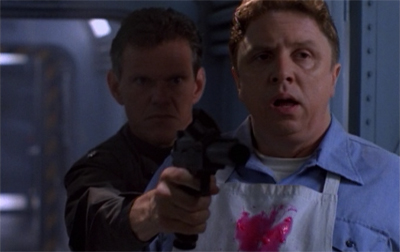
Ray Butts piles on the questions. The show doesn’t reveal his orders for quite a while, asking the audience to decide whether they trust the orders – let alone the man assigned to carry them out. The show also plays up questions around Butts himself; is Butts a man trying work through his own issues in his own way, or simply a risk-taking and borderline incompetent commanding officer? Ray Butts doesn’t have too many surprises, but it works because Morgan and Wong know how to structure an episode of television.

After the misfiring ambition of The Dark Side of the Sun, it feels almost like Ray Butts puts Morgan and Wong back in their element.

Don't shoot the chef!

Don’t shoot the chef!

Continue reading

Star Trek: Deep Space Nine – The Die is Cast (Review)

This September and October, we’re taking a look at the jam-packed 1994 to 1995 season of Star Trek, including Star Trek: Deep Space Nine and Star Trek: Voyager. Check back daily for the latest review.

The Die is Cast is, like Improbable Cause before it, a wonderful piece of television.

As with most Star Trek: The Next Generation and Star Trek: Deep Space Nine two-parters, The Die is Cast maintains continuity and consistency with its predecessor, but it feels like a very different episode than Improbable Cause. After all, the curtain has been pulled back. The assassination attempt is no longer the driving force of the narrative (in fact, it’s barely referenced), with the plot focusing on Enabrain Tain’s pre-emptive strike against the Dominion.

A bruised ego...

A bruised ego…

It’s interesting that it falls to the Cardassians and the Romulans to drive the Dominion plot onwards. There’s been no real development of this long-form plot since Sisko and his crew escaped at the end of The Search, Part II. Episodes like The Abandoned and Heart of Stone have seen the crew encountering individual members of the Dominion, and shows like Visionary have had characters sitting around talking about them, but nothing has actually happened. It is mostly business as usual.

As such, the episode’s title feels beautifully appropriate – it’s the crossing of a threshold, a point from which there can be no return. Not just for Tain or the Cardassians, but the show itself.

Odo's sympathy for Garak runs dry...

Odo’s sympathy for Garak runs dry…

Continue reading