• Following Us

  • Categories

  • Check out the Archives


  • Awards & Nominations

The Simpsons – The Springfield Files (Review)

This February and March, we’re taking a trip back in time to review the fourth season of The X-Files and the first season of Millennium.

A young network hungry to find its place in the American television market, Fox managed to produce two of the television shows that defined the nineties. Both The X-Files and The Simpsons were bold and innovative television shows that captured the zietgeist perfectly. Both shows offered an insightful, innovative and occasionally subversive look at American pop culture in the last decade of the twentieth century. Both have endured quite well, speaking to a generation that came of age in the nineties.

While The X-Files wound itself up in 2002, The Simpsons endures. The show has been running for almost a quarter-of-a-century at this point, and there is no sense that it will ever let up. While there are stock criticisms to be made about how The Simpsons is not as funny as it once was, the series has continually and perpetually reinvented itself. The success of these various iterations has varied. The Simpsons was a different show in 1989 than it was in 1992 or 1996 or 2000.

"Mulder and Scully. FBI."

“Agents Mulder and Scully. FBI.”

However, the show was in the middle of an incredible hot streak in January 1997. The show was in its eighth season, and on the cusp of overtaking The Flintstones as the longest-running prime-time animated series in the United States. This was a phenomenal accomplishment, and there was no indication that the show was in decline. Although fans will argue about exactly how long the so-called “golden age” of the Simpsons actually lasted, the series was still in the middle of it by January 1997.

So The Springfield Files makes a lot of sense as an obvious overlap between the two most important weekly shows airing on Fox at this moment in time. The Springfield Files was treated as a big deal at the time. It aired two weeks before Superbowl XXI, which would help give The X-Files its highest-ever ratings with Leonard Betts. It was sent to the press for review before it aired, to help generate word of mouth. The result is a delightfully satisfying intersection of two massively successful and influential shows.
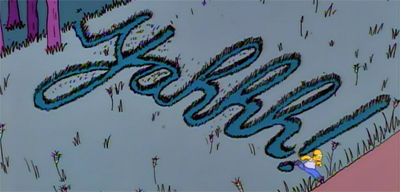
Reading the scene...

Reading the scene…

Continue reading

Millennium – The Wild and the Innocent (Review)

This February and March, we’re taking a trip back in time to review the fourth season of The X-Files and the first season of Millennium.

The Wild and the Innocent is an ambitious piece of television.

It is not a piece of television that works as well as it might, the execution of the central ideas leaving a little to be desired, but it is an episode that commits whole heartedly to something unique. In I Want to Believe, Robert Shearman refers to The Wild and the Innocent as “a plot more suited to Cormac McCarthy than Chris Carter.” He’s not wrong. The Wild and the Innocent is a story about cycles of violence and abuse in the American south, a grim road movie with some very harsh conclusions about the way that the world works.

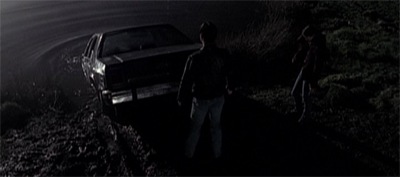
That sinking feeling...

That sinking feeling…

It still fits within the milieu of Millennium. After all the classic “serial killer road movie” is still a serial killer story, and Millennium has already carved out that niche for itself. However, the image of Frank Black and Peter Watts following a trail of bodies from Missouri down through Arkansas suggests a different show than the one that has been airing since The Pilot. In many respects – with its heavy philosophical voice-over, its country-tinged soundtrack, its fixation on the outlaw couple – The Wild and the Innocent feels almost like some old American folk tale.

There’s something decidedly old-fashioned here, with the episode playing more like a western than a police procedural. In the documentary Order in Chaos, Carter described Frank Black as character from a story “like Shane, like any cowboy, any good movie, Western movie.” As such, he fits in quite comfortably with this new type of story.

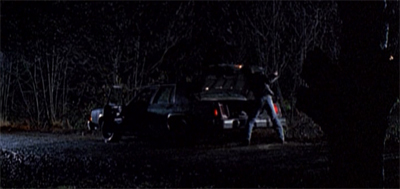
Road warrior...

Road warrior…

Continue reading

The X-Files – Tunguska (Review)

This February and March, we’re taking a trip back in time to review the fourth season of The X-Files and the first season of Millennium.

The show’s conspiracy plot line is rapidly approaching critical mass.

It is quite clear at this point that while colonisation might have a schedule, Fox had just thrown Chris Carter’s out the window. The X-Files: Fight the Future looms large on the horizon. Indeed, Tunguska is credited to Chris Carter and Frank Spotnitz, who would end up writing the screenplay for the feature film over the Christmas break. However, while Carter had originally conceived the movie to put a cap on the television series, Fox wanted it to tie more aggressively into the series. It would not be the end of the journey, but a middle chapter.

Flagging the danger...

Flagging the danger…

As such, the larger conspiracy plotline that had been gathering momentum since the end of the second season spends two years largely spinning its wheels to keep the feature film relevant. The film was written midway through the fourth season and shot in the gap between the fourth and fifth seasons. So, there is a lot of stalling required. To use the “cancer” metaphor that is cleverly (and almost subconsciously) woven through the fourth season, the central conspiracy plotline seems to go into remission for a while.

This isn’t inherently a bad thing. Indeed, the stalling allows the show to take stock and to devote space in the mythology to more personal stories like Tempus Fugit and Max or Christmas Carol and Emily. However, it also means that episodes like Herrenvolk, Tunguska, Terma and The End felt like attempts to buy time – offering the illusion of dynamism and change while only inching the plot along.

Wired up...

Wired up…

Continue reading

The X-Files (Topps) #23 – Donor (Review)

This February and March, we’re taking a trip back in time to review the fourth season of The X-Files and the first season of Millennium.

Donor is the strongest of John Rozum’s work on The X-Files to this point. It might be his best work overall.

It is a story that very clearly and very strongly plays off the classic horror vibe that has been running through this stretch of episodes, taking the idea of supernatural revenge and poetic justice to almost blackly comic extremes. In many respects, John Rozum has pushed the comics towards a very traditional sort of moralistic storytelling – with characters frequently facing ironic consequences of their actions.

Organ grinder...

Organ grinder…

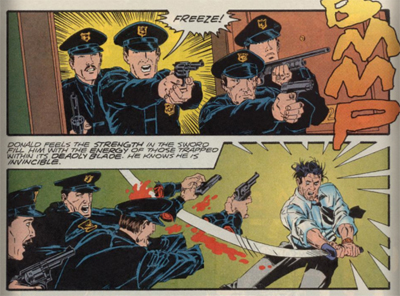
In The Silent Blade, a mass murderer kills himself with the blade that compelled him to kill. In The Kanashibari, a bunch of college kids who terrified an asthmatic classmate to death by locking him in a closet are themselves scared to death by a suffocating spectre. In Silver Lining, a killer murders innocent people to reclaim his good looks, only to lose them almost immediately in a fire while fleeing the FBI.

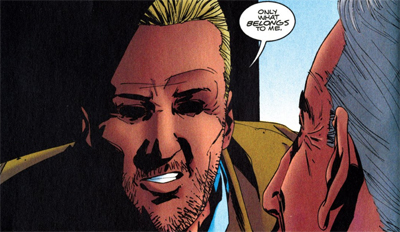
So Donor pushes this sort of storytelling to its logical extreme, as the resurrected body of Bruce Miller tries to reclaim the organs that his widow donated without his consent. Bruce Miller plans to take back what is rightfully his, harvesting various vital organs from recipients. Donor is a very dark little done-in-one story with a delightfully wry and cynical attitude that elevates it above many of its contemporaries.

"You have something that I need..."

“You have something that I need…”

Continue reading

The X-Files – Musings of a Cigarette-Smoking Man (Review)

This February and March, we’re taking a trip back in time to review the fourth season of The X-Files and the first season of Millennium.

“No great man lives in vain. The history of the world is but the biography of great men.”

– Thomas Carlyle, On Heroes, Hero-Worship, and the Heroic in History

Light 'em up...

Light ’em up…

Continue reading

The X-Files (Topps) #22 – The Kanashibari (Review)

This February and March, we’re taking a trip back in time to review the fourth season of The X-Files and the first season of Millennium.

The Kanashibari confirms what readers should expect from Topps’ licensed comics based on The X-Files. It is another atmospheric and episodic horror story, tightly plotted and written, with a grim sense of moral certainty underpinning it. The Kanashibari feels like something of a throwback, a modern-day take on those classic E.C. Comics horror stories – morality tales where the vengeance is exacted against those who have committed an injustice.

It is a throwback in other ways as well. The Kanashibari and Donor are both old-fashioned “supernatural revenge stories”, the kind of stories that would sit comfortably in the first season of The X-Files. Episodes like Shadows, Lazarus, Young at Heart, Born Again and Roland were all stories about characters seemingly returning from beyond the grave to wreak a terrible revenge against those had wronged them.

Who ya gonna call?

Who ya gonna call?

Continue reading

The X-Files – Sanguinarium (Review)

This February and March, we’re taking a trip back in time to review the fourth season of The X-Files and the first season of Millennium.

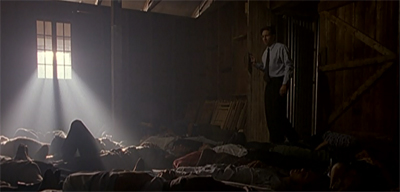
Appropriately enough, Sanguinarium is a bloody mess of an episode.

To be fair, it’s not a total write-off. There are some interesting ideas here, and the episode’s willingness to indulge in trashy horror is almost endearing… to a point. However, Sanguinarium often serves to illustrate just how much care and consideration is necessary to make an episode of The X-Files work. It is a very effective counter-example, an episode that demonstrates it takes more than just pulpy horror to make an episode work. Sanguinarium is almost as revolting and as graphic as Home, but it lack all the little elements that made the earlier episode work.

The doctor will see you now...

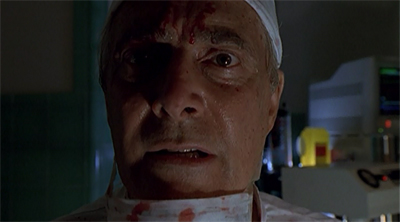
The doctor will see you now…

It’s cheesy instead of wry. It’s gratuitous instead of simply hyperactive. It’s blunt instead of subversive. Sanguinarium is not a misfire to the same extent as – say – Teso Dos Bichos or Excelsis Dei. It has a few ill-judged elements, but it’s more clumsy than offensive. It might be a bit much to suggest that there’s a classic episode buried just beneath the surface of Sanguinarium, but it seems fair to say that there is a much better episode somewhere in here. One suspects that pressure behind the scenes simply made it tougher to bring that episode to the fore.

Nevertheless, Sanguinarium is an interesting failure, if not quite a satisfying episode.

Blood work...

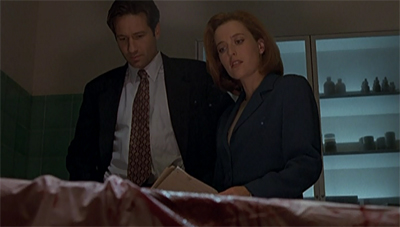
Blood work…

Continue reading

The X-Files – The Field Where I Died (Review)

This February and March, we’re taking a trip back in time to review the fourth season of The X-Files and the first season of Millennium.

Morgan and Wong’s four scripts for the fourth season of The X-Files are utterly unlike any other stories in the show’s nine-season run. Experimental, bold, confrontational; these four stories stretch and pull at The X-Files, as if eager to see just how far the hit show will bend.

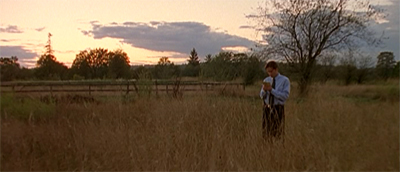
The Field Where I Died is probably the weakest of these four episodes, but it is also the most ambitious. It is a script with big ideas and a willingness to commit to those ideas. There is no modesty here, no hesitation. There is a sense that Morgan and Wong are committing wholeheartedly to their themes and their concepts. The Field Where I Died is an episode that rubs quite a lot of people the wrong way, for a number of different reasons; however, the episode never pulls its punches. It never holds back. It never tries to be anything that it is not.

Far afield...

Far afield…

There is a lot to admire here. The Field Where I Died is not an episode with a simply formulaic concept or a conventional structure. It looks and feels completely unlike any other episode of the show. Even when the show touched on similar themes in its final season, the result was radically different. Hellbound is a much more conventional episode than The Field Where I Died. More than Home or Musings of a Cigarette-Smoking Man or Never Again, this is an episode that really seems like an odd fit for The X-Files.

Then again, that may be the beautiful thing about The Field Where I Died, for all its many flaws. It is utterly unlike anything else on television in the nineties. The fact that it can produce an episode of television so unique and incomparable is ultimately what makes The X-Files feel like The X-Files. The fact that The Field Where I Died feels so unconventional and eccentric is precisely what makes it a worthy episode of The X-Files.

Another roaring success for Mulder...

Another roaring success for Mulder…

Continue reading

The X-Files (Topps) – The Silent Blade (Review)

This February and March, we’re taking a trip back in time to review the fourth season of The X-Files and the first season of Millennium.

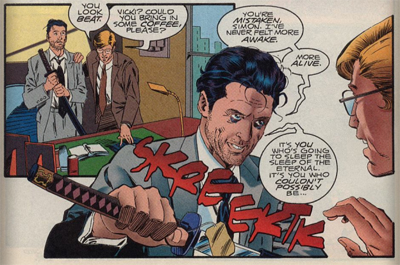
The Silent Blade is filler – one of those short stories that Topps produced as promotional material for wider consumption. In this case, as with The Pit, The Silent Blade was written as a short story to feature in the summer issue of The X-Files Magazine.

Writing a short story is tough. In some respects, writing a nine-page comic strip with a clear beginning, middle and end is harder than plotting a full-length issue or an entire arc. There is only so much space available, particularly when dealing with an exposition-heavy franchise like The X-Files. It can be tough to fit all the necessary ingredients in, let alone to put a novel twist on them. The temptation is to try to do too much with so little.

He won't be drawn on the matter...

He won’t be drawn on the matter…

Writer Stefan Petrucha and artist Charles Adlard had generally done well by their short stories, treating them as light and throwaway. They were not the strongest stories of the run, but they were aware of the limitations of the format and the expectations of the target audience. They were functional pieces of writing, aware of the limitations of the form. John Rozum’s first (and only) abridged X-Files story strains against those limitations.

After all, Rozum’s script for Thin Air had tried to fit too much into a full-length issue, so it makes sense that The Silent Blade is also a little too busy for its own good. This would be the last feature that Topps would produce for The X-Files Magazine, and the last of these sorts of short stories.

You have to do a lot of cutting to make a story this tight...

You have to do a lot of cutting to make a story this tight…

Continue reading

The X-Files – Unruhe (Review)

This February and March, we’re taking a trip back in time to review the fourth season of The X-Files and the first season of Millennium.

Unruhe was the first episode of The X-Files to air on Sunday nights.

The show had vacated its traditional Friday evening slot to make room for Millennium. It had been moved to Sunday evenings. Although the production team were initially quite cautious about the move, it would ultimately pay dividends for the show. The show had already become a mainstream hit, but the Sunday night slot would help to push it into the stratosphere. Airing alongside Fox’s other long-running success story, The Simpsons, the show would secure its highest ratings ever less than six months after moving into its new slot.

Photo copy?

Photo copy?

Of course, this also draws attention to another interesting facet of Unruhe. This was the first episode of The X-Files to air after Millennium hit the air. Unruhe aired two days after the pilot. The impact of Millennium has already been keenly felt on the fourth season of The X-Files in a number of ways; deadline and production issues hindered Herrenvolk, while James Wong and Glen Morgan had been drafted back to The X-Files to help shore up the fourth season. However, Unruhe seems to directly (and perhaps pointedly) acknowledge Chris Carter’s younger series.

Unruhe is an episode that would probably have been quite at home on Millennium. It is an episode that could easily have been re-worked or re-tooled for Carter’s new show – with only a few minor changes. With its serial offender, fascination with forensic psychology, and its grim reflection on mankind’s capacity for evil, it feels like an story that could comfortably have been told using Frank Black. While it serves to welcome Millennium to the genre neighbourhood, it also seems to suggest that Millennium might be a little redundant.

A walk among the tombstones...

A walk among the tombstones…

Continue reading