• Following Us

  • Categories

  • Check out the Archives


  • Awards & Nominations

The X-Files – Synchrony (Review)

This February and March, we’re taking a trip back in time to review the fourth season of The X-Files and the first season of Millennium.

Time travel is one of the great science-fiction tropes.

Although magical or metaphorical time travel has long been a part of literary tradition, pseudo-scientific or pseudo-rational versions of science-fiction really took root towards the end of the nineteenth century. Although H.G. Wells blazed a trail with The Time Machine, Edward Page Mitchell actually beat him to the punch – he published the short-story The Clock That Went Backward fourteen years before Wells wrote The Time Machine. Nevertheless, time travel quickly caught on as a literary device.
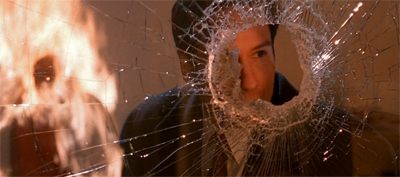
The hole in things...

The hole in things…

There are films, television show, novels, comics and songs all playing with the idea of moving through time. Although there is considerable debate about the feasibility of actually travelling backwards through time, time travel serves as a wonderful narrative device. It opens up all sorts of possibilities for structure and style; it provides some pretty heavy themes; it opens up a myriad of settings and possibility. It is no surprise that there have been so many variations and permutations based upon the idea of going backwards in time.

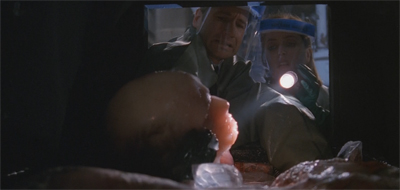
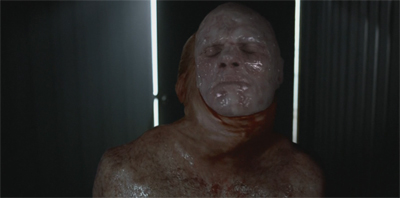
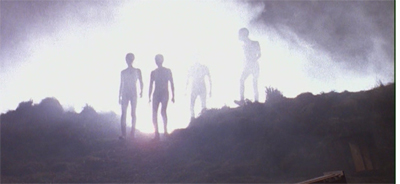
Indeed, it seemed like it was only a matter of time before The X-Files got around to telling its own time travel story. Synchrony was as inevitable as the decision to close the episode with a clumsy hint toward predetermination.
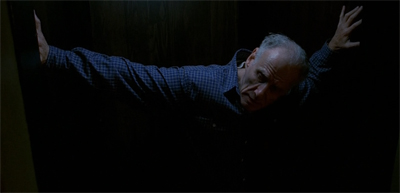
Ghosts of future self...

Ghosts of future self…

Continue reading

The X-Files – Max (Review)

This February and March, we’re taking a trip back in time to review the fourth season of The X-Files and the first season of Millennium.

Reportedly, Tempus Fugit and Max took twenty-eight days to shoot. Assistant director Tom Braidwood described the two-parter as a “pretty challenging” effort for the show. The series built an air plane cabin specifically so that it could film those fantastic abduction sequences. There are fields and hangars strewn with dead bodies and the wreckage of a passenger air plane. By just about any definition, Tempus Fugit and Max comprise the most ambitious and large-scale two-part episode that the show has produced to date.

Paradoxically, this is also the smallest two-part episode that the show has produced to date. It brings back a minor guest star from a first season episode, only to kill him off casually in the teaser for the first episode. None of the big players show up for the drama. The most significant consequence of Tempus Fugit and Max is the death of Agent Pendrell. In many ways, Tempus Fugit and Max is the post-mortem story of a little guy who was crushed by the weight of something much larger than himself – caught between forces of immeasurable power.

In-flight serve will now resume...

In-flight service will now resume…

Tempus Fugit and Max do very little to advance the central mythology arc, which has stalled somewhat in the fourth season. However, they manage to encapsulate so many of the core themes of that central storyline. This is a story about the victimisation of the weak by the powerful; this is a tale about the sacrifices that are made in pursuit of the truth; this is a reflection on the appeal of conspiracy theory; this is a morality play about balancing lives against “the greater good.”

In many ways, Tempus Fugit and Max are the quintessential mythology episodes, despite not being that closely related at all.

Things are looking up...

Things are looking up…

Continue reading

Millennium – Covenant (Review)

This February and March, we’re taking a trip back in time to review the fourth season of The X-Files and the first season of Millennium.

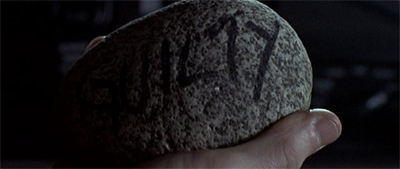
Apparently, the original cut of Covenant ran over an hour and twenty minutes. This is not unusual in network television. Glen Morgan and James Wong faced similar problems when producing The Field Where I Died. However, while cutting The Field Where I Died down to forty-five minutes left something of a jumble, Covenant feels much stronger for the rather ruthless editing done to fit the episode into the broadcast slot. In many ways, Covenant feels quite minimalist – an episode that says the bare minimum, but conveys everything that needs to be conveyed.

Covenant is an episode that could easily seem exploitative. After all, there are points where Millennium feels like it is wallowing in human anguish and suffering. A story concerning the brutal murder of a nuclear family (including three children and a pregnant wife) is something that needs to be approached with care and delicacy. The original script for Covenant is perhaps overwritten, trying to draw too many parallels to Frank’s own family; these associations are best left unsaid.

Bloody handiwork...

Bloody handiwork…

In many ways, Millennium could be described as a “horror” show, and Covenant hones on some of the same fears that the first season has targeted repeatedly. Millennium is a show that is keen to assure viewers that their family members are not safe in their own homes and communities. However, there is a deftness and a tactfulness on display here that elevates Covenant above many of the similar stories in this début season. Covenant is all the more unsettling for its restraint and its control.

Covenant continues a strong late-season streak for Millennium, demonstrating the versatility and the nuance possible within the framework that the show has established. Covenant is a triumph for all involved.

Solid as a rock...

Solid as a rock…

Continue reading

The X-Files – Tempus Fugit (Review)

This February and March, we’re taking a trip back in time to review the fourth season of The X-Files and the first season of Millennium.

Conspiracy lives in the gaps.

Conspiracy theories grow in the gaps of history. They multiple and divide in the absences on the historical record. They entangle and dissemble in the lacunas of memory. In many ways, conspiracy theories represent an attempt to impose order upon a chaotic universe, to know the unknowable. They grow from doubts and questions, holes and voids. Every ellipsis, every redacted line points towards infinite possibilities. Every “no comment” is but conformation of the worst possible outcome.

The truth is up there...

The truth is up there…

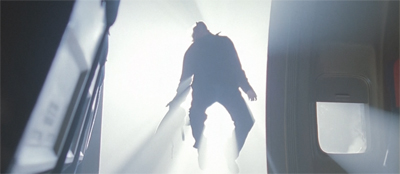
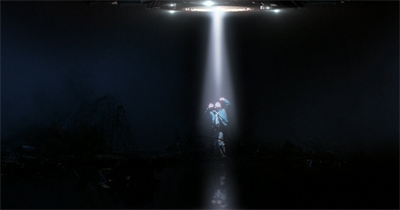
Tempus Fugit opens with a nine-minute gap before a plane crash that claims over one hundred lives. Max closes with another nine-minute gap that sees the ever-elusive proof slip through Mulder’s fingers once again. However, Tempus Fugit and Max are not truly “conspiracy” episodes. Characters like the Cigarette-Smoking Man, the Well-Manicured Man, Alex Krycek and Marita Covarrubias are all absent. Even the sinister functions of shadowy government officials are outsourced to “Cummins Aerospace”, a government contractor never mentioned on the show before or since.

Instead, Tempus Fugit and Max are focused on the little people trying to assemble what they can from these gaps. Mike Millar is an honest and hard-working member of the National Transportation and Safety Board trying to piece together a crashed aeroplane. Max Fenig is trying to piece together some meaning for all his suffering. Mulder and Scully are trying to piece together the truth. Even the aliens themselves seem to be searching. Tempus Fugit and Max are populated with characters trying desperately to make sense of the gaps.

Fly by night...

Fly by night…

Continue reading

The X-Files – Unrequited (Review)

This February and March, we’re taking a trip back in time to review the fourth season of The X-Files and the first season of Millennium.

Unrequited opens with Mulder and Scully’s attempts to stop an assassination attempt by an invisible man, before jumping back twelve hours to explain how our heroes got into this situation. With that set-up, Unrequited falls into a lot of the narrative traps associated with an in media res teaser. After all, there’s not really anything special about the teaser. There is no mystery to be solved, no strange behaviour to explain. What questions are we meant to ask, based on that opening scene? How are we meant to look at the rest of the episode differently, knowing what we know?

Sure, Mulder and Scully are protecting Major General Benjamin Bloch. That would seem to be a little bit outside the remit of “the FBI’s most unwanted”, but that is not too strange a situation for the duo. They are FBI agents, so there is a certain flexibility in their job description. The Field Where I Died – an episode with a much more effective non-linear teaser – featured Mulder and Scully collaborating with the ATF. So it isn’t as if the set-up should be striking or compelling.

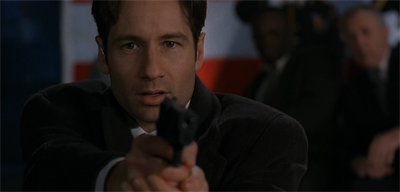
Stop, or my Mulder will shoot!

Stop, or my Mulder will shoot!

It seems like we are meant to focus on the monster of the week – Vietnam veteran Nathaniel Teager. Teager has the ability to turn himself invisible, which is quite something. Sure enough, the teaser to Unrequited offers a glimpse of that ability in action. But why is it important to have show us that ability in a scene from the climax of the episode? With a few adjustments, Teager’s first murder in the back of the limousine would serve the same purpose; introducing the audience to his powers without the need to recycle several minutes of footage from the climax.

After all, the most dissatisfying aspect of the in media res teaser is not the fact that it is completely inessential. Instead, the decision to use footage from the climax means that the audience has to sit through the same sequence twice. The teaser for Unrequited works well enough the first time around, but the sequence is not clever or inventive enough to merit a live-action replay towards the end of the hour. It just saps momentum from episode, rendering the final sequences somewhat tedious. That is the biggest problem with the opening of Unrequited, even beyond laziness.

Flags of our father figures...

Flags of our father figures…

Continue reading

The X-Files – Memento Mori (Review)

This February and March, we’re taking a trip back in time to review the fourth season of The X-Files and the first season of Millennium.

It is easy to see why Scully’s cancer arc is so fondly remembered.

It arrived at a point where the show was at the very top of its game. Scully’s cancer arc comes amid a slew of beloved and classic episodes, in the middle of a season that contains Home, Unruhe, Paper Hearts and many more. It is the defining mythology plot point for the show’s fourth season, which was the point at which The X-Files just exploded into the centre of popular consciousness. More than that, the episode introducing Scully’s cancer – Leonard Betts – was the most-watched episode of The X-Files ever broadcast.

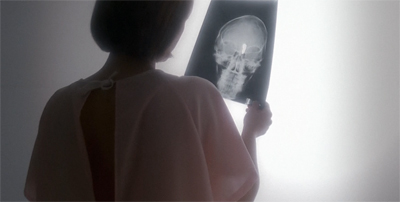
What's in your head?

What’s in your head?

Memento Mori has its own endearing aspects. If Leonard Betts was the show’s highest profile and most populist success, Memento Mori counts as one of the show’s biggest critical successes. The episode is largely responsible for winning Gillian Anderson her Primetime Emmy Award for Outstanding Lead Actress in a Drama Series. It also took home the Primetime Emmy Award for Outstanding Art Direction for a Series and received a nomination for Outstanding Writing for a Drama Series. It is perhaps the most prestigious episode of the fourth season.

However, in spite of all of that, Memento Mori remains something of a mess. It feels like a clumsy retread of One Breath, a story that worked much better in the show’s second season.

Send in the clones...

Send in the clones…

Continue reading

The X-Files – Never Again (Review)

This February and March, we’re taking a trip back in time to review the fourth season of The X-Files and the first season of Millennium.

Not everything is about you, Mulder. This is my life.

Yes but it’s m–

– Glen Morgan and James Wong take their bow; David Chase eat your heart out

...

Continue reading

The X-Files – Leonard Betts (Review)

This February and March, we’re taking a trip back in time to review the fourth season of The X-Files and the first season of Millennium.

Leonard Betts is a big one. In fact, it may just be the biggest one.

Leonard Betts attracted the largest audience in the history of The X-Files, with almost thirty million people tuning in to watch the episode. This audience was largely carried over from Superbowl XXXI, but it arrived at a fortuitous moment for the series. The X-Files was exploding into the mainstream. Chris Carter and Frank Spotnitz had spent Christmas 1996 in Hawaii plotting The X-Files: Fight the Future, a blockbuster movie based on the series. The week before, Mulder and Scully had paid a visit to Springfield in The Springfield Files.

What a waste...

What a waste…

The show’s moment had arrived. Leonard Betts makes for quite the moment. It might not be the best episode in the history of the show; it might not even be the best episode of the season. However, it ranks with Pusher as one of the great archetypal episodes of The X-Files. The show captures so much of what makes The X-Files great, almost perfectly distilling the appeal of the show into a tight forty-odd minute package. It is a beautifully-crafted piece of television that checks all of the right boxes. This is a pretty fantastic introduction to the show and its world.

Leonard Betts is an episode that has been put together with incredible skill, one that demonstrates why The X-Files had such an impact on the popular consciousness.

Comfortable in his skin...

Comfortable in his skin…

Continue reading

The X-Files (Topps) #25-26 – Be Prepared (Review)

This February and March, we’re taking a trip back in time to review the fourth season of The X-Files and the first season of Millennium.

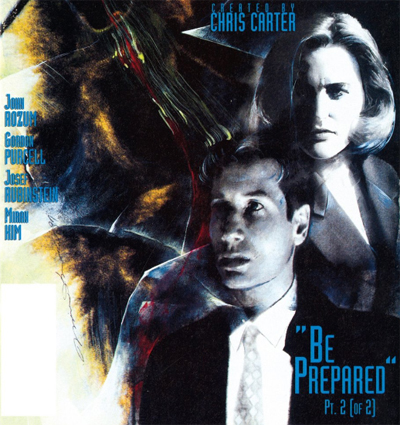
What’s interesting about Be Prepared is how much it feels like an episode of The X-Files.

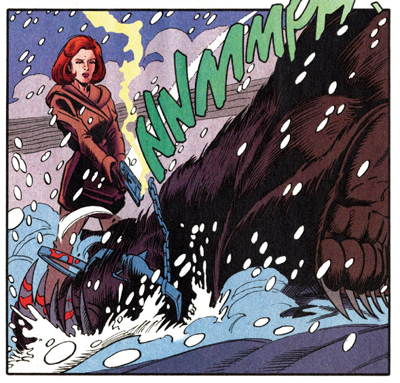
A lot Rozum’s earlier scripts felt like Mulder and Scully had wandered into old E.C. horror stories, cautionary supernatural tales about vengeful ghosts and poetic justice. In contrast, Be Prepared feels very much in tune with the aesthetic of the show itself. Mulder and Scully investigate a uniquely American piece of folklore, finding themselves in an isolated location dealing with human monstrosity at least as much as any paranormal element.

If you go down to the woods today...

If you go down to the woods today…

Indeed, Be Prepared feels very much like an episode from the first two seasons of the show, evoking stories like Ice or Darkness Falls or Firewalker. Indeed, Be Prepared arguably sits comfortably alongside Topps’ range of Season One comics – feeling like a lost episode from the show’s early years. Be Prepared feels like the first time that Rozum is constructing a story specifically from tropes associated with The X-Files, rather than from horror tropes in general.

The result is a fun little adventure that feels more like The X-Files than the comic has in quite a while.

The right to bear arms...

The right to bear arms…

Continue reading

The X-Files – El Mundo Gira (Review)

This February and March, we’re taking a trip back in time to review the fourth season of The X-Files and the first season of Millennium.

The X-Files is a show that sometimes has difficulties when it comes to portraying minorities.

There are lots of episodes that offer insightful and thoughtful explorations of isolated subcultures, without veering into offensive stereotypes or awkward cliché. Fresh Bones and Hell Money are two examples of the kinds of stories that do offer those sorts of interesting and respectful depictions of minorities. In contrast, the show can sometimes seem a little close-minded and xenophobic. Excelsis Dei, Teso Dos Bichos and Teliko are episodes with somewhat questionable depictions of other cultures.

Illegal aliens.

Illegal aliens.

Writer John Shiban likes his horror tropes. He adores the classic horror movie trappings, and revels in a very old-school approach to scary stories. Unfortunately, the horror genre has an unfortunate history of exploitation and racism when it comes to the portrayal of “the other.” The easiest way to make something scary and unknown is to make it foreign, suggesting that the outside world is filled with horrors and monstrosities. Shiban would hit on this trashy exploitation vibe repeatedly during his tenure on The X-Files.

El Mundo Gira is very much a companion piece to Shiban’s other stories about foreign monsters – the indigenous cat-people of Teso Dos Bichos and the butt-dwelling Indian fakir of Badlaa. It is a not a story set in the world of Mexican-American immigrants; it is a story set in a clumsy stereotypical depiction of the world of Mexican-American immigrants, as channelled through unfortunate racial stereotypes.

Green haze...

Green haze…

Continue reading