• Following Us

  • Categories

  • Check out the Archives


  • Awards & Nominations

The Flash (1987-2009) #9-11 – The Chunk/Chunk in the Void/Chunk Barges In (Review)

So, I’m considering reviewing this season of The Flash, because the pilot looks interesting and I’ve always had a soft spot for the Scarlet Speedster. I’m also considering taking a storyline-by-storyline trek through the 1987-2009 Flash on-going series as a companion piece. If you are interested in reading either of these, please let me know in the comments.

While writing The Flash, Mike Baron tended to avoid established villains.

While appearances from Vandal Savage bookend the run, most of the character’s iconic rogues are completely missing from the first year of the title. There is no Reverse-Flash, no Captain Cold, no Weather Wizard, no Heatwave, no Captain Boomerang, no Trickster. Instead, Baron tended to create his own antagonists for Wally West. To be fair, his creatures tended to pop up here and there over the years, but none of them really broke through into the character’s regular supporting cast.
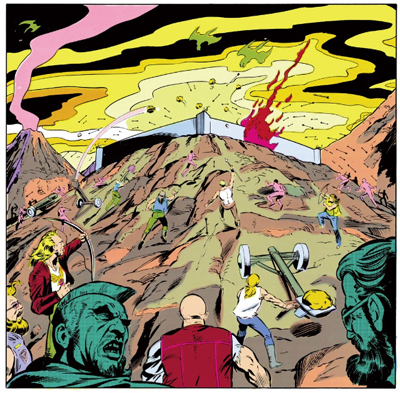
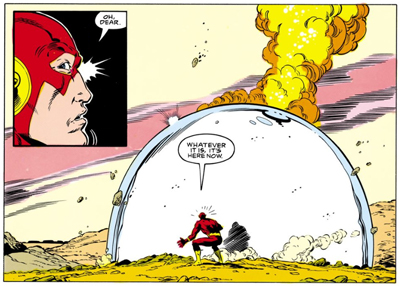
It's the end of the world as we know it...

It’s the end of the world as we know it…

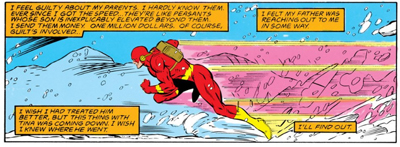
Perhaps Chunk came closest. Chester Runk is the most memorable and well-defined new character to appear during Baron’s run on the title. The character would never become a regular fixture of The Flash, but he would pop up time and again over the years. It is easy to see that might be the case. He is rather distinct from most of the other baddies to debut under Baron’s pen. He looks visually distinctive, has a nice character hook, and fits quite comfortably in the world of The Flash. He’s a nice adversary.

Sadly, his debut story is not a good story.
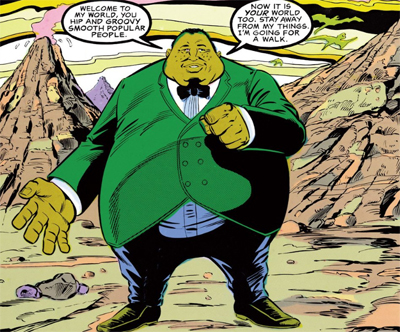
The big man...

The big man…

Continue reading

The Flash – Going Rogue (Review)

So, I’m considering reviewing this season of The Flash, because the pilot looks interesting and I’ve always had a soft spot for the Scarlet Speedster. I’m also considering taking a storyline-by-storyline trek through the 1987-2009 Flash on-going series as a companion piece. If you are interested in reading either of these, please let me know in the comments.

One of the more endearing aspects of The Flash is the way that it embraces the stock superhero clichés. It is a television show that seems completely unashamed of its genre trappings, occasionally basking in its cheesiness. The dialogue is occasionally corny, the set-ups occasionally forced, the plot beats a little melodramatic – but that is a large part of the appeal. The Flash feels like something of a live action comic book.

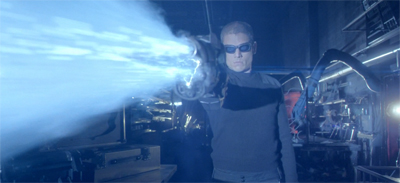
Going Rogue is an episode that basks in its pulpy four-colour roots. Not only does the episode find a bright design for Leonard Snart that hues close to the character’s roots, not only does the show bask in various “cold” puns, not only does it lean heavily on the “save the innocent or catch the guilty” moral dilemma, it even throws in a nice crossover love triangle to keep things interesting. Going Rogue is silly and goofy, but in all the right ways. Endearing and charming, it is a demonstration of how well the show can work.

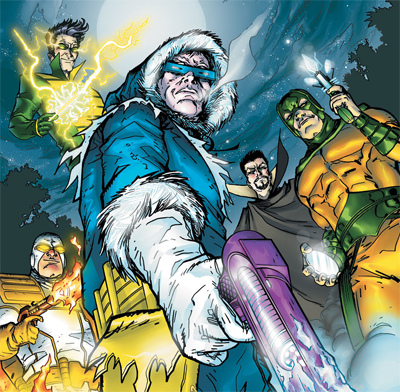
Chill out.

Chill out.

Continue reading

The Flash (1987-2009) #7-8 – Red Trinity/Purple Haze (Review)

So, I’m considering reviewing this season of The Flash, because the pilot looks interesting and I’ve always had a soft spot for the Scarlet Speedster. I’m also considering taking a storyline-by-storyline trek through the 1987-2009 Flash on-going series as a companion piece. If you are interested in reading either of these, please let me know in the comments.

Red Trinity and Purple Haze are at least plotted a bit more tightly than Mike Baron’s earlier issues of The Flash.

Baron’s first two two-part stories on The Flash had seen Wally West literally running into trouble – encountering both Vandal Savage and the Kilg%re by chance while running across the country. Speed McGee was only slightly more subtle, revealing that Wally was now dating a woman whose husband just happened to be working on attempts to generate super-speed. Wally seemed to spend the first six months of The Flash randomly bumping into trouble that seemed tailor-made for him.

... And we're off!

… And we’re off!

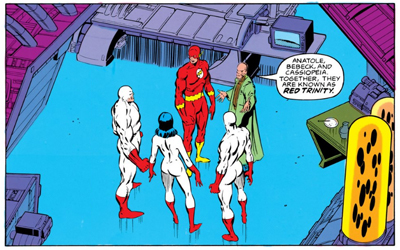
While the plotting of Red Trinity is hardly elegant, it at least makes a bit more sense. Baron builds off the events of Speed McGee to present a story that flows relatively logically – well, according to comic book logic. Instead of conveniently crossing paths with a problem tailored to his abilities, Wally instead sets out specifically to find the problem at the heart of this issue. His encounter with the eponymous trio is as part of his attempts to help find a cure for the self-titled “Speed Demon”, Jerry McGee.

Inevitably, this brings him into conflict with more new opponents perfectly suited to do battle with The Flash.

Trio of terror?

Trio of terror?

Continue reading

The Flash – Some Things You Can’t Outrun (Review)

So, I’m considering reviewing this season of The Flash, because the pilot looks interesting and I’ve always had a soft spot for the Scarlet Speedster. I’m also considering taking a storyline-by-storyline trek through the 1987-2009 Flash on-going series as a companion piece. If you are interested in reading either of these, please let me know in the comments.

The Flash is a show that can withstand a certain amount of cheese. After all, it is a television series about a character dressed in a red jumpsuit who can run faster than the speed of sound. There is going to be a certain amount of cheesiness baked into the premise by default. City of Heroes and Fastest Man Alive managed to skirt along the edge of the show’s threshold of cheesiness. Some Things You Can’t Outrun just jumps right on over that threshold.

Some Things You Can’t Outrun is the show’s first misfire. It’s the first time that the show has been written by anybody other than Andrew Kreisberg & Geoff Johns, and the first time it has been directed by anybody other than David Nutter. It feels like there’s something of a learning curve here, as Some Things You Can’t Outrun doesn’t work on multiple levels. The show seems to take forever to get going, is hampered by a fairly weak guest star, and weighed down by cringe-inducing dialogue.

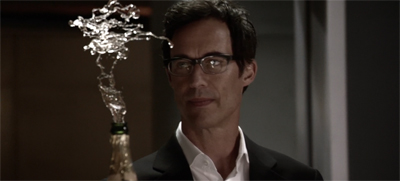
Let's not pop the champagne that fast...

Let’s not pop the champagne that fast…

Balancing cheesiness and earnestness will by one of the biggest challenges to The Flash, as the show has to figure out how to strike the best balance between the inherent goofiness of the character and the demands of a prime-time network drama show. City of Heroes and Fastest Man Alive seemed to suggest that the show had already got a good grip on this delicate equilibrium. Unfortunately, Some Things You Can’t Outrun struggles to be light-hearted without being cheesy, and earnest without being angsty.

There is a sense that the show has hit its first speed bump.

A gas time...

A gas time…

Continue reading

The Flash – Fastest Man Alive (Review)

So, I’m considering reviewing this season of The Flash, because the pilot looks interesting and I’ve always had a soft spot for the Scarlet Speedster. I’m also considering taking a storyline-by-storyline trek through the 1987-2009 Flash on-going series as a companion piece. If you are interested in reading either of these, please let me know in the comments.

In many ways, Fastest Man Alive plays like the second part of a pilot for The Flash. Like City of Heroes before it, Fastest Man Alive is written by Andrew Kreisberg and Geoff Johns, with Greg Berlanti credited on the story. It is also directed by David Nutter, one of television’s most respected pilot directors – even if his famous “hot streak” of pilots going straight to show was interrupted when CBS did not pick up The Doctor in 2011.

Fastest Man Alive is still about building the world around Barry Allen. City of Heroes established the basics, the ground rules of the world in which Barry operates. Fastest Man Alive exists to delineate them a bit further. It defines the ensemble better, clarifying the roles of Joe West and Iris West in the grand scheme of things; it gives Barry the confidence he needs to do what he does; it imposes limits on Barry’s ability; it clarifies that Harrison Wells is not entirely heroic.

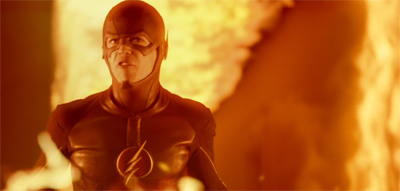
CGI flames! My fatal weakness!

CGI flames! My fatal weakness!

Given the amount of attention and effort that Fastest Man Alive devotes to cementing the foundations of The Flash, it’s understandable that there really isn’t too much room for anything else. Fastest Man Alive is about settling the cast and the writers into a sustainable status quo for the next stretch of episodes – maybe even the entire first season. It makes sure that everybody knows where everything lies and that there’s a solid base upon which to build.

So, while Fastest Man Alive might not be an especially brilliant episode of television, it does a very good job of setting up what it needs to set up.

Born to run...

Born to run…

Continue reading

The Flash (1987-2009) #3-4 – The Killg%re/Kill the Kilg%re! (Review)

So, I’m considering reviewing this season of The Flash, because the pilot looks interesting and I’ve always had a soft spot for the Scarlet Speedster. I’m also considering taking a storyline-by-storyline trek through the 1987-2009 Flash on-going series as a companion piece. If you are interested in reading either of these, please let me know in the comments.

In many respects, The Kilg%re and Kill the Kilg%re are indicative of Mike Baron’s approach to plotting The Flash. There’s never really a sense of an over-arching plot. It often feels like the comic is not being written with a structured story in mind. As the reader follows the story, it seems to develop and grow and move in odd directions. It’s hard to figure out exactly where any of these stories are going, because Baron himself never seems entirely certain from one moment to the next.

In a way, this style of storytelling suits The Flash as a character and as a comic. The Scarlet Speedster is all about forward momentum, a sense of urgency and dynamism. The sense that Baron is making all this up on the spot is energetic at points, because it feels like the comic is being written by the seat of his pants. However, it also means that the character and plot beats can feel arbitrary and illogical, as if to demonstrate that what works in a particular moment is not guaranteed to work in a larger context.

Hate to burst his bubble...

Hate to burst his bubble…

Continue reading

The Flash – City of Heroes (Review)

So, I’m considering reviewing this season of The Flash, because the pilot looks interesting and I’ve always had a soft spot for the Scarlet Speedster. I’m also considering taking a storyline-by-storyline trek through the 1987-2009 Flash on-going series as a companion piece. If you are interested in reading either of these, please let me know in the comments.

Appropriately enough for a television show based around the fastest man alive, City of Heroes moves pretty damn quickly. The forty-five minute episode tears through all the requisite superhero origin elements in forty-five minutes. It takes us two minutes to brush through the story of Barry Allen’s childhood trauma. By the ten-minute mark, Barry has already been hit by lightning. At the end of the forty-five minutes, his uniform is complete and his ensemble fully formed.

There are some minor problems with The Flash, but City of Heroes offers a pretty solid start for the series – hinting that perhaps the show has already found its legs.

Suit up...

Suit up…

Continue reading

Flashpoint (Review)

This January, I’m going to take a look at some of DC’s biggest “events.” I’ll be starting with the most recent one, Flashpoint, following a week full of Flash stories.

Our world is in a violent transition of great change.

– President Obama tells us how it is

I really liked Flashpoint. I liked Flashpoint almost as much as I enjoyed Blackest Night, and far more than I enjoyed most big blockbuster “event” comic books. I think that Flashpoint buckles under the weight of the relaunch that followed – I find it quite sad that so many fans initially ignored the event only to jump on at the last minute because it was “suddenly important.” Does Flashpoint offer a fitting send-off to a version of the DC shared universe that dates back to Crisis on Infinite Earths? It doesn’t really, even if it offers some compelling arguments in favour of the relaunch that followed. Still, it’s a fascinating story about the icons who populate this shared universe, and what makes these enduring characters such heroic figures. Or, rather, what doesn’t make them heroic figures.

Flash sideways…

Continue reading

Flash: Rebirth (Review/Retrospective)

This January, I’m going to take a look at some of DC’s biggest “events.” I’ll be starting with the most recent one, Flashpoint, but – in the spirit of the character – we’re going to have a marathon run through Flash stories before we get there. Check back daily this week for more Flash-ified goodness…

From the outset, Flash: Rebirth was going to be an infinitely more complex endeavour for writer Geoff Johns than Green Lantern: Rebirth had been. Both miniseries aimed to firmly establish an older legacy character (in both cases, the iteration of the character active in the late fifties/early sixties) as the core of that particular franchise, replacing their replacements, as it were. However, Hal Jordan had been absent for about ten years, and had been hovering around the DC Universe in various guises during his absence from the role of Green Lantern. Barry Allen, on the other hand, had been gone twenty years and his appearances had been far scarcer. There had been a whole generation of fans (including the author of this miniseries) who grew up with Wally West as the Flash. Bringing Barry back was always going to be tricky, but here it becomes evident just how tricky.

A darker shade of red?

Continue reading

Final Crisis: Rogues’ Revenge (Review/Retrospective)

This January, I’m going to take a look at some of DC’s biggest “events.” I’ll be starting with the most recent one, Flashpoint, but – in the spirit of the character – we’re going to have a marathon run through Flash stories before we get there. Check back daily this week for more Flash-ified goodness…

Rumours on the street are that Jesse James bought it. I thought you might be dead, too. Tar pit said Zoom buried you under the Flash Museum. Computron swore you were banished to some kinda war planet. And Double Down bet me a grand the Titans had you locked up in their tower.

But you’re here. You escaped!

– The Trickster just about sums up everything that happened since Geoff Johns left

It was a touch period for the Flash after Geoff Johns finished his rather tremendous run on the character. Although Mark Waid’s first run with Wally West was a celebrated comic book run, his brief tenure on the title following Johns’ departure was not nearly as well received. Wally West was shipped off to an alternate dimension, and then brought back. The teenage Bart Allen was turned into the Flash, and then unceremoniously killed. The Rogues were sent to another planet, and the supporting cast suffered the indignity of Countdown to Final Crisis. All of this happened in a few years, and transformed DC’s Flash comic books from some of the best on the market to something of a joke.

However, Geoff Johns’ Final Crisis tie-in miniseries seems intended to assure the faithful that everything is going to be okay. Even Captain Cold dismisses everything that’s happened as “one %%@#$@-up year.”Let’s just put it behind us.

Cold warriors...

Continue reading