• Following Us

  • Categories

  • Check out the Archives


  • Awards & Nominations

Star Trek: Enterprise – Shockwave, Part I (Review)

Next year, Star Trek is fifty years old. We have some special stuff planned for that, but – in the meantime – we’re reviewing all of Star Trek: Enterprise this year as something of a prequel to that anniversary. This January, we’re doing the first season. Check back daily for the latest review.

Re-watching a television show with the benefit hindsight is a particularly intriguing experience. Knowing that certain plot lines or character threads will or won’t pay off can be a liberating experience. While a disappointing ending to a particular story can undermine a lot of what came before, foreknowledge of the inevitable anticlimax allows the viewer to manage their expectations and temper their enthusiasm. It stops the viewer from getting too involved with threads that lead to dead ends, and heightens appreciations for those that pay dividends.

The Temporal Cold War plot on Star Trek: Enterprise never went anywhere. This is rather obvious in hindsight, given that it has been a decade since the end of the show. However, it’s worth acknowledging that many viewers correctly predicted as much on the initial airing of Broken Bow in late 2001. None of the questions raised will be answered, none of the plot threads will be resolved. It will just sit there, nestled snugly in the heart of this Star Trek spin-off, possibly embodying the show’s unfulfilled potential.
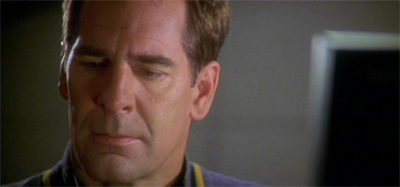
Enterprise isn't quite going to make it to seventh (season) heaven...

Enterprise isn’t quite going to make it to seventh (season) heaven…

While the Temporal Cold War lacks a clear resolution, it does provide the impetus for some pretty good storytelling on its own terms. In many respects, the plot works best when it exists as a driving force in the background of an episode – rather than being pushed to the fore. This is probably why Cold Front and Shockwave, Part I work much better than episodes like Shockwave, Part II – episodes that use the Temporal Cold War as a jumping off point to character work and development, rather than an end of itself.

Shockwave, Part I is notable for ending the first season of Enterprise on a cliffhanger. This was the first time that the opening season of a Star Trek had show had closed on a cliffhanger. The other shows closed out their freshman season with open-ended stand-alone stories, with the last episodes in the first seasons of Star Trek: Deep Space Nine and Star Trek: Voyager emphasising how far their cast had come. In contrast, Shockwave, Part I closes the first year of Enterprise on an honest to goodness “to be continued.” And a good one at that.

Seeking a friend at the end of the world...

Seeking a friend at the end of the world…

Continue reading

Star Trek: Enterprise – Desert Crossing (Review)

Next year, Star Trek is fifty years old. We have some special stuff planned for that, but – in the meantime – we’re reviewing all of Star Trek: Enterprise this year as something of a prequel to that anniversary. This January, we’re doing the first season. Check back daily for the latest review.

Desert Crossing is an intriguing episode.

It’s a very thoughtful and insightful teleplay from André Bormanis, brought to life by director David Straiton. This is Straiton’s first credit on Star Trek: Enterprise, and he does a good job bringing the script to screen. Although the second half of the episode struggles to engage with any of the intriguing issues broached in the first half, and while nobody seems able to keep the scenery out of guest star Clancy Brown’s mouth, Desert Crossing is a very ambitious late-season episode.

Oh, Archer. What have you Dune now?

Oh, Archer. What have you Dune now?

Continue reading

Space: Above and Beyond – The Angriest Angel (Review)

This November (and a little of December), we’re taking a trip back in time to review the third season of The X-Files and the first (and only) season of Space: Above and Beyond.

Existentialism is something of a recurring theme in the work of Glen Morgan and James Wong.

It echoes through their work. Mulder’s choice of action ultimately serves to define him in One Breath, in contrast to the other more senior male characters in the narrative. The duo’s second script for Millennium, 5-2-6-6-6, opens with a quote from existentialist philosopher Jean Paul Sartre. Even the pair’s feature film work – The One and the Final Destination films – touch broadly on existentialist themes.

Pressed (up) on the issue...

Pressed (up) on the issue…

However, The Angriest Angel is perhaps the most candid of their scripts, with McQueen explicitly explaining how his actions are serving to define his identity. In his power-house opening monologue, McQueen describes these defining moments as make-or-break points. “Everyone, everyone in this life knows when the moment is before them. To turn away is simple. To ignore it assures survival. But it is an insult to life. Because there can be no redemption.”

This is perhaps the most elegant and effective summary of Morgan and Wong’s approach to character development. McQueen articulates it clearer than any of their characters, but the philosophy applies just as much to Scully in Beyond the Sea or Never Again as it does to Tyrius Cassius McQueen. Indeed, it would come to define their work on Millennium, with the second season repeatedly suggesting that the end of the world was as much a personal event as a massive social occurrence.

Slice of life...

Slice of life…

Continue reading

Star Trek: Deep Space Nine – Defiant (Review)

The September and October, we’re taking a look at the jam-packed 1994 to 1995 season of Star Trek, including Star Trek: Deep Space Nine and Star Trek: Voyager. Check back daily for the latest review.

Defiant is a cheeky piece of work.

On the surface, it appears to be a rather lame bit of cross-promotion for the release of Star Trek: Generations. The first movie featuring the cast of Star Trek: The Next Generation had opened three-days before Defiant aired, and so it seemed like the perfect opportunity to get a nice cameo from a well-loved cast member and remind audiences that the film was currently in cinemas. Jonathan Frakes is a likeable actor, and Riker has been used as an ambassador for the series before. He appeared in Cybill, after all.

However, then Defiant takes one sharp left-turn, massively upsetting expectations and becoming something a lot more interesting than a cross-media tie-in.

Guess who's coming to Quark's...

Guess who’s coming to Quark’s…

Continue reading

Ed Brubaker’s Run on Detective Comics – Dead Reckoning (Review/Retrospective)

23rd July is Batman Day, celebrating the character’s 75th anniversary. To celebrate, this July we’re taking a look at some new and classic Batman (and Batman related) stories. Check back daily for the latest review.

It remains quite surprising that DC have never capitalised on the work that Ed Brubaker and Greg Rucka did on their Batman line during the early years of the twenty-first century. Given the popularity of Batman as a character, and considering the success that has been enjoyed by Brubaker and Rucka in the years since, it seems strange that DC has never made a consistent or concerted effort to package and release high-profile collections of their work on the character.

It is a shame, because the work is very good – both as solo writers on various titles and in collaboration with one another. Ed Brubaker enjoyed a solo run on Batman with artist Scott McDaniel shortly after No Man’s Land and through the end of Bruce Wayne: Fugitive. A few years later, while collaborating with Greg Rucka on the underrated and sorely missed Gotham Central, Brubaker also had a short run on Detective Comics.

Putting on his game face...

Putting on his game face…

He wrote a team-up between Bruce Wayne and Alan Scott in Made of Wood. However, Brubaker also wrote the epic six-part story, Dead Reckoning. On the surface, Dead Reckoning appears quite familiar. It follows a fairly standard set-up. It’s an adventure that features the width and breadth of Batman’s iconic rogues’ gallery, and unearths a terrible secret about the history of Gotham that – in Brubaker’s style – is a clever updating of a classic piece of continuity.

However, underneath the surface, Dead Reckoning is something much more harrowing and unsettling. It’s the story of lives destroyed by calamities and forces outside the normal human experience – it’s about wounds inflicted on ordinary people by monsters playing a very strange game. It feels like a post-9/11 superhero story, treating Batman’s world as something hostile and horrifying.

Snow escape...

Snow escape…

Continue reading

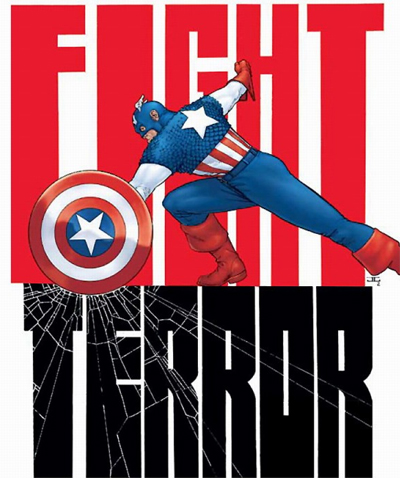
Captain America: The New Deal (Review/Retrospective)

Oh, God — How could this happen here?

– Steve Rogers, Captain America #1

It seemed inevitable that Captain America would have to respond to September 11th. After all, the terrorist atrocities were an attack on the American way of life, and the iconic superhero was perhaps the hero best equipped to explore the scars left by the still-recent attacks upon the American psyche, much as his Secret Empire plot allowed him to respond to the Watergate Scandal. Unfortunately, John Ney Rieber’s work on the character is – while well-intentioned – clumsy, awkward, groan-inducing and cliché-ridden. Even the fantastic artwork of John Cassaday cannot salvage the run from its own tired and trite pseudo-philosophical ramblings.

Subtle.

Continue reading

Non-Review Review: The Siege

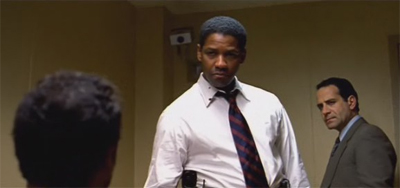
The Siege has the benefit of becoming a lot more relevent in the past couple of years. Exploring the aftermath of a series of terrorist atrocities on New York City by Islamic extremists, the film isn’t exact a subtle exploration of the relationship between liberty and security – instead preferring to offer two-dimensional strawmen instead of characters or legitimate viewpoints. Still, despite its heavy-handedness, it does have some interesting insights into the world after it has been shaken to its core.

Washington under Siege...

Continue reading