• Following Us

  • Categories

  • Check out the Archives


  • Awards & Nominations

Luke Cage – Who’s Gonna Take the Weight? (Review)

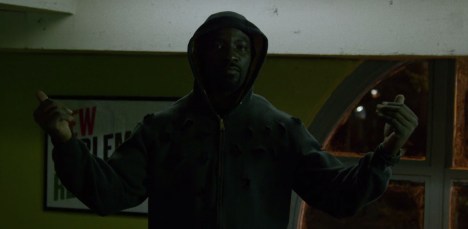
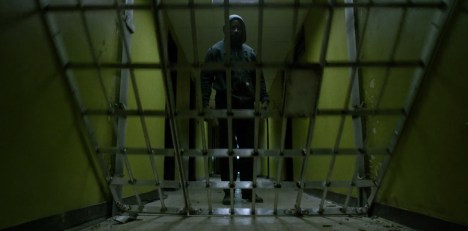
Who’s Gonna Take the Weight? is largely shaped and defined by its central hall way fight sequence.

The hallway fight sequence was hyped in the first teaser trailer for Luke Cage, which set an abridged version of the scene to Shimmy Shimmy Ya by Dirty Ol’ Bastard. However, a scene like this seemed inevitable even before that trailer landed. After all, the extended one-take hallway fight sequence from Cut Man, the second episode of Daredevil, had been a watershed moment for the Marvel Netflix properties; that impressively choreographed centrepiece really demonstrated what the shows could accomplish from a technical and action-driven perspective.

lukecage-whosgonnataketheweight25a

Indeed, the second season of Daredevil treated the hallway fight sequence as something approaching a holy artifact, offering two extended homages to the brawl. The multi-level fight sequence in New York’s Finest was a rather blatant (and awkward) attempt to maintain the one-take conceit while escalating the action to an absurd degree. The prison corridor brawl in Seven Minutes in Heaven shrewdly dropped the insistence on maintaining a single take while increasing the carnage exponentially. The hallway fight sequence is a sacred moment for the Netflix properties.

Jessica Jones notably avoid a tribute to the sequence, but that could be explained any number of ways; from the fact that Jessica Jones would have been in production before the response to the fight sequence hit through to Jessica Jones‘ reluctance to embrace the conventional and expected story beats from a superhero story. In contract, Luke Cage is very keen to deliver upon all these expectations. The extended corridor sequences in Who’s Gonna Take the Weight? are a way for Luke Cage to embrace its superhero stylings, but on its own terms.

lukecage-whosgonnataketheweight27a

Continue reading

Luke Cage – Code of the Streets (Review)

What does it mean for Luke Cage to be the first entry in the so-called Marvel Cinematic Universe to focus on an African American character?

Of course, there have been superhero films built around black characters. Shaq starred in Steel and Halle Berry starred in Catwoman. The most successful example of black superhero cinema is probably the Blade trilogy, which launched slightly before Sam Raimi’s Spider-Man and Bryan Singer’s X-Men reinvented the comic book movie for the new millennium. However, Wesley Snipe’s half-vampire vampire hunter is frequently forgotten in these discussions, perhaps because the films are generally pitched as action horror movies rather than superhero films.

lukecage-codeofthestreets

It is astonishing that it has taken so long for the superhero boom to encompass stories focusing on protagonists that are not white men. So Luke Cage arrives with a lot of expectations. The series is keenly aware of this fact, never shying away from the Luke’s cultural perspective. Then again, this makes a certain amount of sense. Luke Cage is a black superhero whose superpower is his own skin. The opening credits make this quite clear, projecting evocative images of Harlem on to that skin so as to reaffirm that connection.

Luke Cage is a black superhero. Luke Cage is a black superhero television show. The result is a fascinating piece of television that finds something new to say about a long-established genre by looking beyond the stock perspective.

lukecage-codeofthestreets3a

Continue reading

Netflix and Marvel’s Luke Cage – Season 1 (Review)

Luke Cage is an exceptional black superhero show.

Those twin concepts cannot be divorced from one another. The thrill of Luke Cage is how skilfully and how cleverly executive producer Cheo Hodari Coker interweaves those two strands. Luke Cage is not simply a story about Harlem that happens to feature superpowers, nor is just a superhero story that happens to feature African American characters. Coker carefully crafts the show that those two parts of itself become inseparable and indivisible. Luke Cage relishes its superhero storybeats, and bringing them together in service of a different kind of protagonist.

lukecage-nowyourmine29

It feels entirely appropriate that Luke Cage should be the focus of this series, the first superhero story of the franchise age to focus on a black protagonist. (There are a number of earlier examples from Blade to Catwoman to Steel, but those largely predate the current shared-universe-driven popular consciousness.) Luke Cage was the first black comic book hero to have his own on-going monthly title, and one of the earliest high-profile examples of a black superhero character not to incorporate “black” into his name, like the Black Panther or Black Lightning.

Of course, it feels shameful that it took this long. Hawkeye has somehow managed to appear in four blockbuster feature films before Marvel Studios produced a franchise film with a black lead actor. Spider-Man has been rebooted three separate times, but Black Panther will not open until 2018. Guardians of the Galaxy came out of nowhere long before Marvel Studios or Warner Brothers opened a summer tentpole superhero film with a minority or female lead. Meanwhile, Marvel has an influx of blonde white guys named Chris.

lukecage-dwyck2a

As such, Luke Cage is definitely overdue. And it keenly understands this. Every aspect of Luke Cage is filtered through an African American perspective that helps to give it a vibrance and energy that revitalises the format. In terms of plotting and structure, Luke Cage is perhaps the most traditional superhero story since Thor. However, the true beauty of the thirteen-episode miniseries lies in the improvisation around those beats and how the production team choose to hit the requisite notes. Luke Cage feels like an extended jazz album riffing on old standards.

However, as delayed as this appearance might be, it still feels perfectly attuned to the climate of late 2016. As Method Man reflects in and interview with the Sway Universe podcast in Soliloquy of Chaos, a great example of how keenly Luke Cage engages with black culture, “You know, here’s something powerful about seeing a black man that’s bulletproof, and not afraid.” That has never been more true.

lukecage-dwyck9a

Continue reading

Star Trek – The Way to Eden (Review)

This July and August, we’re celebrating the release of Star Trek Beyond by taking a look back at the third season of the original Star Trek. Check back every Monday, Wednesday and Friday for the latest update.

Like any television, or any piece of popular culture, Star Trek is a product of its time.

That does not mean that the show speaks only to its time or that it has no relevance beyond that moment in time, but in means that the series is very much anchored in the zeitgeist of the late sixties. Sometimes that influence is obscured by advances in the intervening years, like the fascination with the novelty of transplant surgery that played out in the background of Spock’s Brain. Sometimes that tangible connection is more like ambient background noise than direct influence, as with the sense of apocalyptic dread that permeates the third season as a whole.

"You reach?"

“You reach?”

Sometimes, however, it is impossible to look upon Star Trek as anything other than a product of the late sixties. Let That Be Your Last Battlefield was undeniably a product of 1968, with its anxiety about civil strife and civil rights, its somewhat reductive metaphor for race relations and its general production aesthetic. However, that is nothing compared to The Way to Eden, which might be the most flamboyantly and stereotypically sixties episode of the entire original run.

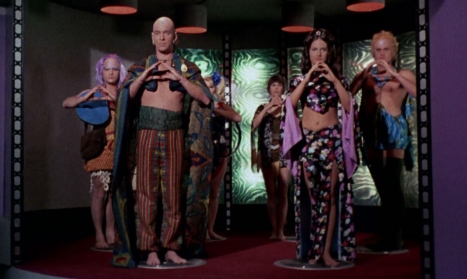
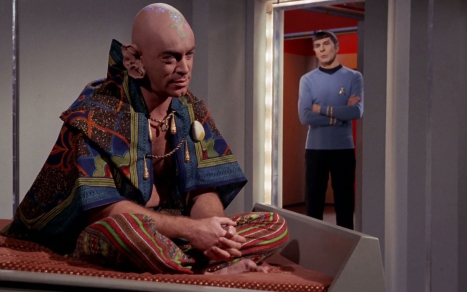
The Way to Eden is the episode that opens with a bunch of space!hippies staging a sit-in in the Enterprise transporter room and escalates from there.

Trippy hippie shakedown.

Trippy hippie shakedown.

Continue reading

The X-Files – Founder’s Mutation (Review)

This June, we’re going to be taking a look at the current run of The X-Files, beginning with the IDW comic book revival and perhaps taking some detours along the way. Check back daily for the latest review.

In technical and aesthetic terms, Founder’s Mutation is the most modern of the six episodes to air as part of the revival miniseries.

To be fair, the other episodes in the miniseries do embrace the twenty-first century in their own unique ways. My Struggle I and My Struggle II update the mythology for the new millennium. Mulder and Scully Meet the Were-Monster deals with themes that resonate particularly strongly now that Mulder and Scully are in their middle age. Babylon is a sincere (if misguided) attempt to engage with the current political climate. However, those episodes are decidedly old-fashioned in how they choose to tell their stories.

Title drop.

Title drop.

There are little nods towards contemporary technology in the other five episodes. Mulder’s inability to work his phone is something of a running joke, whether in his failure to snap a picture of Guy Mann in Mulder and Scully Meet the Were-Monster or his inability to turn off his “find my phone” app in My Struggle II. Carter is justifiably proud of how My Struggle II incorporates cutting edge pseudo-science. However, none of those stories integrate new technology and new ideas as smoothly as Founder’s Mutation.

However, it isn’t just the use of technology that marks Founder’s Mutation out as the most modern of the six episodes. The episode’s storytelling and style are noticeably more contemporary than the episodes around it. Founder’s Mutation tells its story in a way that feels very much in step with the television landscape around it. More than the other five episodes in the miniseries, Founder’s Mutation feels like an episode of twenty-first century television.

Can you hear me at all?

Can you hear me at all?

Continue reading

Non-Review Review: Absolutely Fabulous – The Movie

Absolutely Fabulous: The Movie is that it feels very much like an extended special of the classic British sit-com. Sure, the film has an expanded budget that allows for some suitably glitzy location work. Of course, the film is stuffed to the gills with even more celebrity cameos than you could shake a stick at. However, there is very much a sense that Absolutely Fabulous has not been radically transformed in the transition from goggle box to silver screen. This is very much in the spirit and style of the source material.

That is perhaps both the best and worst thing that could be said about Absolutely Fabulous: The Movie.

Saundering off...

Saundering off…

Continue reading

Star Trek: Enterprise – Kir’Shara (Review)

This May, we’re taking a look at the fourth (and final) season of Star Trek: Enterprise. Check back daily for the latest review.

The fourth season of Star Trek: Enterprise is renowned for its focus upon continuity.

That is as true of the Kir’Shara trilogy as of any other episode. The script is saturated with references and nods to the rest of the franchise, tying together thirty-eight years of Vulcan continuity into a cohesive narrative structure. The Kir’Shara trilogy ties together everything from the Romulan schism in Balance of Terror to the symbolic importance of Mount Seleya in Star Trek III: The Search for Spock to the story behind the IDIC symbol that had first appeared in Is There in Truth No Beauty?

A short and not-so-prosperous future.

A short and not-so-prosperous future.

However, what is most striking the Kir’Shara trilogy is that the episode’s continuity really doesn’t fit in a very rigid way. Although the Kir’Shara trilogy is nominally about explaining how the secretive and distrustful Vulcans of Enterprise became the iconic and well-loved aliens associated with the rest of the franchise, offering an epic three-part story about Archer and T’Pol singlehandedly saving Vulcan society by putting them back in touch with the values espoused by the legendary Vulcan philosopher Surak. (Surak had appeared in The Savage Curtain.)

This makes for a very satisfying story within the larger narrative arc of Enterprise, demonstrating that Earth and Vulcan might be more compatable than Ambassador Soval would ever admit. It paves the way for stories like Babel One, United, Demons and Terra Prime. However, it also stands quite at odds with the larger continuity of the franchise, where the Vulcans have consistently been portrayed as secretive and superior. There is nothing wrong with that continuity contradiction, but it is interesting in the larger context of the fourth season.

Homecoming.

Homecoming.

Continue reading

Star Trek: Deep Space Nine – Broken Link (Review)

This February and March (and a little bit of April), we’re taking a look at the 1995 to 1996 season of Star Trek, including Star Trek: Deep Space Nine and Star Trek: Voyager. Check back daily for the latest review.

What is perhaps most surprising about Broken Link is how quiet and subdued it all it.

The fourth season began with a bang, with the dissolution of the alliance between the Klingons and the Federation that had been established in Heart of Glory and dramatised in Star Trek VI: The Undiscovered Country. In fact, The Way of the Warrior featured the largest and most impressive combat sequence in the history of the Star Trek franchise to that point. Even allowing for The Sacrifice of Angels and What You Leave Behind, the fourth season premiere still ranks as one of the most elaborate set pieces in the franchise’s history.

Pray... for... Odo...

Pray… for… Odo…

Broken Link consciously circles back to that. It features the first reappearance of Robert O’Reilly as Gowron since The Way of the Warrior. The episode makes it clear that the problems depicted in The Way of the Warrior are only worsening. There is no small suggestion that Gowron is hoping to turn the cold war between the Federation and the Klingon Empire into a shooting war. Broken Link is very much a show about taking the status quo that was established in The Way of the Warrior and ramping it up.

However, what is most striking about Broken Link is the manner in which it escalates the situation. Not a single weapon is discharged in Broken Link, which is the last season finalé of Star Trek: Deep Space Nine not to feature a combat sequence of some description. The actual plot of the episode is remarkably straightforward and linear, keenly focused on a single member of the ensemble rather while relegating politics into the background. Even in terms of the scripting of the episode, care is taken to slow the pace down and allow character-driven dialogue scenes.
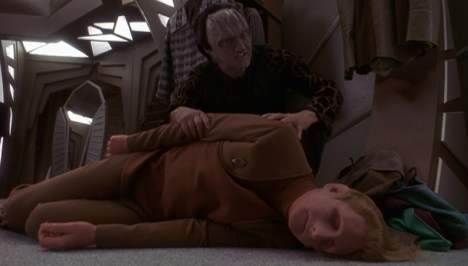
Oh no, Odo!

Oh no, Odo!

The result is a strangely intimate season finalé, one free of the bombast that comes with the season-bridging two-parters favoured by Star Trek: The Next Generation and Star Trek: Voyager. It is interesting to compare Broken Link to something like Basics, Part I, if only because the latter would never make room for Jadzia joking about being surrounded by “naked men” or Garak playing “Star Trek Cluedo” with Odo in sickbay. In fact, Broken Link is even relatively quiet by the standards of Deep Space Nine, lacking the galactic status quo shift of The Jem’Hadar or A Call to Arms.

As with a lot of the fourth season, there is a sense that the production team have made a point to learn from the third season: to improve upon what works and to fix what doesn’t. The Adversary was something of a happy accident at the end of the third season, a script thrown together at short notice when Paramount vetoed a season-ending cliffhanger that would be loosely adapted for Homefront and Paradise Lost. The slow character-centric tension of The Adversary was never intended to close the third season, but Broken Link realises that such an approach worked well.
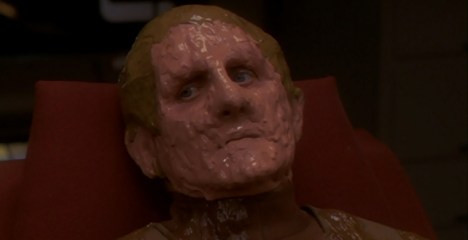
"Melting! Melting! Oh, what a world!"

“Melting! Melting! Oh, what a world!”

The result is an episode that feels incredibly comfortable in its own skin. Deep Space Nine is well aware of what it is, regardless of the direction and input that the studio offered the production team at the start of the fourth season. In fact, despite its somewhat relaxed pace and the space that it affords its character interactions, Broken Link is remarkably focused on what it wants to do. The closing line of the episode (and the season) is clever, consciously tying back the bold new direction of The Way of the Warrior back into the series’ own larger endgame.

In hindsight, Broken Link is something of a misleading title. Instead, it ties everything together.

Only a stone's throw away...

Only a stone’s throw away…

Continue reading

Star Trek: Deep Space Nine – Body Parts (Review)

This February and March (and a little bit of April), we’re taking a look at the 1995 to 1996 season of Star Trek, including Star Trek: Deep Space Nine and Star Trek: Voyager. Check back daily for the latest review.

Like The Quickening before it, Body Parts offers another glimpse at the humanism at the heart of Star Trek: Deep Space Nine.

Body Parts plays into the broader themes of the fourth season. Zack Handlen effectively and memorably described Deep Space Nine as “Star Trek’s version of the Island of Misfit Toys.” In a way, that has been true since Emissary; the episode where the series got a bitter widower who wasn’t even a proper captain and a chief engineer who used to manage a transporter room on the flagship. Characters like Odo and Garak were always outcasts, while it never felt like the crew operating the station could claim to be the franchise’s “best and brightest.”

"Look, we're all exhausted after the season that's been..."

“Look, we’re all exhausted after the season that’s been…”

However, the fourth season really emphasises this aspect of the series. Worf joins the cast in The Way of the Warrior, and is promptly cut off from his own people. In Sons of Mogh, Worf is quickly cut off from his own brother. Kira brings Tora Ziyal to the station in Return to Grace, and she reflects on her isolation in For the Cause. Odo’s estrangement from his own people will be properly formalised in Broken Link, when he is cast into a wilderness between human and changeling. Body Parts simply puts Quark through his version of this arc.

Body Parts is essentially a story about how Quark is no longer a proper Ferengi. He has been exposed to the values and ideals of the Federation, corrupted and changed through his time on Deep Space Nine. Although this winds up costing Quark a lot, the final scenes of Body Parts suggest that Quark has also benefited from his time on the station. Body Parts suggests that wandering out into the winder universe and exposing yourself to different cultures is inherently a good thing, even if it does generate tension.

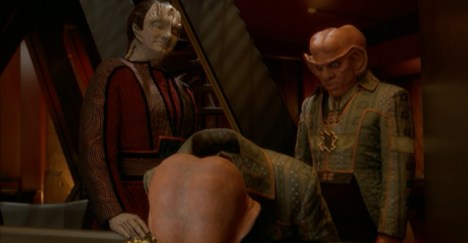
Bearing the Brunt of his wrath...

Bearing the Brunt of his wrath…

Continue reading

Star Trek: Deep Space Nine – Hard Time (Review)

This February and March, we’re taking a look at the 1995 to 1996 season of Star Trek, including Star Trek: Deep Space Nine and Star Trek: Voyager. Check back daily Tuesday through Friday for the latest review.

Hard Time is a fantastic (and vastly underrated) episode of Star Trek: Deep Space Nine.

The episode tends to get overlooked in discussions about the fourth season of Deep Space Nine, perhaps owing to the high average quality of the season or the fact that it arrives in the middle of what is admittedly the season’s weakest run of episodes. However, in spite of all that, Hard Time is an exemplary piece of Deep Space Nine. It is certainly the best of the series’ “O’Brien must suffer” episodes, and a showcase for Star Trek veteran Colm Meaney. In its exploration of trauma and recovery, and cycles of violence, it taps into the heart of the show.

Not phased in the slightest...

Not phased in the slightest…

That said, Hard Time arrives at a point where Deep Space Nine is nudging closer and closer to serialisation. The show has begun to embrace long-form storytelling, as evidenced by the ripple effect of the changes to the status quo in The Way of the Warrior and the way that little plot threads weave through the season. The show has not yet reached the point at which it can structure six- or ten-episode arcs, but it is getting close. Deep Space Nine is clearly moving towards what is (for Star Trek at least) a fairly novel style of television storytelling.

As such, Hard Time is particularly striking for the fact that it is a purely episodic adventure. The episode puts Miles O’Brien through hell, having him struggle with post-traumatic stress disorder while trying to reintegrate into society. This is the kind of plot that feels more suited to a long-running mini-arc than Worf and Dax’s arguments about the relative merits of bladed weapons or Worf’s decision to move to the Defiant. Instead, O’Brien’s trauma is dealt with over the course of a single episode. Hard Time plays as a defence of the tradition television episode structure.

Growing the beard...

Growing the beard…

Continue reading