• Following Us

  • Categories

  • Check out the Archives


  • Awards & Nominations

Doctor Who: Dark Water (Review)

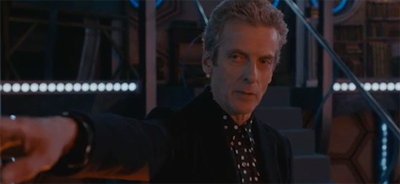
I presume you have stairs?

I’m not a Dalek.

Dark Water is downright provocative in places, and rather ingenious.

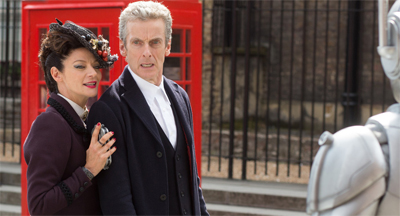
On the surface, Dark Water is the first part of a season-ending two-parter building to the return of two very obvious pieces of Doctor Who continuity. In doing so, it cleverly demonstrates one of the most obvious issues with the two-part structure in contemporary Doctor Who. The episode spends forty-five minutes building to a game-changing cliffhanger that is quite easy to figure out ahead of time. (Not least because the BBC’s publicity department loves Cybermen.) As such, the typical first part of a two-parter ends where the Doctor Who story actually begins.
doctorwho-darkwater9

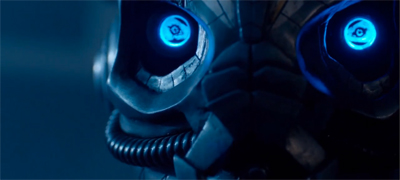
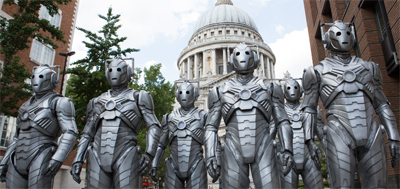
However, there’s something far shrewder happening beneath the surface. While Dark Water spends most of its runtime affectionately mocking the inevitability of the two revelations at the climax, it is very in keeping with the aesthetic of the Moffat era around it; it is much more interested in the intimate than the epic. The climax beautifully subverts the classic Davies era “global invasion” cliffhanger by dismissing the Doctor as “another mad Scot” while the public look on bemused at the six Cybermen wandering down from St. Paul’s Cathedral.

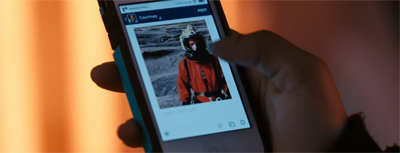
In contrast, the juicy parts of Dark Water are those defined by the personal relationships at play. For all the iconic visuals and soaring music, the episode doesn’t close on the Cybermen or the Master; it closes on Danny and the reflection of the young child he killed. The episode’s big dramatic beat is that final conversation between Danny and Clara. The reveal that Missy is really the Master is obvious, but it is more interesting for her re-contextualising her relationship with the Doctor as that of a spurned and abandoned lover. It’s all personal.
doctorwho-darkwater13 Continue reading

Doctor Who: Kill the Moon (Review)

I don’t like people being sick in my TARDIS. No being sick. And no hanky-panky.

If The Caretaker began the transition into the second half of the season, Kill the Moon completes it. The Twelfth Doctor is established. Peter Capaldi has found his footing. The audience has a clear grasp of what distinguishes his take on the character from the iterations played by David Tennant or Matt Smith. The orderly transition of lead actors is complete; the show can no go about its business. Along with The Caretaker, Kill the Moon marks the point at which the season starts building clearly and concretely towards Death in Heaven.

This is the point at which the show feels free to get a little experimental. With the exception of Listen, the first six stories of the season were all relatively conservative. Deep Breath returned to the Paternoster Gang in order to ease the transition to the new lead. Into the Dalek was the obligatory “Dalek episode.” Although it featured a fictional celebrity, Robot of Sherwood was a throwback to the old school celebrity historical. Time Heist was a light run-around. The Caretaker was the “dump the Doctor into the real world” story.

"Yes, I'm wearing my One Direction shirt. Wanna make something of it?"

“Yes, I’m wearing my One Direction shirt. Wanna make something of it?”

In contrast, the second-half of the season is more bold and experimental. Steven Moffat is not credited as a co-writer, suggesting that the training wheels are coming off. While the first six episodes were all written by established Doctor Who writers, the four episodes between The Caretaker and Dark Water are all credited to newbies. More than that, there is a spirit of experimentation. Kill the Moon and In the Forest of the Night are perhaps two of the most divisive and controversial episodes of the show since it returned in 2005. Only Love and Monsters comes close.

Kill the Moon is bold, provocative, insane and more than a little twisted.

David Tennant has the same tumblr photo...

David Tennant has the same tumblr photo…

Continue reading

Doctor Who: The Caretaker (Review)

Why do I keep you around?

Because the alternative would be developing a conscience of your own?

It is interesting to look at the development of the way that the writers on Doctor Who have developed during Steven Moffat’s tenure as executive producer. Although the show does not maintain a “writers’ room” in the literal sense of the phrase, there is a sense that certain writers have recurred often enough to develop and distinguish their own voices on the show. There is enough precedent to firmly identify Robot of Sherwood as a Gatiss script, and Time Heist as a Thompson script.

As such, The Caretaker definitely feels like a Gareth Roberts script. It shares a very clear thematic throughline with Roberts’ other scripts for the Moffat era – The Lodger and Closing Time. The idea is that the Doctor has waded into the normal world and finds himself dealing with situations that normally affect normal people. In The Lodger, the Doctor rented a room. In Closing Time, the Doctor got job. In The Caretaker, the Doctor imposes himself upon his companion’s everyday life.

Watch the man...

Watch that man…

As with Roberts’ other scripts, there is a sense of fun to the adventure. Doctor Who is frequently a show about the Doctor wandering into different kinds of stories – from horrors to science-fiction to period pieces to westerns. Throwing the Doctor out of a more conventional story and into something resembling the real world is always a source of fun, even if the Moffat era has touched on this quite a bit. While The Caretaker is similar to The Lodger and Closing Time, it is perhaps closer in theme to The Power of Three.

However, Peter Capaldi’s performance is distinct enough from that of Matt Smith that The Caretaker never feels like a retread. Watching the Twelfth Doctor intersect with the real world is very different from watching the Eleventh Doctor, because he is a fundamentally different character. The Caretaker is one of the highlights of the season, marking a clear transition between the first and second halves of Peter Capaldi’s first year in the title role.

Robot!

Robot!

Continue reading

Doctor Who: Time Heist (Review)

Why? There’s no immediate threat?

Warning, intruder alert!

I should really stop saying things like that.

After the ambition of Listen, Time Heist feels like a return to the general narrative conservatism that marks the first half of the season. Introducing the Twelfth Doctor, the first six episodes of the season are all written by veteran writers. With the exception of Listen, they all play it relatively safe. Five episodes into the Twelfth Doctor’s tenure, the approach is starting to grate just a little bit. The training wheels are still on, but there is a sense that the show is itching to remove them.

Indeed, without the ambition that tempers the many flaws with In the Forest of the Night, Time Heist is probably the weakest episode of the season. However, there is something to be said about that; Time Heist may not be a particularly memorable piece of television, but that alone is enough to mark it as much stronger than misfires like Fear Her or Night Terrors or Evolution of the Daleks

or Curse of the Black Spot.

... and they lived happily ever after...

… and they lived happily ever after…

Continue reading

Doctor Who: Listen (Review)

Are you making conversation?

I thought I might give it a try.

Listen is an episode important in its unimportance.

It is the first non “event” episode credited to Moffat as a solo writer since The Beast Below. Every episode credited exclusively to Moffat since The Beast Below has been a premiere or a finalé or two-parter or a special of some description. Listen is the fourth episode of Peter Capaldi’s first season, following a celebrity pseudo-historical written by Mark Gatiss. It is an episode that is about very little. There is a lot of talking, and a lot of sitting, and – as the title implies – a lot of listening. It is utterly unlike any other episode of Doctor Who ever produced.

doctorwho-listen17

Midnight in the TARDIS…

Listen has a central mystery that it refuses to resolve, a wealth of lovely character moments, and just the faintest trace of Moffat’s “timey-wimey” stuff. As with a lot of Moffat’s writing for the show, Listen is packed with little details that seem to exist to drive fans wild, but which make a lot of sense for those willing to relax and go with it. It is fascinated with negative space, with the characters ruminating on how questions are more important than answers, and how nothing can be more defining or revealing than something.

It is an episode that feels very much in touch with the mood and themes Moffat era. In keeping with Moffat’s style since he took over the show, Listen is a lesson in the art of misdirection.

doctorwho-listen6

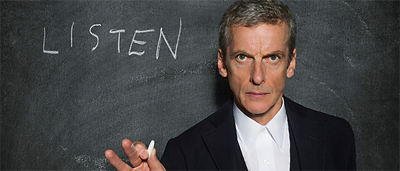
Chalking it up to a title drop…

Continue reading

Doctor Who: Robot of Sherwood (Review)

Shortly, I shall be the most powerful man in the realm. King in all but name, for Nottingham is not enough.

It isn’t?

After this, Derby.

Right.

Then Lincoln. And after Lincoln…

Worksop?

The world!

– the Sheriff outlines his plot to Clara

Robot of Sherwood is a functional piece of television, with a wonderful closing scene capping a very light forty-five minutes. Mark Gatiss is a writer who tends to trade on nostalgia, and who clearly holds a great deal of affection for the past. As such, Robot of Sherwood provides a fairly effective and straightforward counterpoint to the heavy moral questions of Deep Breath and Into the Dalek. Is the Doctor a hero? It doesn’t matter, because his story is that of a hero.

There is a sense that perhaps Gatiss is being a little bit too glib here, to the point where Robot of Sherwood almost plays defensively – a justification of the writer’s tendency to rose-tinted nostalgia and a rejection of critical approaches towards history or story. Nevertheless, Robot of Sherwood does pretty much what it sets out to do. It provides Peter Capaldi with a suitably light script and a chance to flex his comedic muscles, while providing a suitably fairy-tale-ish pseudo-historical.

Legendary outlaw...

Legendary outlaw…

This season is introducing a new lead actor, a risky proposition for any show. As a result, the first half of the season tends to play it rather safe. Robot of Sherwood is the only episode in the first half of the season not to credit Steven Moffat as writer or co-writer; however, it is still written by an established Doctor Who veteran. After all, Mark Gatiss wrote The Unquiet Dead, the first episode of the relaunched series not written by Russell T. Davies. He also wrote Victory of the Daleks, the first story of the Moffat era not written by Moffat himself.

Indeed, the season returns to the classic “home”/“future”/“historical” opening triptych structure that defined the Davies era; it is the first time that this structure has been seen since Matt Smith’s opening season. (For Davies, “home” was twenty-first century London; for Moffat, it is the Paternoster Gang.) Robot of Sherwood is the show’s first proper “celebrity historical” since Vincent and the Doctor in that same opening season. “Safe” is very much the name of the game for this stretch of the season. Robot of Sherwood is very safe.

"You'll ruin the paint work!"

“You’ll ruin the paint work!”

Continue reading

X-Over: The X-Files & Steven Moffat’s Doctor Who

It goes without saying that The X-Files was a massively influential television show. As early as its second season, the show had launched all manner of imitations and copycats, both inside and outside the Fox Network. It seems quite likely that Fox invested two-and-a-half million dollars in the failed Doctor Who relaunch of 1996 in the hopes of spinning off another cult/mainstream science-fiction hit like The X-Files. It was launched as a two-hour television movie, failing to earn the rating necessary to spin it off into a weekly series.

However, although the 1996 telemovie provides an obvious point of intersection between The X-Files and Doctor Who, the influence of The X-Files can perhaps be most keenly felt in Steven Moffat’s work on the relaunched television series. Moffat is credited as the producer who helped the show to “break” America during his second year as showrunner, and he did so in a number of ways. Perhaps the most interesting is that he leaned rather heavily on The X-Files as a point of cultural intersection.

Shades of greys...

Continue reading

Doctor Who: The Time of the Doctor (Review)

It’s okay, Barnable, don’t worry. I have got a plan. Off you pop.

[beat]

I haven’t got a plan, but people love it when I say that.

Doctor, what are you going to do?

I don’t know. Talk very fast. Hope something good happens. Take the credit. That’s generally how it works.

– the Doctor and Clara discuss standard operating procedure

An epic struggle for universal peace lasting centuries on a back water world; a conflict spanning generations; the potential to re-spark the Time War; the possibility of burning the turkey. The epic and intimate co-mingle in The Time of the Doctor.

In many respects, The Time of the Doctor serves as an effective counterpoint to The End of Time. Even the title seems to allude towards the Tenth Doctor’s final episode, as if to suggest that “time” is a thing that passes naturally rather than ending brutally. “I don’t want to go,” the Tenth Doctor pleaded in his final moments, a line that Moffat gently tried to re-write at the end of The Day of the Doctor. The Eleventh Doctor is more even-handed. “But you, you are the Doctor,” Clara assures him. “Yep, and I always will be,” he replies. “But times change, and so must I.”

This is when the magic happens...

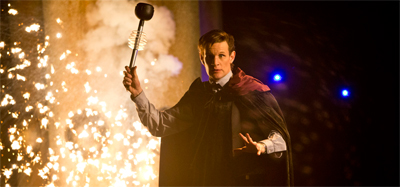
This is when the magic happens…

(In fact, Moffat has a bit of gentle fun at the expense of The End of Time. Whereas the Tenth Doctor reluctantly sacrificed himself to save Wilf, the Eleventh Doctor quite selfless spends his entire life defending the town of Christmas on the planet of Trenzalore. Discussing the fake regeneration at the climax of The Stolen Earth, the Eleventh Doctor quips, I had vanity issues at the time.” He could easily be hinting at the hubris that built up towards the Tennant and Davies era’s swansong.)

In contrast, The Time of the Doctor was relatively low key. Well, as low key as an episode featuring all of the Doctor’s classic adversaries laying siege to one planet across hundreds of years as the threat of a reignited Time War looms large in the horizon. Still, as wonderful as that epic scale might be, The Time of the Doctor feels like a spiritual companion to Moffat’s other Christmas episodes – the story of the loneliest man in the universe saving Christmas (the town and the holiday), on an intimate scale that just happens to be epic; “the man who stayed for Christmas.”

What's cooking?

What’s cooking?

Continue reading

Doctor Who: The End of Time, Part II (Review)

To celebrate the fiftieth anniversary of the longest-running science-fiction show in the world, I’ll be taking weekly looks at some of my own personal favourite stories and arcs, from the old and new series, with a view to encapsulating the sublime, the clever and the fiendishly odd of the BBC’s Doctor Who.

The End of Time, Part II originally aired in 2010.

I don’t want to go.

– the Doctor channels David Tennant and Russell T. Davies

The End of Time, Part II is an incredibly confident piece of science-fiction. It’s also fiendishly self-indulgent. “Where are you going?” Wilf asks the Doctor after the Doctor takes a fatal dose of radiation. “To get my reward,” the Doctor responds, as if he has earned enough credit and kudos that he can cash it in for one last victory lap around the cosmos. Cue an exceptionally sentimental sequence in which the Tenth Doctor visits most of his major companions (and a few minor ones) before he departs.

It’s a nice excuse to trot out the familiar characters from the Davies era one last time. Martha is there; Jack shows up; even Jackie Tyler gets a look-in. It’s not just the Tenth Doctor’s farewell tour of the universe, it’s a reminder of how skilfully Davies has built a world around his lead character. And this was really the last chance for the show to say goodbye to all of that. It makes a great deal of sense, and it’s well earned. Davies resurrected a television show that died a joke and turned it into a success story that was strong enough to anchor the Christmas and New Year schedules. He’s earned the right to be this self-indulgent.

Worlds apart...

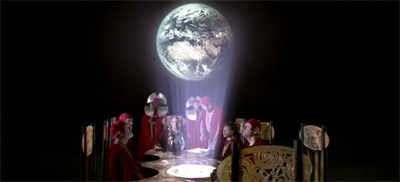
Worlds apart…

The problem is that the show seems more than a little entitled, more than a little brash about what is owed to it. The universe owes the Tenth Doctor one last go around; the audience owes Tennant and Davies enough to put up with this sort of ham-fisted sentimentality. There’s a moment when the Doctor seems to honestly consider leaving Wilf to die from radiation poisoning, and rants against the cruelty of the universe. How dare the universe put him in a position where he has to make this sort of moral choice!

The problem is that the episode tries to present this a sympathetic moment. We’re supposed to emphasise with the Doctor as he considers walking away from a poor old man who has been nothing but helpful and trustworthy and friendly to him. The End of Time, Part II is clearly intended as a celebratory romp in the style of Journey’s End, a reminder of how Doctor Who conquered television. The problem is that The End of Time, Part II overplays its hand a bit, and over-estimates how much the audience loves the Tenth Doctor.

Not quite a blaze of glory...

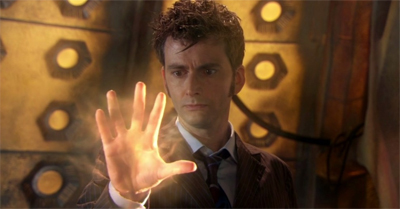
Not quite a blaze of glory…

Continue reading

Doctor Who: Planet of the Dead (Review)

To celebrate the fiftieth anniversary of the longest-running science-fiction show in the world, I’ll be taking weekly looks at some of my own personal favourite stories and arcs, from the old and new series, with a view to encapsulating the sublime, the clever and the fiendishly odd of the BBC’s Doctor Who.

Planet of the Dead originally aired in 2009.

Hello, I’m the Doctor. Happy Easter!

– the Doctor sets the mood

Planet of the Dead is light-weight Doctor Who. That wouldn’t normally be a problem. In fact, there’s a significant portion of each season devoted to light-weight run-around adventures. The problem is that it didn’t air as part of a season. It aired as the first piece of Doctor Who since Christmas and the next aired around Halloween. This was something of an attempt to tide fans over, to remind everybody that Doctor Who was still on the air while Steven Moffat and Matt Smith prepared to take over the TARDIS, the BBC got used to filming in HD and David Tennant pursued his career beyond the show.

As a result, the special feel a little funny. In a way, they seem like an attempt to truncate a standard season of Davies’ Doctor Who. The Next Doctor fits the mould of Christmas special quite well. It even snows! The Waters of Mars is the darker second two-parter of the season, dealing with bigger ideas and adult fears. The End of Time is very much a spiritual successor to Journey’s End. All of this is a way of pointing out that Planet of the Dead is clearly designed to serve as the bombastic family-friendly adventure two-parter that typically aired after the first two episodes of a given season.

As such, the logical point of comparison is Rise of the Cybermen, The Sontaran Stratagem or Daleks in Manhattan. Indeed, Planet of the Dead is conspicuous for its gratuitous location shooting; the last time the production team went abroad to film a story was Daleks of Manhattan, even if the cast stayed at home that time. The problem is that those light two-parters are tolerable in the context of a longer series. On its own, Planet of the Dead is far from satisfying.

Egging him on...

Egging him on…

Continue reading