• Following Us

  • Categories

  • Check out the Archives


  • Awards & Nominations

Star Trek: Voyager – Parturition (Review)

This February and March, we’re taking a look at the 1995 to 1996 season of Star Trek, including Star Trek: Deep Space Nine and Star Trek: Voyager. Check back daily Tuesday through Friday for the latest review.

One of the more interesting aspects of the second season of Star Trek: Voyager is its stubborn refusal to give up on elements that simply do not work.

Time and again, and often at the behest of producer Michael Piller, the second season returns to concepts that were problematic and troublesome in the first season. The obvious goal is to fix those problems so that those elements can be successfully reintegrated into the surrounding show. This is why the second season returns to concepts like the Kazon as a threat and Tom Paris as a rebel and Neelix as a character with a useful function on the ship. This is not a bad approach. If the first season of a show is about experimentation, then the second season is about calibration.
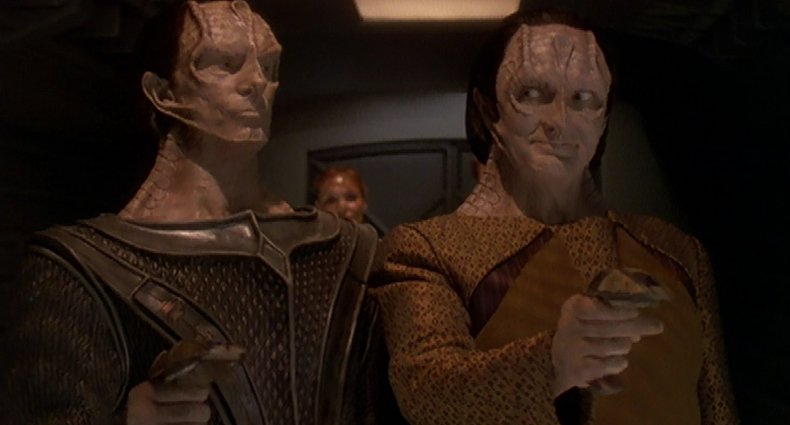
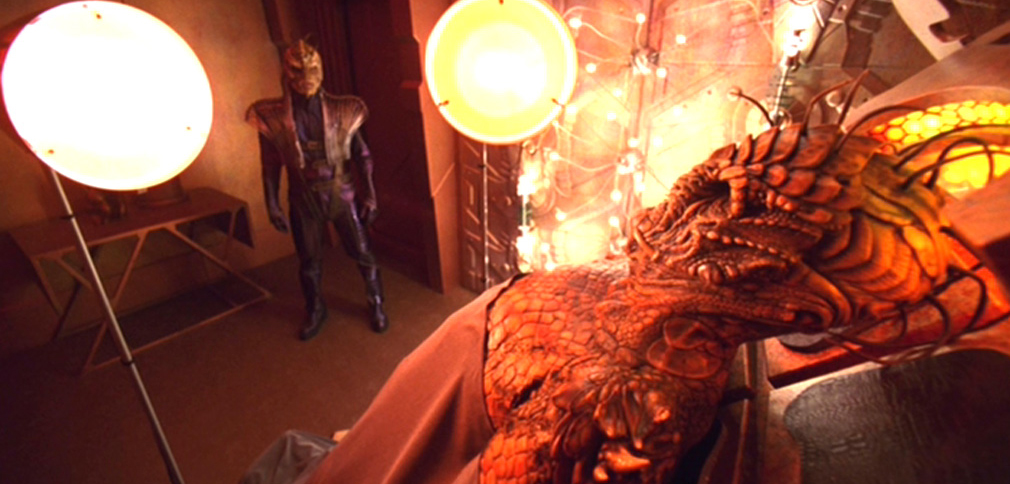
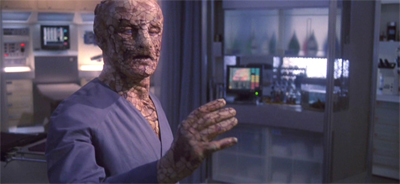
Two men and a lizard lady...

Two men and a lizard lady…

It is hard to begrudge Michael Piller this approach. After all, it had worked quite well on Star Trek: The Next Generation and Star Trek: Deep Space Nine. In particular, it took Deep Space Nine about three years before it figured out how to make characters like Bashir, Dax and Quark capable of carrying their own episodes without making the audience want to bash their heads against a large blunt surface. It is not unreasonable to take the same approach to dealing with the elements of Voyager that are not working.

There is a very significant difference, though. The problematic elements of Voyager have little to do with execution; they are fundamental problems with the concepts. The Kazon do not work as a threat because they are one of worst alien species that Star Trek ever produced, rooted in some rather unpleasant racial stereotypes tied to contemporary Los Angeles gang culture. Tom Paris does not work as a rebel and womaniser because Robert Duncan McNeill works better as a charming goof. Neelix’s romance with Kes is toxic because she is a child and he’s possessive.

Cooking up a storm...

Cooking up a storm…

As such, it feels like the second season of Voyager spends a lot of time fixing problems that are fundamentally unfixable. One of the great aspects of the premise of Voyager is the fact that the show is in a constant state of movement. Unlike the cast of Deep Space Nine who are fixed in a single place, the cast of Voyager are constantly moving forward. It is possible for Voyager to jettison the parts that are simply not working. (Cue lazy joke about the size of Kazon space.)

Parturition is an example of this phenomenon, as Voyager tries to “fix” the toxic relationship between Neelix and Kes, while offering Tom Paris some small semblance of character growth. Unfortunately, it seems very attached to the idea of Neelix and Kes as a romantic couple and Tom Paris as a playful romantic rogue, which means that the best that it can hope to do is to not make the underlying problems any more obvious. While Parturition is nowhere near as bad as Elogium or Twisted, it still feels like a series treading water.

It's time for the Delta Quadrant's favourite fifties sitcom, "Last Tango With Paris."

It’s time for the Delta Quadrant’s favourite fifties sitcom, “Last Tango With Paris.”

Continue reading

Star Trek: Deep Space Nine – The Way of the Warrior (Review)

This February and March, we’re taking a look at the 1995 to 1996 season of Star Trek, including Star Trek: Deep Space Nine and Star Trek: Voyager. Check back daily Tuesday through Friday for the latest review.

The third season of Star Trek: Deep Space Nine was really just a dress rehearsal for what lay ahead.

The third season had been a tumultuous time for the show, with Michael Piller departing the franchise to pursue opportunities outside Star Trek. It was the year directly after the end of Star Trek: The Next Generation, and all attention was focused on the pending release of Star Trek: Generations and the launch of Star Trek: Voyager. On top of that, the third season suffered from a great deal of confusion and disorganisation throughout the year, making it very hard for the production team to set an end goal for themselves.

"This could be the start of a beautiful friendship..."

“This could be the start of a beautiful friendship…”

In fact, the third season of Deep Space Nine was such a mess that the production team had not even managed to hit the end of season cliffhanger that they wanted. The Adversary had been drafted at the last possible minute when the studio vetoed the idea of ending the year with a Vulcan withdrawal from the Federation. This is not to discount the long list of impressive episodes produced during the season, but it does illustrate that the third season of Deep Space Nine had not progressed according to plan.

At the same time, it was a vital learning experience for the show. It provided a clear framework for what followed, providing producer Ira Steven Behr with a foundation from which he would build the rest of the run. The work put in during the third season would pay dividends in the fourth and fifth seasons, as the show began to play with and pay off ideas that had been carefully and meticulously established during that most chaotic of seasons. In fact, the show begins paying off those dividends with The Way of the Warrior, the first episode of the fourth season.

Klingons woz 'ere...

Klingons woz ‘ere…

Continue reading

Star Trek: Enterprise – Season 3 (Review)

Next year, Star Trek is fifty years old. We have some special stuff planned for that, but – in the meantime – we’re reviewing all of Star Trek: Enterprise this year as something of a prequel to that anniversary. This August, we’re doing the third season. Check back daily for the latest review.

The third season of Star Trek: Enterprise is a mess.

It is very clearly the work of a production team still figuring out how to plot long-form stories and struggling with the logistical difficulties of mapping out a single narrative across what was originally planned as a twenty-six episode season. There are extended periods where narrative momentum stalls; there are key moments where it seems like the show has no idea where it wants to go next. It seems like the production team never sat down in the gap before production began to figure out what story they wanted to tell, and ended up improvising.

ent-e2f1

However, it is also a bold and ambitious piece of television. It demonstrates an energy and excitement that had been lacking from the Star Trek franchise since Star Trek: Deep Space Nine went off the air. It is a season of television that doesn’t always work, but that is to be expected when the production team are trying something new. The failures of the first two seasons of the show often stemmed from a lack of ambition on the part of the production team; the failures in the third season are rooted in a surplus of ambition. It is hard to find them too objectionable.

The Xindi arc doesn’t always work as well as it might, but it works more than often enough to excuse the clumsy missteps along the way. There is something compelling and dynamic about a Star Trek show that is willing to push itself so far outside its own comfort zone. There is a spirit of adventure to the third season of Enterprise that had been sorely lacking from the first two seasons of the show. The biggest disappointment is that it took the show this long to find that confidence and that adventurousness.

ent-thexindi25 Continue reading

Star Trek: Enterprise – Zero Hour (Review)

Next year, Star Trek is fifty years old. We have some special stuff planned for that, but – in the meantime – we’re reviewing all of Star Trek: Enterprise this year as something of a prequel to that anniversary. This August, we’re doing the third season. Check back daily for the latest review.

There was a very real chance that Zero Hour might have been the last episode of Star Trek: Enterprise to air.

In fact, it was entirely possible that Zero Hour‘s distinctive (and downright provocative) closing shot of an evil!alien!space!Nazi might have been the last shot of Star Trek to air on television for quite some time.

Time is running out...

Time is running out…

Continue reading

Star Trek: Enterprise – The Council (Review)

Next year, Star Trek is fifty years old. We have some special stuff planned for that, but – in the meantime – we’re reviewing all of Star Trek: Enterprise this year as something of a prequel to that anniversary. This August, we’re doing the third season. Check back daily for the latest review.

From a technical standpoint, The Council is the third last episode of the third season. From an arc-based standpoint, the third season Xindi arc is not completely resolved until the events of Home three episodes into the fourth season. However, there is an argument to be made that The Council represents the logical conclusion of the third season arc. Sure, Countdown and Zero Hour provide a suitably bombastic resolution to the year-long story, but The Council is the story that really resolves the central conflict driving the season.

After twenty-one episodes of moral ambiguity and ethical compromise, The Council exists to assure viewers that Star Trek: Enterprise has not forgotten the optimistic humanism that has guided the franchise. The Council confirms what most even-handed fans had probably deduced from The Expanse and what had been rendered explicit in The Shipment. The third season was never about getting away from the core utopian values associated with the Star Trek franchise; instead, it was about an attempt to get back to those hopeful ideals.

"I told you not to interrupt me when I'm working on my tan!"

“I told you not to interrupt me when I’m working on my tan!”

As the name implies, The Council is a rather talky script; it is certainly the most talky script between this point and the end of the third season. The episode’s plot finds Archer making his case to the Xindi Council, appealing for a peaceful resolution to the escalating crisis. Archer puts aside his anger and his thirst for retribution, in the hope of finding common ground that might accommodate both sides without resort to warfare or attempted genocide. Naturally, Archer is not entirely successful; the season needs an action climax. However, he is close enough.

Much like The Forgotten, it turns out that The Council is a script about moving beyond grief and hatred towards reconciliation and understanding. It affirms that the third season of Enterprise is (and was always) following a very traditional Star Trek arc.

"Et tu, Dolim?"

“Et tu, Dolim?”

Continue reading

Star Trek: Enterprise – E² (Review)

Next year, Star Trek is fifty years old. We have some special stuff planned for that, but – in the meantime – we’re reviewing all of Star Trek: Enterprise this year as something of a prequel to that anniversary. This August, we’re doing the third season. Check back daily for the latest review.

Conventional wisdom treats as a bump in the road between The Forgotten and The Council, an episode that could easily be skipped on a marathon rewatch of the season. The argument suggests that the episode ultimately provides little meaningful information and advances the season’s over-arching plot by inches. The most critical of fans will consider an episode that saps the momentum out of the final run of the third season, preventing a clear home run between Azati Prime and Zero Hour.

This is certainly true from a plot-driven perspective. It would be easy enough to trim from the twenty-four episode season order without anybody batting an eyelid. At least Shran gets to make a cameo appearance in Zero Hour, while Lorian fades into discontinuity and non-existence. Like so many time travel stories, the final act of conveniently erases itself from existence. This just reinforces the sense that nothing that happened actually mattered in the grand scheme of things.

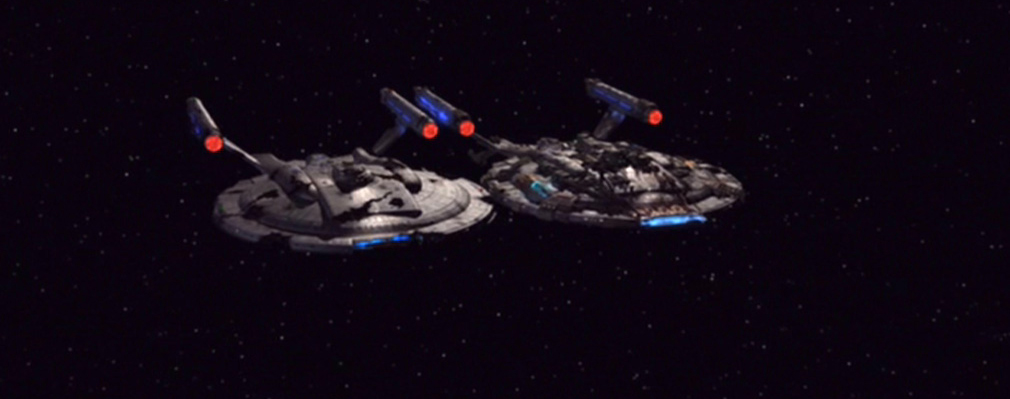
It's like looking in a mirror...

It’s like looking in a mirror…

This is another example of the complications that tend to come with serialised storytelling. The conventional way of telling a long-form story is to drive it via plot – to have a clear path along which the characters might advance with a number of clear markers along the way. In the case of the third season of Star Trek: Enterprise, the launch of the Xindi weapon is an obvious marker; it is a plot point which the show must address before the end of the season. As such, the show’s serialisation is typically measured by whether it moves the crew in relation to that plot point.

doesn’t move the crew appreciably closer to that plot point. There is a miniature hurdle for the crew to overcome (getting into the subspace corridor to make the meeting with Degra), but it is very clearly just window-dressing on a plot that is very clearly more interested in the time-travel dynamics of having the Enterprise crew meet their descendants. The same narrative ground could have been covered by having Degra accompany Archer to the Xindi Council at the end of The Forgotten.

He's all ears...

He’s all ears…

However, plot is not the only thing important to long-form storytelling. Theme and character are just as important, as The Forgotten demonstrated. The biggest problem with is that it is a plot-driven episode of television that advances the season’s thematic and character arcs, but with a story that is disconnected from the season as a whole. Which is a shame, because the thematic and character dynamics are fascinating. This is the perfect point at which to confront Archer with the idea of legacy and consequence; to ask what kind of future might lie ahead.

As with a lot of the scripts for the third season, feels like a meditation on Enterprise‘s relationship with the rest of the franchise and where it stands at this point in its run.

"Worf and Dax neve rhad to put up with crap like this."

“Worf and Dax neve rhad to put up with crap like this.”

Continue reading

Star Trek: Enterprise – Azati Prime (Review)

Next year, Star Trek is fifty years old. We have some special stuff planned for that, but – in the meantime – we’re reviewing all of Star Trek: Enterprise this year as something of a prequel to that anniversary. This August, we’re doing the third season. Check back daily for the latest review.

If you can end on a high note, the audience will forgive a lot.

The third season of Star Trek: Enterprise is one of the boldest and most ambitious seasons of Star Trek ever produced; it is certainly the most adventurous season of the franchise to air outside of Star Trek: Deep Space Nine. However, on an episode-to-episode basis, the quality is quite variable. There are great episodes (Impulse, Twilight), underrated episodes (North Star, Exile), fun episodes (Stratagem), and experimental episodes (Harbinger), but there are also a lot of episodes that are more interesting in theory than in practice.

Explosive finalé...

Explosive finalé…

It becomes increasingly obvious over the course of the season that the writing staff did not plan the year-long arc far enough in advance and that the show struggles to figure out where it wants to go after the initial burst of speed wears off. There are even a couple of outright stinkers that rank with the worst that the franchise ever produced. However, there is a lot to be said for an ending. The third season of Enterprise hits a few speed bumps along the way, but it manages to rally for an impressive and largely satisfying conclusion.

Azati Prime begins the march towards the end of the season. It was the first episode to be filmed after the Christmas break, suggesting that it was the work of a revitalised writing staff and an energised production team. More than that, it was broadcast as the last episode before a six-week break in the broadcast schedule, suggesting that everybody involved knew exactly the kind of hit that they had on their hands. It injects an incredible energy into a show that might be racing towards its own apocalypse.

Future's end...

Future’s end…

Continue reading

Star Trek: Enterprise – Hatchery (Review)

Next year, Star Trek is fifty years old. We have some special stuff planned for that, but – in the meantime – we’re reviewing all of Star Trek: Enterprise this year as something of a prequel to that anniversary. This August, we’re doing the third season. Check back daily for the latest review.

Hatchery is a very odd episode.

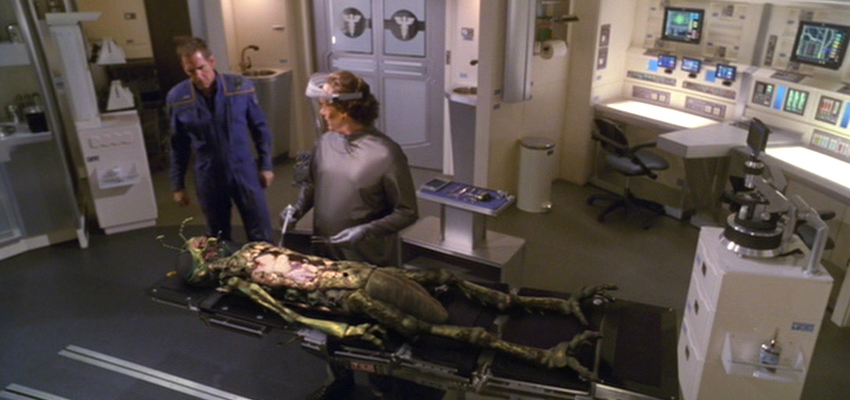
On the one hand, it feels like another irrelevant detour on the path to Azati Prime. It is a standalone episode about a wacky adventure that the crew have upon discovering a crashed ship on the surface of a dead world, playing with the standard Star Trek tropes about mind control and possession. This is not the first time that a Star Trek character has had their behaviour dramatically altered by an alien compound, and it does seem a bit distracting to tell this story at this point in this season, even in the aliens in this case are insect!Xindi.

Slice o' life...

Slice o’ life…

At the same time, it does feel like an important episode thematically. The third season of Star Trek: Enterprise is packed with all manner of existential explorations of what it means to be Star Trek. What are the essential ingredients of the franchise? How far can you wander off the template without breaking it? What does Star Trek even mean in a post-9/11 world? There are aspects of Hatchery that deal with these questions rather directly, as the episode explores the consequences of putting a bunch of marines on a Star Trek ship.

It just feels rather surreal that “Archer goes crazy from bug spray” should be the jumping-off point for that particular story.

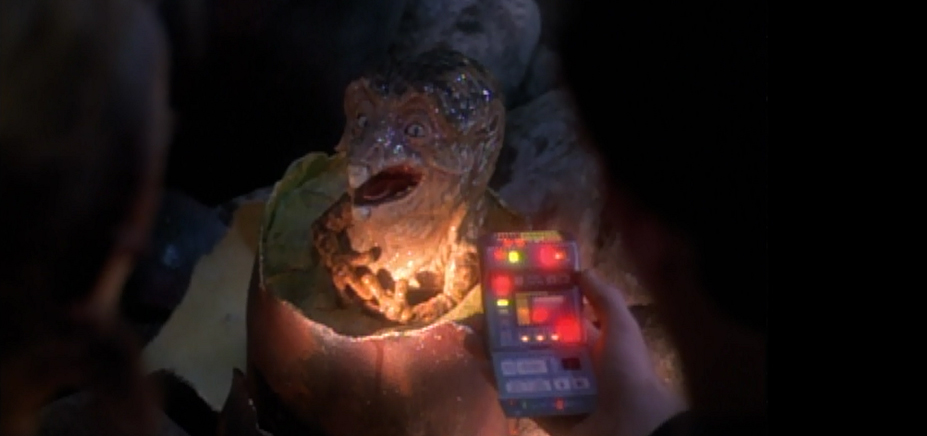
"Hey there, little fella..."

“Hey there, little fella…”

Continue reading

Star Trek: Enterprise – Harbinger (Review)

Next year, Star Trek is fifty years old. We have some special stuff planned for that, but – in the meantime – we’re reviewing all of Star Trek: Enterprise this year as something of a prequel to that anniversary. This August, we’re doing the third season. Check back daily for the latest review.

It goes almost without saying that the third season of Star Trek: Enterprise was an attempt to revitalise a franchise that had already been on television for a decade and half. It was an attempt to do something quite radical and dynamic with a television property that had become rather staid and conservative. Star Trek: The Next Generation had been perfectly calibrated for the late eighties and early nineties, but its approach towards storytelling was increasingly outdated after seven seasons of Star Trek: Voyager.

One of the recurring issues in the first season of Enterprise was the conflict between the established franchise structure and something more adventurous and exciting. So many of those first season episodes seemed laboriously paced and awkwardly arch; there was a sense of dull routine rather than exciting adventure. The show would occasionally try to deviated from the established template (to varying degrees of success) with stories like Dear Doctor, Shuttlepod One, and A Night in Sickbay, but narrative conservatism won out in the sophomore season.

"So... sweeps?"

“So… sweeps?”

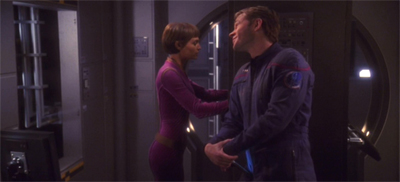
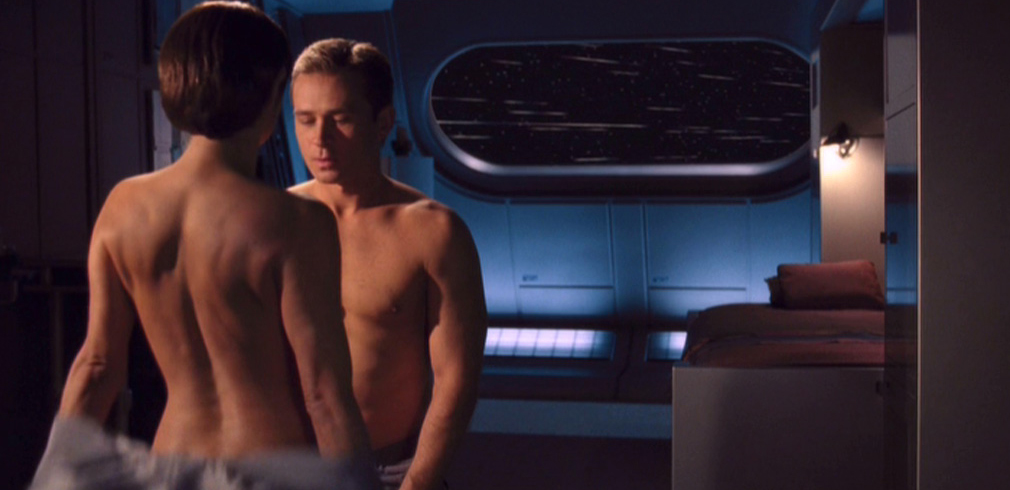
In many ways, Harbinger plays as a return to those earlier experiments in story structure. It is an episode that is not driven by story. Although the strange alien discovered by the crew provides a suitably dramatic climax, most of Harbinger is built around established character dynamics. Trip and T’Pol begin working through the sexual tension that has existed between them since the start of the third season; Reed and Hayes do something similar in a very different fashion. In the meantime, the ship just cruises along en route to the third season’s next big plot beat.

Harbinger is not entirely successful in this regard. There is a sense that the franchise is still figuring out how to construct episodes that don’t conform to a rigid story structure, with the mysterious alien visitor serving as an effective crutch to help get around these problems. Still, it is an interesting experiment and an example of how the show is consciously trying to reinvent itself in a manner that is more than simply cosmetic.

Expanding his Sphere of influence...

Expanding his Sphere of influence…

Continue reading

Star Trek: Enterprise – Stratagem (Review)

Next year, Star Trek is fifty years old. We have some special stuff planned for that, but – in the meantime – we’re reviewing all of Star Trek: Enterprise this year as something of a prequel to that anniversary. This August, we’re doing the third season. Check back daily for the latest review.

With Stratagem, the third season of Star Trek: Enterprise gets its head back in the game.

The recent stretch of third season episodes seemed to lose sight of what made this such an intriguing premise. Although Rick Berman had conceded that there was an escape hatch in place in case the Xindi arc could not sustain a full season of television, it was increasingly clear that the third season of Enterprise would be a single extended arc exploring Archer’s attempts to find the source of a deadly threat against mankind. It was a bold experiment for a show that had been quite rigidly episodic to this point. At least in theory.

Archer's on candid camera...

Archer’s on candid camera…

In practice, the third season of Enterprise seemed to flounder a little bit once it got past the initial burst of speed powering it into the third season. All of a sudden, the crew found themselves involved in a number of increasingly stand-alone adventures with superficial ties to the larger arc. Episodes like Extinction and Chosen Realm could easily have been produced and broadcast during the show’s first two seasons, with minor alterations. Exile and North Star were only loosely connected to the season’s plot. Carpenter Street was a time travel episode.

Proving Ground had suggested that the show was ready to re-focus its attention on the matter at hand and get back to the imminent threat posed by the Xindi. At the same time, the episode was also keen to stress its episodic nature – most notably in its role as the show’s annual check-in with the Andorians. Stratagem is very much its own self-contained story, but it is a lot more confident about how it fits in the larger scheme of things, and where it fits in the broader arc of the season.

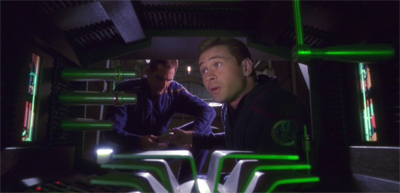
Engineering a convincing set-up...

Engineering a convincing set-up…

Continue reading