• Following Us

  • Categories

  • Check out the Archives


  • Awards & Nominations

Star Trek: Voyager – Scorpion, Part II (Review)

Scorpion, Part II demonstrates the real strength of the blockbuster two-part episodes scattered across the run of Star Trek: Voyager.

Generally speaking, the two-part episodes of Star Trek: The Next Generation suffered from a sense of disharmony. The two parts seldom felt integrated, often feeling quite disconnected from one another. This was most obvious in the cliffhangers bridging the seasons, when the writing staff would take time away from the office before returning to write the second part. Michael Piller famously had no idea what he was going to do with The Best of Both Worlds, Part II when he wrote The Best of Both Worlds, Part I.

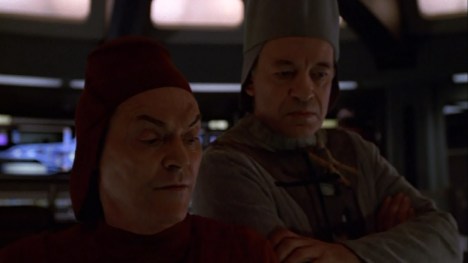
Droning on.

Droning on.

Even for the two-part episodes within a given season, there tended to be a disjointedness. Chain of Command, Part I is very much set-up for Chain of Command, Part II, with the second part feeling much stronger (and more substantial) than the first. Birthright, Part I leads into Birthright, Part II, but also features an entirely unrelated subplot that is dropped completely in the second half. Arguably, The Next Generation only really figured out how to properly balance two-parters in its final season, with Gambit, Part I, Gambit, Part II and All Good Things…

In contrast, Voyager does a much better job of balancing its two-parters so that they feel like two halves of a movie rather than an extended first act followed by a compressed second and third act. Future’s End, Part I and Future’s End, Part II established that template, but Scorpion, Part I and Scorpion, Part II demonstrates that it can applied as readily to season-bridging two-parters as to mid-season sweeps episodes. Scorpion, Part I and Scorpion, Part II integrate beautifully to form an impressive Voyager television movie.

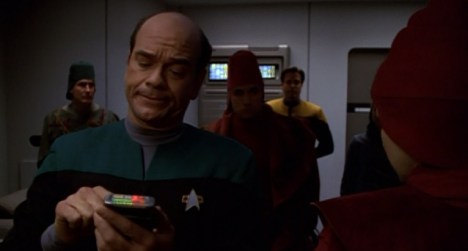
Venting frustration.

Venting frustration.

Continue reading

Star Trek: Deep Space Nine – Season 5 (Review)

The fifth season of Star Trek: Deep Space Nine is one of the best twenty-odd-episode seasons of television in the history of the medium.

Naturally, some episodes are stronger than others. There are a couple of duds to be found in the twenty-six episodes that make up the broadcast season. This is true of any season that runs for over twenty episodes; the reality of television production means that not every episode can be perfect and that some will inevitably be terrible. This is one of the nicer things about shifts to shorter television seasons; while it means fewer episodes in a given year, it also allows the production team more consistency.

ds9-empoknor12a

So the fifth season has episodes that do not work, to nobody’s surprise. The fourth season had Shattered Mirror and The Muse. The third season of Star Trek: The Next Generation had The Price and Ménage à Troi. The third season of The X-Files had The Blessing Way and Teso Dos Bichos. The second season of Millennium had Sense and Antisense and Siren. These are all great seasons of television, diminished in no way by their failures. The fifth season gets its failures out of the way early, with The Assignment and Let He Who Is Without Sin…

However, the fifth season of Deep Space Nine works so well because it has a very strong sense of internal consistency. As with the fourth season before it, there is a clear sense of where this production team wants to take the series. More than that, there is a very strong sense of harmony to the season. While each of the individual members of the writing staff have their own strengths and interests, they are all working together in pursuit of a common goal. Everybody writing for Deep Space Nine is on the same page as to what the show is about.

ds9-theassignment29a

The result is a season that marches very effectively and very coherently towards a logical and organic end point. A Call to Arms is perhaps the most radical cliffhanger in the history of the Star Trek franchise, sending Gene Roddenberry’s utopia into a two-season-long war while evicting the primary cast from the title location for more than just a single episode. It is to the credit of everybody working on the season that this finale is at once a gripping and subversive addition to the franchise mythology and a perfectly reasonable conclusion to the season.

The fifth season of Deep Space Nine ranks as a spectacular accomplishment.

ds9-trialsandtribbleations26a

Continue reading

Star Trek: Voyager – Season 3 (Review)

The third season of Star Trek: Voyager marks the point at which the show stops trying.

To be fair, it is not as though the opening two seasons of the show were marked by a surplus of ambition. Caretaker was a bold piece of science-fiction that promised a host of interesting ideas for the new Star Trek show, but all of those fascinating conflicts were quickly brushed aside by episodes like Parallax and Time and Again, which insisted on formulaic plotting and familiar storytelling. In many ways, the first season of the show felt like a cheaper eighth season of Star Trek: The Next Generation.

voy-fairtrade3

During the second season, the production team did attempt something a little bolder. Michael Piller returned from his work on Legend convinced that the franchise needed a dramatic shake-up and reinvention. So he attempted to introduce long-form storytelling on the series, with an arc building the Kazon as a credible threat to ship and crew. This arc failed spectacularly for a variety of reasons, with episodes like Alliances and Investigations ranking among the worst in the series’ run.

The Voyager writing staff were apparently traumatised by their experiences on that second season. Piller stepped aside at the end of the year, forced by the threat of mass resignations. Piller bid farewell to the show with Basics, Part I and Basics, Part II, effectively allowing the staff a clean slate coming into the third series of the show. Jeri Taylor stepped up into the role of showrunner, trying to steady a ship that was very clearly on troubled water. Three years into the run, how did Voyager define itself?

voy-futuresendparti13a

The third season has traditionally been a formative year for the Star Trek spin-offs. Michael Piller took charge of Star Trek: The Next Generation during its third season and established the template for the franchise heading into the nineties. Ira Steven Behr solidified the direction of Star Trek: Deep Space Nine during its third season, outlining many of the concepts and ideas that would play in the stronger fourth and fifth seasons. Even Star Trek: Enterprise came into its own in its third season, telling its own stories.

Voyager did not come into its own during this third season. Jeri Taylor’s direction for Voyager set the series on a course back to familiar territory. The third season of Voyager marks the point at which a troubled series adopts the path of least resistance, content to stop pushing itself in any direction and let itself be pulled by the gravity of the franchise around it. The third season of Voyager marks the point at which the series becomes content to be generic Star Trek.

voy-distantorigin27a

Continue reading

Star Trek: Deep Space Nine – Call to Arms (Review)

The release of atomic energy has not created a new problem. It has merely made more urgent the necessity of solving an existing one. One could say that it has affected us quantitatively, not qualitatively. As long as there are sovereign nations possessing great power, war is inevitable. This does not mean that one can know when war will come but only that one is sure that it will come. This was true even before the atomic bomb was made. What has changed is the destructiveness of war.

– Albert Einstein, “Einstein on the Atomic Bomb”, The Atlantic, November 1945

Feels like coming home...

Feels like coming home…

Can war ever be justified? Can war ever be inevitable? Can war ever be necessary?

These are very tough ethical questions, particularly when posed in the abstract. In fact, the vast majority of policy decisions about warfare are rooted in living memory rather than philosophical certainty. It has been repeatedly suggested that Bill Clinton’s reluctance to intervene in Rwanda was a consequence of the spectacular failure in Somalia, and that his eventual intervention in Kosovo was an act of atonement for the moral lapse in Rwanda. This is to say nothing of how Obama’s policy on Syria is shaped by Bush’s actions in Iraq and Afghanistan.

Station keeping.

Station keeping.

The Star Trek universe is a utopia. It is a world where technology has eliminated poverty and hunger. The replicator, the holodeck, the transporter and warp drive are the building blocks of an idealistic future in which mankind seems to have found peace with itself. Dating back to Star Trek: The Motion Picture at the latest, Gene Roddenberry proposed that the franchise represented an idealised future for mankind. It was a world in which nobody ever wanted for anything, in which mankind were free to explore the universe.

This idealism is a cornerstone of the franchise. It is one of the most recognisable and universal aspects of Star Trek. This is a franchise that genuinely believes that mankind can be better than we are today. That is a large part of what makes the show so powerful, particularly in its original context. As the Doomsday Clock ticks closer and closer to midnight, Star Trek is a franchise that seems to argue that mankind has a future worth aspiring toward; a future beyond the end of the world or some corporate dystopia.

A farewell at arms.

A farewell at arms.

The franchise was never particularly interested in exploring how mankind reached that level of enlightenment. Star Trek: Enterprise was nominally a prequel series for the franchise, picking up in the wake of Star Trek: First Contact, but it opened after mankind had eliminated warfare and famine and nationalism. In some ways, the franchise could seem like a rather surreal experiment. If you imagined a world without warfare or without greed or without hunger, maybe people would get along? There is undoubtedly value on this, but it feels simplistic.

In contrast, Star Trek: Deep Space Nine dared to ask tough and uncomfortable question by challenging these assumptions. If these characters did not live in a perfect world, would they still aspire to betterment? If hunger and greed were still a part of everyday life, could mankind still work to improve themselves? If warfare is the inevitable outcome of statesmanship, then how do these twenty-fourth century people retain their values and ideals? These are legitimately tough questions for the franchise to ponder, but Deep Space Nine embraces them.

Terror on Terok Nor.

Terror on Terok Nor.

It is hard to overstate just how shocking Call to Arms was on broadcast. The actual plot mechanics are fairly standard Star Trek season finale stuff. The ominous and mounting sense of dread coursing through the episode evokes The Best of Both Worlds, Part I, the first season-ending cliffhanger from Star Trek: The Next Generation. The decision to have the recurring antagonists hijack the eponymous space station recalls Basics, Part I, the cliffhanger that Star Trek: Voyager broadcast at the end of the previous television season.

However, Call to Arms is more shocking for the one element of the episode that has been building since the first encounter with the Dominion in The Jem’Hadar. It is the beginning of the franchise’s first extended war story. This is bold new territory for the franchise, something that remains controversial to this day.

"The ball is in your court."

“The ball is in your court.”

Continue reading

Star Trek: Deep Space Nine – In the Cards (Review)

In the Cards is the perfect penultimate episode to a sensational season of television.

One of the more common observations about Star Trek: Deep Space Nine is that it is the most dour and serious of the Star Trek series. It is the grim and cynical series of the bunch, with many commentators insisting that the series rejects the franchise’s humanist utopia in favour of brutality and nihilism. This criticism is entirely understandable. The series is literally and thematically darker than Star Trek: The Next Generation or Star Trek: Voyager. Even at this point, it is about to embark upon a two-year-long war arc, the longest in the franchise.

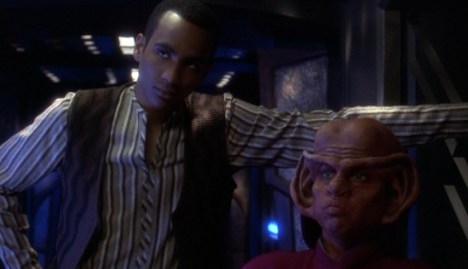
Jake and the Ferengi Man.

Jake and the Ferengi Man.

However, this is also a very reductive reading of Deep Space Nine. The series is more willing to criticise and interrogate the foundations of the Star Trek universe than any of its siblings, but it remains generally positive about the human condition. Governments and power structures should be treated with suspicion, but individuals are generally decent. Positioned right before the beginning of an epic franchise-shattering war, In the Cards is the perfect example of this philosophy. In the Cards elegantly captures the warmth and optimism of Deep Space Nine.

Deep Space Nine is fundamentally the story of a diverse and multicultural community formed of countless disparate people drawn together by fate or chance. In the Cards is a story about how happiness functions in that community, how the bonds between people can make all the difference even as the universe falls into chaos around them. It is also very funny.

Pod person.

Pod person.

Continue reading

Star Trek: Voyager – Scorpion, Part I (Review)

In some ways, Scorpion, Part I is the perfect cap to the third season of Star Trek: Voyager.

The third season has largely seen the show retreating from ideas and concepts that would render it unique in the larger Star Trek canon. Although the first two seasons were hardly radical in terms of storytelling style or substance, Michael Piller did make a conscious effort to build off some of the premises unique to this show. The Kazon might have been a terrible idea in both concept and execution, but they were at least something new. While the second season botched its attempts at serialisation, at least it made the effort.

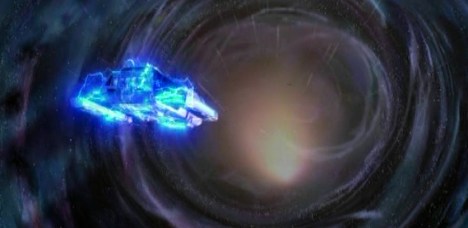
This is perhaps a metaphor for what Voyager is going to do to the Borg...

This is perhaps a metaphor for what Voyager is going to do to the Borg…

In the third season, the production team seem to have settled upon the idea of producing generic Star Trek, rather than telling stories unique to Voyager. This is something of a mixed blessing. While the third season features a host of forgettable episodes like Warlord and Alter Ego, it features few episodes as soul-destroying as Alliances or Investigations. More than that, episodes like Remember or Distant Origin demonstrate the appeal of producing generic Star Trek stories, ranking among the best episodes that the show has produced to date.

More than that, the production team have consciously pushed the show much closer to the model of Star Trek: The Next Generation. This is most obvious in the handling of Q as a character. While Death Wish found something novel and interesting to do with the character after All Good Things…, The Q and the Grey returns the character to his default settings for a cringe-worthy dress-up episode that owes far too much in concept and execution to Q-Pid. There are plenty of other examples.

This might also be a potent metaphor for what Voyager is about to do to the Borg...

This might also be a potent metaphor for what Voyager is about to do to the Borg…

However, Voyager‘s most overt embrace of the legacy of The Next Generation came with the introduction of the Borg. The Borg are in many ways the most iconic creation of the Berman era, perhaps the only new alien species liable to recognised alongside the Klingons or the Romulans or the Vulcans. After all, the Borg were the antagonists of Star Trek: First Contact, the theatrical release intended to celebrate the thirtieth anniversary. Their aesthetic influence can even be felt on Star Trek Beyond, the theatrical release intended to celebrate the fiftieth anniversary.

The Borg made their first appearance at the end of Blood Fever, in a postscript scene that feels like almost like a post-credits tease that arrived ten years too early. The Borg also appeared in Unity, an episode which featured Chakotay encountering the survivors from a disconnected Borg ship desperately trying to reconnect their shared link. However, neither of these episodes featured the Borg Collective, the powerful and single-minded collective consciousness that drives the hive mind.
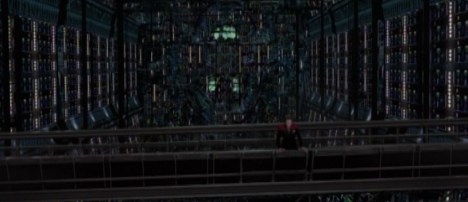
Building a bridge...

Building a bridge…

So it makes sense that the Borg Collective would appear in full force for Scorpion, Part I, the third season finale and cliffhanger bridging to the fourth season. Once again, this is a creative decision right out of the Next Generation playbook. The Next Generation really cemented its distinct cultural identity with the broadcast of The Best of Both Worlds, Part I at the end of its third season. Part of this was simply down to the fact that it had outpaced the original Star Trek, which only lasted three years. However, part of it was also that the cliffhanger was spectacular television.

Scorpion, Part I is not spectacular television. It is good television. It is a satisfying blockbuster epic, with a strong sense of momentum and some interesting ideas. However, it also smells a little bit of desperation. It feels like Voyager has completely abandoned its own sense of identity and followed the path of least resistance. Insert your own joke there.

Or, you know, don't. Whatever floats your boat.

Or, you know, don’t. Whatever floats your boat.

Continue reading

Star Trek: Deep Space Nine – Empok Nor (Review)

Empok Nor is effectively a slasher movie.

It is Bryan Fuller’s second story credit for Star Trek: Deep Space Nine, and it shares a number of tonal and thematic similarities with his story for The Darkness and the Light. Both episodes are essentially pitched as serial killer horror movies, in which monsters from the past stalk our lead characters. These are fascinating tonal departures for the Rick Berman era of the Star Trek franchise, even if they feel like the logical extension of early horror-tinged episodes like The Man Trap or Charlie X or The Enemy Within.

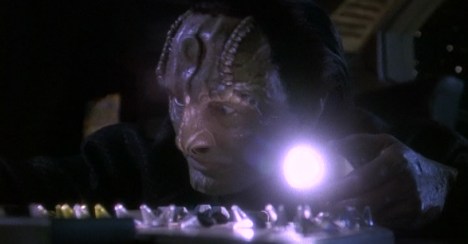
The great game.

The great game.

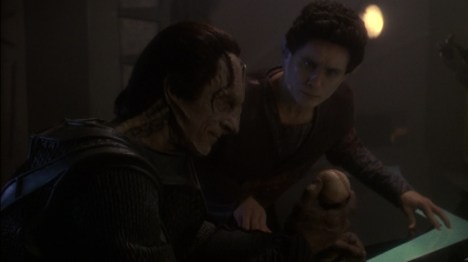
Empok Nor is not as well developed or as effective as The Darkness and the Light. It lacks the thematic and character-driven punch of that earlier episode, even suffering as a little derivative. While Kira’s efforts to reconcile her past as a terrorist with her current status quo was the driving force of The Darkness and the Light, the contrast between O’Brien as a soldier and O’Brien as an engineer feels a little underdeveloped in Empok Nor. More than that, Empok Nor suffers from casually transforming Garak into a gloating nineties serial killer.

At the same time, there is a cheeky thrill to watching the Deep Space Nine production team try their hand at a particularly trashy and visceral genre, offering jump scares and atmosphere on familiar sets with the lighting turned way down low. Empok Nor is not a standout of this most spectacular of television seasons, but it had its charms.

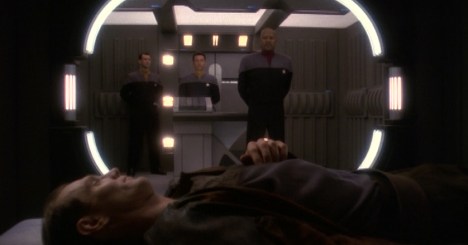
Sleeping beauties.

Sleeping beauties.

Continue reading

Star Trek: Deep Space Nine – Blaze of Glory (Review)

Blaze of Glory is a spectacular piece of television.

It is an episode that serves a very clear plot function in the larger context of Star Trek: Deep Space Nine. It is clearly designed to tidy away some of the dangling loose ends before the show transitions into the Dominion War. Much like Children of Time was really the last “strange Gamma Quadrant phenomenon” episode, Blaze of Glory is the last Maquis episode. It also marks the last appearance of Michael Eddington, a character who has come a long way since his first appearance as the station’s new security officer in The Search, Part I.

Michael Eddington, Noted Brigand.

Michael Eddington, Noted Brigand.

However, even ignoring the fact that Blaze of Glory fulfils these larger obligations in terms of the show’s long-running plot threads, the episode is an engaging and exciting buddy action film that finds Benjamin Sisko paired with one of his most hated adversaries on a dangerous mission into the heart of enemy territory. Ira Steven Behr and Robert Hewitt Wolfe prepare a script laced with wry banter for unlikely action heroes Avery Brooks and Ken Marshall, while Kim Friedman directs the episode as if it were a lost Reagan era Shane Black script.

However, Blaze of Glory also feels very much like Deep Space Nine at its best. It is an episode that celebrates how much these characters can grow and change, while also revelling in the diversity of perspectives that make Deep Space Nine such a compelling show. It is an episode that understands Sisko and Eddington are perhaps more alike than either would concede, but which explores those parallels in a way that never obscures their key differences or their mutual mistrust.

Disarming conversation.

Disarming conversation.

Continue reading

Star Trek: Voyager – Displaced (Review)

The Star Trek franchise has a reputation for being liberal and open-minded.

After all, the franchise is very much rooted in an extension of Kennedy-era liberalism, with the “final frontier” very much an extension of Kennedy’s “new frontier.” It is a franchise that is supposed to celebrate “new lifeforms and new civilisations” that it meets on “strange new worlds”, embracing the alien and celebrating diversity. The franchise is rooted in a utopian version of the future that has been portrayed as at least mostly socialist dating back to Star Trek: The Motion Picture at the latest.

The end is Nyrian.

The end is Nyrian.

However, there are also points at which Star Trek could be considered to be reactionary and conservative. The original Star Trek was nowhere near as progressive on matters of race and gender as many would claim. The first two seasons of Star Trek: Enterprise frequently played as endorsements of politics of the Bush era and the fear of the unknown. The third season of Star Trek: Voyager has been particularly conservative in its outlook; consider the treatment of sex in Blood Fever or Darkling, of the traditional family in Real Life, of globalisation in Unity.

Displaced is perhaps the most striking example, an episode that is essentially a forty-five minute treatise on the risk posed by immigration.

Damn space immigrants, clogging up our space hospitals.

Damn space immigrants, clogging up our space hospitals.

Continue reading

Star Trek: Deep Space Nine – Children of Time (Review)

Time is the fire in which we burn.

Children of Time comes towards the end of the franchise’s thirtieth anniversary season. By all accounts, the thirtieth anniversary season had been a resounding success. Star Trek: First Contact managed to please audiences and critics with a journey back to the beginning of the Star Trek universe. Star Trek: Deep Space Nine offered a crowd-pleasing homage to The Trouble With Tribbles in Trials and Tribble-ations. Even Star Trek: Voyager got in on the act with Flashback, Future’s End, Part I and Future’s End, Part II.

More than that, the franchise was thriving by just about any measure. Three casts were active simultaneously; two casts on television and one in cinemas. The thirtieth anniversary had garnered incredible media attention and had helped to remind audiences that the franchise was still chugging along a decade after its resurrection. To many observers, it appeared that the Star Trek had been resurrected. Against all odds, the television show that had been cancelled by NBC after only three seasons seemed to have been granted a form of immortality.

Walking into the sunset.

Walking into the sunset.

However, things were not as rosy behind the scenes. In fact, the franchise had been underperforming since the end of Star Trek: The Next Generation. The ratings would not become a real problem until the launch of Star Trek: Enterprise, but there were early signs that the franchise was in decline. Both Deep Space Nine and Voyager underwent cast revisions in their fourth seasons to try to solidify the ratings. Deep Space Nine got to keep its existing cast and add one new face, while Voyager had to fire one cast member to make room for the newest player.

Children of Time feels very much like a meditation and contemplation upon the theme of legacy, asking the characters on Deep Space Nine to wonder what they might leave behind.

Shocking.

Shocking.

Continue reading