• Following Us

  • Categories

  • Check out the Archives


  • Awards & Nominations

Star Trek: Deep Space Nine – Shadows and Symbols (Review)

Image in the Sand and Shadows and Symbols continue to reframe the theology of Star Trek: Deep Space Nine in terms of Christian iconography.

To be fair, it makes sense that Christian imagery and metaphor should so heavily influence film and television. The United States is the world’s largest exporter of entertainment, and so it makes sense that its preoccupations should filter through into the art that it creates. After all, certain plot and story threads on Star Trek: Voyager (including the Kazon, and the treatment of immigrants and refugees in Displaced and Day of Honour) are very clearly anchored in a number of racial anxieties unique to California during the nineties.

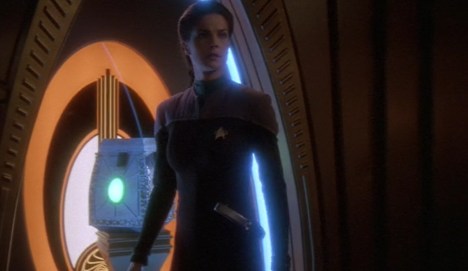
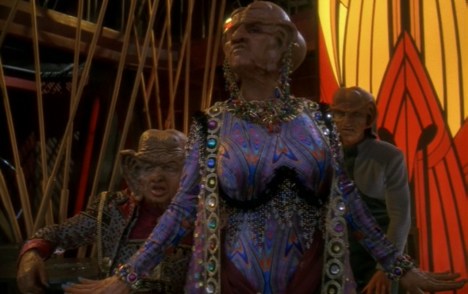
The writing’s on the wall.

However, there was something very interesting in the way that Deep Space Nine had introduced and developed its theology. The early seasons of Deep Space Nine were heavily influenced by more eastern religions, like Buddhism. They were also more ambiguous in their portrayal of the wormhole aliens, suggesting that the enigmatic creatures could be both aliens and gods, depending on one’s perspective. Even then, there was a recurring suggestion in episodes like Emissary and Prophet Motive that the wormhole aliens did not conform to human morality.

As Deep Space Nine approaches the end of its run, it simplifies its approach to religion. The Prophets become a lot less ambiguous, and the spiritual framework becomes a lot more conventional. This process really began in earnest with The Assignment and was solidified in The Reckoning, but it becomes a lot more concrete in Image in the Sand and Shadows and Symbols.
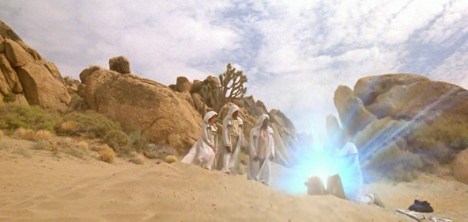
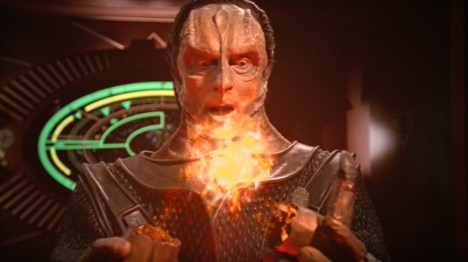
Let there be light.
And it was good.

Continue reading

Star Trek: Deep Space Nine – Image in the Sand (Review)

There is an endearing sense of symmetry to the seventh season premiere of Star Trek: Deep Space Nine.

The writers who worked on the show have been quite candid about their creative process. In particular, most of the production team would acknowledge that the show was heavily improvised rather than planned in advance. While the creators had a sense of the direction in which they wanted to move, they did not have a clear destination in mind until quite late in the journey. This was quite obvious looking at a number of the strange narrative detours that the arc took, most notably Gul Dukat’s time as a space pirate between Return to Grace and By Inferno’s Light.

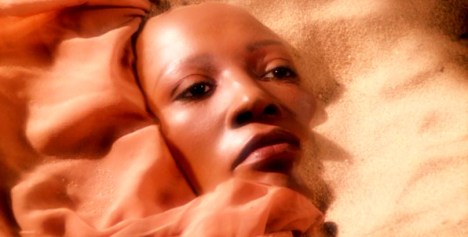
A Time to Sands.

At the same time, as the seventh season began, it seemed like the writers working on Deep Space Nine had a much stronger idea of how they wanted the series to come to a close. Image in the Sand and Shadows and Symbols feel like a very clever structural choice for the seventh season premiere. They exist at once as echoes of the arc that opened the sixth season and as preludes to the story that would conclude the seventh. They exist as bookends to these two chapters of the larger series, feeling almost like the exact midpoint of a larger story.

Positioned approximately half-way between the epic six-episode arc that opened the sixth season and the sprawling ten-episode narrative that would draw down the curtain at the end of the seventh season, Image in the Sand and Shadows and Symbols feel like a much smaller affair. However, they are still well-observed and well-written, covering a lot of thematic and narrative ground in a way that contextualises what come before and sets up what will follow.

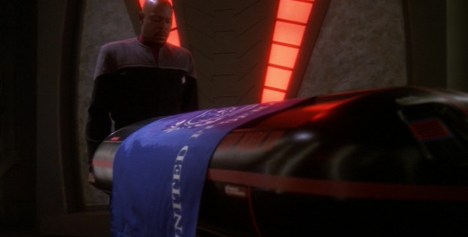
“Play it again, Sisko.”

Continue reading

Star Trek: Deep Space Nine – Season 6 (Review)

The sixth season of Star Trek: Deep Space Nine seems to brush up against the limits of what the show could do.

To be fair, Deep Space Nine spent most of its fourth and fifth seasons smashing through the arbitrary boundaries imposed upon what a Star Trek show could and could not do. Overseen by executive producer Ira Steven Behr, the writing staff very consciously and very vigourously pushed past the limitations imposed by the so-called “Roddenberry Box” and the style of television overseen by franchise leader Rick Berman. The storytelling became more complex, serialisation crept in, the music became more noticeable, conflict became more evident.

This all built to a climax in the second half of the fifth season, a series of interlinked stories that stretched from In Purgatory’s Shadow and By Inferno’s Light through to Call to Arms. Diplomatic tensions rose, character arcs became clear. Then, at the very end of the season, the unthinkable happened. The Federation went to war with the Dominion. More than that, the Federation started a war with Dominion. It was a bold creative choice, one that chipped away at so many of the assumptions underlying the utopian future of Star Trek.

The sixth season faces a number of serious problems. Most obviously, the fourth and fifth seasons had pushed so far that there was only so much ground left to cover. The sixth season explored that ground thoroughly. There is an argument to be made that the arc that opens with Call to Arms and continues through the first six episodes of the sixth season ranks as the single most ambitious stretch of the Rick Berman era. Episodes like Far Beyond the Stars, Inquisition and In the Pale Moonlight pushed the franchise well outside its comfort zone.

At the same time, there was a clear sense that the production team was butting up against the limits of the form, that they had pushed Deep Space Nine almost as far as it was possible to push a nineties Star Trek show, and so the season lacked the same sense of forward momentum as the fourth and fifth seasons had. Many creative decisions in the sixth season feel like the result of creative compromise, whether the sense that the writers had told all the big stories that they wanted to tell or because they had to bow in some way to the conventions of television storytelling.

The result is a frustrating season of television. The sixth season of Deep Space Nine features some of the best Star Trek episodes in the fifty-year history of the franchise. However, it also contains a lot of thwarted ambitions. For every barrier that the sixth season smashes through, it brushes up against another. It is a reminder of just how far Deep Space Nine had pushed the franchise during its run. In some ways, it felt like the sixth season of Deep Space Nine was not so much brushing up against the limits of Star Trek as against the limits of nineties television.

Continue reading

Star Trek: Deep Space Nine – Tears of the Prophets (Review)

Tears of the Prophets has a number of very good ideas.

The character arc driving the episode is very good, particularly in the context of a finale leading into the final season of the show. Star Trek: Deep Space Nine has always been a show more interested in character arcs and long-form storytelling than the other Star Trek shows, so “Benjamin Sisko experiences a loss so great that he resigns his commission” is an organic story beat. It feels like a story that the writers on this show can tell, and a story that fits very comfortably within the grand mythic framework that the writers are trying to construct.

All fired up.

Deep Space Nine has earned a lot of goodwill in this regard, demonstrating a willingness to let stories play out over extended periods and to follow stories through to their natural conclusion. Sisko leaving the station at the end of Tears of the Prophets is not the same as Picard being assimilated at the end of The Best of Both Worlds, Part I or Worf leaving the Enterprise at the end of Redemption, Part I. Any savvy audience member knows that Sisko will return to his post, probably sooner rather than later, but they also trust the show to treat it as more than just a striking cliffhanger.

Unfortunately, Tears of the Prophets is compromised by a number of very poor ideas. Some of those ideas did not originate with the writing staff, their hands forced by outside factors. Ira Steven Behr’s original plans for Tears of the Prophets did not include the death of Jadzia Dax, but the writers had to incorporate that plot element rather late in the cycle. Of course, this does not excuse some of the poor decisions made in how the writers chose to handle that unforeseen plot element, although that was also a result of a number of outside factors.

So Jad to zia you.

However, Tears of the Prophets also leans into some of the more frustrating creative decisions of the sixth season as a whole. The script doubles down on some of the least satisfying elements of Deep Space Nine‘s long-form storytelling, even combining several of these frustrating beats into a central narrative strand of the season finale. Tears of the Prophets combines the generic cartoon villainy of Gul Dukat as suggested at the climax of Waltz and the teaser to Wrongs Darker Than Death or Night with the stock mysticism of the Pah-Wraiths from The Reckoning for a heady ill-judged cocktail.

The result is a somewhat uneven episode, a story with a very strong central character arc that plays to the strengths of the show, but with several supporting elements that indulge the series’ worst impulses.

Funeral for a friend.

Continue reading

Star Trek: Deep Space Nine – Time’s Orphan (Review)

In some ways, Time’s Orphan provides a companion piece to Profit and Lace.

A recurring theme of the sixth season of Star Trek: Deep Space Nine has been the suggestion that the series has reached the limits of what is possible within the context of a nineties Star Trek series, that it has really done just about everything that it is possible for a mid-nineties genre television show to do within the confines of Gene Roddenberry’s universe. After the fourth and fifth seasons crashed through boundaries, the sixth discovers new limits on the horizon.

This will not end well.

In some ways, Profit and Lace marks the end of the line for Deep Space Nine‘s Ferengi-centric episodes. It suggests that the production team have done just about everything that they can do within that framework, and that the ideas remaining are somewhat underwhelming. Time’s Orphan does something similar with the annual (or even biannual) “O’Brien must suffer!” stories. The production team have inflicted almost every horror imaginable on Chief Miles Edward O’Brien, and Time’s Orphan represents just about the last idea left.

Time’s Orphan is nowhere near as bad as Profit and Lace, although it taps into the same core problem. The writers on Deep Space Nine have taken a given story thread about as far as they can take it, which means that there is very little left to do within an established framework. Time’s Orphan manages a few moments of genuine emotion, but it also feels strained and tired. Time has caught up with the production team.

Scarred to death.

Continue reading

Star Trek: Voyager – Season 4 (Review)

The fourth season is probably the show’s best season.

Of course, that is arguably damning with faint praise. By any measure, the fourth is probably weaker than at least four seasons of Star Trek: The Next Generation and four seasons of Star Trek: Deep Space Nine. It is also weaker than the first two seasons of Star Trek or the final two seasons of Star Trek: Enterprise. In the grand scheme of things, that places the best season of Star Trek: Voyager around the franchise median. Somehow, this feels entirely appropriate.

The fourth season of Voyager has some of the show’s best episodes. As such, it also has some of the franchise’s best episodes. Scorpion, Part I and Scorpion, Part II are spectacular television, while Year of Hell, Part I and Year of Hell, Part II offer a glimpse of the show that Voyager could have been while also developing some of the series’ core themes. There are also truly great standalone episodes like Nemesis, Prey, and Living Witness. More than that, there is a lot of really fun storytelling as well, with lighter episodes like Concerning Flight and Message in a Bottle.

However, there is also an unevenness to the season. While there are arguably fewer truly terrible episodes than in the earlier seasons, there are a couple of true stinkers like Retrospect or Vis á Vis. More than that, there are quite a few disposable and dull episodes, stories quickly forgotten after the end credits. Stories like Scientific Method, Random Thoughts, Waking Moments, Unforgettable and Demon fail to make a lasting impression. They just fill up the season order adding very little beyond a familiar Star Trek beat sheet.

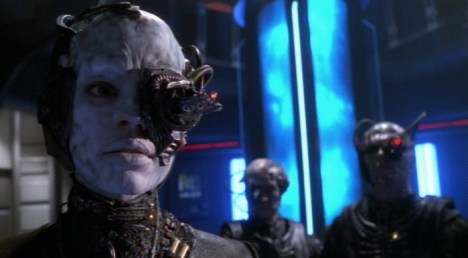
In some ways, this is the central tension of the fourth season, one reflected in the addition of Seven of Nine and the focus on Borg culture. The fourth season of Voyager is caught between mediocrity and brilliance, between being a perfectly serviceable mid-tier Star Trek show and being something a little more ambitious. The fourth season is a weird synthesis of generic Star Trek and something unique, reflecting the fusion of organic and mechanical that defines the Borg Collective.

The fourth season of Voyager ultimately retreats back to the comfort and safety offered by familiarity, but there are moments when it looks like the show might finally be ready to take flight. Unfortunately, it never really gets off the ground, but there is something heartwarming in the effort.

Continue reading

Star Trek: Voyager – Hope and Fear (Review)

Hope and Fear is a reasonably solid conclusion to the fourth season of Star Trek: Voyager.

To be fair, the episode has a number of very clever ideas. There are a number of creative choices in Hope and Fear that feel entirely appropriate for the final episode of what has been a relatively strong season. Various concepts and ideas are brought back into play, from Janeway’s alliance with the Borg in Scorpion, Part II through to her conversion of Seven of Nine in The Gift and up to the secret coded message from Starfleet suggested in Hunters. It makes sense to bring all of these ideas back into play for the grand finale.

The fourth season comes to a head.

More than that, it makes sense to build the episode around the dynamic between Janeway and Seven. One of the recurring tensions in the fourth season, both behind the scenes and in front of the camera, has been the debate about the prominence of Seven of Nine. In the year since she was introduced, Seven has effectively become one of the three most important members of the cast. There is a credible argument to be made that she is the most important member of the cast, an anxiety played out in One. As such, it is logical to build Hope and Fear around Janeway and Seven.

At the same time, there is a certain clumsiness to the plotting of the episode. There is a very rushed quality to the story, which never really takes the time to develop or explore these big revelations and twists. Hope and Fear races towards its conclusion as if it has been sucked into quantum slipstream, a very disorienting and disjointed effect. Certain character arcs feel under-explored, and certain gaps in the plot logic are brushed aside. Hope and Fear feels like a story that deserved a bigger canvas.

The hard cell.

Continue reading

Star Trek: Deep Space Nine – Profit and Lace (Review)

Profit and Lace is a disastrous misfire, a late-season catastrophe that many would consider to be the absolute nadir of Star Trek: Deep Space Nine. At best, it is an episode that belongs in conversation with Meridian, Prophet Motive, Let He Who Is Without Sin… and The Emperor’s New Cloak. It is a very bad piece of television. It could reasonably be argued that the toxicity of Profit and Lace is not even quarantined. The episode is so bad that it becomes a retroactive taint upon Deep Space Nine‘s attempts to develop and flesh out the Ferengi.

Some of the show’s best episodes focus on the Ferengi characters, like House of Quark or Family Business or Little Green Men or The Magnificent Ferengi, not to mention all manner of very solid stories like The Nagus or Bar Association or Body Parts. The writers on Deep Space Nine did a tremendous job developing and humanising the Ferengi, but the late one-two punch of Profit and Lace and The Emperor’s New Cloak erases all of that good will. Suddenly, the Ferengi are appearing in episodes as tone-deaf and ill-advised as The Last Outpost.

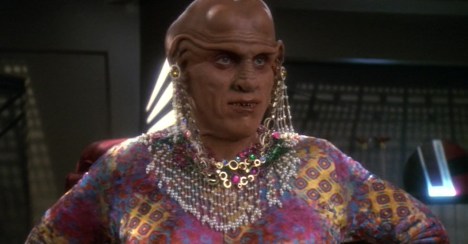
How Ishka got her groove back.

There are any number of reasons why Profit and Lace is so horrible. On a very basic level, it is a comedy episode that is simply not funny. The script is built around jokes that were already tired by the standards of fifties Hollywood, but refuses to do anything interesting or compelling with them. It is uncomfortably backwards-looking and regressive, its sexual politics feeling horribly outdated. The direction veers wildly between something approaching earnest world-building and broad slapstick, resulting a tonal mismatch that is toxic to the touch.

Profit and Lace is a stinker, by just about any measure.

A Quarky installment.

Continue reading

Star Trek: Voyager – Living Witness (Review)

Living Witness is a fantastic piece of television, and a great example of what Star Trek: Voyager does best.

Living Witness is in many ways archetypal Star Trek, a story that uses the franchise framework to construct a powerful allegorical story that comments upon contemporary anxiety. It is a story that could easily have been told on any of the other franchise series, especially Star Trek: The Next Generation or Star Trek: Enterprise, but it is a story told well. Living Witness is one of the highlights of the fourth season, and one of the strongest episodes from the seven-season run.

Command and conquer.

In many ways, Living Witness is the culmination of themes and ideas that have been bubbling through Voyager from the outset. Some of these elements are less than flattering, with the episode’s racial politics evoking the clumsiness with which the Kazon were handled. However, there is also a fascination with idea of history and how history functions in a world rooted in postmodernism and recnstruction. At the end of history, is the past up for grabs? Are facts anything more than pieces to be manoeuvred on a political chessboard?

Given this archetypal quality of Living Witness, how it reflects the themes and pet interests of Voyager, there is some irony in the fact that the episode does not actually feature a single regular character from Voyager. The regular cast appear as holographic representations of themselves, exaggerations and distortions. When the EMH appears almost half-way through the episode, he is explicitly identified as “a back-up programme”, and thus distinct from the version of the EMH who will appear in Demon or One.

Core principles.

In some ways, Living Witness confirms one of the more interesting aspects of Voyager, the fact that the characters are themselves largely irrelevant to the show and that the series is much more compelling as a framework to explore archetypal ideas. Living Witness is just one of several episodes that treat the regular characters as a secondary aspect of the show, almost as guest stars who have crossed over into a completely different series. Living Witness is very much of a piece with stories like Distant Origin or Course: Oblivion, or even Muse or Live Fast and Prosper.

Living Witness is a story about the thin line between history and mythology. In doing so, it consciously reframes Voyager as a story within a story, as concept more powerful as an archetype than as a material object. Living Witness images the ship and its crew as history elevated to mythology.

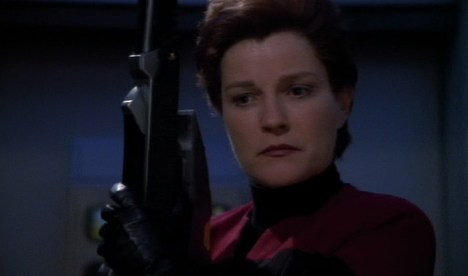
Any which Janeway but loose.

Continue reading

Star Trek: Deep Space Nine – The Reckoning (Review)

The end is nigh.

As the sixth season of Star Trek: Deep Space Nine draws to a close, the production team are increasingly aware that things will be wrapping up shortly. Star Trek: The Next Generation ran for seven seasons, setting a nice target for the spin-offs. Indeed, most of the sixth season had been spent discussing contract extensions with the cast for a final season. The writers (and the cast) knew that the seventh season would be the last. As the sixth season wound down, that massive deadline loomed large.

That’s gonna leave a stain.

The long-term storytelling on Deep Space Nine was largely improvised on the fly, with the writers adding new and interesting twists to the mythology as they went; this led to strange-in-hindsight tangents like Dukat’s time as a space pirate between Return to Grace and By Inferno’s Light. There had never really been a long-term plan, explaining why seemingly important plot points like Bajor’s admittance to the Federation seemed to just drop off the table after Rapture.

At best, the writers on Deep Space Nine knew the direction in which they were moving, but had not charted the course that they would follow. Still, a looming deadline tends to focus the mind. In the final third of the sixth season, the production team begin aligning plot points and character arcs towards the end of the story. Ira Steven Behr wrote His Way in large part because he wanted to introduce Vic Fontaine and pair off Kira and Odo, realising that time was working against him.

Who Prophets?

The Reckoning is a story about the end of days, in more ways than one. Broadcast in April 1998, it perfectly taps into the millennial eschatology that had taken root in the popular consciousness in the lead up to the twenty-first century. The Reckoning posits an epic battle between good and evil that will mark the end of an epoch, tapping into an anxiety simmering through popular culture in television shows like Millennium and films like End of Days. As the nineties came to a close, there was a clear anxiety about what the future might hold, if it existed at all.

However, The Reckoning also feels like a conscious effort to align various characters and plot beats in service of the final season ahead. The Reckoning properly seeds an entire subplot that will play through the remainder for the show, from Tears of the Prophets through to What You Leave Behind. Character motivations are made clear, stakes are heightened, mythology is explained. All of this is very much in service of where the writers plan for Deep Space Nine to go.

The wormhole in things…

Continue reading