• Following Us

  • Categories

  • Check out the Archives


  • Awards & Nominations

Star Trek: Deep Space Nine – Treachery, Faith and the Great River (Review)

Treachery, Faith and the Great River is a beautiful piece of Star Trek: Deep Space Nine.

It is a meditation on everything suggested by the title, recurring themes across the seven-season run of Deep Space Nine. Indeed, it is a reflection on how each of those three concepts all tie back to the same notion of belief. Treachery is what happens when belief is betrayed, faith is what happens when belief is held without validation, and the great river reflects a more generic belief in the balance and distribution of the wider universe. Treachery, Faith and the Great River is a story about belief and the various forms that it takes, and the rewards that it offers.
“And how can man die better than facing fearful odds, for the ashes of his fathers, and the temples of his Gods?”

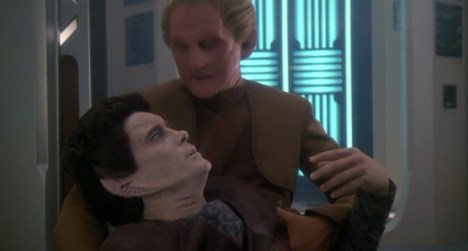
In many ways, Treachery, Faith and the Great River marks a return to the sort of softer religious belief that defined the early seasons of Deep Space Nine. It is an episode that engages with the challenges of faith, rather than taking it at face value. It is no small irony that an episode as nuanced as Treachery, Faith and the Great River should be credited to the writers responsible for The Reckoning. In many ways, Treachery, Faith and the Great River asks what it means to truly believe in something, even knowing that this belief might never be rewarded.

Treachery, Faith and the Great River is a story about looking for the divine, and the answers that are offered in return.

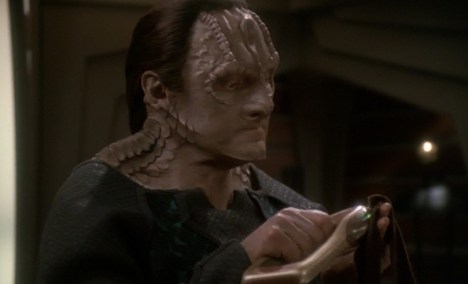
Weyoun Six, Weyoun Seven…
All good clones go to heaven…

Continue reading

Star Trek: Deep Space Nine – Take Me Out to the Holosuite (Review)

Star Trek: Deep Space Nine is populated by losers.

There are exceptions to this blanket statement, of course. By some measures, the crew of this fringe outpost are quite distinguished. Benjamin Sisko is the Emissary of the Prophets and is a decorated combat veteran. Worf served as Chief of Security on the Federation flagship. Julian Bashir has been genetically engineered to make him stronger and faster than the average human. The Dax symbiont was heavily involved in the negotiation of the peace agreement between the Federation and the Klingon Empire.

A whole different ball game.

However, even these examples of success and prestige are somewhat tempered. Sisko arrived on this backwater outpost as a man considering resigning. Worf is a terrible father and a widower. Bashir spent most of his life hiding his abilities, to the point that he has been forced to pretend to be less than he was; although he is now “out”, his genetic engineering has arguably served to further marginalise him within Starfleet. The Dax symbiont is now joined to Ezri Tegan, a young woman who had never planned to be a host.

In the larger context of the Star Trek universe, Deep Space Nine feels like the island of misfit toys. Odo was found drifting alone through the void; when he finally found his people, he discovered that they were monstrous fascists; when he killed one of his own people, he was forced into exile. Quark is stuck managing a bar that can barely turn a profit, watching others get ahead. Garak was forced into exile by his own father, and is now a traitor to his own people. Martok lost his eye in a Dominion prison camp.

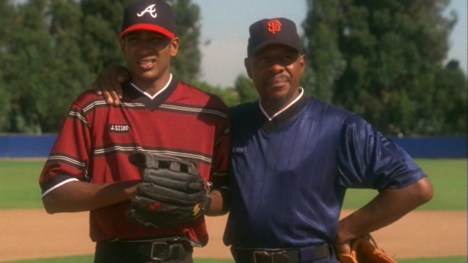
Playing games.

This is in marked contrast to the characters who usually populate the franchise. JJ Abrams’ rebooted Star Trek essentially makes a point to feature at least one sequence demonstrating how each crew member is the top of their given field. Star Trek: The Next Generation was set in one of the most professional working environments in television history. Star Trek: Voyager might have been populated by rebels and scientists, but they still trounced the Borg on a regular basis. Star Trek: Enterprise was a crew of the best and the brightest.

There are a lot of things to love about Take Me Out to the Holosuite, and one of them is the fact that it understands that Deep Space Nine is populated by losers. Take Me Out to the Holosuite also understands that this is part of what makes Deep Space Nine so winning.

Game on.

Continue reading

Star Trek: Deep Space Nine – Afterimage (Review)

Afterimage is a necessary episode, in part because Ezri Dax is a necessary character.

Adding a new character to a show in the middle of its run is always a challenge. The addition of Seven of Nine to Star Trek: Voyager had generated considerable tension, both around what the show wanted to be and in terms of the cast working on the series. It can be difficult to strike a balance, to figure out how much attention to devote to this new arrival, to give them some focus without stealing focus from the surrounding cast. It is a tightrope for the writers to walk, one compounded by the relative novelty of this late addition, the new toy in the writers’ toy box.

Make it sew.

This problem is compounded when the new addition arrives at the start of the final season. In any final season, space is at a premium. The production team are racing towards the finish line, trying to service all the dangling plot threads and complete all the important plot arcs. Every beat is important, every story vital. Final seasons are about providing closure, about wrapping things up. Introducing a new character in the midst of all that is a daunting responsibility, a challenge with very high stakes.

The writers at Star Trek: Deep Space Nine were working at something of a disadvantage and to a deadline. However, they did have some handicaps. Most notably, the production team had already successfully integrated a new character into the ensemble, when Worf joined the cast in The Way of the Warrior. More than that, there was some luxury in the fact that Ezri Dax would not be an entirely new character. She would be a logical extension of the premise that was built in Jadzia Dax. She was at least partially familiar, and her concept had been properly seeded.

On airlock down.

Still, introducing Ezri Dax into the final season of Deep Space Nine would prove difficult. The production team would often struggle to strike a balance between writing stories that extended (and concluded) the arcs of other major characters while also writing episodes that introduced and established the character of Ezri. It could often seem like Ezri’s journey was just beginning, right as everybody else’s was coming to a close. The final season of a seven-year show is seldom the perfect place for a new beginning.

As such, Afterimage is more an episode driven by necessity than by desire, a story that has to be told because of factors that were outside the control of the production team. The result is solid, if not exceptional. It is an episode that works best at establishing a new character and new dynamics, suffering just a little bit from clumsy storytelling in the process.

Holo pleasures.

Continue reading

Star Trek: Deep Space Nine – Shadows and Symbols (Review)

Image in the Sand and Shadows and Symbols continue to reframe the theology of Star Trek: Deep Space Nine in terms of Christian iconography.

To be fair, it makes sense that Christian imagery and metaphor should so heavily influence film and television. The United States is the world’s largest exporter of entertainment, and so it makes sense that its preoccupations should filter through into the art that it creates. After all, certain plot and story threads on Star Trek: Voyager (including the Kazon, and the treatment of immigrants and refugees in Displaced and Day of Honour) are very clearly anchored in a number of racial anxieties unique to California during the nineties.

The writing’s on the wall.

However, there was something very interesting in the way that Deep Space Nine had introduced and developed its theology. The early seasons of Deep Space Nine were heavily influenced by more eastern religions, like Buddhism. They were also more ambiguous in their portrayal of the wormhole aliens, suggesting that the enigmatic creatures could be both aliens and gods, depending on one’s perspective. Even then, there was a recurring suggestion in episodes like Emissary and Prophet Motive that the wormhole aliens did not conform to human morality.

As Deep Space Nine approaches the end of its run, it simplifies its approach to religion. The Prophets become a lot less ambiguous, and the spiritual framework becomes a lot more conventional. This process really began in earnest with The Assignment and was solidified in The Reckoning, but it becomes a lot more concrete in Image in the Sand and Shadows and Symbols.

Let there be light.
And it was good.

Continue reading

Star Trek: Deep Space Nine – Image in the Sand (Review)

There is an endearing sense of symmetry to the seventh season premiere of Star Trek: Deep Space Nine.

The writers who worked on the show have been quite candid about their creative process. In particular, most of the production team would acknowledge that the show was heavily improvised rather than planned in advance. While the creators had a sense of the direction in which they wanted to move, they did not have a clear destination in mind until quite late in the journey. This was quite obvious looking at a number of the strange narrative detours that the arc took, most notably Gul Dukat’s time as a space pirate between Return to Grace and By Inferno’s Light.

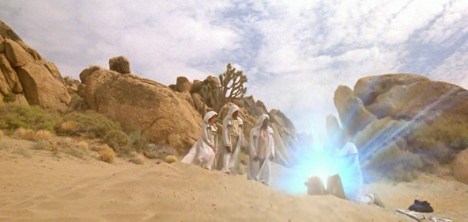
A Time to Sands.

At the same time, as the seventh season began, it seemed like the writers working on Deep Space Nine had a much stronger idea of how they wanted the series to come to a close. Image in the Sand and Shadows and Symbols feel like a very clever structural choice for the seventh season premiere. They exist at once as echoes of the arc that opened the sixth season and as preludes to the story that would conclude the seventh. They exist as bookends to these two chapters of the larger series, feeling almost like the exact midpoint of a larger story.

Positioned approximately half-way between the epic six-episode arc that opened the sixth season and the sprawling ten-episode narrative that would draw down the curtain at the end of the seventh season, Image in the Sand and Shadows and Symbols feel like a much smaller affair. However, they are still well-observed and well-written, covering a lot of thematic and narrative ground in a way that contextualises what come before and sets up what will follow.

“Play it again, Sisko.”

Continue reading

Star Trek: Deep Space Nine – Season 6 (Review)

The sixth season of Star Trek: Deep Space Nine seems to brush up against the limits of what the show could do.

To be fair, Deep Space Nine spent most of its fourth and fifth seasons smashing through the arbitrary boundaries imposed upon what a Star Trek show could and could not do. Overseen by executive producer Ira Steven Behr, the writing staff very consciously and very vigourously pushed past the limitations imposed by the so-called “Roddenberry Box” and the style of television overseen by franchise leader Rick Berman. The storytelling became more complex, serialisation crept in, the music became more noticeable, conflict became more evident.

This all built to a climax in the second half of the fifth season, a series of interlinked stories that stretched from In Purgatory’s Shadow and By Inferno’s Light through to Call to Arms. Diplomatic tensions rose, character arcs became clear. Then, at the very end of the season, the unthinkable happened. The Federation went to war with the Dominion. More than that, the Federation started a war with Dominion. It was a bold creative choice, one that chipped away at so many of the assumptions underlying the utopian future of Star Trek.

The sixth season faces a number of serious problems. Most obviously, the fourth and fifth seasons had pushed so far that there was only so much ground left to cover. The sixth season explored that ground thoroughly. There is an argument to be made that the arc that opens with Call to Arms and continues through the first six episodes of the sixth season ranks as the single most ambitious stretch of the Rick Berman era. Episodes like Far Beyond the Stars, Inquisition and In the Pale Moonlight pushed the franchise well outside its comfort zone.

At the same time, there was a clear sense that the production team was butting up against the limits of the form, that they had pushed Deep Space Nine almost as far as it was possible to push a nineties Star Trek show, and so the season lacked the same sense of forward momentum as the fourth and fifth seasons had. Many creative decisions in the sixth season feel like the result of creative compromise, whether the sense that the writers had told all the big stories that they wanted to tell or because they had to bow in some way to the conventions of television storytelling.

The result is a frustrating season of television. The sixth season of Deep Space Nine features some of the best Star Trek episodes in the fifty-year history of the franchise. However, it also contains a lot of thwarted ambitions. For every barrier that the sixth season smashes through, it brushes up against another. It is a reminder of just how far Deep Space Nine had pushed the franchise during its run. In some ways, it felt like the sixth season of Deep Space Nine was not so much brushing up against the limits of Star Trek as against the limits of nineties television.

Continue reading

Star Trek: Deep Space Nine – The Sound of Her Voice (Review)

The Sound of Her Voice is a very sweet and thoughtful little episode.

In many ways, it is the perfect penultimate episode of the sixth season of Star Trek: Deep Space Nine. It is a reminder of just how much the series has changed over the past few seasons, but also a demonstration of the things that make the show different from Star Trek: The Next Generation or Star Trek: Voyager. It is an episode that is anchored in the sort of careful character development and rich atmosphere that sets the series apart from the other Star Trek series. It is difficult to imagine this episode working as well with any other cast.

Absent friends.

However, The Sound of Her Voice is more than just a clever character-driven ensemble piece. It is a very reflective piece of television. Like Ronald D. Moore’s previous script for the sixth season, Valiant, his work on The Sound of Her Voice feels very introspective. Over the course of the episode, the characters find themselves in contact with a voice from the past. In a very direct way, The Sound of Her Voice puts the characters from Deep Space Nine in conversation with the franchise’s history.

There is a lot of maturity and consideration in The Sound of Her Voice, which feels appropriate as the sixth season draws to a close.

The window of opportunity is closing.

Continue reading

Star Trek: Deep Space Nine – Time’s Orphan (Review)

In some ways, Time’s Orphan provides a companion piece to Profit and Lace.

A recurring theme of the sixth season of Star Trek: Deep Space Nine has been the suggestion that the series has reached the limits of what is possible within the context of a nineties Star Trek series, that it has really done just about everything that it is possible for a mid-nineties genre television show to do within the confines of Gene Roddenberry’s universe. After the fourth and fifth seasons crashed through boundaries, the sixth discovers new limits on the horizon.

This will not end well.

In some ways, Profit and Lace marks the end of the line for Deep Space Nine‘s Ferengi-centric episodes. It suggests that the production team have done just about everything that they can do within that framework, and that the ideas remaining are somewhat underwhelming. Time’s Orphan does something similar with the annual (or even biannual) “O’Brien must suffer!” stories. The production team have inflicted almost every horror imaginable on Chief Miles Edward O’Brien, and Time’s Orphan represents just about the last idea left.

Time’s Orphan is nowhere near as bad as Profit and Lace, although it taps into the same core problem. The writers on Deep Space Nine have taken a given story thread about as far as they can take it, which means that there is very little left to do within an established framework. Time’s Orphan manages a few moments of genuine emotion, but it also feels strained and tired. Time has caught up with the production team.

Scarred to death.

Continue reading

Star Trek: Deep Space Nine – Profit and Lace (Review)

Profit and Lace is a disastrous misfire, a late-season catastrophe that many would consider to be the absolute nadir of Star Trek: Deep Space Nine. At best, it is an episode that belongs in conversation with Meridian, Prophet Motive, Let He Who Is Without Sin… and The Emperor’s New Cloak. It is a very bad piece of television. It could reasonably be argued that the toxicity of Profit and Lace is not even quarantined. The episode is so bad that it becomes a retroactive taint upon Deep Space Nine‘s attempts to develop and flesh out the Ferengi.

Some of the show’s best episodes focus on the Ferengi characters, like House of Quark or Family Business or Little Green Men or The Magnificent Ferengi, not to mention all manner of very solid stories like The Nagus or Bar Association or Body Parts. The writers on Deep Space Nine did a tremendous job developing and humanising the Ferengi, but the late one-two punch of Profit and Lace and The Emperor’s New Cloak erases all of that good will. Suddenly, the Ferengi are appearing in episodes as tone-deaf and ill-advised as The Last Outpost.

How Ishka got her groove back.

There are any number of reasons why Profit and Lace is so horrible. On a very basic level, it is a comedy episode that is simply not funny. The script is built around jokes that were already tired by the standards of fifties Hollywood, but refuses to do anything interesting or compelling with them. It is uncomfortably backwards-looking and regressive, its sexual politics feeling horribly outdated. The direction veers wildly between something approaching earnest world-building and broad slapstick, resulting a tonal mismatch that is toxic to the touch.

Profit and Lace is a stinker, by just about any measure.

A Quarky installment.

Continue reading

Star Trek: Deep Space Nine – Valiant (Review)

Valiant is a very bitter and mean-spirited little episode of Star Trek: Deep Space Nine, and all the more effective for that fact.

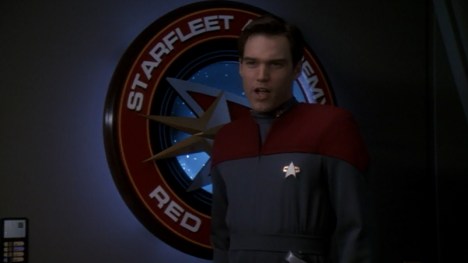
Some of that bitterness is baked into the basic premise. Valiant is an episode about a bunch of plucky young cadets who get brutally murdered for daring to believe in themselves. The final act of Valiant is a brutal piece of television, the camera lingering over the death and destruction on familiar sets, panning across the dead bodies of these promising young recruits. No matter how arrogant or inexperienced Red Squad might be, no matter how eager their participation in an attempted fascist coup in Homefront and Paradise Lost, it is still an unsettling image.

A legend in his own mind.

However, there is something even nastier lurking beneath the surface of this episode. On a superficial level, Valiant suggests that the guest characters fail in their daring mission because they lack the self-awareness to recognise the folly of their plan, but this is disingenuous. Countless Star Trek episodes have been built around far more reckless and audacious schemes, generally paying off the heroes. Valiant does not punish these young cadets for doing something that the main characters would never have attempted, it punishes them for not being the main characters.

Valiant is in some ways a brutal deconstruction of the typical Star Trek storytelling framework, an episode built around a selection of guest characters whose biggest mistake is assuming that they are the stars of the show rather than simply bit players. Valiant comes down hard on these would-be heroes, a reminder that life does not always operate according to familiar storytelling structures.

Hard to pin it on just one person.

Continue reading