• Following Us

  • Categories

  • Check out the Archives


  • Awards & Nominations

Star Trek – The Way to Eden (Review)

This July and August, we’re celebrating the release of Star Trek Beyond by taking a look back at the third season of the original Star Trek. Check back every Monday, Wednesday and Friday for the latest update.

Like any television, or any piece of popular culture, Star Trek is a product of its time.

That does not mean that the show speaks only to its time or that it has no relevance beyond that moment in time, but in means that the series is very much anchored in the zeitgeist of the late sixties. Sometimes that influence is obscured by advances in the intervening years, like the fascination with the novelty of transplant surgery that played out in the background of Spock’s Brain. Sometimes that tangible connection is more like ambient background noise than direct influence, as with the sense of apocalyptic dread that permeates the third season as a whole.

"You reach?"

“You reach?”

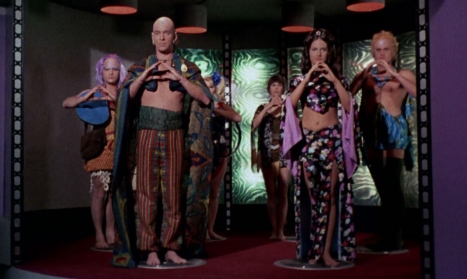
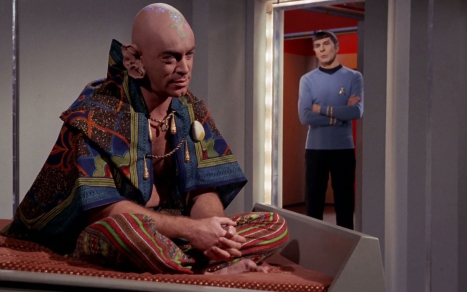
Sometimes, however, it is impossible to look upon Star Trek as anything other than a product of the late sixties. Let That Be Your Last Battlefield was undeniably a product of 1968, with its anxiety about civil strife and civil rights, its somewhat reductive metaphor for race relations and its general production aesthetic. However, that is nothing compared to The Way to Eden, which might be the most flamboyantly and stereotypically sixties episode of the entire original run.

The Way to Eden is the episode that opens with a bunch of space!hippies staging a sit-in in the Enterprise transporter room and escalates from there.

Trippy hippie shakedown.

Trippy hippie shakedown.

Continue reading

Star Trek – Whom Gods Destroy (Review)

This July and August, we’re celebrating the release of Star Trek Beyond by taking a look back at the third season of the original Star Trek. Check back every Monday, Wednesday and Friday for the latest update.

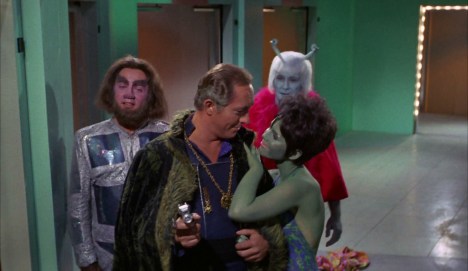
Whom Gods Destroy is a mess.

In a lot of ways, Whom Gods Destroy is shoddy and lazy. In many ways, the episode plays like a collection of familiar Star Trek elements blended together to pad out forty-odd minutes of television with no regard for internal logic or plotting and with minimal regard for the characters caught in the middle of it all. There are very few ideas in Whom Gods Destroy that have not been done before, and done better. The episode is not only a rehash of familiar concepts, but it is an exercise in diminishing returns.

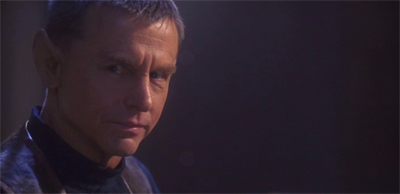
Dance with destiny.

Dance with destiny.

This is to say nothing of the chaos unfolding behind the scenes during the production of the episode. It seemed only appropriate that Kirk’s latest mission would take him to what is effectively a gothic asylum in outer space, because it seemed more and more that Star Trek was turning into a madhouse. Veteran staffers were leaving the show in droves, while tensions were mounting on the set, and Fred Freiberger was struggling to keep the budget under control. More than that, there was a clear sense that the series was over, and this was the end of the line.

Whom Gods Destroy really sounds like a disaster. It is certainly not a good episode of television. However, this is the third season. Whom Gods Destroy is interesting enough that it works much better than the season’s weaker episodes. It is elevated by a manic energy that goes some way towards covering for the more illogical elements of the plot, and three central performances that play into the high camp of the premise. Whom Gods Destroy is far from classic Star Trek, but it is much better than it has any right to be.

Absolute madness.

Absolute madness.

Continue reading

Star Trek – That Which Survives (Review)

This July and August, we’re celebrating the release of Star Trek Beyond by taking a look back at the third season of the original Star Trek. Check back every Monday, Wednesday and Friday for the latest update.

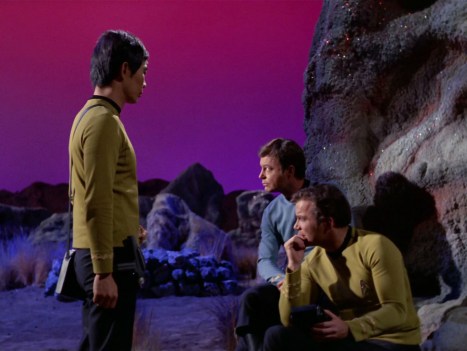
Even the title feels morbid.

That Which Survives is sad and mournful. It is a story about returning, but wrong. It is the story of a dead world that by all accounts should not be, haunted by the image of a woman who has been dead for millennia. This spectre both is the original woman and is not; it is mechanical guardian that retains just enough of its subjects personality to be horrified by what it is doing. It is an unsettling premise, particularly for an episode that features Lee Meriwether menacing the crew with her arm outstretched while repeating “I am for you.”

The more, the Meriwether.

The more, the Meriwether.

However, Losira is not the only character who “comes back wrong” over the course of the episode. Over the course of That Which Survives, the crew of the Enterprise are thrown throw space and find themselves racing to rescue Captain Kirk. However, mysterious malfunctions begin to affect the script. Eventually, Spock deduces the cause. “The Enterprise was put through a molecular transporter and reassembled slightly out of phase.” In other words, the Enterprise was taken apart and put back together wrong.

This seems like as an apt a metaphor for the third season as any. Star Trek had been killed at the end of its second season, cancelled by NBC. The show was resurrected for a third season, although it did not return at full strength. Vital members of the production team departed the show. The budget was cut. An outside producer with no previous experience of working on the show was drafted. For many watching at home, there was a sense that the third season had changed. In some ways, Star Trek had come back wrong.

"At least we got in before the purple rain."

“At least we got in before the purple rain.”

Continue reading

Star Trek – Is There in Truth No Beauty? (Review)

This July and August, we’re celebrating the release of Star Trek Beyond by taking a look back at the third season of the original Star Trek. Check back every Monday, Wednesday and Friday for the latest update.

The third season of Star Trek is very odd. It stands quite apart from the previous two seasons.

There are a lot of reasons for this; a new executive producer, the loss of veterans from the first two seasons, production limitations imposed by a slashed budget. Star Trek was never a lavish show, and it always faced production challenges, but those challenges were never more acute than during the third season. In a lot of cases, that oddness is not a good thing. And the Children Shall Lead and Spock’s Brain are very strange pieces of television, but not in a good way. They are clumsy, cheap, ill-judged and ill-advised.

Healthy green glow.

Healthy green glow.

At the same time, that strange vibe of the third season is not inherently bad. There are a number of episodes produced during the third season (particularly during this stretch of the third season) that feel weird and odd, but also refreshing and exciting. Episodes like Is There in Truth No Beauty?, The Empath and The Tholian Web have an eccentric and ethereal quality to them that feels quite removed from the first two seasons of the show. They are also three of the strongest episodes of the season, feeling adventurous and playful.

After all, for all that the third season is maligned, it is surprisingly influential. The third season of Star Trek contributes a great deal to the language and iconography of the franchise, perhaps as a result of the unusual constraints and production realities that inform it. Is There in Truth No Beauty? is an odd little tale, but it is also a clever and effective metaphor that explores grand ideas in the classic Star Trek tradition.

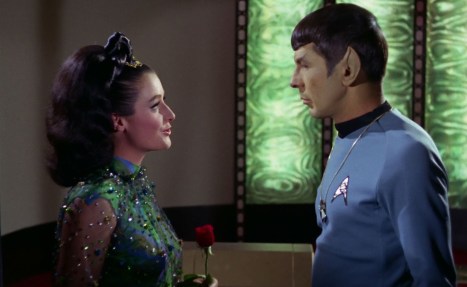
Jonesing for for some Diane Muldaur.

Jonesing for for some Diane Muldaur.

Continue reading

Star Trek: Enterprise – Babel One (Review)

This May, we’re taking a look at the fourth (and final) season of Star Trek: Enterprise. Check back daily for the latest review.

It seems entirely appropriate that the United trilogy sits in the middle of the fourth season.

The three-parter is not the strongest of the season’s multi-episode epics, abandoning the clean three-act structure that made the Kir’Shara trilogy so successful in favour of a disjointed two-parter-and-coda format that prevents the story from feeling as cohesive as it might. It jolts and starts, never really finding the proper flow for the story that it wants to tell. There is a sense that the production team’s desire to do both a “birth of the Federation” story and a “visit to Andoria” story within the same three-part narrative ultimately hinders the storytelling.

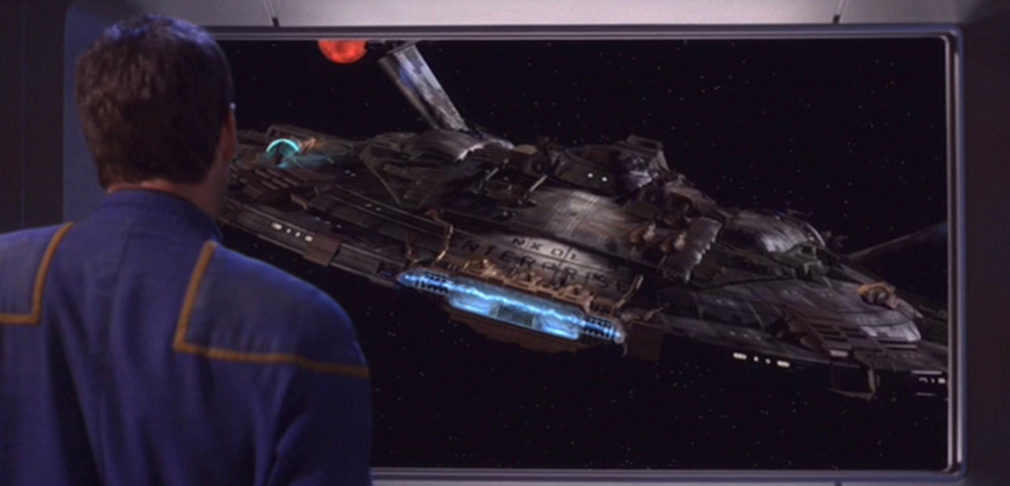
"What do you mean I'm not in the third part?!"

“What do you mean I’m not in the third part?!”

However, there is something satisfying in watching Star Trek: Enterprise commit to the idea of the birth of the Federation. It could be argued that this is an example of the fourth season’s continuity pandering, but the Federation is far more fundamental to the fabric of the franchise than something like Klingon foreheads or that ghost ship from that third season episode. If Enterprise is to be a prequel, it should devote some attention to building the fabric of the shared universe. The Federation is an essential part of the idealistic future of Star Trek.

However, the most compelling aspect of the United has nothing to do with continuity and history. Instead, it is simply reassuring to see Enterprise embracing the franchise’s utopianism and hope for the future, particularly in the context of January 2004.

Shran, Shran, he's our Andorian...

Shran, Shran, he’s our Andorian…

Continue reading

Star Trek: Enterprise – E² (Review)

Next year, Star Trek is fifty years old. We have some special stuff planned for that, but – in the meantime – we’re reviewing all of Star Trek: Enterprise this year as something of a prequel to that anniversary. This August, we’re doing the third season. Check back daily for the latest review.

Conventional wisdom treats as a bump in the road between The Forgotten and The Council, an episode that could easily be skipped on a marathon rewatch of the season. The argument suggests that the episode ultimately provides little meaningful information and advances the season’s over-arching plot by inches. The most critical of fans will consider an episode that saps the momentum out of the final run of the third season, preventing a clear home run between Azati Prime and Zero Hour.

This is certainly true from a plot-driven perspective. It would be easy enough to trim from the twenty-four episode season order without anybody batting an eyelid. At least Shran gets to make a cameo appearance in Zero Hour, while Lorian fades into discontinuity and non-existence. Like so many time travel stories, the final act of conveniently erases itself from existence. This just reinforces the sense that nothing that happened actually mattered in the grand scheme of things.

It's like looking in a mirror...

It’s like looking in a mirror…

This is another example of the complications that tend to come with serialised storytelling. The conventional way of telling a long-form story is to drive it via plot – to have a clear path along which the characters might advance with a number of clear markers along the way. In the case of the third season of Star Trek: Enterprise, the launch of the Xindi weapon is an obvious marker; it is a plot point which the show must address before the end of the season. As such, the show’s serialisation is typically measured by whether it moves the crew in relation to that plot point.

doesn’t move the crew appreciably closer to that plot point. There is a miniature hurdle for the crew to overcome (getting into the subspace corridor to make the meeting with Degra), but it is very clearly just window-dressing on a plot that is very clearly more interested in the time-travel dynamics of having the Enterprise crew meet their descendants. The same narrative ground could have been covered by having Degra accompany Archer to the Xindi Council at the end of The Forgotten.

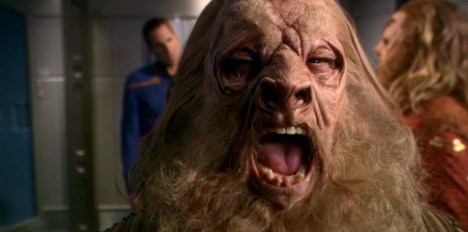
He's all ears...

He’s all ears…

However, plot is not the only thing important to long-form storytelling. Theme and character are just as important, as The Forgotten demonstrated. The biggest problem with is that it is a plot-driven episode of television that advances the season’s thematic and character arcs, but with a story that is disconnected from the season as a whole. Which is a shame, because the thematic and character dynamics are fascinating. This is the perfect point at which to confront Archer with the idea of legacy and consequence; to ask what kind of future might lie ahead.

As with a lot of the scripts for the third season, feels like a meditation on Enterprise‘s relationship with the rest of the franchise and where it stands at this point in its run.

"Worf and Dax neve rhad to put up with crap like this."

“Worf and Dax neve rhad to put up with crap like this.”

Continue reading

Leonard Nimoy

Leonard Nimoy passed away today.

Nimoy is an interesting figure. He is an actor and director with a long a prolific career, who seldom wanted for steady work. He did a lot of quality work in front of (and behind) the camera. Nimoy was a series regular on the sixties version of Mission: Impossible, taking over from Martin Landau. He played a major role in the 1978 remake of Invasion of the Body Snatchers with Donald Sutherland. He also directed both Three Men and a Baby. He worked quite regularly and quite frequently. His body stretches over half a century.

leonardnimoy1

However, all of this work (and it is great work) is inevitably overshadowed by a single role. To an entire generation of people – not just fans, not even just casual television viewers – Leonard Nimoy was Spock. With his pointed ears, memorable catchphrases and iconic Vulcan salute, Nimoy was enigmatic half-human half-Vulcan who served as the first officer of the USS Enterprise. His work spans the franchise, from the unbroadcast original pilot (The Cage) to the most recent JJ Abrams feature (Star Trek Into Darkness).

This was the conflict at the heart of Nimoy, the extremely professional performer who worked pretty consistently throughout his life and the one role that he turned into a screen icon across television and film. Nimoy was a complex character. He famously published an autobiography declaring I Am Not Spock, only to follow it up with I Am Spock. It is a credit to the actor’s complexity and nuance that both could seem to be true in the same instant.

tos-amoktime12

Continue reading

Star Trek – Patterns of Force (Review)

The first Star Trek pilot, The Cage, was produced in 1964. To celebrate its fiftieth anniversary, this December we are reviewing the second season of the original Star Trek show. You can check out our first season reviews here. Check back daily for the latest review.

Patterns of Force is a rather strange little episode, the type of weird and iconic adventure that Star Trek tended to do quite well. It’s very much an off-the-wall adventure, of the kind that none of the spin-off shows would attempt. “Planet of the Nazis” is a concept that belongs alongside other second-season episodes like “Planet of the Romans” or “Planet of the Gangsters.” It’s a very goofy premise, one that requires considerable suspension of disbelief before the episode even starts.

And, yet, despite the many serious problems with Patterns of Force, this is an episode that very clearly and very forcefully has something to say. Reflecting the world in which it aired, Star Trek is a show that is largely defined by the Second World War. In The City on the Edge of Forever, it was revealed that the Second World War had to happen to beckon the bright and optimistic future of Star Trek. Almost forty years later, the final televised season of the franchise would return to that idea in its opening episode.

"Computer, query. What is Godwin's Law?"

“Computer, query. What is Godwin’s Law?”

Kirk’s “final frontier” was Kennedy’s “new frontier” extrapolated centuries into the future, an optimistic and very American vision of what the twenty-third century might hold. Given that the show aired two decades following the end of the Second World War, the conflict that made America the most powerful global superpower, it makes sense that the conflict should cast a shadow over Star Trek. Various members of the production had served in the conflict, and it remained part of the national consciousness.

So an episode pitting Kirk and Spock against honest-to-goodness space Nazis seemed inevitable.

"Well, there goes syndication in Germany..."

“Well, there goes syndication in Germany…”

Continue reading

Star Trek – The Immunity Syndrome (Review)

The first Star Trek pilot, The Cage, was produced in 1964. To celebrate its fiftieth anniversary, this December we are reviewing the second season of the original Star Trek show. You can check out our first season reviews here. Check back daily for the latest review.

The Immunity Syndrome is an underrated masterpiece, the first genuine classic overseen by producer John Meredyth Lucas.

It is bold, brilliant and more than a little bit weird. This is Star Trek as pure sixties science-fiction. It is a psychedelic ecological tale focused on mankind’s place in the larger universe. It doesn’t just pit the Enterprise against a giant space amoeba, it suggests that the universe itself is a singular gigantic organism, a complex system in which the Enterprise is just one part. The Immunity Syndrome is weird and wonderful, eerie and beautiful in equal measure. It is one of Star Trek‘s most effective encapsulations of the sixties.

Freak out!

Freak out!

Continue reading

Star Trek – A Private Little War (Review)

The first Star Trek pilot, The Cage, was produced in 1964. To celebrate its fiftieth anniversary, this December we are reviewing the second season of the original Star Trek show. You can check out our first season reviews here. Check back daily for the latest review.

Star Trek is a pop culture relic of the sixties. It’s possible to see the decade reflected in just about every facet of the production. The show’s costume and set design speak to the decade, as do the series’ sexual politics. The Cold War colours a significant portion of the series, reflected in the Klingons and elsewhere. The Second World War is treated as the beginning of the future, while much emphasis is put on mankind’s expansion to the stars.

Even outside of these general parallels, there are episodes that speak to particular facets of the sixties. The Naked Time, This Side of Paradise and The Way to Eden all play with the idea of social liberation. The Ultimate Computer, Return of the Archons, The Apple and The Changeling all speak to concerns and insecurities about the rapid advance of technology and the people left behind. Journey to Babel touches on the gap felt between conservative parents and liberal children ready to embrace life’s possibilities.
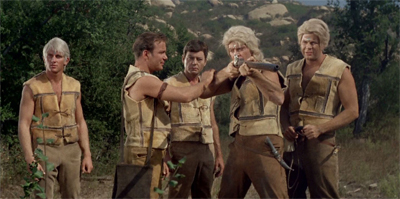
Make war, not love...

Make war, not love…

And then there’s the Vietnam episodes. Shows like Errand of Mercy and A Taste of Armageddon reflect the conflict in a number of ways that were not possible in the scripted dramas of the time. However, A Private Little War is perhaps the definitive Vietnam episode. Part of this is due to the script and the production, which makes explicit reference to “the twentieth century brush wars on the Asian continent.” With the Klingons and the Federation meddling directly in the conflict on a small backwater planet, comparisons invite themselves.

However, there were factors at play outside the control of the production team. A Private Little War was produced in late 1967. It aired on February 2, 1968. However, North Vietnamese forces had launched the Tet Offensive only a few days earlier – the campaign would land through the end of March. The Tet Offensive would end with the North Vietnamese suffering heavier losses than the American or South Vietnamese forces, but the attacks would have a devastating affect on public opinion.
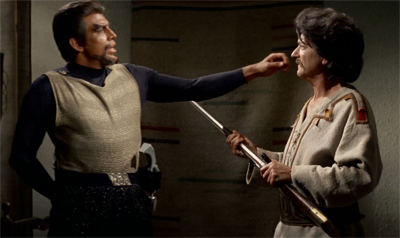
"Got your nose! And, soon, your planet!"

“Got your nose! And, soon, your planet!”

A Private Little War is placed terribly. It is a reluctant justification of the Vietnam War, presenting interference in a foreign war as a terrible (but necessary) burden weighing on Kirk’s conscience. The episode closes with Kirk committing to arm the natives, even if the show doesn’t have the courage of its conviction to follow the idea to its logical consequences. For all that Star Trek is described as a liberal and pacifistic vision of the future, A Private Little War endorses American interference in Vietnam.

The broadcast of A Private Little War only a couple of days following the turning point of the public perception of the war is an absolutely fascinating pop cultural synergy – a demonstration of how Star Trek was inevitably and inexorably of its time in a way that even a few months delay between filming and broadcast could change the context of the episode so dramatically.

I wouldn't look so happy with myself...

I wouldn’t look so happy with myself…

Continue reading