• Following Us

  • Categories

  • Check out the Archives


  • Awards & Nominations

Space: Above and Beyond – The River of Stars (Review)

This November (and a little of December), we’re taking a trip back in time to review the third season of The X-Files and the first (and only) season of Space: Above and Beyond.

And so this is Christmas.

On the face of it, doing a Christmas episode of Space: Above and Beyond seems absurd. Space: Above and Beyond is a show about a grim and relentless future war, where human lives are sacrificed in a long and brutal slog. It is very hard to reconcile that with the traditional structure of a Christmas story, which typically draws together a family so that they might celebrate the possibility of “peace on Earth” and “goodwill to all men.”
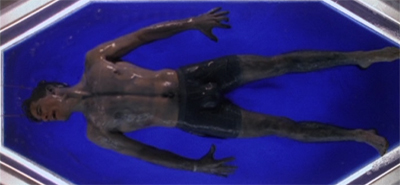
Homecoming...

Homecoming…

And yet, the episode works in spite of this contrast – or, perhaps, because of it. The River of Stars opens with a monologue narrated by Wang that helps to set the mood for the next forty-five minutes, documenting the well-known Christmas truces that took place during the First World War. Although these spontaneous demonstrations of good will and trust were by no means unique, those temporary reprieves served as a reminder of the humanity that often seemed lost amid the pain and the bloodshed.

If any show could use a charming feel-good story about the possibility of peace on Earth and goodwill towards other people, Space: Above and Beyond might be it.
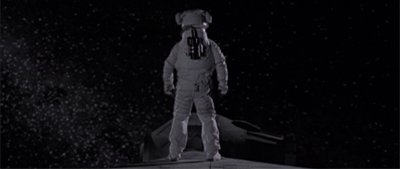
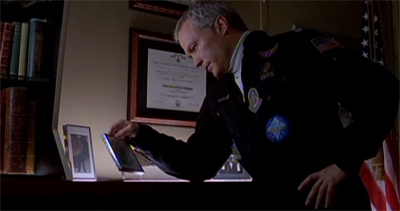
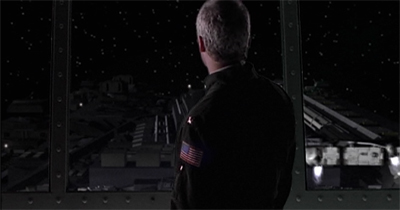
Staring at the stars...

Staring at the stars…

Continue reading

Space: Above and Beyond – Stay With The Dead (Review)

This November (and a little of December), we’re taking a trip back in time to review the third season of The X-Files and the first (and only) season of Space: Above and Beyond.

There is a nice story buried somewhere in Stay With the Dead. Space: Above and Beyond has generally worked better as a story about warfare than an action-adventure science-fiction show. As such, it’s telling that the best parts of Stay With the Dead have less to do with the plot-driven flashback-ridden mystery at the heart of the episode, and more to do with the aspects of the script that confront the uncomfortable realities of war.

Post-traumatic stress disorder is an absolutely terrifying aspect of armed conflict. War claims lives; countless soldiers and civilians are sacrificed in the name of the greater good. However, even those who survive are left scarred by the experience. The trauma need not be physical. Exposure to combat and warfare can leave a lasting psychological scar. It has widely been suggested that shell-shock and other post-traumatic stress disorders have been under-reported among veterans of previous conflicts.

The wages of warfare...

The wages of warfare…

Stay With the Dead broaches the topic when West is recovered from the field of battle suffering from anxiety attacks and struggling to recall the details of his experience. He is unable to sleep, with even the smallest noise reminding him of his experiences. Army doctors are unable to help him, and make suggestions that seem more interested in what is most convenient for the war effort rather than addressing his own needs. There’s a lot of potentially compelling commentary about how warfare works, and the conflicts of interest that arise.

However, instead of exploring these issues, Stay With the Dead instead becomes a flashback race-against-time mystery. It is not a very good one.

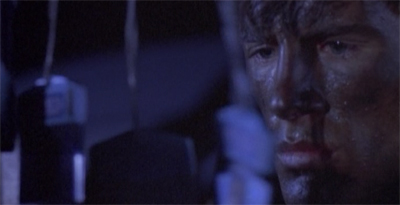
Purple haze...

Purple haze…

Continue reading

Space: Above and Beyond – Hostile Visit (Review)

This November (and a little of December), we’re taking a trip back in time to review the third season of The X-Files and the first (and only) season of Space: Above and Beyond.

At this point, Space: Above and Beyond could do a lot worse than learn from The X-Files.

There are quite a few echoes of The X-Files in Space: Above and Beyond, becoming more pronounced as the show approaches the middle of the season. Eyes built on the suggestion of conspiracy and cover-up to assure viewers that Space: Above and Beyond was just as cynical about authority as The X-Files ever was. The Enemy felt like an attempt to copy the formula that Morgan and Wong had worked so well back in Ice.

Picture imperfect...

Picture imperfect…

Hostile Visit and Choice or Chance feels like an attempt to do a big sweeps two-parter in the style of The X-Files. This was a crucial moment for Space: Above and Beyond. The series had been scheduled outside of its comfort zone, had not been drawing huge ratings, had found itself preempted and bounced around the schedule as a result of factors outside its control. It needed a strong performance for the November sweeps, which were a matter of pride (and money) for the networks and a matter of interest for the advertisers.

So structuring a two-parter around that period makes a great deal of sense. Unfortunately, Hostile Visit does not make for the most compelling first half.

"I want a good clean sweep."

“I want a good clean sweep.”

Continue reading

Space: Above and Beyond – Eyes (Review)

This November (and a little of December), we’re taking a trip back in time to review the third season of The X-Files and the first (and only) season of Space: Above and Beyond.

Eyes is perhaps the most ambitious that Space: Above and Beyond has been to this point in the season.

Eyes develops scraps hinted at in The Pilot and The Farthest Man From Home into a complex web of intrigue, with an assassination plot playing out against all sorts of institutionalised prejudice and suggesting sinister conspiracies at work behind the horrific war that drives the show. The last episode of Space: Above and Beyond credited to Glen Morgan and James Wong in 1996, the episode feels like it is solidifying the series. Six episodes in, enough foundations have been laid that development can begin.

An unstoppable killing machine.

An unstoppable killing machine.

Eyes is rather epic in scale, and massive in scope. It is a story about politics and scheming, unfolding quite far away from the front lines. In episodes like The Pilot, The Farthest Man From Home and even Ray Butts, it often felt like our lead characters were quite divorced from the big decisions. It seemed like the show was very much preoccupied with a day in the life of a space marine, rather with the larger forces at play seen only in glimpses and shadows.

Eyes is a show that does a lot to build the world of Space: Above and Beyond, doing a much better job than The Dark Side of the Sun or Mutiny at giving a sense of this dark future. While the script is perhaps a little too cluttered for its own good, it is a very well-constructed paranoid conspiracy thriller.

That's not at all fascist.

That’s not at all fascist.

Continue reading

Space: Above and Beyond – The Farthest Man From Home (Review)

This November (and a little of December), we’re taking a trip back in time to review the third season of The X-Files and the first (and only) season of Space: Above and Beyond.

Due to network anxiety about the investment in Space: Above and Beyond, The Pilot had a very clear three-act structure building to a very explicit resolution. Not only did The Pilot figure the beginning of the war with the aliens, it also featured a crucial moral-boosting victory. It ended with the squad fully-formed and ready for action. It packed a lot of stuff in, and worked quite well as its own self-contained story; even if it left a host of broad narrative threads for the rest of the series to follow.

The Farthest Man From Home is pretty solid as far as first standalone episodes go. Free from the constraints of having to work as a potential movie-of-the-week, The Farthest Man From Home is free to do a little development and foreshadowing, but doesn’t have to wrap up everything in a neat bow by the time that the closing credits role. It’s also spared a lot of the exposition that made The Pilot feel so heavy – Hawkes’ status as an InVitro is fleetingly mentioned, and the Silicates don’t come up.

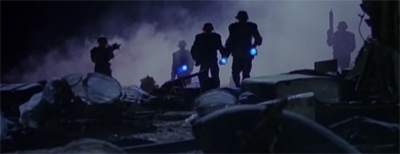
It's a wasteland out there...

It’s a wasteland out there…

Instead, The Farthest Man From Home is free to focus on the story that it wants to tell, and in marking out narrative space  for the development of both the larger war arc and West’s own personal journey. The Farthest Man From Home is a rather loose episode, but it’s loose in a way that makes sense for a second episode. It eases the audience into the world of Space: Above and Beyond a lot more fluidly than The Pilot did.

That said, there’s still an awkwardness here as Morgan and Wong struggle to figure out what the show is about and the form that it will eventually take. Examined in hindsight, while The Farthest Man From Home establishes a lot of important stuff for the show, it is also clearly a work in progress for the series – an early iteration of a show that would grow and change over the course of its first season. This is perhaps the second draft of Space: Above and Beyond, a solid base to build on for what lies ahead.

Tag it and move on...

Tag it and move on…

Continue reading

Space: Above & Beyond – Pilot (Review)

This November (and a little of December), we’re taking a trip back in time to review the third season of The X-Files and the first (and only) season of Space: Above and Beyond.

Space: Above and Beyond made a great deal of sense in the context of the mid-nineties. Fox had begun its life as a scrappy little network that had trouble producing seven nights of broadcasting, but had rapidly solidified itself into a credible alternative to the big three networks. There were lots of reasons for this. The X-Files was one reason, but the network had also solidified itself with a slate of popular young dramas like Beverly Hills 90210, Melrose Place and Party of Five. Securing the NFL rights in 1993 didn’t hurt.

By late 1995, Fox was largely past the growing pains stage of its evolution. The network had been announced in late 1985, and first hit the airwaves in late 1986. It was approach the end of its first decade by the time Space: Above and Beyond was broadcast. Fox was no longer a small network fighting for scraps, but a viable challenger to the so-called “big three.” This change in outlook would lead to great success in the twenty-first century, but would also lead to change in how Fox did business.

Everything burns...

Everything burns…

The X-Files had been the right show at the right time in a number of ways. It landed at the perfect point to speak to a generation that grew up in the shadow of Watergate, but also to tap into millennial anxieties and insecurities. From a commercial perspective, The X-Files launched towards the end of the period where Fox could take chances on young shows struggling to find an audience. The first season of The X-Files was a cult hit, but not a breakout success story. The network had faith in the show, and that faith paid off.

It is interesting to wonder whether The X-Files would have received a second season if it débuted even two years later. After all, Fox would develop a reputation as a network with a ruthless tendency towards cancellation and plug-pulling. If The X-Files had first appeared in September 1995, would it have enjoyed the same fate as Space: Above and Beyond?

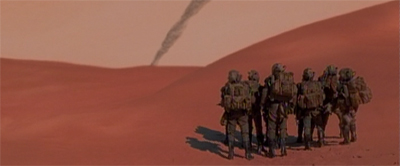
Distant sands...

Distant sands…

Continue reading

Star Trek: Voyager – Jetrel (Review)

This September and October, we’re taking a look at the jam-packed 1994 to 1995 season of Star Trek, including Star Trek: Deep Space Nine and Star Trek: Voyager. Check back daily for the latest review.

Jetrel is an interesting episode for a number of reasons. It’s another example of how the first season of Star Trek: Voyager seems anchored in the aftermath of the Second World War. The episode exists primarily as a meditation on guilt over the use of atomic weapon, with the Metreon Cascade attack on Rinax standing in for the dropping of the atomic bomb on Hiroshima and Negaska in 1945. Jetrel aired three months shy of the fiftieth anniversary of the bombing, and amid a national period of reflection about the morality of Harry S. Truman’s actions.

Whatever the context of Jetrel in 1995, it serves as another example of how Voyager seems like a relic from a bygone age, a snapshot of atomic age science-fiction. Cathexis was the show doing Invasion of the Body Snatchers. Faces was an old-fashioned monster movie. Jetrel wasn’t even the first time that the first season had traded in atomic imagery. The aftermath of the polaric detonation in Time and Again was very clearly designed to evoke the aftermath of an atomic blast.

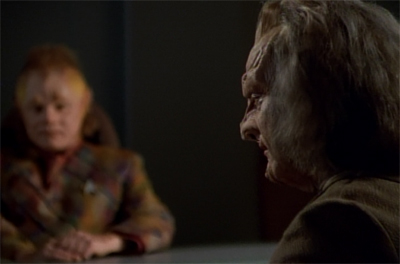
The devil in the pale moonlight...

The devil in the pale moonlight…

Even without all this baggage, Jetrel still feels like a mess of an episode. The heart of the story finds a member of the ensemble confronting a former war criminal while dealing with issues of war guilt and responsibility – a structure that evokes Duet the penultimate episode of the first season of Star Trek: Deep Space Nine. While that episode worked brilliantly, there’s a sense that Jetrel is burdened a little bit trying to offer a two-hander about guilt while tackling the issue of the atomic bomb.

The problem is compounded by a somewhat messy final act that eschews all the episode’s heavy character-based drama in favour of a contrived techno-babble climax that involves a lot of characters spouting nonsense while playing with light-emitting diodes. Jetrel begins as the strongest and boldest episode of the show’s first season, but ends as one of the prime examples of Voyager‘s preference for techno-babble over character work.

Burn with me...

Burn with me…

Continue reading

Doctor Who: Mummy on the Orient Express (Review)

“You know, Doctor, I can’t tell if you’re ingenious or just incredibly arrogant.”

“On a good day, I’m both.”

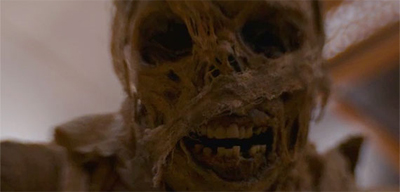
Mummy on the Orient Express is Doctor Who in a blender. It’s classic period piece, genre pastiche and science-fiction spectacle, mixed with a healthy dose of creature feature horror and a solid development of the themes running through the eighth season so far. It’s clever, witty and energetic. The episode is a delight from beginning to end, beating out Robot of Sherwood and Time Heist to claim the title of the year’s best “romp” – as you might expect from a story that is a Hammer Horror murder on the Orient Express in Space.

doctorwho-mummyontheorientexpress8

Continue reading

Watch! Commander Chris Hadfield Sings Space Oddity…

There are no words.

Recorded after Hadfield handed over command of the International Space Station, this video demonstrates that NASA should probably make him their official spokesperson. It’s just brilliant. If government officials are going to make science-fiction pop culture references, they could do a lot worse.

Yes, that was a cheap shot at the IRS.

Doctor Who: The Monster of Peladon (Review)

To celebrate the fiftieth anniversary of the longest-running science-fiction show in the world, I’ll be taking weekly looks at some of my own personal favourite stories and arcs, from the old and new series, with a view to encapsulating the sublime, the clever and the fiendishly odd of the BBC’s Doctor Who.

The Monster of Peladon originally aired in 1974.

Oh, have a heart, Sarah. I’ve been meaning to pay a return visit to Peladon for ages.

I can’t think why.

– the Doctor and Sarah Jane

What made The Curse of Peladon so fantastic was the fact that it felt so unique and different, as compared to all the Third Doctor adventures that had appeared before. Sure, the Doctor had travelled in time and space in Colony in Space, but The Curse of Peladon was really the first time that the colour television series had indulged in designing a truly alien world populated with truly alien creatures. Since the series had begun transmission in colour with Spearhead from Space, there had been nothing quite like it, and that was what made The Curse of Peladon so refreshing.

As such, the idea of doing The Monster of Peladon seems a bit questionable, especially when it’s going to feature the same world, the same aliens and be two episodes longer than the original adventure.

Not an underrated gem, I'm afraid...

Not an underrated gem, I’m afraid…

Continue reading