• Following Us

  • Categories

  • Check out the Archives


  • Awards & Nominations

Non-Review Review: Antebellum

Antebellum never seems entirely sure whether it wants to be a biting social commentary or a pulpy genre exercise.

To be clear, this is a false dichotomy. One of the most interesting aspects of horror is how frequently it can satisfy both of those objectives. Get Out is perhaps the most obvious recent example of this, and it is telling that (like so many modern horrors) Antebellum markets itself as “from the producers of Get Out.” However, this has always been a feature of horror, as demonstrated by the films of directors like Wes Craven and John Carpenter. Antebellum shouldn’t have to choose between being socially relevant and being an effective horror, but it insists on doing so.

Shining some light on the matter.

There is a good movie buried somewhere in Antebellum. It is very clear that writers and directors Gerard Bush and Christopher Renz have a good idea that resonates in the current moment. Indeed, Antebellum hammers that point pretty heavily. It opens with a quote from William Faulkner, reminding audiences that “the past is never dead. It’s not even past.” In case the audience doesn’t get how that applies to the movie’s set-up, a character repeats it about forty minutes into the runtime. Antebellum has things to say, and is not shy about saying them.

However, what Antebellum is trying to say is muddled by a number of awkward structural choices. Antebellum is a film that is consciously built around a number of developments that are intended to wrong-foot the audience and catch them off-guard, to invite the viewer to ask questions about what is happening and why, and maybe even add some compelling gif-able content for the film’s marketing. This structuring of Antebellum is wrong-headed on a number of levels, but most profoundly in the way that it reduces the movie’s biting thesis to a cheap narrative hook.

Burning unease.

Continue reading

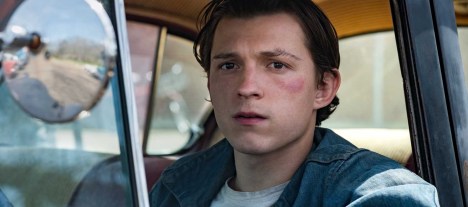
Non-Review Review: The Devil All the Time

The Devil All the Time demonstrates that the adjective “novelistic” isn’t always a compliment.

Writer and director Antonio Campos is clearly aiming for an epic sweep to The Devil All the Time. The film unfolds over the course of several decades, following several intersecting lives in rural Ohio in the space between the end of the Second World War and the height of the Vietnam War. This is a tale that spans generations, with an impressive density. Small characters get huge arcs, dramatic twists hinge on chance encounters, and a large amount of the film’s plot is delivered by way of folksy omniscient narration.

Holland of the Free?

It is easier to admire The Devil All the Time than it is to appreciate it. Campos has drawn together a formidable cast to tell a story that explores a host of big ideas about small town life. The Devil All the Time clearly aspires to be a piercing study of religion, sex and violence in the American northeast. The film maintains an impressive atmosphere, in large part due to Campos’ moody direction and the work of Lol Crawley and the rumbling soundtrack from Danny Bensi and Saunder Jurriaans.

However, nothing in The Devil All the Time has room to breath. There are so many elements competing for narrative space that even films two-hours-and-twenty-minute runtime feels overstuffed. Characters are never allowed to stew or develop in a way that a story like this demands, instead reducing the movie to a series of plot points and thematic observations delivered in a rich and moody manner, but without any real substance to bind them all together.

Book ‘im.

Continue reading

Non-Review Review: Enola Holmes

Enola Holmes is a movie with a lot of charm, anchored in a sense of playful enthusiasm and a winning central performance.

Adapted from Nancy Springer’s The Enola Holmes Mysteries series of novels, the basic premise of Enola Holmes is straightforward enough. The classic Victorian detective Sherlock Holmes is given a younger sister, who inevitably finds herself forced to navigate the wider world while solving mysteries and avoiding the best efforts of her older brothers to ship her off to a suffocating and restrictive boarding school where she might be taught to be a lady.

Make yourself at Holmes…

Enola Holmes moves quickly and cheerfully through its starting premise and central mystery, bouncing from one sequence to another with considerable grace. However, it’s lead actor Millie Bobby Brown who carries the film. Brown is probably best known for her work on Stranger Things and a prominent role in Godzilla: King of the Monsters, but Enola Holmes suggests a long and promising career ahead of the young actor. It is impossible to imagine the movie seeming as effortless without her at its centre.

In fact, Enola Holmes suffers most when it moves away from its protagonist and makes room in her story for less compelling (but more nominally “important”) characters that wind up sapping the film’s energy. Enola Holmes has a surprisingly slow start for a film that breezes along once it finds its footing, and that is largely because it is initially reluctant to give its central character the breathing room that she needs. Still, once the film gets past that, it is a highly enjoyable adventure.

Enola that look…

Continue reading

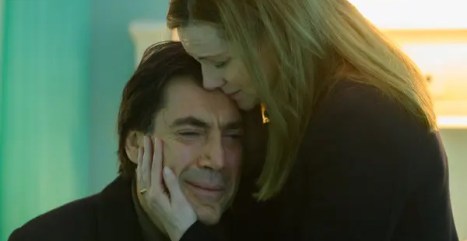
Non-Review Review: The Roads Not Taken

There are two different, decent competing movies tucked away inside The Roads Not Taken. Sadly, the whole is much less than the sum of its two largest parts.

The first  of these movies is a fairly conventional study of a daughter coping with her father’s neurological degeneration. It is a fairly standard template, tapping into recognisable anxieties about growing old, and the realisation that many children will have to act as caregivers for their parents in old age. This is a solid basis for a movie on its own terms. Indeed, it seems like a film that could easily net an awards nominations for actors Javier Bardem and Elle Fanning.

Holding it together.

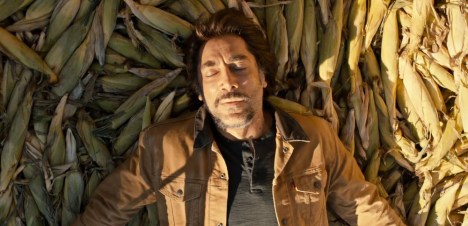
The second film is a more abstract and ambitious work, in which an older man reflects on the life that he has lived and – trapped inside his own head with a slipping sense of reality – allows himself to play out fantasies of how his life might have been different. This a more philosophical work, a more reflective and introspective film. It seems like something from a stranger and more unusual movie, something like The Fountain or even Cloud Atlas.

The problem is that these two angles on the story do not fit together. In cutting across them, director Sally Potter undercuts and undermines both narratives. Neither thread has enough room to breath and build momentum, and both are driven by fundamentally different stakes. One movie is about the experiences of an aging writer named Leo, while the other is about his daughter Molly, and shifting back and forth causes the movie to lose its emotional footing. The result is an interesting and well-intentioned curiosity, but an underwhelming film.

Baby, I’m a-maize-d by you.

Continue reading

Non-Review Review: Mulan (2020)

Niki Caro’s Mulan is an interesting beast.

As a piece of production, it’s impressive. It lands neatly among the best of Disney’s live action adaptations of its classic animated films, simply by virtue of its willingness to offer something new. It avoids the limp and slavish devotion of films like The Lion King, Aladdin and Beauty and the Beast, even if it never quite transcends its origins like Pete’s Dragon. It is vibrant and dynamic film, one that leans into what is possible in live action rather than animation, with cinematographer Mandy Walker ensuring that colours really pop off the screen.

Claws for concern

However, there’s also something slightly frustrating about Mulan. It often feels like the changes from the animated film were not made with the intention of improving the film or finding a new angle, but instead to render Mulan more palatable to a targetted Chinese audience. After all, for all the attention paid to the film’s video-on-demand release, its box office prospects have always had one eye on China. The result is a film that feels more cautious and more conservative than an animated film produced over two decades ago.

Mulan is clean and stylish, but feels a little too calculated and sterile to be its best self.

A prime cut?

Continue reading

New Escapist Review! “TENET”

I have actually already reviewed TENET for this blog. However, given the state of the pandemic in the United States, The Escapist did not feel comfortable asking its writers to attend cinema screenings. As I am based in a country that is dealing with the crisis (relatively) well, I have stepped into the gap to provide written reviews for movies not receiving a streaming release.

This is unlikely to be a long-term dynamic, but I was flattered at the invitation and was happy to substitute in for this particular situation. This is a very unusual time. The review is much more conventional and concise than the reviews on this site, and even has a numerical score attached. I feel like a proper film critic. You can read the review here, or click the picture below.

New Escapist Review! “The New Mutants”…

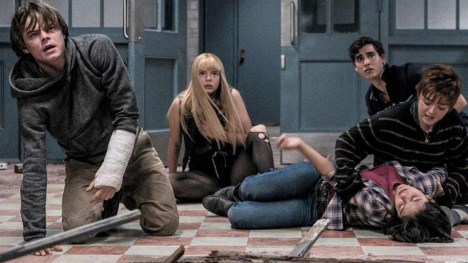
Normally, I would review The New Mutants for this blog. However, given the state of the pandemic in the United States, The Escapist did not feel comfortable asking its writers to attend cinema screenings. As I am based in a country that is dealing with the crisis (relatively) well, I have stepped into the gap to provide written reviews for movies not receiving a streaming release.

This is unlikely to be a long-term dynamic, but I was flattered at the invitation and was happy to substitute in for this particular situation. This is a very unusual time. The review is much more conventional and concise than the reviews on this site, and even has a numerical score attached. I feel like a proper film critic. You can read the review here, or click the picture below.

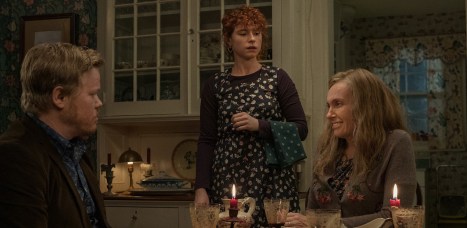
Non-Review Review: I’m Thinking of Ending Things

“There is no objective reality,” explains Jake late in I’m Thinking of Ending Things. “You know there’s no colour in the universe, right? Only in the brain.”

This seems to be as close to a thesis statement at I’m Thinking of Ending Things dares to offer. Charlie Kaufman’s latest work is a dense and surrealist exploration of the fragility of memory and identity, and the blurred boundaries that exist between the inside and the outside. The story is relatively simple. A young woman accompanies her boyfriend on a trip to have dinner with his parents. She needs to get home, but there is a snow storm. As the couple journey into rural America, things begin to slowly but surely unravel.

Snow escape.

There’s been an abundance of cinema recently about the collapse of time and reality, the sense of a universe folding into itself – Palm Springs, TENET, Bill and Ted Face the Music. These films are made all the more uncanny for having been produced long before the current global pandemic unravelled our sense of space and time, but seem to speak perfectly to it. That anxiety that all of history is happening at once and that “cause” and “effect” are unmoored as reality itself contorts and bends.

I’m Thinking of Ending Things stands apart from these other films, as one might expect of a Charlie Kaufman project. I’m Thinking of Ending Things has a greater interiority. The film seems to unfold in vast snowy wilderness, but it seems just as accurate to suggest that it unfolds in the writer’s imagination. Perhaps it isn’t time and reality that contort, but simply the protagonist’s understanding of these concepts. Then again, do these ideas exist in some absolute and objective form somewhere, or are they just concepts that people label so as to feel more comfortable?

Table discussion for later.

Continue reading

Non-Review Review: TENET

NOTE: I live in Ireland. Our cinemas are open. Evidence suggests that it is (relatively) safe for people to attend the cinema if they take the necessary precautions. However, I am aware that it is not safe in every country to do so, and I also understand that many readers may not feel safe attending their local cinema even in areas where the evidence suggests it is safe. As this seems to be a hot-button issue with all theatrical releases during the pandemic – but with TENET in particular – it feels important to stress this outside the body of the review itself.

This should go without saying, but given the nature of the current pandemic it is worth repeating: No movie is worth risking your life for. If you feel – or if information from sources you trust suggest – that it is unsafe to go to the cinema, then please do not go. I loved this film. I will see it in cinemas again at least twice within the next week, because it is safe for me to do so. This review should not be taken as an endorsement that the reader should feel they have to (or are expected to) risk their lives to see this film. With that in mind, here is the review.

“Time isn’t the problem,” insists Neil early in TENET. Like a lot of things that the shady operator says over the course of the film, this is not exactly true.

There is a lot riding on TENET. Almost none of this was intended when the film was conceived and produced. As the first major theatrical release since the coronavirus pandemic, TENET effectively shoulders the burden of saving cinema – particularly with a death of major releases between now and Wonder Woman 1984 and with the planned release of Mulan on Disney+. It’s a lot of weight for a film like TENET to carry. Time will tell whether it can succeed or not, but it makes a valiant effort.
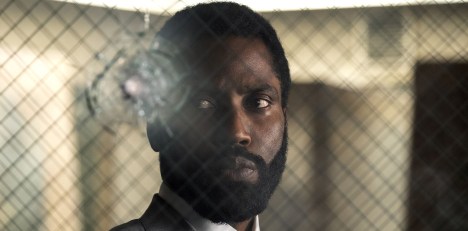
Shattering the release window.

TENET rises to this challenge in a couple of ways. Most obviously, TENET is quite simply a triumph of blockbuster filmmaking. Director Christopher Nolan has boasted about how much of the film was completed using in-camera effects and how carefully choreographed it all was. TENET is a movie that showcases the power of spectacle, whether in its delightfully complicated action sequences or even in Hoyte Van Hoytema’s breathtaking establishing shots. TENET is a movie that demands as big a screen as possible, reminding audiences of the scale of such filmmaking.

However, there’s more to it than that. TENET is a film that feels curiously attuned to this cultural moment. It is a film that deals with many of Nolan’s pet themes and obsessions, but in a way that feels very much in step with the modern moment. It’s hard to summarise TENET without spoiling the movie, without revealing too much in terms of plot mechanics or character motivations, but TENET is a film about the breakdown of time itself. It is a film about the collapse of chaos and effect, and a world in which the future and the past are a war over the present.

A career highlight?

It’s an ambitious film. Nolan’s movies are frequently driven by high-concepts and abstract ideas, and the director is remarkable in his ability to build crowd-pleasing blockbusters around concepts like time dilation in Inception and the theory of relativity in Interstellar. If anything, TENET seems to push that idea to breaking time. As Neil repeatedly points out over the course of the film, he has a degree in quantum physics and he struggles to make sense of the film’s internal logic. Perhaps the film’s protagonist (known simply as the Protagonist) sums it up best, “Woah.”

TENET is an interesting film from Nolan in a number of ways. The villainous Russian oligarch Andrei Sator is probably the director’s scuzziest character since Insomnia or Memento. The film itself is perhaps Nolan’s most emotionally repressed since The Prestige. These sensibilities are blended with his more modern high-concept blockbuster aesthetic, and flavoured with a surprising amount of self-awareness. The result is a heady cocktail that is occasionally overwhelming, but never unsatisfying.

Well, masks are recommended at cinema screenings.

Note: Warner Brothers have specifically requested that reviews avoid spoilers. As a result, this review will talk rather generally about TENET. However, if you want to see it completely unspoiled, it is perhaps best to just take our word for it: it is good. It is probably even the best film we’ve seen this year. That is a very short review.

Continue reading

195. The Third Man (#177)

Hosted by Andrew Quinn and Darren Mooney, and this week with special guest Neasa Hardiman, The 250 is a (mostly) weekly trip through some of the best (and worst) movies ever made, as voted for by Internet Movie Database Users.

This time, Carol Reed’s The Third Man.

Holly Martins arrives in Vienna to visit his old friend Harry Lime. However, Holly quickly discovers that all is not what it seems. Harry apparently died in a freak traffic accident shortly before Harry arrived. As British officers start asking pointed questions about the dead man, Holly becomes increasingly anxious that something has gone very wrong.

At time of recording, it was ranked 177th on the list of the best movies of all time on the Internet Movie Database.

Continue reading