• Following Us

  • Categories

  • Check out the Archives


  • Awards & Nominations

Non-Review Review: Eurovision Song Contest – The Story of Fire Saga

Eurovision Song Contest: The Story of Fire Saga is a limp misfire.

There’s no doubt that the film comes from a place of affection and sincerity, reportedly inspired by writer and star Will Ferrell’s delight on discovering the camp weirdness of the Eurovision Song Contest. Indeed, The Story of Fire Saga has clearly been produced with the enthusiastic participation of the contest itself; the film uses a lot of branding associated with the event, features cameos from commentators like Graham Norton, and even ropes in a couple of past participants for its most endearing tribute to the surreality of the competition.

Marching on.

However, whether because it constrained by the official branding or simply by the limitations of Ferrell as an outsider looking in, The Story of Fire Saga doesn’t work. On a basic level of comedy mechanics, there are not enough jokes to sustain the indulgent two-hour runtime. On a more fundamental level, The Story of Fire Saga often fails to grasp what makes the Eurovision Song Contest such a beloved cultural institution. There’s a sense in which The Story of Fire Saga could be about almost anything else, and would be functionally the same movie.

This is a disappointment, particularly given that The Story of Fire Saga is being released in a year without the Eurovision.

A pretty weak ‘Vision.

Continue reading

Non-Review Review: Irresistible

Irresistible is a movie that largely exists to demonstrate that nobody hates the political left like the political left.

Jon Stewart’s second feature as writer and director essentially positions itself as a post-2016 political satire. Stewart’s former correspondent Steve Carell is cast as Democratic campaign manager Gary Zimmer, who is still nursing the wounds of the 2016 election. The film features two short table-setting prologues, the second of which finds Zimmer lying in bed on November 9th, 2016 as the news media plays back his unearned confidence in the face of the earth-shattering Donald Trump victory. There’s a sense in which Zimmer needs to be humbled.

Window into a broken system.

A couple of years later, both Zimmer and the party clearly still smarting from that humiliating defeat, a video comes across Zimmer’s desk. Recorded at a town hall in Deerlaken, Wisonsin, it shows a military veteran standing up for the rights of immigrants and minorities to a town administration desperate to lock them out of welfare. Colonel Jack Hastings appears to be the complete package, a white rural farmer with genuinely progressive politics. “He’s a Democrat,” Zimmer insists. “He just doesn’t know it yet.”

Stewart tries to position Irresistible as a biting social commentary on the state of the modern Democratic party and its awkward relationship with the white rural voters who are undergoing incredible political hardship as a result of a series of global recessions, and who feel increasingly disconnected from the political establishment. It’s an old theme that belongs to a rich cinematic tradition including films like Mister Smith Goes to Washington, and it should still resonate these days.

Making Hastings while the sun shines.

Unfortunately, Stewart’s satire is unfocused and tonally unbalanced. It’s never clear exactly what the film is saying, beyond expressing an understandable frustration with the establishment of the political left. However, the film’s anger is clearest when it is singularly focused as to imply a vacuum that simply doesn’t exist. More than that, Stewart occasionally seems to invest in the some sort of nostalgic and romantic fetishisation of the rural community that he so scathing ridicules in the political establishment.

This issue reflects a broader problem with the movie. Irresistible is tonally erratic at the best of times, alternating between a biting satire set in a world that is at least meant to be recognisable and a more cartoonish comedy populated by outlandish science-fiction elements. Stewart can’t seem to hone in on what Irresistible is trying to say about the political system, beyond the simple fact that political types are the absolute worst.

Dems the breaks.

Continue reading

Non-Review Review: Artemis Fowl

Artemis Fowl is only ninety-three minutes long, but it feels much longer. In more ways than one.

As with Scoob! or Trolls World Tour, there’s something slightly cynical in releasing Artemis Fowl direct to streaming. The film feels like it might have wallowed in a theatrical release, with little to distinguish it from other young adult adaptations like The Maze Runner or The Mortal Engines. Although derived from a series of beloved children’s books, the cinematic adaptation of Artemis Fowl was never going to be this generation’s answer to Harry Potter and the Philosopher’s Stone or The Hunger Games – despite the belaboured sequel hooks.

Fowl play.

The most interesting question that occurs when watching Artemis Fowl is at what point this became clear to the production team. Artemis Fowl has the look and feel of a movie that has been fed through a meat grinder. It is appreciably shorter than most would-be tentpoles, even though there is a seemingly continuous voice-over delivering reams of exposition. The plotting is haphazard. The character arcs are broad. There is a palpable sense that something happened in getting from page to screen, and the real mystery is where in the process things went so wrong.

Watching Artemis Fowl becomes almost an interactive mystery of itself. Was the project always this disjointed and chaotic, or was that something that happened in postproduction? More than that, was that process something that happened before or after Artemis Fowl was earmarked for a streaming release? When exactly on the creative process did everybody working on Artemis Fowl just give up completely?

A flying finish.

Continue reading

Non-Review Review: Da 5 Bloods

Da 5 Bloods argues that the wounds inflicted by the Vietnam War never truly healed.

The basic plot of Da 5 Plots is standard war movie stuff, recalling the set up of the classic Simpsons episode Raging Abe Simpson and His Grumbling Grandson in “The Curse of the Flying Hellfish”, which itself drew upon a variety of inspirations including episodes of M*A*S*H and Barney Miller. The film follows four veterans who return to Vietnam ostensibly to repatriate the remains of their lost squad commander “Stormin’ Norman.” However, it quickly becomes clear that these former soldiers also have their eyes on a more lucrative prize.

The past never stays buried.

Co-writer and director Spike Lee uses the familiar trappings of war movies – and specifically of Vietnam War movies – to interrogate the legacy of the conflicts and the scars that it left on the national psyche. Indeed, one of the most interesting structural choices in Da 5 Bloods is to effectively invert the basic structure of BlacKkKlansman, which opened as a pointed genre tribute before seguing into actual contemporary news footage during its final act. Da 5 Bloods starts by offering a glimpse of the chaos of the early seventies before diving into the story that it wants to tell.

The result is to contextualise both Da 5 Bloods and its statement on contemporary American identity, drawing a strong line from the unrest and horror of the Vietnam era to the madness of the present moment. Da 5 Bloods was obviously written and filmed well before the latest crisis in the United States, but Lee is a shrewd filmmaker with his finger on the pulse. Da 5 Bloods feels like a movie that is both about the nightmare of this particular moment and the tragic inevitability of that moment as the outcome of unprocessed trauma that has been festering for decades.

Normcore.

Continue reading

Non-Review Review: Dating Amber

Dating Amber is a sweet, if perhaps overly familiar, coming of age story.

Dating Amber has a pretty compelling hook. Eddie and Amber are both gay teenagers growing up in rural Ireland during the mid-nineties. The country has just decriminalised sodomy, and finds itself in the midst of a highly divisive and contentious referendum on divorce. Against this backdrop, Amber hits on a clever idea to avoid the scrutiny of her classmates. She and Eddie will pretend to be a couple, so that they can both present as heterosexual long enough for Amber to escape this suffocating environment.

Vicious cycles.

It’s a very straightforward but compelling premise. It evokes the set-up of something like Easy A, tapping into the youthful anxieties of teenage life, and combines it with the increasingly progressive and diverse entries into the genre like Love Simon or Handsome Devil. Writer and director David Freyne draws from his own teenage experiences to add a level of authenticity, and the film is elevated by two winsome performances by Lola Petticrew and Fionn O’Shea.

The film lacks the delicate tonal balance that is necessary to elevate a teenage coming of age story from a charming affair to a classic of the genre, swerving too dramatically from its playful and cheeky opening premise to an overly earnest and sincere final stretch. It allows suffers slightly from a heavy reliance on formula, hitting most of the marks expected of a story like this, but never really finding a way to push past those conventions into something more profound or insightful. However, Dating Amber is an appealing and engaging entry into the genre.

Couple of friends.

Continue reading

Non-Review Review: The High Note

The High Note doesn’t quite manage to hit the peak that it title suggests, but it hits most of the notes that it needs to.

The basic plot of The High Note concerns a personal assistant named Maggie who works for Grace Davis. Davis is a singer in the twilight years of her career, working hard to remain relevant and to stay afloat in an industry that seems ready to cast her aside. Maggie is convinced that her boss (and her idol) is capable of delivering so much more than her management and her record label expect of her, but finds herself trapped in an uphill battle to prove that she has a vision that is worth listening to.

She’s got the juice.

There are any number of obvious comparisons to be made with The High Note. The classic underappreciated-working-stiff-is-finally-recognised-as-a-prodigious-talent narrative unfolding against a Hollywood backdrop obviously evokes any of the myriad (official and unofficial) versions of A Star is Born. However, the emphasis within that template on a demanding ageing female star and the younger woman working under her feels like it is somewhat carried over from Nisha Ganatra’s previous film, Late Night.

The High Note is tremendously predictable, but it’s to the credit of Flora Greeson’s screenplay that the movie understands this. There are very few surprises nestled in the story, but The High Note leans into that. It is a surprisingly and endearing gentle movie about the path to stardom, one that keeps its stakes low and which tempers its formula with just enough self-awareness to avoid feeling stale or rehashed. The High Note is solid, sturdy and appealing – even if it seems to reflect the Grace Davis that audiences see, rather than the one that Maggie aspires towards.

Tune in for more…

Continue reading

Non-Review Review: Scoob!

Have you ever wondered what it might look like is a beloved fifty-one-year-old children’s television franchise had a midlife crisis?

If so, Scoob! might just be for you.

We have lift-off.

Continue reading

Non-Review Review: M.o.M. Mothers of Monsters

M.o.M. Mothers of Monsters is an ambitious and clever piece of indie horror constructed on a tight budget.

It marks the feature-length narrative directorial debut of Tucia Lyman. Lyman has a variety of experience in horror, particular on television shows like Fact or Faked: Paranormal Files, Ghosts of Shepherdstown and Ghosts of Morgan City. With that in mind, it makes sense that Lyman’s first narrative feature should borrow a lot of the language of paranormal reality television. M.o.M. is essentially a found-footage horror film, with the audience navigating and assembling a collection of seemingly raw video files into a cohesive narrative.

Will he snap?

There is something inherently old-fashioned about the found footage horror template. The format was all the rage in the early years of the twenty-first century, perhaps informed by the use of first-person camcorder footage to document events like 9/11. It arguably reached its apotheosis with the release of the security-camera home haunting horror Paranormal Activity in 2007. Contemporary horror has moved back toward more traditional approaches, prompted by the success of films like The Conjuring, making M.o.M.‘s found footage approach feel decidedly retro.

M.o.M. is occasionally a little clumsy and heavy-handed, sometimes stretching its premise a little too far and struggling to balance sharp tonal shifts between heightened sensationalism and grounded domestic horror. Still, there’s something endearingly committed and energetic in this low-fi horror thriller, an infectious and gleeful embrace of its more absurd elements.

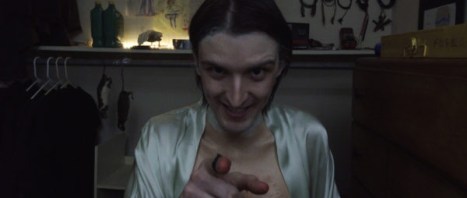
Receiving a dressing gown.

Continue reading

Non-Review Review: The Assistant

The Assistant is a quiet and simmering examination of complicity.

The story unfolds over the course of a single day in the life (mostly the office) of Jane. Jane is the eponymous assistant, working at an independent film company in New York as the right-hand woman to a(n in)famous producer with an explosive temper and monstrous appetites. Kitty Green’s film follows Jane from her early morning Uber ride into work to the single muffin that she allows herself at the deli on the way home, keeping an intense and claustrophobic close-up on lead actor Julia Garner.

Garnering praise.

The Assistant arrives with enough weight that the audience knows what it is about even before the film clearly articulates it. The Assistant is transparently a #metoo movie and the unnamed and largely unseen (but very clearly heard and very strongly felt) producer is very plainly a stand-in for convicted sexual offender Harvey Weinstein. This allows The Assistant a great deal of freedom. Because the audience comes to the film with that assumed knowledge, Green’s script and direction are able to peddle in ambiguity and tease the veil of plausible deniability.

The beauty of The Assistant lies in the way that both the audience and Jane (and seemingly everybody else) knows what is happening, but keep their head down and their focus elsewhere. It’s a story about looking away so that one might see no evil and the noise that people make so that they might hear no evil. It’s an anxious, ominous, suffocating study of the constant smoothing done at the margins of these sorts of horror stories.

Dial it back.

Continue reading

Non-Review Review: Fantasy Island

What, exactly, is the point of the Blumhouse reboot of Fantasy Island?

To be fair, Blumhouse are a studio with a varied track record. They have produced some of the most interesting and compelling mainstream horror movies of the past few decades, including films like Get Out and The Invisible Man. They have also produced a fair amount of cynical schlock, such as Truth or Dare. There are also a number of films that seem to exist in the middle ground between those two extremes, like The Hunt or Black Christmas. It’s certainly a more varied approach than the standard horror films that heralded the studio’s arrival, like Insidious or Sinister.

Palming it off.

Jason Blum is a shrewd producer, and there’s a sense in looking at the studio’s output of trying to balance competing artistic and commercial demands. Blum tends to keep budgets under control, but he also seems to offset the riskier and more ambitious projects with generic crowd-pleasing fare. Fantasy Island would seem to belong in that category, but exactly what crowd is it intended to please? Watching Fantasy Island is a strange experience, and not just because of the multitude of structural and storytelling problems.

On a more basic level: who exactly is this movie for?

Can’t stick the island-ing.

Continue reading