• Following Us

  • Categories

  • Check out the Archives


  • Awards & Nominations

Star Trek: Enterprise – Canamar (Review)

Next year, Star Trek is fifty years old. We have some special stuff planned for that, but – in the meantime – we’re reviewing all of Star Trek: Enterprise this year as something of a prequel to that anniversary. This April, we’re doing the second season. Check back daily for the latest review.

The story behind Canamar is much more interesting than the story told in Canamar.

On the surface, Canamar is quite simple – Star Trek does Con Air.” However, it had an interesting journey from original pitch to televised episode. Indeed, Canamar developed from David A. Goodman’s attempts to break out Judgment, trying to figure out what would happen to Archer after he had been found in Klingon court. Originally, the crew would have rescued Archer from a prison transport rather than Rura Penthe. However, producer Brannon Braga took such a liking to the “Archer on a prison transport” concept that he pulled it out of Judgment and assigned it to John Shiban to script.

"Have you seen Con Air?" "No." "Good. Then this'll all seem new to you."

“Have you seen Con Air?”
“No.”
“Good. Then this’ll all seem new to you.”

However, Braga also divorced Canamar completely from Judgment. Archer would no longer be a prisoner on a Klingon prison transport. Instead, he would find himself mistakenly arrested by an entirely new alien species a couple of episodes before he’d find himself arrested by a more recognised alien species. It feels somewhat redundant, with the first act of Canamar rushing through set-up of plot beats that would feel more organic and fluid if they came from an early episode explicitly designed to build to the idea of Archer on the prison transport.

Canamar is a prime example of just how out of touch Star Trek: Enterprise was with the television landscape, reinforcing the sense that the second season of the show was a holdover from some much earlier period of television production.

"It's the ship that made the Kessel Run in less than twelve parsecs. I've outrun Imperial starships."

“It’s the ship that made the Kessel Run in less than twelve parsecs. I’ve outrun Imperial starships.”

Continue reading

Millennium – Wide Open (Review)

This February and March, we’re taking a trip back in time to review the fourth season of The X-Files and the first season of Millennium.

The middle stretch of the first season of Millennium is preoccupied with suburban horror.

In The Well-Worn Lock, Wide Open and Weeds, Millennium presents the audience with threats to supposedly “safe” suburban families. In each case, the threat is shown not to come from outside these homes, but is instead nestled snugly inside. In The Well-Worn Lock, Joe Bangs is a respected family patriarch and a monster. In Weeds, Edward Petey is both an active member of his gated community and a predator. Wide Open is perhaps a little more sensationalist, featuring a serial killer who sneaks into houses that are on display, hiding inside until after dark, and then brutally murdering any adults in the home.

Home (in)security...

Home (in)security…

There is an intriguing thematic continuity here between what might loosely be termed “the suburban trilogy.” Indeed, Weeds was shuffled around in the broadcast order so it would not air directly after Wide Open, perhaps because of this similarity. This thematic continuity is quite striking, like the presence of Scully proxies and surrogates in the stretch of the second season of The X-Files running from One Breath to Irresistible or the subtle fixation on “cancer” from the end of the third season into the fourth season of The X-Files.

Like The Well-Worn Lock before it and Weeds after it, Wide Open is not particularly elegant in its meditations about suburbia under siege. The story is a bit clunky, prone to the same trashy exploitative excess that can be found in some of the weaker moments of the first season. Nevertheless, Wide Open largely works – it manages to tap into a fairly universal fear in a decidedly unsettling manner, inviting the audience to wonder whether there may actually be monster lurking in their own closets or under their own beds.

Standing guard against the world...

Standing guard against the world…

Continue reading

The X-Files – Terma (Review)

This February and March, we’re taking a trip back in time to review the fourth season of The X-Files and the first season of Millennium.

Tunguska and Terma borrows the structure that made the show’s early mythology episodes so effective. Tunguska is full of intriguing and compelling questions, implications that would seem to broaden or deepen the mythology. However, instead of resolving any of the major threads, Terma simply turns itself into a roller-coaster thrill ride. A cynical observer might compare the weaker mythology episodes to a shell-game: the potential of an interesting premise, lost in a shuffle designed to disorientate and catch the viewer off-guard.

It is an approach that has served the show well. Ascension avoided answering too many of the questions posed by Duane Barry, barrelling along with the momentum of a runaway freight train. Similarly, End Game did not dwell too heavily on the questions posed by Colony, instead serving as a series of high-momentum chase sequences with Mulder following the Alien Bounty Hunter to the ends of the Earth. Paper Clip moved so quickly that the viewers never wondered why the documents recovered in Anasazi were no longer earth-shattering, but merely macguffins.

Things are really heating up...

Things are really heating up…

The X-Files is very good at this sort of dynamic mile-a-minute plotting. The production team are very good at what they do. There is a sleek professionalism to these episodes that makes them easy to watch. Although filmed in Vancouver, there were few shows in the nineties ambitious enough to send their character to a Russian gulag for human experimentation. However, the cracks are starting to show. Herrenvolk demonstrated how frustrating a lack of answers could become. Terma struggles to balance a number of potentially interesting plot threads.

There are a lot of elements of Terma that might have worked well, if they had been given more room to breath. Sadly, the episode spends most of its run time trying to build up momentum towards the inevitable scene where proof narrow slips through Mulder’s fingers one more time.

Evil oil...

Evil oil…

Continue reading

Millennium – Kingdom Come (Review)

This February and March, we’re taking a trip back in time to review the fourth season of The X-Files and the first season of Millennium.

Kingdom Come is a horrible misjudged episode of Millennium, and the show’s first truly spectacular misfire.

Kingdom Come was notably the first episode to air out of production order. It had been produced as the fourth episode following The Pilot, between Dead Letters and The Judge. However, the episode was broadcast as the sixth episode of the television season, after 5-2-2-6-6-6 and before Blood Relatives. The official reason given for this delay was the death of Cardinal Joseph Bernardin in mid-November 1996, following a long and public battle with cancer. It was suggested that an episode about a serial killer targeting religious figures would have been in poor taste at the time.

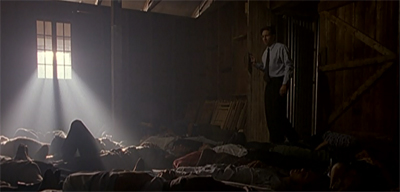
A light in the darkness...

A light in the darkness…

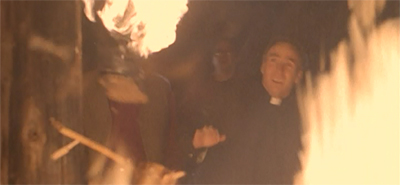
Still, whatever the official reason given, it cannot help but feel like the production staff were hoping to bury a stinker a little deeper into the season. Kingdom Come is an episode that does not work on any number of levels, offering a rather patronising and condescending view of religious faith as explained through stilted exposition and trite cliché. The show’s observations about faith and hope feel more like sentiments from Hallmark greeting cards than observations on the human condition.

The result is an episode that embodies the worst traits of Millennium, feeling just as crass and sensationalist as it does hollow and superficial.

The episode really bombed...

The episode really bombed…

Continue reading

The X-Files – The Field Where I Died (Review)

This February and March, we’re taking a trip back in time to review the fourth season of The X-Files and the first season of Millennium.

Morgan and Wong’s four scripts for the fourth season of The X-Files are utterly unlike any other stories in the show’s nine-season run. Experimental, bold, confrontational; these four stories stretch and pull at The X-Files, as if eager to see just how far the hit show will bend.

The Field Where I Died is probably the weakest of these four episodes, but it is also the most ambitious. It is a script with big ideas and a willingness to commit to those ideas. There is no modesty here, no hesitation. There is a sense that Morgan and Wong are committing wholeheartedly to their themes and their concepts. The Field Where I Died is an episode that rubs quite a lot of people the wrong way, for a number of different reasons; however, the episode never pulls its punches. It never holds back. It never tries to be anything that it is not.

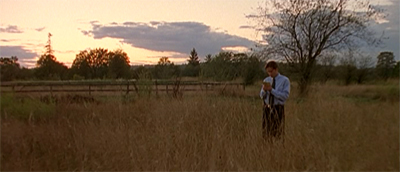
Far afield...

Far afield…

There is a lot to admire here. The Field Where I Died is not an episode with a simply formulaic concept or a conventional structure. It looks and feels completely unlike any other episode of the show. Even when the show touched on similar themes in its final season, the result was radically different. Hellbound is a much more conventional episode than The Field Where I Died. More than Home or Musings of a Cigarette-Smoking Man or Never Again, this is an episode that really seems like an odd fit for The X-Files.

Then again, that may be the beautiful thing about The Field Where I Died, for all its many flaws. It is utterly unlike anything else on television in the nineties. The fact that it can produce an episode of television so unique and incomparable is ultimately what makes The X-Files feel like The X-Files. The fact that The Field Where I Died feels so unconventional and eccentric is precisely what makes it a worthy episode of The X-Files.

Another roaring success for Mulder...

Another roaring success for Mulder…

Continue reading

Space: Above and Beyond (Review)

This November (and a little of December), we’re taking a trip back in time to review the third season of The X-Files and the first (and only) season of Space: Above and Beyond.

It is very hard to judge a series based on the first season alone. After all, many long-running series evolve quickly and radically from their debut year. In many cases, the first season is about desperately trying to find a footing as everybody gets used to the realities of producing a television show. Assessing a first season is often an exercising in gauging potential, which makes it a risky proposition when trying to evaluate the first and only season of a cancelled television show.

Space: Above and Beyond contains its fair share of clunkers, as does any first season with twenty-odd episodes. There are episodes that seem at odds with the premise and mood of the show, being written by staff writers before the show went to air or simply trying to do something with which the show isn’t comfortable. There are episodes that have interesting ideas, but don’t place emphasis on the show’s strengths.

spaceaboveandbeyond-pilot32

However, this is all but expected for a first season. A first season is a learning experience for all involved. After all, the first season of The X-Files was packed with episodes like Shadows, Fire, Lazarus, Young at Heart and Born Again. It is very rare for the first season of any show – particularly a genre show – to be the strongest. There are rules to be learned, beats to be established, foundations to be laid. If shows are lucky, that work gets to pay off in later seasons, as everybody gets more comfortable.

Space: Above and Beyond never got that chance, which is a shame. Because there is a phenomenal amount of potential on display here.

spaceaboveandbeyond-thefarthestmanfromhome24

Continue reading

‘Ship Shape or Ex-Files? Mulder, Scully and Paranormal Romance

This November (and a little of December), we’re taking a trip back in time to review the third season of The X-Files and the first (and only) season of Space: Above and Beyond.

It is very hard to talk about The X-Files without talking about the relationship between Mulder and Scully.

This goes without saying. After all, David Duchovny was a regular for seven years of the show, making a few appearances across the final seasons. Gillian Anderson was in the primary cast for all nine seasons. Both movies have centred around the characters. The recent comic book “Season Ten” returns to the classic Mulder and Scully dynamic. It is impossible to imagine The X-Files without Fox Mulder and Dana Scully.

xfiles-pilot8

Given how frequently the possibility of a revival comes up, one suspects that the biggest problem with potentially rebooting or relaunching the series is the fact that it would be impossible to book Duchovny and Anderson for twenty-odd episodes in a given year. Surely some enthusiastic executive has pitched a new X-Files show (“the neXt files”, perhaps?), only to have the idea shot down because it fails to consider how big a deal Mulder and Scully are to the show.

Indeed, given how important Mulder and Scully are to the show, it seems inevitable the discussion would turn towards the possibility of a romantic relationship between the two. They are two very attractive straight people of opposite genders with great chemistry. Romance seems all but assured between the two. Of course the possibility of a romance between Mulder and Scully became a fault line in X-Files fandom.

xfiles-endgame3

Continue reading

The Flash (1987-2009) #12-14 – Velocity 9/Savage Vandalism/Wipe Out (Review)

So, I’m considering reviewing this season of The Flash, because the pilot looks interesting and I’ve always had a soft spot for the Scarlet Speedster. I’m also considering taking a storyline-by-storyline trek through the 1987-2009 Flash on-going series as a companion piece. If you are interested in reading either of these, please let me know in the comments.

Does anything date a mainstream superhero comic worse than the almost obligatory anti-drug issue?

In the wake of Crisis on Infinite Earths, DC made a rather conscious effort to engage with younger readers. Some of these worked, but quite a few were cringe-induncing in execution. On paper, introducing more diversity into the shared universe via New Guardians was a good idea; in practice, these diverse characters were little more than stereotypes. On paper, killing Barry Allen and replacing him with the younger Wally West was worth doing; in practice, it seemed like the company had no idea how to make him relatable.

Drugs are bad, m'kay?

Drugs are bad, m’kay?

Quite a few of the comics published around this time have dated poorly. They seem like awkward attempts to reengage with the cultural zietgeist, without understanding that zietgeist at all. Mike Baron had given fans a younger and more grounded version of the Flash, but immediately had the character win the lottery and move to the Hamptons. There was a sense that the comic wanted to dispel criticisms that DC was old-fashioned or stuffy, but had no idea of how to actually go about that.

This leads to stories like Velocity 9, the obligatory “winners don’t use drugs” story that tries to be timely and cutting edge, but simply doesn’t work.

Tripping himself up...

Tripping himself up…

Continue reading

The X-Files – Oubliette (Review)

This November (and a little of December), we’re taking a trip back in time to review the third season of The X-Files and the first (and only) season of Space: Above and Beyond.

There’s a plausible argument to be made a large part of The X-Files‘ third season is doing what worked in the first and second seasons, only better.

The Walk feels very similar to a less racist and sexist version of Excelsis Dei. 2Shy decides to split the difference between Tooms and Irresistible, with David Nutter directing. The show keeps the mythology two-parters during sweeps, and David Duchovny gets to contribute to two key stories over the course of the season. It’s not a bad approach, and it pays dividends. There is a reason that the third season of The X-Files works as well as it does. It’s a ruthlessly efficient television production machine.

Drowning his sorrows...

Drowning his sorrows…

If that argument holds water, then perhaps Oubliette can be seen as an update to Aubrey. Both stories build on the idea that horrific crimes leave very lasting consequences, and that women often have to live with the scars inflicted by men. More broadly, they are shows about our relationship with history – the idea that the past cannot ever be escaped, and that violence and pain tend to linger on years after they are initially inflicted.

Given the broader themes of the mythology in the third season, about the secret shameful legacy of America’s conduct in the aftermath of the Second World War, Oubliette plays like a thematic prelude to Nisei and 731. However, that doesn’t do the episode justice. Oubliette is a thoughtful, moving and sentimental episode that tempers its darkness with the very faintest traces of optimism. While it is a story about abuse and exploitation and neglect and failure, it is also a story about empathy.

Shining some light on the issue...

Shining some light on the issue…

Continue reading

Space: Above and Beyond – Eyes (Review)

This November (and a little of December), we’re taking a trip back in time to review the third season of The X-Files and the first (and only) season of Space: Above and Beyond.

Eyes is perhaps the most ambitious that Space: Above and Beyond has been to this point in the season.

Eyes develops scraps hinted at in The Pilot and The Farthest Man From Home into a complex web of intrigue, with an assassination plot playing out against all sorts of institutionalised prejudice and suggesting sinister conspiracies at work behind the horrific war that drives the show. The last episode of Space: Above and Beyond credited to Glen Morgan and James Wong in 1996, the episode feels like it is solidifying the series. Six episodes in, enough foundations have been laid that development can begin.

An unstoppable killing machine.

An unstoppable killing machine.

Eyes is rather epic in scale, and massive in scope. It is a story about politics and scheming, unfolding quite far away from the front lines. In episodes like The Pilot, The Farthest Man From Home and even Ray Butts, it often felt like our lead characters were quite divorced from the big decisions. It seemed like the show was very much preoccupied with a day in the life of a space marine, rather with the larger forces at play seen only in glimpses and shadows.

Eyes is a show that does a lot to build the world of Space: Above and Beyond, doing a much better job than The Dark Side of the Sun or Mutiny at giving a sense of this dark future. While the script is perhaps a little too cluttered for its own good, it is a very well-constructed paranoid conspiracy thriller.

That's not at all fascist.

That’s not at all fascist.

Continue reading