• Following Us

  • Categories

  • Check out the Archives


  • Awards & Nominations

Non-Review Review: The Book Thief

This film was seen as part of the Jameson Dublin International Film Festival 2014.

Any film set in Germany between 1938 and 1945 narrated by death itself is going to feel a little… surreal. As wonderful as Roger Allam’s tones might be, there’s something decidedly unwholesome about the narration of the story told from the perspective of the Grim Reaper, particularly as he recounts a story from his “best of” collection.

The implication is that the life of the eponymous booklifter has touched the Death itself, which feels rather uncomfortable in the context of Nazi Germany. One would imagine that there would be quite a lot of moving and affecting stories to hold our narrator’s attention, without a need to single out one particular story as especially moving.

This is, in essence, the heart of the problem with The Book Thief, an efficient and well-produced – if condescending and tone-deaf – family film exploring the story of one family living in the shadow of Hitler’s Germany. It spends far too long telling us why these protagonists are unique, when the crux of the story seems to be that they are not.

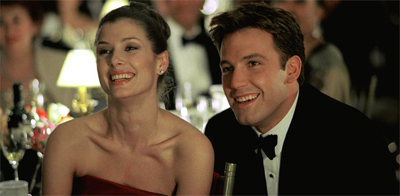
Book her, boys!

She has no shelf-control…

Continue reading

Non-Review Review: The Monuments Men

If you tried to take an Indiana Jones film and turn it into a meditation on the scale and conflict of the Second World War, you would end up with The Monuments Men. That is to say, if you sucked all the fun out of it while trying to balance a pulpy tone with a more weighty reflection on the cultural responsibilities that came with winning the Second World War. The movie is just as tone deaf and ill-judged as that description seems to imply – having a lot of clever things to say, but never being quite sure how to say them.

There is a good film to be found in The Monuments Men, if one looks hard enough. One can imagine writer, director and actor George Clooney chipping away at the story trying to find that good movie, like one of those artists whose work was rescued by this band of merry men. You get a sense that Clooney can see the angel in here somewhere; he’s just not sure how to set it free.

The art of the chase...

The art of the chase…

Continue reading

Non-Review Review: Fort McCoy

This film was seen as part of the Jameson Dublin International Film Festival 2012.

Fort McCoy is a mess of a film that manages to botch a fairly interesting and compelling premise. Though Eric Stoltz does manage to escape the film with much of his dignity intact, many of his co-stars are not nearly as lucky. Written and directed by, and co-starring, Kate Connor, the movie struggles to find any measure of tonal consistency, as the movie takes basic concepts like cultural identity and coming-of-age drama, only to mangle them by playing to extreme melodrama. Indeed, most of the movie’s problems find expression in a single awkward moment: following the death of one of their own, the German P.O.W.’s at the eponymous camp arrange a funeral profession, which Connor opts to film in slow-motion, treating us to the unintentionally hilarious image of a bunch of mourning slow-motion goose-stepping Nazis. It’s a scene that beautifully evokes all the sorts of complex emotions that Connor was undoubtedly aiming for, but also demonstrates that the film has absolutely no idea how to get them to work together.

The war at home...

Continue reading

The Adventures of Tintin: King Ottokar’s Sceptre (Review)

To celebrate the release of The Adventures of Tintin: The Secret of the Unicorn in the United States later this month, I’ll be taking a look at some of nineties animated television show. Check back daily!

Note: This is our review of the animated episode, check out our review of the book here.

In a way, King Ottokar’s Sceptre feels like the end of an era. King Ottokar’s Sceptre is the last adventure in the series that Tintin would spend alone (save for the company of the loyal companion, Snowy). Although Hergé began work on The Land of Black Gold next, the next completed story (The Crab With the Golden Claws) would introduce Captain Haddock, who would follow Tintin for the rest of the series.  It was also the last story that Hergé completed before the outbreak of the Second World War, and the sense of paranoia is palpable. After this story, Hergé would remove a lot of the more overt political commentary from the series, preferring to offer more subtle and biting commentary. I’m delighted to say that the animated adaptation retain pretty much all of the spirit of Heré’s original story, which I was a little worried about given how deeply rooted the story is in the European politics of the thirties.

Keys to the kingdom...

Continue reading

Tintin: Land of Black Gold (Review)

In the lead-up to the release of The Adventures of Tintin: The Secret of the Unicorn, I’m going to be taking a look at Hergé’s celebrated comic book character, from his humble beginnings through to the incomplete post-modern finale. I hope you enjoy the ride.

Land of Black Gold is certainly an interesting Tintin story. It was begun during the Second World War, but suspended while Hergé’s paper, Le Soir, was investigated under suspicion of collaboration. Following the war, the author returned to complete the work, updating the adventure to remove some of the more obvious political elements, and to retroactively insert some of the more modern characters into the tale (Captain Haddock has a small role, and Cuthbert Calculus appears only via letter). However, despite all this interesting shuffling around, and the fact the story was begun in one political climate and finished in another, it’s surprising how relevent Hergé’s exploration of Middle Eastern politics remains.

Thompson and Thomson get their just deserts, eh?

Continue reading

Non-Review Review: The Sum of All Fears

The Sum of All Fears is a strange little beast. By changing the nature of the movie’s threat from Middle Eastern terrorists to a secret cult of Nazis, the film seems to want to avoid seeming “heavy” or “relevent.”However, any form of entertainment that depicts a nuclear attack on a US city on the same scale as that depicted here, seems to carry a lot of weight with it anyway. I think that’s really the core problem with an otherwise reasonable solid film, the fact that it has difficulty balancing what should be an uncomfortable viewing experience with an attempt not to upset anyone.

Ryan, Jack Ryan...

Continue reading

Wednesday Comics: Sgt. Rock & Easy Co.

Earlier this week I reviewed Wednesday Comics, a rather spanking anthology from DC Comics. I kinda figured, however, it might be worth my while to break out some of those fifteen stories on their own (but not all of them) and discuss them, as it’s easy to lose sight of a particular writer/artist’s work in an anthology. Now we’re going back to a “new” old bunch of pulp characters.

Sgt. Rock & Easy Co. is an interesting choice for the anthology. Although it’s a war comic, it was only introduced in 1959, long after the end of the conflict and in the twilight days of the newspaper strips that this anthology is meant to reproduce. It’s inclusion arguably speaks more to the desire by DC to create a nostalgia for a long legacy that never quite existed than it does to the character’s popularity or place within DC continuity. Sgt. Rock & Easy Co. is one of only three non-superhero strips included – the post-apocalyptic adventures of Kamandi and the Strange Adventures strip, following Adam Strange: Space Hero – and it seems a logical fit if the goal was to create the impression of a large interconnected tapestry of DC history. After all, the only thing as pulpy as a superhero story is good old fashioned war yarn.

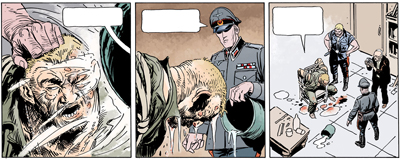
That's the closest you'll come to a splash page in this storyline...

Continue reading

Going Nutz Over Nazis…

Ah, Nazis. The most typical of Hollywood villains. It seems that whenever you want the audience to cheer at what your morally ambiguous hero is up to, just stick his opponent in a Nazi uniform and you can guaruntee that the viewers will know which side they’re on. It used to be in the old days that simply putting a villain in a Nazi uniform was a regular past time for any big director. You didn’t need characterisation or complexity. If they’re German between 1941 and 1945, they’re a bad guy. Well, at least that used to be the way. In recent years it seems that we have accepted that things may be slightly more complex than those black and grey uniforms that they wore. There are many shades. So much so that the ‘thoughtful Nazi flick’ has pretty much become guarunteed Oscar bait. Given the minor furore which surrounded the release of Inglourious Basterds, is the time of the one-dimensional cardboard cutout passed into history? And has political correctness gone too far?

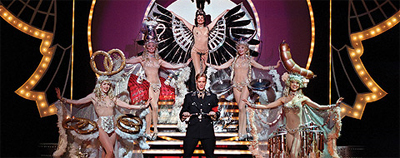
Don't make a song and dance about it...

Don't make a song and dance about it...

Continue reading

What a Basterdly Ending…

Alright, since the entire point of this post is spoilers, consider yourselves duly warned. I don’t like spoiling films, but I also really think that there is a lot of discussion to be had about the end of Inglourious Basterds. Only read on if you have seen the film, or know you won’t. Because there’s no going back. Seriously. It’s something you should really see for yourself before you make up your mind on it. Anyway, those disclaimers out of the way, here we go…

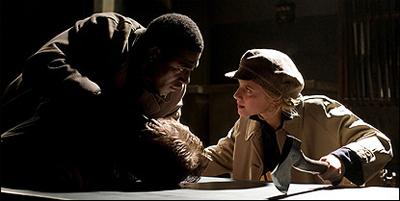
I've got an axe to grind...

Shoshanna's got an axe to grind...

Continue reading

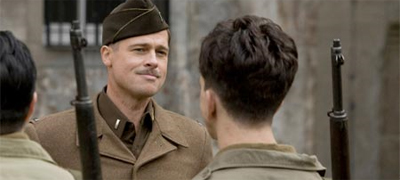
Non-Review Review: Inglourious Basterds

I went to see Inglourious Basterds with my brother last night at the cinema in Swords. I’m not sure what either of us was expecting – I’d read enough reviews and opinion articles and am well-versed in the knowledge that trailers always lie to know that it wouldn’t be a straight-up Nazi-killing flick. In fairness to the misdirecting marketing campaign though, I’m not sure how you could advertise what Tarantino has produced here. What we’ve got is a film possibly unlike any other you’ve ever really seen. I’m still not entirely sure what to make of it, which is certainly a big indicator in the film’s favour.

Tarantino, you magnificent basterd, you...

Tarantino, you magnificent basterd, you...

Continue reading