• Following Us

  • Categories

  • Check out the Archives


  • Awards & Nominations

When Average Just Isn’t Good Enough: Do Better Directors Have Further to Fall?

I watched Cop Out at the weekend, and I have to admit it was just about okay. It wasn’t terrible, but it wasn’t consistently funny. It had moments of wit, but they were separated by pointless and boring scenes. It had a talented cast, but didn’t do anything with them. I wouldn’t describe it as a bad film, but I wouldn’t advise you to rent it (or otherwise seek it out). However, there was a stronger and more bitter taste in the air. There was something especially disappointing about the film, because of its director. Cop Out was a Kevin Smith film, and it actually felt a bit worse than it arguably should have because I knew the director was capable of so much more. Am I the only one who tends to be more disappointed by an average film from a talented filmmaker than perhaps even a bad film from an untalented director?
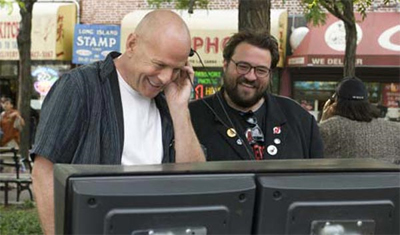
Feels like a bit of a cop out...


Continue reading

Remember Me: The Box Office & Pop Culture Longevity…

I was reading an interesting article on Rope of Silicon which pondered whether Scott Pilgrim vs. The World was our generation’s iteration of The Big Lebowski. Much like the comparisons between The Social Network and Citizen Kane, it doesn’t matter whether the question is downright ridiuclous or even improper, it simple serves to illustrate the type of movie that people think of when they see these modern films. That people would even utter “Scott Pilgrim” and “The Dude” in the same sentence is a huge compliment to the latter, no matter what the literal result of the comparison. Of course, this is small comfort to the studio which is no doubt disappointed by the less than stellar box office returns. However, ignoring the obvious immediate and practical impact of box office receipts, do they speak at all to a film’s longevity?

Does the box office disappointment mean "game over" for Scott Pilgrim?

Continue reading

Non-Review Review: Transformers – Revenge of the Fallen

Transformers: Revenge of the Fallen is one of those films that you have heard so much about that you feel almost obligated to check out. It’s like a challenge. “It can’t possibly be that bad,” you laugh off criticism from just about everybody you know, “I mean, if it’s that bad, it has to at least be entertaining – you know, in the same way that Ed Wood films are entertaining?” And those people reply in what gradually become pleas, imploring you to just accept that it’s a terrible film and let it go. And yet, it’s like a “do not touch” warning to a small child – it draws you closer, attracts your attention, arouses your curiousity. It couldn’t be that bad.

Oh, but it is.

Two-and-a-half hours of torture...

Continue reading

Non-Review Review: The Social Network

Blessed are the geeks, for they shall inherit the earth.

– The Bible. It’s in the back somewhere.

I’m blogging about The Social Network. How post-modern is that?

Should it be the anti-social network?

Continue reading

Non-Review Review: Punisher – WarZone

Punisher: WarZone is not a good film. But it’s not necessarily a poorly-made film, either. There’s a fair amount of skill on display here, but the problem is that the movie never seems to be sure how seriously it wants to be taken. Perhaps the closest point of reference is one of the well-made Steven Seagal films: it spends a great deal of its time delivering what amounts to ridiculousness while offering itself to the audience with a stoic face. It’s a fairly entertaining piece of disposable action fare, but it’s nothing to write home about.

Oh shoot, it's another Punisher movie...

Continue reading

Is Classism Alive And Well At The Box Office?

Richard Nixon introduced the phrase “the silent majority” into the popular lexicon, referring to those people who weren’t out protesting or stirring up a storm, but quietly and strongly sanctioning his actions. Since then the term has become almost synonymous with “middle America” or the “the big red middle”, the clear indication that liberalism and activism were traditionally associated with the coasts of the country – specifically concentrated around Washington, New York and California. Whenever loud and vocal protests arise in these regions, expect the more conservative politicians to speak about the silent majority of decent middle-class folks in “flyover country” who don’t make big deals of things and vote with their feet. These are the people, these politicians will tell you, who save their public political expressions for the election day. And so, it would seem, this central part of the country has voted on The Social Network. And silence was certainly there in spades.

The Silent Majority turned down The Social Network's Friend Request...

Continue reading

Quelling the Prequels…

I’ve always wondered who thought prequels are good ideas. I mean, the ending is a foregone conclusion. It has to end as the other film started. No matter how much danger your leading character is place in, he has to live through it. In fact, the very idea of a prequel is to play out events that you’ve heard about already – so even then you know roughly what’s going to happen and how it’ll turn out before the film is even written. Sure, there are particulars that need to be specified, but it’s an incredibly risky venture – those particulars need to be really awesome in order to justify the film.

No point fighting over the prequels, the third one is the only okay one...

Continue reading

Non-Review Review: Road to Perdition

Road to Perdition may be the best graphic novel adaptation ever to make it to screen – and also perhaps one of the most seldom recognised (very few people seem to realise the film’s roots, perhaps because – as an Oscar contender – it played them down). It’s an old-style biblical fable set in the thirties about the lengths that a father will go to in order to protect his son, but it’s crafted with a skilled hand. It’s a genuine classic.

He's a New Man...

Continue reading

Non-Review Review: Wall Street

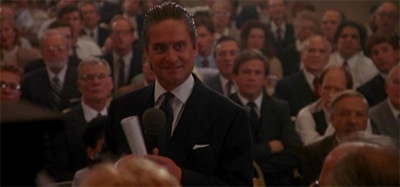
It’s interesting that Wall Street, a movie set in the time that it was made, begins with a titlecard reminding the audience that it’s 1985. Maybe it’s because director Oliver Stone realised that the movie would be dated almost as swiftly as it had been released – financial services are very much a product of their time, anchored in a specific moment. “By four o’clock, I’m a dinosaur!” one character exclaims over the phone as he tries to get information – information that will be redundant if he waits too long. However, I don’t think Wall Street is in anyway redundant. The current financial crisis suggests that – if anything – the original film is as relevant now as when it was released (and is the only reason I am not flat-out dreading the release of Wall Steet: Money Never Sleeps). No, I think that it is because, even in the midst of the decade that it was produced, Stone could see the movie would perfectly capture that moment in time. Seriously, despite the fact that its core ideas are as insightful as they were twenty-five years ago, the movie itself feels like the pure essence of the eighties distilled into a two-hour film. That titlecard isn’t there to remind viewers that this is a dated film, it serves as a stamp or a label. Not to say “this is set in 1985”, but “this is 1985″.

Gordon takes stock...

Continue reading

Trail me Lies, Trail me Sweet Little Lies: Hollywood Trailers, Omission of Facts and Downright Lies

Movie trailers are a fickle bunch. Some spoil movies by revealing crucial plot twists. But there’s arguably something far more sinister than an advertisement which innocently gives a plot twist or two away: the movie trailer which actively lies to the audience. It’s a very dodgy advertising strategy, but sadly one that movie studios seem to be quite comfortable resorting to.

Machete: A Romantic Comedy...

Continue reading