• Following Us

  • Categories

  • Check out the Archives


  • Awards & Nominations

Non-Review Review: A Little Chaos

Perhaps what is most remarkable about A Little Chaos is how deftly the film blends stock romantic comedy tropes with the trappings of a loftier period piece drama. A Little Chaos fictionalises the construction of the gardens at Versailles, undertaken at the behest of King Louis XIV. However, A Little Chaos uses this historical event as the backdrop for a series of quirky romantic misadventures. Matthias Schoenaerts plays André Le Nôtre, the stickler for order who is forced to take on some hired help to ensure that he meets the assigned deadlines.

Kate Winslet is Sabine De Barra, who is hired to design one of the garden’s fountains. Whereas Le Nôtre advocates for order, De Barra argues for a little randomness. The two are introduced at loggerheads, their philosophical positions made clear when De Barra presumes to move a single potted plant in a sequence arranged by Le Nôtre. Inevitably, attraction blossoms as the two find themselves working harder and harder to meet the targets set by the sitting monarch.

Another feather in her cap?

Another feather in her cap?

For all the promise of the title, A Little Chaos packs very few surprises. The formula is quite clearly honed, and it is easy enough to plot the various character arcs and dynamics across the movie’s runtime. Indeed, A Little Chaos might even have benefited from some tightening, feeling quite stretched across its two-hour runtime. At the same time, Alan Rickman has assembled quite the cast for his second film as director. A Little Chaos can count on a superb ensemble – both above and below the title – to carry it when things get a little indulgent.

A Little Chaos is not as fun or as playful as it might be. On the other hand, it looks and feels very impressive, with an occasionally clunky script brought to life by a talented array of actors.
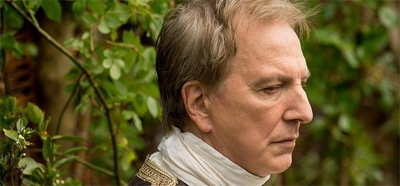
Long live the king!

Long live the king!

Continue reading

Non-Review Review: Suite Française

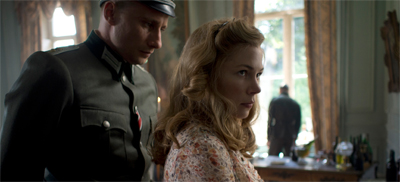
Suite Française is the name given to a planned series of five novels written by Irène Némirovsky during the Second World War. Living in France during the conflict, Némirovsky was Ukrainian and Jewish descent. She completed the first two novels in the series (Tempête en Juin and Dolce) and had outlined the third (Captivité) before she was arrested as a Jew in 1942. Némirovsky was detained at Pithiviers, before she was transferred to Auschwitz. She died in Auschwitz in August 1942.

The two novels were undiscovered for more than half a century; her daughter – Denise Epstein – only discovered the novels in the nineties. They were written microscopically inside journals. The 140 pages that Némirovsky had written expanded to more than 500 printed pages. There is some evidence that even the two “completed” manuscripts were not quite finished. Notes suggested that Némirovsky was considering revisions to Dolce so as to change the fate of a featured character. More than six decades after her death, Suite Française was eventually published in 2004.

An officer and a gentleman...

An officer and a gentleman…

Adapting any novel for the screen is tough job, let alone a sequence of five novels – only two of which were ever finished, and published posthumously. Part of the intrigue of Suite Française was the fact that these were novels depicting incredible historical events as they actually occurred. It is impossible to quite convey that sense of urgency and vitality after decades of storytelling about the Second World War. Although it is an adaptation of a novel published only a decade earlier, Suite Française has the weight of considerable expectations baring down on it.

Even allowing for the difficulties with this particular adaptation, Saul Dibb and Matt Charman’s script still feels quite clumsy in execution; despite excising most of Tempête en Juin, the finished script feels curiously over-written. Monologues tend to meander and wander, as if the script doesn’t trust the cast to convey deep emotion through their performances, as if the writers are afraid the audience might miss the key philosophical or moral points of the script. This is a shame, as Suite Française is beautifully acted and looks quite wonderful.

The good German...

The good German…

Continue reading

Non-Review Review: Cake

Cake is very much a performance piece, in the style of Wild. It is a film built around a fantastic central performance that lives or dies based on the strength of that performance. The film itself is almost irrelevant – a collection of familiar emotional and character beats given life by a stellar cast that are all present to support a lead actor offering what is clearly intended to be a career-defining (or even -defying) performance.

Cake is a movie that is carried by Jennifer Aniston’s superb and moving central performance as a woman living with chronic pain – literal and emotional. It is a movie that could easily seem crass or exploitive, focusing on a physically incapacitated and mentally damaged woman who is trying to piece her life back together. Director Daniel Barnz and writer Patrick Tobin find themselves walking a very fine line.

St. Jude, don't make it bad...

St. Jude, don’t make it bad…

Cake manages to stay on the right side of that line. Barnz might be a little fond of long tracking shots of Jennifer Aniston being driven through areas covered by foliage, and Tobin’s script occasionally seems like it is trying just a little bit too hard, but the film itself is comfortable enough to allow Aniston the spotlight. Cake is very much an actor’s vehicle, and it is unashamedly so.

Aniston does great work here, demonstrating the same credibility and vulnerability that she brought to The Good Girl, another example of the performer playing largely against type. Aniston fleshes out the character of Claire Bennett, taking an arc that is perhaps a little too familiar and too formulaic, and gives the role an emotional core that holds everything together. It is a great performance in a solid film.

It all goes rather swimmingly...

It all goes rather swimmingly…

Continue reading

Non-Review Review: The Wedding Ringer

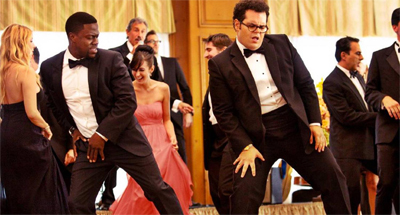
The bromantic wedding comedy is a fairly reliable comedy subgenre; but it is also one that requires a great deal of care. Producing a comedy about weddings can be something of a minefield; it is very easy to play into the familiar gendered stereotypes the controlling fiancée or the disengaged husband-to-be. The Wedding Ringer is an addition to the rapidly-growing subgenre that focuses on a stereotypically masculine perception of “the big day” – wondering what the groom makes of festivities.

The Wedding Ringer comes packed with awkward gender truisms. At one point, professional best man Jimmy Callahan (head of “TBM – The Best Man Inc.”) is confronted by his assistant Doris Jenkins. Doris explains to Jimmy that male and female relationships work differently; that it is tough for men to acknowledge emotion and to connect with one another. This is perhaps the most dialogue that The Wedding Ringer affords any female character in any one scene.

theweddingringer5

“Weddings are for the woman,” Jimmy assures his client, Doug Harris, in one scene. It seems like a stock stereotype that the movie is setting up to subvert – that Jimmy and Doug will eventually learn (in a “knowing is half the battle” sort of way) that marriage is a two-person enterprise that becomes shared at the moment of union. Instead, The Wedding Ringer never shifts its position. The Wedding Ringer sticks to its guns, hitting all the plot beats that one might expect from a movie espousing that philosophy.

Kevin Hart works the material as best he can, and The Wedding Ringer works best when it allows itself to drift from its central premise. However, it is weighed down by a clunky script and a decidedly mean-spirited world-view.

theweddingringer1 Continue reading

Non-Review Review: Inherent Vice

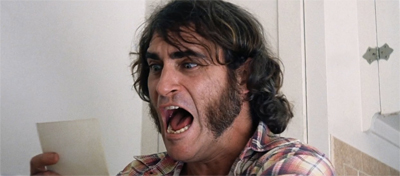
In many ways, Inherent Vice resembles its central character – former-hippie-turned-private-investigator Larry “Doc” Sportello.

Inherent Vice is prone to ramble and meander, stumbling across its central conspiracies as much by fate as by actual investigation. The logic is fuzzy, but the genius is clear. Navigating a complex web of seventies paranoia, it often seems as if Inherent Vice is playing a game of free association between its themes, stumbling upon some higher meta-physical plane where all the evils of the world (or, at least, Los Angeles) are connected by threads almost imperceptible.

Bad trip...

Bad trip…

Both Inherent Vice and Doc are hooked on their own particular drugs. Over the course of Inherent Vice, Doc makes it quite clear that heroine is just about the only dope he won’t take into his body. Inherent Vice itself is drawn the delightfully trippy far-out prose of Thomas Pynchon, with Paul Thomas Anderson’s script pausing intermittently to dump large quantities of existential musing on to the market. If Pynchon’s prose didn’t flow eloquently from actresses like Katherine Waterston and Jeannie Berlin, the audience might complain.

Running almost two-and-a-half hours, Inherent Vice is more than a little indulgent. Luckily, it is more than a little brilliant as well.

Lawyer up...

Lawyer up…

Continue reading

Non-Review Review: Selma

Selma is a fascinating look at the Civil Rights Movement, and at the life and times of the Reverend Martin Luther King Junior.

Adopting the increasingly common approach of narrowing its focus to a rather tight sequence of events, Selma offers an interesting and insightful glimpse at the protest in Selma, Alabama – culminating in a planned march from Selma to Montgomery in March 1964. That was a pivotal moment for the Civil Rights struggle, as the cameras of the nation focused on the brutally wielded by local authorities against those marching peaceably. Selma focuses on that national moments as a vehicle to explore the Civil Rights movement as a whole.

selma3

To be fair, Selma does have its problems. There is a sense that the film is perhaps too concerned with the character of Lyndon B. Johnson, even ultimately affording him something of a heroic moment at the climax. The carefully-maintained period feel is undermined by the decision to dub Yesterday Was Hard On All Of Us by Fink over a crucial moment. In contrast, the period-specific (or close enough) songs by Otis Redding, the Impressions or Duane Eddy add context and texture to the film; the tracks by The Fink and Common (featuring John Legend) feel superficial.

However, these are minor problems. Selma features a tight script, solid direction and a host of fantastic central performances. Eschewing the sentimentality or softness associated with these sorts of prestige pictures, Selma deserves to be considered among the best of the awards season prestige pictures. Its diminished presence on Academy Awards ballots seems sadly telling.

selma1 Continue reading

Non-Review Review: The Kingsman

The creators of The Kingsman either really love or really hate the classic Roger Moore Bond films. Probably both.

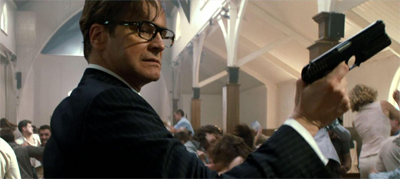
Another creative collaboration between Matthew Vaughn, Jane Goldman and Mark Millar, The Kingsman is just as juvenile, crass and ultimately charming as Kick-Ass. There is a sense of mischievous and cheeky fun to this classic spy film homage. It is effectively an update of those seventies and eighties spy films with a more cynical and self-aware attitude. There is a sense that The Kingsman is simply more transparent than its inspirations in its infectiously juvenile and borderline offensive sensibilities.

Sound and Firthy...

Sound and Firthy…

It is hard to tell how much of this homage is genuine nostalgic affection, and how much is witty subversion. The Kingsman is a spy film that not only uses outdated (and occasionally insensitive) spy movie tropes, it practically revels in them. Although the third act occasionally feels a little too mean-spirited in its riff on classic Bond sensibilities, The Kingsman has enough boundless energy and raw enthusiasm to keep the audience watching. The script is well-observed and the direction is tight. A superb central cast helps to anchor the film.

The Kingsman is an odd beast. It is that rare homage that seems quite likely to shock and offend many fans that otherwise share its nostalgic inclinations. However, those willing to be a bit more adventurous will find much to love in this updated spy caper.

Matthew Vaughn's fingerprints are all over this...

Matthew Vaughn’s fingerprints are all over this…

Continue reading

My 12 for ’14: The Guest and a Halloween Christmas Movie…

With 2014 coming to a close, we’re counting down our top twelve films of the year. Check back daily for the latest featured film.

2014 was a spectacular year for genre work. Perhaps emboldened by the success of genre fare (shared universes! talking apes! killer racoons!) in the summer movie season over the past number of years, it seemed like both major and minor studios were more willing to play with concepts that could easily seem absurd or throwaway.

’71 blended its historical real-world setting with the claustrophobia one might expect to find in horror thriller – a zombie movie set in seventies Belfast. The Babadook is a awards-caliber study of disillusioned parenthood that just happens to use the language of a supernatural horror. Birdman is a blistering Hollywood satire and character study driven by imagery and iconography more traditionally associated with fantasy. There has always been genre overlap, but it seemed particularly pronounced this year.

theguest

The Guest revels in its pulpy nature, offering a gleefully absurd intersection of a classic slasher movie with a more traditional holiday fare. The story of a mysterious visitor who moves in with the family of a deceased soldier, The Guest is wry and quick-witted, subversive and cheeky in equal measure. Anchored by a script from Simon Barrett that refuses to pull any punches, razor-sharp direction from Adam Wingard and a superb central performance from Dan Stevens, The Guest is a pure pulpy pleasure.

In many respects, The Guest feels like what would happen if you asked John Carpenter to make a Christmas movie. Only set at Halloween.

Flying the flag...

Flying the flag…

Continue reading

Non-Review Review: Unbroken

The true story of Louis Zamperini is absolutely fascinating. It lends itself to this sort of big spectacle. It has everything you need for a movie that might clean up during awards season: a historical setting; a war; a sporting story about triumph of adversity; incredible physical transformations from the cast; a character enduring incredible hardship and coming out the other side. These are the sorts of ingredients that make a Best Picture contender. Unbroken just heaps more and more on top of these already alluring elements.

It isn’t the terrible and messy script that ultimately defeats Unbroken, with beloved filmmakers Joel and Ethan Cohen at the top of the bill. It isn’t the pedestrian unchallenging direction, either. It isn’t Alexandre Desplat’s condescending and patronising score, that doesn’t trust the audience to determine what they should be feeling from one moment to the next. It is not even the cynical Coldplay song playing over the closing credits, to put a pleasant life-affirming spin on events.

The Oscar race is on...

The Oscar race is on…

The detail that really shatter Unbroken is the fact that all of this has been very carefully and meticulously calibrated to check off the requisite items on the big Oscar check list. Unbroken is just as mechanical and lifeless a production as Transformers 4, but it happens to be built for a different purpose. There is no energy here, no enthusiasm, no emotion. It is just a bunch of things that have been successful in other stories heaped on top of one another, hoping to hit the high score on that fateful morning in January 2015.

Despite managing to eat up an incredible amount of attention and discussion in the larger Oscar race – taking attention off far more deserving contenders – Unbroken is a complete and utter misfire.

"This is what happens to anybody who suggests Merry Christmas Mister Lawrence is a better Japanese prisoner of war film."

“This is what happens to anybody who suggests Merry Christmas Mister Lawrence is a better Japanese prisoner of war film.”

Continue reading

Non-Review Review: The Hobbit – Battle of the Five Armies

It has become a stock criticism to suggest that Peter Jackson did not need a full trilogy to adapt The Hobbit for the big screen. That said, The Hobbit: The Desolation of Smaug was an unexpected pleasure – a movie not all hindered by the pacing concerns of the trilogy and instead interested in its own central narrative. You could cut the opening scene from The Hobbit: Battle of the Five Armies onto the end of The Desolation of Smaug and you would have pretty much everything that you need.

While this approach benefited The Desolation of Smaug, it puts Battle of the Five Armies at something of a disadvantage. It is debatable whether there was enough material to support three full films based on The Hobbit – even drawing from other sources in the Tolkien canon – but this is clearly not the best way of structuring those three films. There is a sense that Battle of the Five Armies suffers from the decision to extend the planned duology into a full-blown trilogy.

The not-so-magic dragon...

The not-so-magic dragon…

To be fair to Peter Jackson, he does avoid the ending issues that haunted The Lord of the Rings: The Return of the King. However, he does that by editing Battle of the Five Armies as a brief epilogue to the previous two films, following by a massive battle sequence. This is quite impressive from a technical standpoint, but there is a sense of fatigue to it all. As the title implies, this is a five-way battle involving thousands of participants; both organic and computer-generated. A lot gets lost in the shuffle, and the plot – as it stands – could be explained in two sentences.

More than that, Battle of the Five Armies is hindered by its status as a prequel. The fact that everybody in the audience has likely seen The Lord of the Rings: The Fellowship of the Ring means that they know all this spectacle is really for nothing. The first two films in the trilogy largely avoided the problem by pitching the story as a working-class version of The Lord of the Rings, allowing characters to engage in quests that are deeply personal even as they ripple to larger events.

A messed-up character orc...

A messed-up character orc…

Continue reading