• Following Us

  • Categories

  • Check out the Archives


  • Awards & Nominations

Non-Review Review: Rafiki

This film was seen as part of the Virgin Media Dublin International Film Festival 2019. Given the high volumes of films being shown and the number of reviews to be written, these may end up being a bit shorter than usual reviews.

Rafiki is a sweet and tender love story, and well worth seeking out.

Writer and director Wanuri Kahiu is part of an artistic movement that brands itself “Afrobubblegum.” A collective of artists working together to redefine what Africa looks and feels like on screen, the “Afrobubblegum” movement is dedicated to breaking away from many of the clichés and conventions associated with continent to provide a much broader perspective of twenty-first century Africe. Rafiki is very much a part of that movement. It is a story of teen love, of the simmering attraction between two young women on the cusp of adulthood within a reactionary society that would crush such love underneath its heel. It’s a familiar set-up, evoking any number of coming-of-age same-sex love stories, the obvious (and perhaps lazy) comparison being Moonlight.

Rafiki is a fairly conventional narrative in these in terms. Indeed, the audience has a fairly good idea of where the film is going from the opening scenes that establish the realities with which Kena lives before also suggesting her strong attraction to Ziki. However, Rafiki is elevated by a number of factors. Most obviously, there are the winsome performances from young leads Samantha Mugatsia and Sheila Munyiva, who bring a very naturalistic vulnerability to their roles. However, there’s also the sheer charm of the script and the direction, which beautifully captures the feeling of young love from moment to moment, without recourse to exposition or purple prose or heavy-handed soliloquies. Rafiki feels like a movie that knows love, in a very personal and intimate way.

Rafiki is perhaps a little unpolished around the edges, but works well where it matters. It is a movie that understands the trepidation, the excitement, the longing, the fear, the passion, and the power of what it is to want another person, even (and especially) when there are so many reasons not to. There is a simple and convincing beauty in that.

Continue reading

Non-Review Review: Her Smell

This film was seen as part of the Virgin Media Dublin International Film Festival 2019. Given the high volumes of films being shown and the number of reviews to be written, these may end up being a bit shorter than usual reviews.

Put frankly, Her Smell stinks.

To be fair, there’s some interesting material here. film has long been obsessed with stories about fame and celebrity, particularly when filtered through the lens of tragedy and recovery. After all, A Star is Born roared to life as the early frontrunner in this year’s awards race, while Vox Lux provided a darker and weirder meditation on similar themes. Her Smell is very much a companion piece to these other films, a meditation on what fame does to a person, how strange it is. Her Smell is the story of a washed up punk rocker who inevitably collides with rock bottom, and yet somehow finds a way to keep going despite (or perhaps because of) the love of the people around her.

It is interesting to note that “Becky She” hits rock bottom and just keeps going, because this feels like an adequate assessment of Her Smell. Alex Ross Perry’s latest film is two hours and fifteen minutes long, and feels every single one of them. The movie has one single point that it keeps hammering again and again and again, one particular rhythm that it keeps playing again and again and again. Scenes within the film are interminable of themselves, but somehow repeated again and again and again. However, this shallow repetition is not the biggest problem with Her Smell, it’s the combination of that shallow repetition with a smug satisfaction, the cocky assuredness that underscores every single moment.

Her Smell is a dull and lifeless movie convinced of (and insistent upon) its own profundity. Roger Ebert famously argued that no good movie is too long and no bad movie is too short. One could cut two hours from Her Smell and it would still be fifteen minutes too long.

Continue reading

Non-Review Review: Papi Chulo

This film was seen as part of the Virgin Media Dublin International Film Festival 2019. Given the high volumes of films being shown and the number of reviews to be written, these may end up being a bit shorter than usual reviews.

Papi Chulo has a very narrow line to walk.

At its core, Papi Chulo is a very old-fashioned opposites-ultimately-attract buddy comedy. In keeping with the conventions of the genre, the central duo crosses racial and class divides. It is the story of a burnt-out Los Angeles weatherman who hires a Mexican day labourer to (ostensibly) paint his patio deck. Despite the fact that the two are from very different worlds and literally speak different languages, an unlikely bond develops between the two. This is a fairly standard set-up, and an old feel-good Hollywood standard. Indeed, Green Book employed the formula to considerable awards-season success, demonstrating that the template endures.

Peak happiness.

As such, Papi Chulo comes a fascinating premise, but a loaded one. Indeed, the Green Book comparison is something of a double-edged sword. The decision to position an immigrant day labourer as one half of the mismatched couple at the centre of Papi Chulo gives the movie a lot of political weight in the current cultural climate. It would be impossible for a movie about an unlikely friendship between a white man and a Mexican in modern California that crosses class divides not to resonate with everything else happening in the world around it. In fact, given the popularity of this sort of template for exploring issues of race and class in America, it is surprising that there have been so few movies along these lines. It is also surprising that this movie comes from an Irish director.

To be fair to Papi Chulo, the movie always seems aware of how deeply awkward it is for a rich white person to hire a day labourer to (in effect) be his friend. That power imbalance and privilege is always lurking off-screen, and the film is never particularly ambiguous in its assessment of Sean’s behaviour; the weatherman is not working through his issues in a healthy way, but imposing himself on Ernesto. However, these issues never come to the fore, and are only fleetingly acknowledged over the course of the film. This works well enough when the film can count on the unlikely chemistry between Matt Bomer and Alejandro Patino to carry the first half of the film, but it doesn’t really work when the film makes a conscious choice to separate the duo in the second half.

Snap chat.

Continue reading

Non-Review Review: Isn’t It Romantic?

Isn’t It Romantic? is a movie that seriously misjudges its own premise.

At the heart of Isn’t It Romantic? is a fairly solid observation. The conventional romantic comedy has seen better days. The genre enjoyed a boom in the nineties, largely driven by the star power and charisma of actors like Sandra Bullock, Julia Roberts, Meg Ryan and Tom Hanks. It is no surprise that Isn’t It Romantic? opens with the familiar chords of Roy Orbinson’s Pretty Woman and then cuts to a childhood memory of the lead character watching Pretty Woman. In recent years, the genre has gradually been squeezed out of cinemas. It is no longer the cultural force that it once was, with a handful of notable exceptions. Isn’t It Romantic? positions itself as part of a larger discussion about the state of the genre.

He will, in fact, take you to the candy shop.

However, Isn’t It Romantic? approaches this issue in a very strange way. Typically, genres that have been marginalised or pushed to the fringes respond with a level of introspection and analysis; think of Unforgiven with westerns or even Cabin in the Woods with schlocky teen horrors. The idea is that the genre can take itself apart and put itself back together. On the surface, Isn’t It Romantic? seems to be positioning itself as this sort of movie. Indeed, a significant portion of the movie’s stretch of set-up is given over to an extended sequence of the lead character working through the tropes and rhythms of, and the problems with, the romantic comedy genre in almost excruciating detail. Isn’t It Romantic? seems to position itself as an autopsy.

However, it very quickly becomes clear that beyond pointing out these tropes, Isn’t It Romantic? has very little interesting to actually say about them. If the film genuinely believes that the genre is dead, then Isn’t It Romantic? opens as a public autopsy before morphing into a strange act of cinematic necrophilia.

The best laid plans.

Continue reading

Non-Review Review: The Hole in the Ground

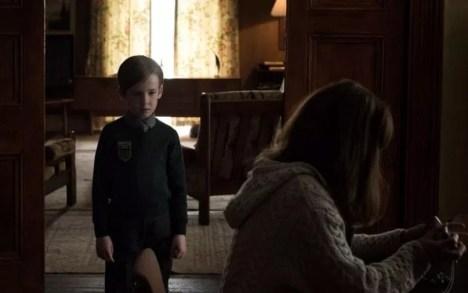
Reduced to a snappy elevator pitch, The Hole in the Ground is perhaps best described as Without Name by way of The Babadook with a dash of The Descent for flavour.”

Such descriptions are inevitably reductive, and don’t do justice to Lee Cronin’s maternal pagan wilderness horror, but they provide a strong sense of texture for the film. Indeed, given the quality of the three horror movies cited, The Hole in the Ground is at least drawing from the best sort of sources. The Hole in the Ground is a horror movie that draws upon Ireland’s rich supernatural framework to deliver a more relatable and universal sort of horror. The Hole in the Ground is a tale about the parental anxiety about the bond between mother and child informed by a heritage of faeries and changelings. It’s very shrewdly constructed so that one set of primal fears resonates with another quintessentially human fear.

Curtains for you.

The Hole in the Ground is a canny and well-constructed horror. It is effectively directed by Cronin, who knows how to build suspense and dread. It understands the power of something as simple as close-ups and sound effects to create a feeling of repulsion in an audience, even confronted with a seemingly mundane activity; if not for The Killing of a Secret Deer, this film would have cornered the market on the visceral horror of eating spaghetti. Cronin’s ability to build suspense carries the film through to its logical conclusion, culminating in the relatively rare horror movie third act that feels confident, effective and ambitious. It helps that Cronin has actor Seana Kerslake in a lead role as well, effectively tasked with carrying much of the film singlehandedly.

The Hole in the Ground is well made and efficient. Its biggest issue is that it often feels assembled from left-over parts, that it is playing with clusters of ideas that have already been thorough and substantively explored by films with an even tighter focus. This isn’t a fatal flaw by any means; the horror films that The Hole in the Ground evokes are some of the finest of the twenty-first century. The Hole in the Ground isn’t quite competing at that level, but it is stille very, very good.

You must be kidding.

Continue reading

Non-Review Review: Happy Death Day 2 U

“You mean this is all about money?” asks a confused grad student early in Happy Death Day 2 U, as a stubborn college dean shuts down his (frankly reckless science experiment. The dean explains that the college is primarily interested in cultivating intellectual property and patents, which comes as news to his more innocent students. The dean protests, bluntly, “Somebody has to keep the lights on around here.”

It’s an odd exchange within an odd film, and one that makes relatively little sense in the context of the story being told. however, it feels like a very revealing exchange in terms of the logic underlying Happy Death Day 2 U. The original Happy Death Day was a cinematic highlight of 2017. Somewhat (and fairly) overshadowed by Get Out, the original film was a playful and self-aware slasher movie hybrid which worked as both a charming example of the genre and broad critique of the exhausting and repetitive nature of such films.

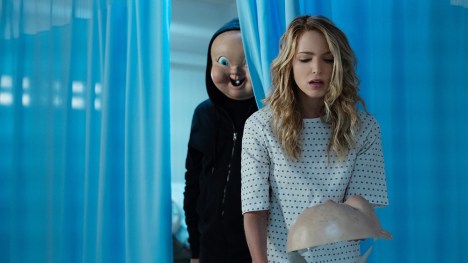
Masking his intentions.

Happy Death Day was the story of a young woman who finds herself trapped reliving the same day over and over, facing a masked serial killer and getting murdered in a variety of inventive ways before resetting to do it all over again. Within that premise was a clear critique of horror franchise formulas that tended to trap protagonists within these familiar frameworks over and over and over again. In that context, Happy Death Day 2 U seems almost redundant. Tree has already lived the same story twelve times. What could a sequel possibly add, beyond some dollars to the bottom line?

It is to the credit of Happy Death Day 2 U that the film inherently and intrinsically understands this. Happy Death Day 2 U is a messy and awkward film, but it is crystal clear in at least one respect. Happy Death Day 2 U knows exactly what sort of film it doesn’t want to be. Unfortunately, it never seems entirely certain of the film that it does want to be.

Stab me, Baby, one more time.

Continue reading

Non-Review Review: On the Basis of Sex

On the Basis of Sex is a sturdy, old-fashioned awards season film.

On the Basis of Sex is earnest, unshowy and very conventional in both concept and execution. All of its beats are familiar, all of its rhythms predictable. It’s not especially inventive or innovative. It is a meat-and-potatoes awards fare, a fascinating story that is told in an uncluttered manner. While there are still a handful of these sorts of films released every year, it often seems like the ground is shrinking out from under them. As awards season has leaned towards quirky indie films like Vice or The Favourite, it has left films like On the Basis of Sex and Can You Ever Forgive Me? sitting in the dust.

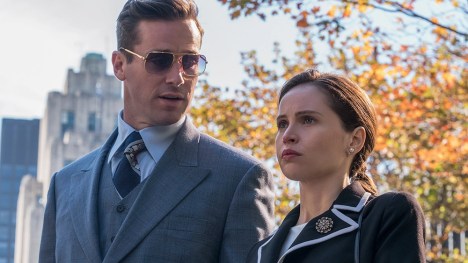
Ruthless litigation.

There is nothing wrong with old-fashioned awards fare, even if On the Basis of Sex occasionally feels conflicted about which particular mode of old-school biographical film it seeks to emulate; it starts like a conventional subject’s-life-in-two-hours piece in the style of films like Ghandi or Patton, and then shifts into the slightly more modern twist on the genre that tends to focus on one formative event like Frost/Nixon or The Queen or Elvis & Nixon. It is a strange shift, with On the Basis of Sex spending half an hour on a general introduction to Ruth Bader-Ginsberg before focusing on the meat of this particular story.

This lack of focus is not a major issue. Old-fashioned awards fare can work reasonably well with the right material and talent, despite seeming quaint by the standards of the time. On the Basis of Sex never stands out from the crowd in the same way as its central character, but then that might be expecting too much given that surprisingly long shadow cast by Ruth Bader-Ginsberg.

Courting controversy.

Continue reading

Non-Review Review: High Flying Bird

High Flying Bird is a quietly radical movie about a sports agent.

This should not be a surprise. Director Steven Soderbergh is a director fascinated with systems, particularly capitalist systems. Unsane might have taken the form of a trashy and tacky nineties thriller, but it was primarily interested in exploring the horrors of a psychiatric industrial complex. Side Effects touched upon the way in which pharmaceutical companies and legal systems work. Contagion was a story about structural responses to a viral infection that spread rapidly through an increasingly interconnected world.

Managing the situation.

With that in mind, it makes sense that Steven Soderbergh’s movie about the NBA lockout of 2011 would feature very little actual basketball. Sure, footage of games plays on several of the large flatscreens adorning bar or office walls, but it’s just window dressing. Just when it looks like Soderbergh might actually show a game, he cuts away dramatically to a shot of a billionaire’s daughter carrying her dog on board a private jet, flanked by two helpful staff holding umbrellas to protect her from the wind. High Flying Bird is about basket ball as an institution, but not a sport.

A cynic would argue that  High Flying Bird is about basket ball in the same way that the NBA is about basket ball, interested in institutions and structures more than the actual sport itself. Such a cynic would be right at home in the world of High Flying Bird, where characters talk freely and repeatedly about the  “game that’s been played behind the game”, “the game that they made over the game”, or “a game on top of a game.” Professional basket ball is not about basket ball, High Flying Bird argues coherently and consistently. Professional basket ball is about profiting off basket ball.

“What are you doing here?”
“Beatz me.”

High Flying Bird is drawn from a script by Tarell Alvin McCraney, who is perhaps best known for working on the story for Moonlight with Barry Jenkins. Indeed, the cast is anchored by Moonlight co-star André Holland. High Flying Bird recalls Moneyball, in that it is a film about sport that does not feature sport, understanding that the activity does not exist in a vacuum. For High Flying Bird, professional basket ball is about money and power and race, and the real game is being played away from where the camera and the audience is looking.

The only thing that keeps High Flying Bird from being a slam dunk is a lack of focus. High Flying Bird doesn’t entirely trust its cast and its premise to hold the audience’s attention through all of these conversations about abstract concepts layered upon abstract concepts placed over a game that the film only shows in the background. As a result, McCraney and Soderbergh crowd out the story with subplots designed to generate human interest; a tragic back story, an emerging romance. These elements ultimately distract from the most interesting aspects of the film.

This screenshot is also about capitalism. Somehow.

Continue reading

Non-Review Review: Alita – Battle Angel

Alita: Battle Angel is the result of a creative union between James Cameron and Robert Rodriguez.

This partnership makes a certain amount of sense. Both Cameron and Rodriguez are genre film-makers, and one suspects that the two men would have been fast friends had they emerged at around the same time; Cameron came of age making films like Piranha 2 or Terminator, and those are certainly of a piece with Rodriguez’s filmography from Desperado through to Planet Terror and even Sin City. Cameron has arguably elevated his work into the mainstream, in that it is impossible to imagine Rodriguez producing a mass-appeal cultural smash like Cameron did with Terminator 2: Judgment Day Titanic or Avatar.

Slice o’ life.

However, allowing for that core similarity, Cameron and Rodriguez are still fundamentally different film-makers. Their interests might align when it comes to genre work, but they construct their movies in a very different manner, with a different emphasis on different aspects of their technique. Cameron is much more interested in bringing polish to his genre work, in finding a way to transform otherwise niche high-concept tales into crowd-pleasing blockbusters with mass appeal. In contrast, Rodriguez revels in the grottier aspects of his genre work, believing that the lack of sheen is part of the appeal.

Alita: Battle Angel finds these two aesthetics at odds with one another. The story at the heart of Alita is pure Cameron, dedicated to world-building and social commentary while relying on exposition and centring on big set pieces. However, the delivery of Alita is very much in the style of Rodriguez, stressing cool beats and individual sequences rather than the singular cohesive whole. The result is jarring and deeply fascinating, but it doesn’t quite come together. Alita is an intriguing piece of cinema, but a less than satisfying would-be blockbuster. Like its central character, it seems constructed of parts that don’t quite fit.

Red is dead.

Continue reading

Non-Review Review: The Lego Movie 2 – The Second Part

Appropriately enough, given the brand involved, The Lego Movie 2: The Second Part very skillfully builds on The Lego Movie.

Of course, The Second Part faces the typical challenges that haunt sequels to beloved and genre-bending films. A large part of what made The Lego Movie such a joy was the way in which it played with audience expectations of what it could be. More specifically, it built very cleverly and very consciously to a late development that was both entirely organic and very surprising, which is a difficult balance to strike. The Second Part starts with that late development baked into the premise, which means that it can’t pull the same twist again. It removes an important toy from the chest.

Bricking it.

However, while The Second Part lacks the novelty that made The Lego Movie so refreshing, it does have the advantage of building on what came before. In keeping with the nature of the toys depicted, The Second Part has the luxury of building upon an established template to tell its own story. The Second Part can trust that the audience understands the logic (both literal and metaphorical) that guided The Lego Movie, and so can develop that idea in interesting directions.

The result is a sequel that is fulfilling and satisfying, but which never quite matches the highs of the original film. The Second Part is clever, funny and canny. However, it is also – by its very nature – less innovative and creative. The results are impressive and affecting. While they don’t have quite the same impact as they did in The Lego Movie, the success of The Second Part is at least reassuring. That the template works so well even without disguising its twists offers proof that the fundamental building blocks are solid.

Piece in our time.

Continue reading