Paranormal Activity 2 feels like a massive disappointment. While the original film left me tossing and turning in my bed, I can’t help but feel like I’ll have forgotten this by the time I rest my head against the pillow this evening. It almost feels like the on-screen hauntings were conducted by two very different poltergeists (or demons). If the original film was the work of a stone-cold profession with the world record in terror, just flexing his creative muscles, it almost feels like this film was the work of the office intern, clumsily trying to emulate what came before, but never really succeeding.
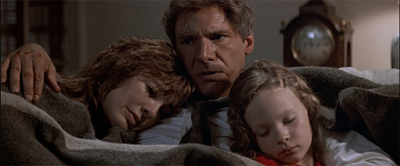
Truth be told, I think Patriot Games stands as one of the best American spy movies produced in the last thirty or so years. It helps that it has, for my money, one of the great leading actors in Harrison Ford, but I also think it works because it tries to explore something of how the American espionage services work, while functioning as a thriller in its own right. It’s easy to reduce the American intelligence agencies to mere window-dressing in a conventional action movie, or to heavily politicise the organisations as part of a political drama, but I think Patriot Games works best because it’s a spy movie that actually feels like it’s a thriller about the intelligence gathering community.
Spying is a damn dirty business. Don’t let James Bond and his fancy Union Jack parachutes or underwater cars fool you. According to The Spy Who Came In From The Cold, it’s an empty and depressing little existence where the players are all confined to the role of pawns on a chessboard. I can’t help but feel that there’s something symbolic about the scene where Alec Leamas, played by Richard Burton, assaults an elderly shopkeeper, played by Bernard Lee – the actor who was playing Bond’s paymaster, M. Given the character’s growing sense of disillusionment, it can’t help but feel strangely potent to see him lash out a symbol of the other – far more romanticised – series of adventures built around British Intelligence.
"I, I can remember... standing by the wall... and the guns, the guns shot above our heads..."
The Offence was reportedly one of the pictures that MGM agreed to fund for Sean Connery in order to get the veteran actor to sign on to reprise the role of James Bond in Diamonds Are Forever. While the film is too slow, methodical and restrained to really qualify as an undisputed classic, I do sleep just a little bit better for knowing that something good came from Connery signing on to play Bond once more. (Although, to be fair, he also donated his salary to charity, so that speaks to his character as well.)
You know what? I was sad to hear that Jon Favreau wasn’t coming back to direct Iron Man 3, especially after Marvel so thoroughly mucked with his vision of Iron Man 2 – turning the second act into an extended infomercial for The Avengers. However, I was kinda glad to see Shane Black come on board, if only because his last collaboration with Robert Downey Jr. (Kiss Kiss Bang Bang) was pure gold. Anyway, Black – as a screenwriter – will be writing the new Iron Man film, and he’s promising a Tom Clancy plot and “real world villains.” So what exactly does that mean?
The other "Man of Steel" (well, gold-titanium alloy)...
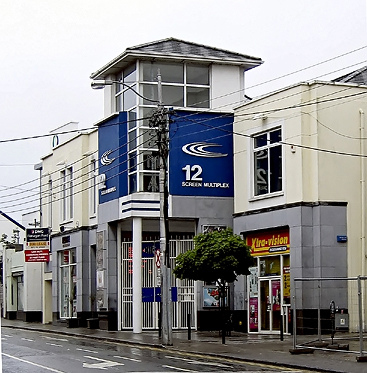
I took a trip down to Sligo with the better half at the weekend there. I grew up in the city, but I haven’t found myself visiting too often. There’s something strange about returning to the town where you grew up. Everything seems smaller, even if there are far more shopping centres and recognisable brands around the place. It was good to go back and to see it all again. And my better half was so kind that she suggested that we go to the local cinema and catch a screening. And so we attended a showing of The Fighter at the Gaiety Cinema Sligo.
I had hoped to end James Bond January as a celebration of one of the most iconic film franchises ever produced. It as a fantastically organised event – thanks to the legend that is Paul Thain over at Paragraph Film Reviews. Through the month, we had some surprising good news. Despite the shadow that loomed over MGM, the next Bond film (Bond 23, as it is known) would enter production. It would be released for the film’s fiftieth anniversary, would see Daniel Craig return and would be directed by Oscar-winner Sam Mendes. That was good news, and it really contributed to the atmosphere of the month.
1933-2011
Unfortunately, as the month came to a close, there was bad news. It’s tragic to end the month with the passing of John Barry. Barry had a tremendous career that others can do far more justice to than I would dare attempt. A legendary composer, his work is instantly recognisable – even if you don’t know you’re listening to it. It’s rare for a composer to exude pure and refined class and sophistication, while still remaining truly accessible. Barry did that. He won an Oscar for his work on Born Free, a soundtrack that I can sing along with even though I have never seen the film. I imagine there are more than a few readers who can say the same thing.
There are those who will sum up his career more eloquently than this truncated blog post, but he was a master. He worked on twelve of the Bond films, however his work was so iconic that the only major departure from his style occurred with GoldenEye (and this was promptly corrected forTomorrow Never Dies). Perhaps his most iconic Bond theme is for Goldfinger. There’s a video below embedded of Barry conducting an instrumental rendition.
However, my own personal favourite John Barry theme comes fromYou Only Live Twice:
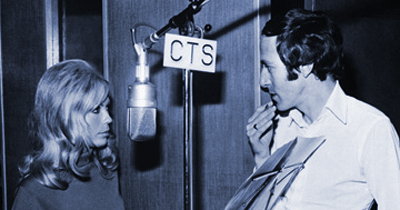
And I have a soft spot for Diamonds Are Forever, where he famously coaxed Shirley Bassey to give it lots and then some.
It’s been a while since I’ve written one of these, and I’m not sure I should bring them back – but, hey, it might be nice to have an index of all the James Bond January shenanigans I got up to this January. Let’s start with the reviews of the 22 films – all of them:
Note: I have another review of the film here, but this was written as part of “James Bond January”, after watching all 22 films in quick succession. This post is part of James Bond January, being organised by the wonderful Paragraph Films. I will have reviews of all twenty-two official Bond films going on-line over the next month, and a treat or two every once in a while.
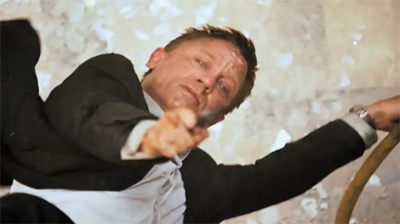
Quantum of Solace is a strange film. In many ways, it feels more like a return to the Bond formula than its direct predecessor, and yet it feels like less of a Bond film. It isn’t a case that film takes the franchise in a new direction while retaining its core identity (as Licence to Kill did, for example), but the feeling that there’s been a fundamental shift in the series, occurring under the radar. It feels as if, though the movie can talk the talk, there’s something different in the step – it can’t quite walk the walk, unfortunately.
This post is part of James Bond January, being organised by the wonderful Paragraph Films. I will have reviews of all twenty-two official Bond films going on-line over the next month, and a treat or two every once in a while.
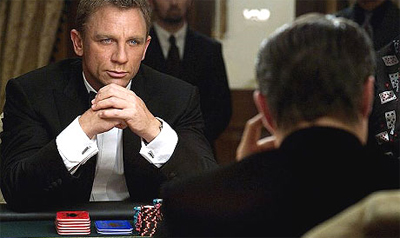
Casino Royale was breath of fresh air for the Bond franchise. The twenty-first film in the series, it represented something akin to a “back to basics” philosophy, pulling back from the camp excesses of Die Another Day to offer us a version of Bond which was a thriller rather than an action comedy. It’s a familiar pattern for low-key entries to follow over-the-top instalments (after all, the producers followed Moonraker with For Your Eyes Only), but arguably not to the same extent. While other movies made the pretense of operating within the same continuity (with numerous references, for example, to Bond’s marriage from On Her Majesty’s Secret Service), Casino Royale was an attempt to completely start from scratch, with a new actor playing a James Bond who was new to his 00-agent status.






















 the m0vie blog