• Following Us

  • Categories

  • Check out the Archives


  • Awards & Nominations

Green Lantern 101: A Beginner’s Guide to The Green Lantern Mythos…

The trailer for Green Lantern arrived yesterday. I’m already excited about the release. However, I acknowledge that Hal Jordan isn’t quite the household name that Bruce Wayne or Clark Kent is. So I put together this collection of frequently asked questions about Green Lantern, which will hopefully give you a bit of an introduction to the character. If this proves popular, I might do the same for Thor or Captain America, the other major comic book releases of next year. Check out the trailer below.

Continue reading

Brian Michael Bendis’ Avengers – Mighty Avengers: Assemble & Secret Invasion (Hardcover) (Review/Retrospective)

This is the ninth in a series of comic book reviews that will look at the direction of Marvel’s core continuity (and in particular their “Avengers” franchise) over the past five or so years, as they’ve been attempting to position the property at the heart of their fictional universe. With The Avengers planned for a cinematic release in 2012, I thought I’d bring myself up to speed by taking a look at Marvel’s tangled web of continuity. Get an overview of what I’m trying to take a look at here.

After the schism of Civil War, a title like Mighty Avengers makes sense on some level. If you’ve pitted heroes against heroes in a contest that you’ve deemed to be allegedly subjective (Marvel’s editorial policy was that there was no right or wrong side to the conflict), then it makes sense to follow the winners as well as the losers. The post-Civil War issues of Bendis’ New Avengers followed those heroes who had fought against registration of superheroes and lost, and Mighty Avengers was launched to offer us an on-going narrative featuring the winning side. It also seems to be a conscious nostalgic effort on the part of author Bendis, perhaps a response to the criticism that his early work on New Avengers steered clear of conventional Avengers storylines – occupied as they were with Japanese ganglands, prison breakouts and Sentry’s inter-personal issues. Here, Bendis seems to be consciously focusing on classic Silver Age devices – in the first run of issues, the State-sanctioned Avengers team faces classic foes like Ultron, the Symbiotes and even Doctor Doom. The problem is that Bendis isn’t necessarily comfortable drafting conventional superheroic fare.
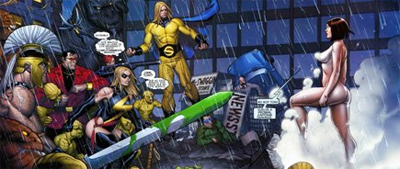
Ultron puts Tony in touch with his feminine side…

Continue reading

Brian Michael Bendis’ Avengers – New Avengers Vol. 3-4 (Hardcover) (Review/Retrospective)

This is the eighth in a series of comic book reviews that will look at the direction of Marvel’s continuity (and, in particular at their “Avengers” franchise) over the past five or so years, as they’ve been attempting to position the property at the heart of their fictional universe. With The Avengers planned for a cinematic release in 2012, I thought I’d bring myself up to speed by taking a look at Marvel’s tangled web of continuity.

And now we’re entering a continuity-heavy area. You have been warned. As if we’ve been in a continuity-free zone for the past couple of weeks, remarks you, trusted reader. This is where my little experiment to venture deep into the heart of Marvel’s comic book continuity becomes a little bit more complicated and a little bit more difficult. Whereas the first part of Bendis’ run on New Avengers was relatively stand-alone (while still drawing on decades of events and continuity), it’s at this point the series becomes irrevocably intertwined with the on-going events at the heart of the Marvel Universe. It’s been described as “a spine”, and that’s pretty much exactly what it is: it’s a support structure which ties together the big Marvel events year-on-year, a thread that joins events like Civil War and Secret Invasion and Siege to each other and the greater fictional universe.

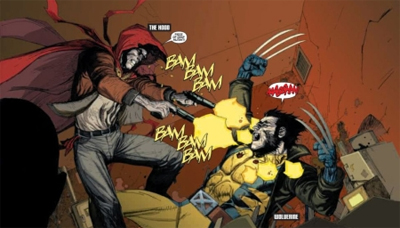
Wolverine learns the hard way not to bring claws to a gun fight...

Continue reading

House of M (Review/Retrospective)

This is the third in a series of comic book reviews that will look at the direction of Marvel’s “Avengers” franchise over the past five or so years, as they’ve been attempting to position the property at the heart of their fictional universe. With The Avengers planned for a cinematic release in 2012, I thought I’d bring myself up to speed by taking a look at Marvel’s tangled web of continuity. Get an overview of what I’m trying to take a look at here.

The X-Men represent the oddball of mainstream superhero comic books. In a genre and medium dedicated offering a static setup – things never really change or resolve – the X-Men are built upon the very idea of evolution. The whole basis of the franchise is the pursuit of equality by the genetically distinct mutant population, the idea that they and mankind can grow together. It has even been frequently suggested that these super-powered individuals represent out future or our replacements. However, the only way to actually tell a story like that is to follow it through to its logical conclusion – to let the ball roll and to let the world change. It feels a little counterproductive for Charles Xavier and his students to still be fighting for the same rights as everyone else nearly fifty years on – it might even seem a little stale. Grant Morrison’s superb New X-Men run offered a solution of sorts – it gave us a world where humanity would be extinct in a couple of generations and showed the growth and relationship between human and mutant subculture. Gone was the minority struggling against an oppressive majority – a more complex example of race relations had come into play with “mutant music” and “mutant slang” making their impression on the youth, amid a silent and almost invisible middle-class backlash. This was an ingenious approach which demonstrated the relevance of the franchise. Unfortunately, Marvel were not quite pleased with this – some people even, ridiculously, accused Morrison of telling all the remaining X-Men stories – and decided to set things right. They did that through House of M.

Dive in...

Continue reading

Planet Hulk (Review/Retrospective)

This is the second in a series of comic book reviews that will look at the direction of Marvel’s “Avengers” franchise over the past five or so years, as they’ve been attempting to position the property at the heart of their fictional universe. With The Avengers planned for a cinematic release in 2012, I thought I’d bring myself up to speed by taking a look at Marvel’s tangled web of continuity. We’re taking a bit of a detour this week, but it’ll feed into Marvel’s event-driven central narrative fairly shortly. Get an overview of what I’m trying to take a look at here.

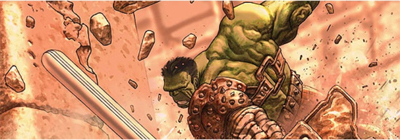
Finally. Hulk knows who to smash.

– Hulk, less than ten pages into the event

Planet Hulk is perhaps a prime example of the type of event-driven storytelling that has become increasingly common at Marvel in recent years. It isn’t really an event of itself, but there’s a strong smell of editorial mandate behind the plot. The key objective – and one conceded by the powers that be – was to isolate the Hulk character from the greater Marvel Universe during the Civil War event (which he would arguably have considerably complicated) and position him for the follow-up event World War Hulk. As such, exiling the Hulk to a foreign planet and watching him play out his own version of Gladiator isn’t exactly the most fluid storytelling direction. However, it’s to the credit of author Greg Pak that the story works as well as it does.

A smashing good time...

Continue reading

Brian Michael Bendis’ Avengers – New Avengers Vol. 1-2 (Hardcover) (Review/Retrospective)

This is the first in a series of comic book reviews that will look at the direction of Marvel’s “Avengers” franchise over the past five or so years, as they’ve been attempting to position the property at the heart of their fictional universe. With The Avengers planned for a cinematic release in 2012, I thought I’d bring myself up to speed by taking a look at Marvel’s tangled web of continuity. Get an overview of what I’m trying to take a look at here.

Alright. I figure I sound a bit hypocritical complaining about the impact of big events on Marvel’s storytelling continuity without reading said big events. Well, actually, I don’t think I’m a hypocrite – I think it’s perfectly reasonably that a reader should be able to pick up Ed Brubaker’s Captain America without having to worry about Mark Millar’s massive Civil War crossover which they either don’t know enough to care about or know enough not to care about. However, I feel like maybe – just maybe – I should try to ride this “cross-continuity” thing out just once and see if the story somehow justifies the damage it causes to the cohesion of individual runs.  Yes, I’m going to jump head-first into the event-populated minefield of continuity which is recent Marvel history, and I will be using New Avengers as a checklist to that. I’m going down the rabbit hole, following the arc from Civil War through to Siege.

Sentry is responsible for the Carnage in this run...

Continue reading

Iron Man: Extremis (Review/Retrospective)

John Pillinger says the Iron Man suit is a military application. I told him he was wrong. I’m trying to decide if I was lying. I’ve never sold any element of the Iron Man to the military. It’s used for extraordinary rescue and response situations. Iron Man saves lives. Iron Man used to represent the future.

– Tony Stark considers his legacy

What’s the Iron Man for, Tony?

– Sal cuts straight to the heart of the matter

The more Iron Man stories I read – and the more movies I see as well – it appears that Tony Stark as a lost individual isn’t a metaphor, it’s more of a metaphysical observation. He’s typically well written and carefully considered (of course, there are glaring exceptions), but he rarely seems to find himself involved in any particularly strong narratives. His appeal is centred entirely on the character’s charm, charisma and pride of place as one of fiction’s most famous and prestigious futurists. I don’t mean this as a slight on Extremis by any means – in fact, Warren Ellis’ revised mission statement for the true man of tomorrow may be the best Iron Man story I’ve read.

What is Tony Stark made of?

Continue reading

Ultimate Comics Iron Man: Armour Wars

Iron Man has always been a character better suited to defining character arcs than to defining runs – which is arguably odd, when considered with most iconic characters. When we talk about Daredevil, for example, we talk about Frank Miller and Brian Michael Bendis; when we talk about the X-Men, we talk about Chris Claremont; when we talk about the Green Lantern, we talk about Geoff Johns. On the other hand, when we talk about Iron Man, we talk about Armour Wars or Demon in a Bottle or Extremis. Perhaps that’s a strength when releasing a big budget blockbuster like Iron Man 2 – it’s easy to flood the market with reprints of six or seven issue storylines, rather than having to deal with huge chunks of narrative. It’s also perhaps the reason that this particular miniseries – essentially a modernised continuity-light retelling of a classic story – seems like such a great idea. It’s ridiculous to suggest a retelling of an iconic writer’s tenure, but remaking a single iconic story seems much more reasonable and more than a bit smart – surely it’s a great way to bring readers into step with arguably the most popular comic book character in the world right now?

Par Armor...

Continue reading

The Mandarin Candidate: Legacies From A By-Gone Era

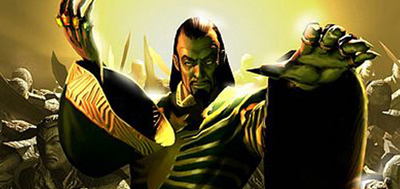
Jon Favreau has effectively confirmed that “the Mandarin” will be the villain for Iron Man 3. Of course, the fact that this particular opponent has been the character’s arch nemesis means that we would have expected him on celluloid long before this – most superhero movies take great joy in using the archnemesis for the original film, after all (Batman Begins managed to just about do without the Joker, but arguably only because he’d already done Batman). Part of the reason it may have taken so long to transition this particular character to the big screen may have something to do with his origins: essentially the character is a yellow peril villain (as the name implies), who was arguably long out of date when he was introduced, let alone now. Favreau has, diplomatically, acknowledged that the character is going to take great care to get ready for a film role, and it got us thinking: how do we deal with long term and iconic characters who may reflect concepts that we aren’t particularly comfortable with right now?

Yep, this doesn't conjure up any unfortunate implications at all...

Continue reading

Man of Iron, Feet of Clay: Nothing Succeeds Like Success…

A little while ago, I mumbled something about how ‘failure’ didn’t really mean much, despite how often the term was thrown around in discussions about films like Watchmen and Kick-Ass. They generally made their money back, received cult attention and didn’t enter the history books as massive wastes of time or energy – which I figured was kinda fair given that neither example was a box office bomb in the style of, say, Motherhood, Uma Thurman’s last film (opening weekend of £88 at the UK box office – I’m not kidding and I didn’t omit an ‘m’). Still, it looks like success isn’t a particularly better deal, given what is circulating on the web regarding Iron Man 2 and its opening weekend – just shy of $130m, I believe. When is success not success?

There may be blood in the water... but Ivan isn't the only shark circling...

Continue reading