• Following Us

  • Categories

  • Check out the Archives


  • Awards & Nominations

New Escapist Column! “Kong: Skull Island” and the Monster in All Human Hearts…

I published a new In the Frame piece at The Escapist this evening. With the announcement that all Warner Brothers films are going to HBO Max, I thought I’d take a look at one of the films related to that move, in particular Godzilla vs. Kong and one of the films leading into it, Kong: Skull Island.

Skull Island is easily the best of the films leading into Godzilla vs. Kong. It is appreciably stronger than either Godzilla or Godzilla: King of the Monsters. A large part of that is down to the fact that it actually has themes, using its central monster to construct an exploration of the idea of warfare. Indeed, one of the more interesting aspects of Skull Island is the way that it implicitly positions King Kong in parallel with Godzilla, turning the giant monkey into a metaphor for the American experience of warfare in the twentieth century.

You can read the piece here, or click the picture below.

New Escapist Column! On How Christopher Nolan Became the Internet’s Villain…

I published a new In the Frame piece at The Escapist this evening. Last week, the cinematic wold was shaken by the announcement that Warner Bros. would be releasing their entire cinematic slate day-and-date on HBO Max. This drew a lot of discussion and debate, but also demonstrating one of the internet’s weird cinematic fault lines: the strong hatred of director Christopher Nolan.

Nolan is one of the most interesting directors working the day. He is the last director who can approach a major studio with an original idea and secure hundreds of millions of dollars to realise it with minimal interference. In his early career, Nolan was a critical and internet darling, with a strong online following. However, since around 2012, Nolan has become a figure of a vocal and persistent derision online, much of which is anchored in the portrayal of the director as an old-fashioned auteur with a distinct sensibility.

This hatred of Nolan – which seems to bubble over in relation to anything from Anne Hathaway sharing chat show anecdotes about working with him to his reasonable critique of Warner Bros. failing to inform any of their directors or collaborators about the move to HBO Max – is interesting because it tied to other cultural trends that overlap. The internet’s passionate dislike of Nolan reflects broader shifts in the embrace of an intellectual-property- and corporate-identity-driven fandom. This hatred of Nolan often feels like a hatred of what he represents as a filmmaker.

You can read the piece here, or click the picture below.

New Escapist Video! On Sam Raimi and What it Means to be a Good (Spider-)Man…

So, as I have mentioned before, I am launching a new video series as a companion piece to In the Frame at The Escapist. The video will typically launch with the Monday article, and be released on the magazine’s YouTube channel the following week. This is kinda cool, because we’re helping relaunch the magazine’s film channel – so if you can throw a subscription our way, it would mean a lot.

With that in mind, here is last week’s episode. With the release of Spider-Man: Miles Morales, we thought it might be fun to take a look back at Sam Raimi’s Spider-Man trilogy, and the central stakes of the film: the question of what it means to be a good man, Spider- or otherwise.

https://www.youtube.com/watch?v=3Sfxxjl8N3Y

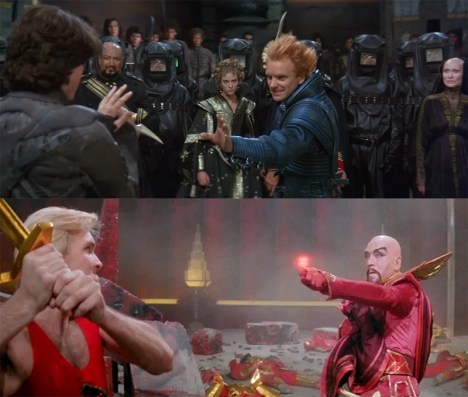
New Escapist Column! On “Flash Gordon” and “Dune” as Biblical Epics for a Secular Age…

I published a new In the Frame piece at The Escapist this evening. As this week marks the fortieth anniversary of Flash Gordon and this month would have seen the release of the next cinematic adaptation of Dune, it seemed like a good time to talk about Dino DeLaurentiis’ science-fiction epics.

Flash Gordon and Dune exist in the shadow of George Lucas’ Star Wars, but they are markedly different films. While Lucas drew heavily from classic science-fiction serials, he adopted modern techniques in production and editing. In contrast, Dune and Flash Gordon are more old-fashioned in their storytelling. More than that, with the death of New Hollywood and the emerging blockbuster film market, it seems like the studios leaned rather heavily into the kind of epic that they knew how to make. As a result, Dune and Flash Gordon feel rather like biblical epics… in space!

You can read the piece here, or click the picture below.

New Escapist Video! On the Terrible “Terminator” Metaphor at the Heart of “Hillbilly Elegy”…

So, as I have mentioned before, I am launching a new video series as a companion piece to In the Frame at The Escapist. The video will typically launch with the Monday article, and be released on the magazine’s YouTube channel the following week. This is kinda cool, because we’re helping relaunch the magazine’s film channel – so if you can throw a subscription our way, it would mean a lot.

With that in mind, here is last week’s episode. With the release of the dead-on-arrival Oscar contender Hillbilly Elegy, a lot of very talented writers have examined and interrogated its exploration of rural white poverty in America. However, very few have directly engaged with the movie’s truly terrible Terminator analogy.

New Escapist Column! On Sam Raimi’s “Spider-Man” and What It Means to be a Good Man…

I published a new In the Frame piece at The Escapist this evening. There’s been a lot of coverage about the new videogame Spider-Man: Miles Morales, so it seemed like a nice opportunity to go back and take a look at Sam Raimi’s Spider-Man trilogy.

In hindsight, one of the most striking things about Sam Raimi’s Spider-Man trilogy is how low the stakes are. Barring the climax of Spider-Man II, Peter Parker never faces an apocalyptic threat. Even when Peter does face down larger-than-life supervillains, Raimi is sure to ground the films in more relatable stakes. Raimi’s trilogy is fascinated with the question of whether Parker Parker will become a good man. It understands this question as it relates to a lot of young men. Peter’s dark side doesn’t build omnicidal robots or order killer drown strikes, but offers a more mundane evil.

You can read the piece here, or click the picture below.

New Escapist Column! On the Morality Plays that Ground Quentin Tarantino’s “Reservoir Dogs” and “Pulp Fiction”…

I published a new In the Frame piece at The Escapist this evening. Yesterday was Thanksgiving and Christmas is fast approaching, so it seemed like as good a time as any to talk about the heartwarming morality of director Quentin Tarantino.

Tarantino arrived in the early nineties as something of a provocateur, and caused no shortage of outrage among older and more traditional audiences. One of the more frequent criticisms thrown at Tarantino suggested that the director was nihilistic, that he presented worlds without meaning or sense beyond violence and chaos. While this might superficially appear to be true in that many of Tarantino’s films feature both violence and chaos, it fundamentally misunderstands the director.

On the contrary, Tarantino is arguably one of America’s most morally conscious filmmakers. His films present characters with worlds in which arbitrary forces sweep through their lives, reflecting the reality of living in a world outside of an individual’s control. However, many of Tarantino’s protagonists react to that chaos by fashioning their own order out of it – discerning their own meaning, constructing their own reasons. Although obscured by Tarantino’s preference for non-linear structure, his stories are often miniature morality plays.

You can read the piece here, or click the picture below.

New Escapist Column! On the Terrible “Terminator” Metaphor at the Heart of “Hillbilly Elegy”…

I published a new In the Frame piece at The Escapist this evening. With Hillbilly Elegy arriving on Netflix tomorrow, it seemed like the right moment to take a look at one of award season’s biggest misfires.

There are a lot of problems with Hillbilly Elegy, many of which have been explored by writers with a lot more probing insight and personal experience than I have on the matter. That said, one aspect of the film has stuck with me since I first watched it: Hillbilly Elegy has possibly the worst Terminator metaphor that I have ever seen. It’s impressive how terrible the metaphor is. It relies on both a fundamental misunderstanding of the Terminator franchise, but also on a misunderstanding of what Hillbilly Elegy is trying to say.

You can read the piece here, or click the picture below.

New Escapist Column! On James McAvoy’s Complex and Compelling Charles Xavier…

I published a new In the Frame piece at The Escapist this evening. With New Mutants releasing on streaming this week, effectively drawing the shutters down on Fox’s “X-Men Cinematic Universe”, it seemed an appropriate time to take a look back at one of the franchise’s unsung highlights: its portrayal of Charles Xavier.

Charles Xavier is a challenging character. He was essentially introduced as a plot function, the adult in the room for a teenage superhero team. However, over the years, Xavier has come to embody more. However, he has typically been portrayed as a saint or an icon. As played by James McAvoy, Xavier becomes a much more complex and compelling character, one who raises important questions about the X-Men as a metaphor for minority groups and about the best way of advancing ideas like social change and equality.

You can read the piece here, or click the picture below.

New Escapist Video! On “GoldenEye” and an Unchanged Bond in a Changed World…

So, as I have mentioned before, I am launching a new video series as a companion piece to In the Frame at The Escapist. The video will typically launch with the Monday article, and be released on the magazine’s YouTube channel the following week. This is kinda cool, because we’re helping relaunch the magazine’s film channel – so if you can throw a subscription our way, it would mean a lot.

With that in mind, here is last week’s episode. To mark the twenty-fifth anniversary of GoldenEye, we took a look back at the first James Bond film of the nineties, which introduced the suave secret agent to a whole new generation. Indeed, the genius of the film lay in its understanding of Bond. It presented a version of Bond that had no changed, even as the world around him had.