• Following Us

  • Categories

  • Check out the Archives


  • Awards & Nominations

Peter Milligan’s Run on Detective Comics (Review/Retrospective)

23rd July is Batman Day, celebrating the character’s 75th anniversary. To celebrate, this July we’re taking a look at some new and classic Batman (and Batman related) stories. Check back daily for the latest review.

Peter Milligan’s run on Detective Comics was cut unfortunately short. After writing six issues of Detective Comics, the writer felt a little over-stretched, and so decided to concentrate on more personal projects. While that’s entirely understandable, it’s also a little unfortunate. Milligan’s work on Batman is rather underrated and often overlooked. Grant Morrison’s decision to build some of his extended Batman run off Milligan’s Dark Knight, Dark City helped bring some exposure to Milligan’s work on the character.

Despite the brevity of his run, Milligan is incredibly influential when it comes to the character of Batman. His work prefigures a great deal of the nineties. The way that Milligan seems to play Detective Comics as an existential horror story feels like it sets the stage for the extended collaboration between Doug Moench and Kelley Jones on the main Batman book during the mid-nineties. Although he didn’t stay to see the idea through, Milligan did play a (very) small part in the development of Knightfall.
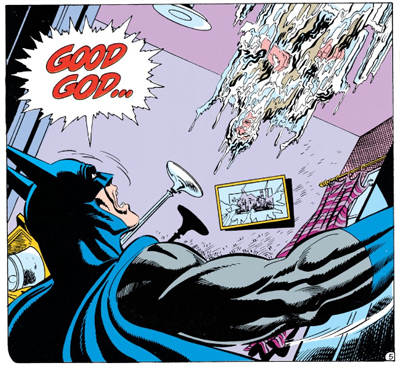
Hanging on in there...

Hanging on in there…

Even outside of the general mood of Milligan’s work on the title, and demonstrating that a Batman comic could work as a horror story, even Milligan’s individual stories are influential. Dark Knight, Dark City is major influence on Grant Morrison’s work on the character. Perchance to Dream on Batman: The Animated Series seems to owe a debt to Milligan’s Identity Crisis, imagining a version of Bruce Wayne who is not Batman. (Something Morrison revisited during Final Crisis.)

However, perhaps Milligan is most influential in his portrayal of Gotham itself, offering us a damaged Batman protecting a haunted Gotham.
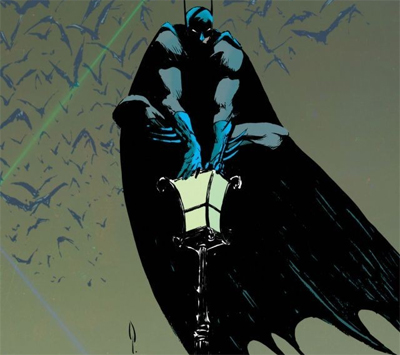
Knight clubbing...

Knight clubbing…

Continue reading

Non-Review Review: Oculus

Oculus is torn between two extremes. On the one hand, it’s an ambitious horror film that engages with questions of perception and subtext, while throwing all manner of horror tropes together to form something of a horror movie stew. On the other hand, it rather quickly devolves into a fairly generic horror film that coasts on gore to unsettle the audience and always takes the easiest possible scare. Oculus is at its best during its muddled and exposition-filled opening acts.

While certainly flawed, these segments have an endearing substance to them. In contrast, Oculus is at its worst in the obligatory third act run-around.

All work and no play makes Rory Cochrane a dull boy...

All work and no play makes Rory Cochrane a dull boy…

Continue reading

Non-Review Review: Only Lovers Left Alive

This film was seen as part of the Jameson Dublin International Film Festival 2014.

The vampire genre has been around for a reasonably long time. The literary genre that was formalised by Bram Stoker’s Dracula at the dawn of the twentieth century, even if it drew on a rich selection of local beliefs and superstition. And yet, despite that, there really hasn’t been too much radical done with vampires in recent times. The last attempt to do something a bit provocative and game-changing with vampires occurred with Anne Rice’s discovery that you could easily shape vampire narratives into creepy romances – a technique refined by Stephanie Meyer to considerable commercial and popular success.

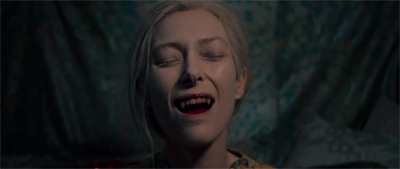
As such, Jim Jarmusch’s Only Lovers Left Alive is fascinating because it manages to push the archetype a little further. It builds off those sorts of vampire romances and vampire fantasy epics in order to tell a more novel sort of story. Only Lovers Left Alive is a wonderful piece of mood based around two powerful central performances, taking one of cinema’s oldest monsters and finding a way to make them interesting again.

Only Lovers Left Alive is the most original vampire movie in what feels like an eternity.

onlyloversleftalive5

Continue reading

Non-Review Review: The Last Days on Mars

This film was seen as part of the Jameson Dublin International Film Festival 2014.

There’s very little original to be found in The Last Days on Mars. Ruarí Robinson has constructed a gigantic homage to science-fiction horror, taking great pride in setting up the familiar clichés and working through the obligatory tropes. There are any number of shout-outs and references built into The Last Days on Mars, so much so that the film seems to struggle to stand on its own two feet.

At the same time, there’s an undeniably trashy charm to The Last Days on Mars. There’s a sense of Robinson’s abiding affection and enthusiasm for the conventions he evokes, the movies he homages. Nobody watching the film will confuse it for a trailblazing or original piece of work; however, it works surprisingly well as a gigantic tribute to pulpy science-fiction B-movies.

thelastdaysonmars

Continue reading

Non-Review Review: Devil’s Due

The single biggest problem with Devil’s Due is that it’s boring.

There are a lot of other flaws. It’s really creepily xenophobic. It has little interest in the female character carrying this baby. It is completely uninterested in the “found footage” thing, but still commits to using it. It is really just a bunch of clichés that we’ve seen done much better elsewhere. Its protagonists rank incredibly low on the intelligence scale for horror movies, which sets a pretty low baseline to begin with.

However, the most frustrating flaw with this reproductive horror is the fact that it’s just deathly dull.

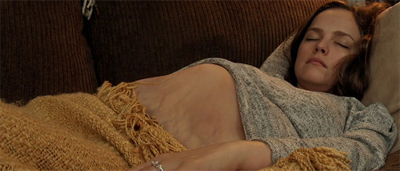
The belly of the beast...

The belly of the beast…

Continue reading

Non-Review Review: Evil Dead (2013)

Evil Dead does has a bit of a quirky charm to it, serving as perhaps the best-made horror throwback I’ve seen in quite some time, much more effective than most of the recent splurge of exorcism movies. As far as competent execution of classic horror movie tropes go, complete with the sense of “something gruesome’s gonna happen” dread and a healthy amount of gore, Evil Dead succeeds admirably. There are some issues in the final act, but Evil Dead checks all the necessary boxes, and does so with a minimum amount of fuss or pretension, which makes it a surprising enjoyable watch for those looking to enjoy a good old-fashioned video nasty.

That said, it can’t help but feel a little awkward, through no fault of its own. Sam Raimi’s Evil Dead was a genre classic which worked in a large part because it eschewed all but the most basic tropes of horror storytelling, refusing to dress a video nasty in anything too fancy. The movie came to embody a particular subgenre of horror, and it wore its grotesqueness on its sleeve. Last year, Cabin in the Woods offered a fitting follow-up, a capstone to that approach to horror. As such, through no fault of its own, this version of Evil Dead feels like it arrived a little late.

Down the rabbit hole...

Down the rabbit hole…

Continue reading

Non-Review Review: The Thing (2011)

The reflexive reaction to a film like the 2011 version of The Thing is one of scepticism. There’s something very strange about seeing a movie that had been relatively unloved on initial release garnering the remake/prequel treatment, an attempt to cash in on its cult success by turning it into a franchise. And, to be fair, a lot of that cynicism is justified by The Thing. There are times when it seems like – despite the obvious affection for the original horror master piece held by the writers and the director – that nobody really has any idea why John Carpenter’s The Thing has become such an iconic piece of cinematic horror.

There are some nice touches here, and it seems like director Matthijs van Heijningen Jr. is genuine in his love of the classic body horror. Unfortunately, it feels like the finished product is more the result of mechanical number-crunching than honest enthusiasm.

All fired up...

All fired up…

Continue reading

Birthing Hips Sink Ships: Dark Shadows & Improbable Feminism…

I will concede that I am fonder of Dark Shadows than most. I’ve been disappointed with a lot of Tim Burton’s recent output, but something about his revival of the seventies soap opera worked strangely well. I’ll be the first to concede that it’s pretty esoteric. After all, like Casa de mi Padre, it’s effectively one single joke stretched across a film’s runtime. However, I couldn’t help but warm to it, at least because it seemed like Burton was enjoying himself a lot more than head been with films like Alice in Wonderland. There was something quite cheeky about it, from the way that it portrayed its central character as ridiculously unheroic through to the fact that it was perhaps the year’s most subversive feminist film.

Indeed, watching the film again this weekend, it struck me just how feminist the narrative actually was, despite the somewhat superficial distractions from that.

darkshadows10

Continue reading

My 12 for ’12: The Cabin in the Woods & The Virtues of Constructive Criticism

I’m counting down my top twelve films of the year between now and January, starting at #12 and heading to #1. I expect the list to be a little bit predictable, a little bit surprising, a little bit of everything. All films released in the UK and Ireland in 2012 qualify. Sound off below, and let me know if I’m on the money, or if I’m completely off the radar. And let me know your own picks or recommendations.

This is #4

The horror movie has always been a bit of an ugly stepchild when it comes to film genres. It seems, for instance, that horror movies (and directors) have to wait longer to receive recognition for the work that they’ve done. The Shining, for example, earned several Razzy nominations in the year of release, but is now regarded as one of many classics within Kubrick’s oeuvre. There are lots of reasons that the horror genre is easy enough to dismiss or ignore.

You could argue that there’s something so basic about fear that it isn’t considered as much of an artistic accomplishment to scare the audience. There are legitimate arguments to be made about the sexist connotations of various horror films. Perhaps more than any other genre, successes within the horror genre have a tendency to lead to self-cannibalisation – sequels, remakes, knock-offs – that dilute and erode any credibility that the original film had earned. The innovation of Paranormal Activity is harder to recognise after half-a-decade of found-footage imitations. The cleverness of the original Saw becomes harder to distinguish amongst a crowd of “torture porn” wannabes.

All of these are very legitimate criticisms to make about the nature of the genre as a whole, and perhaps they speak to why films within that niche are so easily dismissed. I will aggressively argue that several horror films are among the most important films ever made, but I will also concede that there is (as with everything) a lot of trash out there, and a lot of things we need to talk about. Cabin in the Woods feels like a genuine attempt to have that sort of conversation, and to raise those questions. More than that, though, it comes from a place of obvious affection for the genre and all that it represents. This isn’t a stern lecture about the inherent inferiority of a particular type of film,  but constructive criticism from a bunch of people who care deeply about the genre as a whole.

cabininthewoods8

Continue reading

Non-Review Review: Red Riding – The Year of Our Lord 1980

Talk to someone else!

There is no one else, they’re all %$#!ing dead!

– BJ and Hunter

Red Riding: 1980 isn’t quite as strong as its direct predecessor. In fact, it’s probably the weakest of the films in the trilogy. There are quite a few reasons for this, but that doesn’t mean that it isn’t worth watching. For all its flaws as part of a continuing narrative, Red Riding: 1980 is still a fascinating tale of police corruption, and arguably the movie of the trilogy that works best as a standalone feature. Or, at least, better than it does as one connected narrative. Red Riding: 1974 depends on Red Riding: 1983 for an ending, and Red Riding: 1983 depends on Red Riding: 1974 for a beginning. Red Riding: 1980 sits in the middle, and serves as something of an example of the type of endemic corruption that has taken root in this version of Yorkshire.

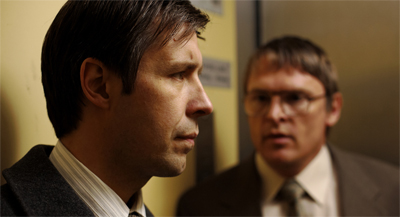
Hunter on the prowl…

Continue reading