• Following Us

  • Categories

  • Check out the Archives


  • Awards & Nominations

The X-Files – Chimera (Review)

This September, we’re taking a trip back in time to review the seventh season of The X-Files and the first (and only) season of Harsh Realm.

There is a sense of fatigue about the seventh season of The X-Files.

It makes a certain amount of sense. After all, seven years is a long time in television. It is a particularly long time when the staff are churning out more than twenty episodes in a year. One hundred episodes is typically considered the threshold for syndication success, but The X-Files crossed that with Unusual Suspects back in the fifth season. By this point, The X-Files is comfortably past one hundred and fifty episodes of television. That is a lot of television. Assuming one were to watch it straight through, that’s nearly five straight days of television.
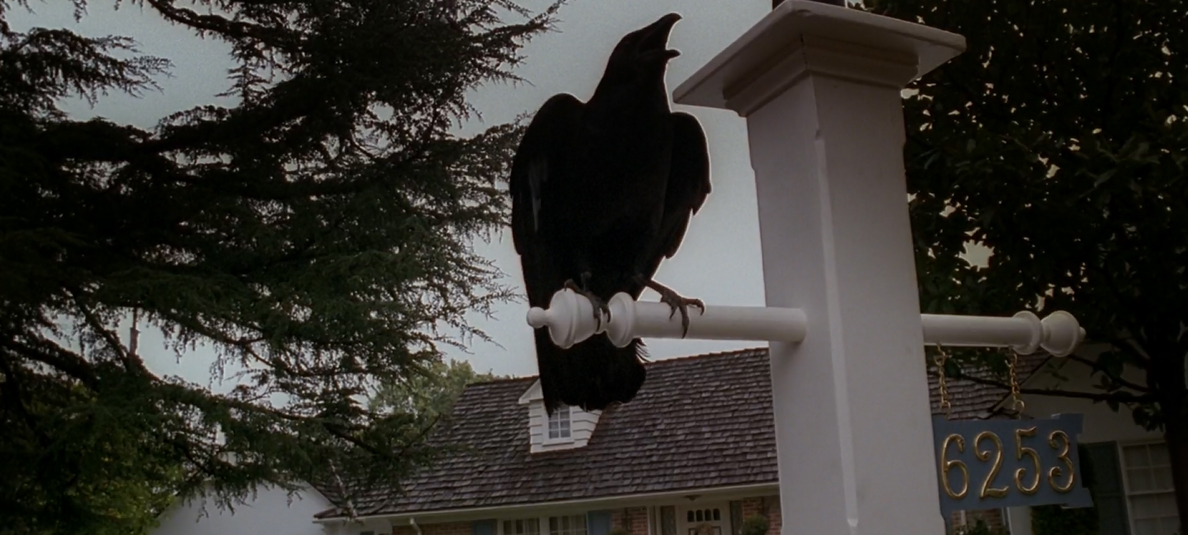
Quoth the raven...

Quoth the raven…

There comes a point where it feels old and outdated, where the sense of novelty and excited has faded to familiarity and dull routine. There comes a point where it feels like there is not much to talk about, because the show has already said a lot of what it has to say about a particular subject. It could be described as a “seven-year-itch”, but there is a reason why shows that last longer than seven seasons tend to rotate actors and producers more frequently than The X-Files has. Occasionally a blood transfusion is necessary to reoxygenate the blood.

Chimera is a perfectly solid episode of television. It is produced to the high standards of The X-Files, directed very well, and written in an efficient manner. However, it feels like it is covering a lot of well-trodden ground for the show with nothing new to say. Chimera feels like it is simply echoing sentiments the show had clearly articulated as recently as the sixth season; a curious blend of Terms of Endearment and Arcadia, but without the novelty or nuance of either. The X-Files has begun to feel as familiar as the rows of suburban houses it so fears.
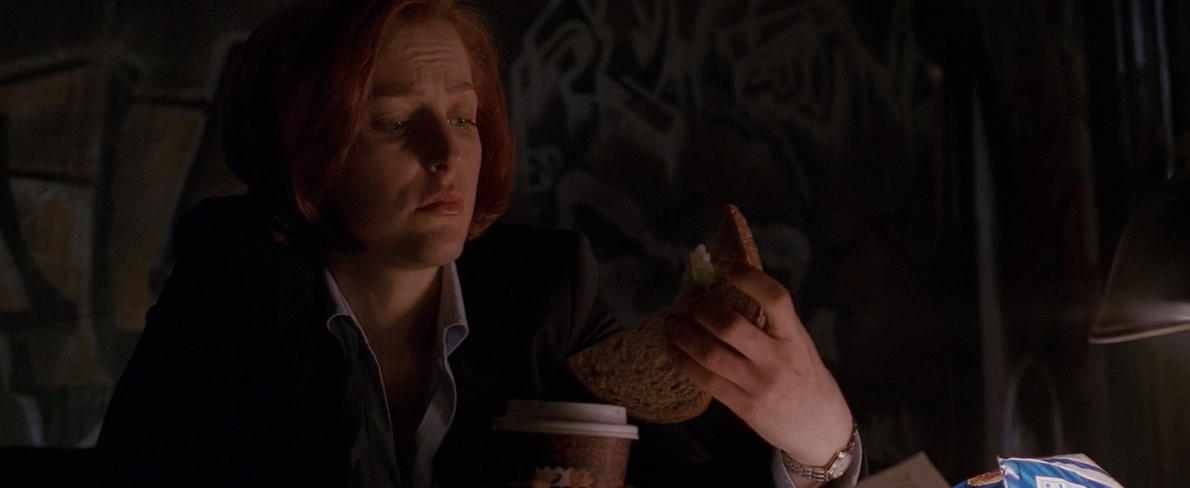
Food for thought...

Food for thought…

Continue reading

The X-Files – X-Cops (Review)

This November, we’re taking a trip back in time to review the seventh season of The X-Files and the first (and only) season of Harsh Realm.

There is a very serious argument to be made that X-Cops represents the last point at which The X-Files truly pushed itself.

There are experimental episodes later in the run that play with new narrative forms and concepts. Improbable features a snazzy musical number; Lord of the Flies intersects with stunt-driven television shows; Sunshine Days has the characters enter The Brady Bunch. However, X-Cops represents the last time that The X-Files allows itself to be completely submerged in a high-concept idea, following the concept through to its logical conclusion in the spirit of Jose Chung’s “From Outer Space” or Bad Blood or Triangle.

xfiles-xcops17a

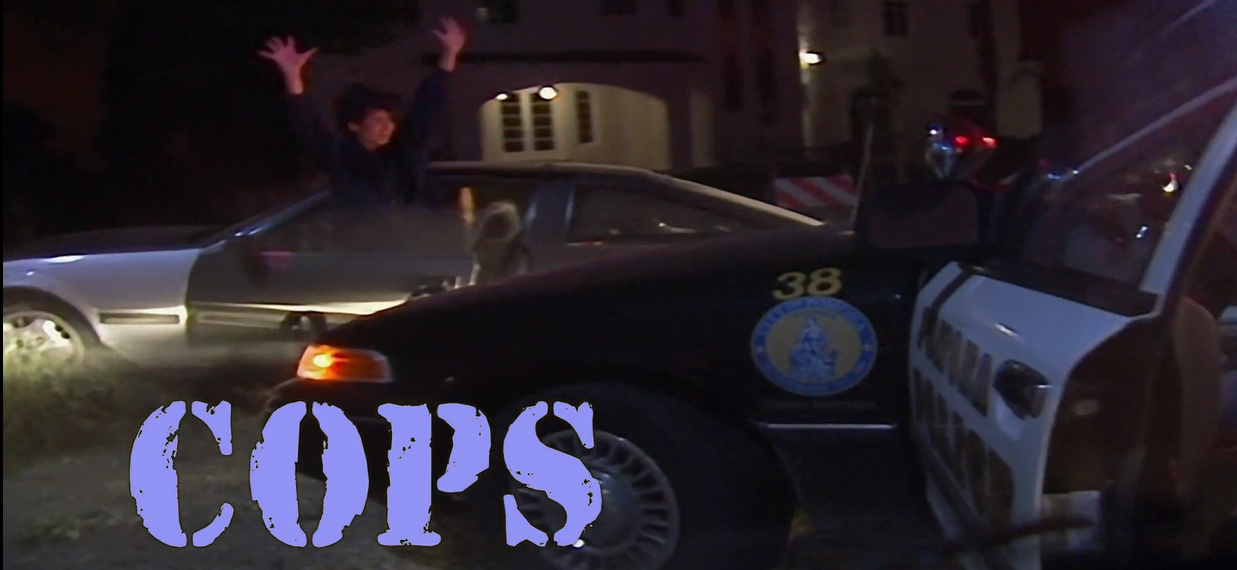
X-Cops features Mulder and Scully crossing over into an episode of Cops. However, the episode is told entirely from the perspective of the Cops production team, filmed and broadcast as if it were an episode of Fox’s long-running law enforcement reality television show. The camera becomes a performer in X-Cops, and at no point in the entire forty-five minutes does it “break character.” Barring the use of the X-Files opening credits sequence and superimposing the logo at commercials, X-Cops adopts the form and structure of Cops.

This is a boldly experimental piece of television; it is not the sort of episode that viewers expect from a show in its seventh season. This is a giddy and goofy concept more akin to enthusiastic student filmmaking than an established television institution. After Sein und Zeit and Closure suggested that The X-Files was winding down, X-Cops proves that there’s life in the old show yet. Sadly, this feels like something of a last gasp; there would never be quite as much life in The X-Files after this point.

xfiles-xcops2a

Continue reading

The X-Files – Millennium (Review)

This November, we’re taking a trip back in time to review the seventh season of The X-Files and the first (and only) season of Harsh Realm.

There are any number of ironies around the cancellation of Millennium.

The show was cancelled by Fox to make room for Harsh Realm, hoping that Chris Carter’s new show would perform better in the Friday night slot. Of course, that did not turn out to be the case; Harsh Realm was cancelled after only three episodes had been broadcast, all failing to even match the already low numbers of the third season of Millennium. A show in its third season was cancelled to make room for a hip new show that was pretty much dead on arrival. However, that is not the only irony.

Frank Black's return...

Frank Black’s return…

Millennium concluded with Goodbye to All That in May 1999. The show fell seven months shy of its own deadline. If Fox had commissioned only eight new episodes, the creative team would have been able to take the show right up to the turn of the millennium itself. (Well, in a way that would make sense to most viewers. “Nobody likes a maths geek, Scully.” Even one who is technically correct.) It seems like Frank Black would not get to see the arrival of the date that had defined his show. (It was the title, after all.)

If Christmas is the season of goodwill to all men, then it is a nice gesture that The X-Files invited Frank Black to ring in the new year (and the new millennium) with them. It might not be much more, but it is a nice gesture.

... is just one thing that fans remember about this episode.

… is just one thing that fans remember about this episode.

Continue reading

Harsh Realm – Inga Fossa (Review)

This November, we’re taking a trip back in time to review the seventh season of The X-Files and the first (and only) season of Harsh Realm.

Inga Fossa is a noteworthy episode of Harsh Realm for a number of reasons.

In production terms, it closes out the loose three-episode introduction to the series. The Pilot, Leviathan and Inga Fossa were all written by Chris Carter and served as an introduction to the world and rules of Harsh Realm. Perhaps owing to the relative complexity of the show’s premise, Carter takes a bit of time to lay out and establish the core ideas of the show. It isn’t until the end of Inga Fossa that characters like Thomas Hobbes and Sophie have reached the status quo that will carry them through the rest of the first season.

Game on...

Game on…

However, all of this is ultimately irrelevant. Inga Fossa will always be notable for being the final episode of Harsh Realm to air on Fox. Chris Carter’s new show was infamously cancelled after only three episodes were broadcast. The six episodes that had been produced before cancellation were quietly shuffled off Fox’s 1999 schedule; they eventually aired on FX in mid-2000, to little fanfare. The cancellation was a shocking development. The ratings were spectacularly terrible, but Harsh Realm had been intended to establish Carter as the network’s idea-generating machine.

Something was very wrong.

"You can't $@!# in here, this is the war room!"

“You can’t $@!# in here, this is the war room!”

Continue reading

Star Trek: Enterprise – Impulse (Review)

Next year, Star Trek is fifty years old. We have some special stuff planned for that, but – in the meantime – we’re reviewing all of Star Trek: Enterprise this year as something of a prequel to that anniversary. This August, we’re doing the third season. Check back daily for the latest review.

Impulse is a Star Trek zombie story.

It might sound absurd, but it works very well. After all, the Star Trek franchise rooted in pulp space horror, with extended stretches of the original show portraying space as haunted. In some ways, Impulse could be seen as a logical extension of Regeneration from late in the second season. Both episodes are very much modelled on the classic zombie horror movie formula, both deal with how traditional Star Trek morality applies to that formula, and both are even directed by veteran Star Trek producer David Livingston, who brings a nice kinetic feel to the adventures.

Dead space...

Dead space…

Impulse works a lot better than it really should. There are some plotting issues created by the secondary storyline grafted into the episode, and the show doesn’t quite develop its Vulcan themes as well as it might. However, it compensates for these issues with an incredible sense of energy and momentum. The third season of Star Trek: Enterprise might be the first season of Star Trek to be seriously facing cancellation in decades, but it had an entirely new lease on life.

Impulse is a bold and exciting piece of television, one that feel vital and urgent. It recaptures some of the appeal of the new status quo that had been somewhat squandered by Extinction and Rajiin.

Reed shirt...

Reed shirt…

Continue reading

Millennium – Darwin’s Eye (Review)

This July, we’re taking a trip back in time to review the sixth season of The X-Files and the third (and final) season of Millennium.

There is a reckless abandon to the the late third season of Millennium that is oddly endearing.

The first half of the year seemed almost cautious and conservative, as if trying to smooth the rough edges off the show in the hopes of turning it into a more generic piece of television. That approach failed spectacularly, and hobbled the rest of the season. Towards the end of the third season, Millennium allowed itself to become a bit bolder and more abstract, proudly flying its freak flag high. The show found an energy and verve, throwing crazy concepts into scripts with reckless abandon and little regard for how they fit together.

Shady theories...

Shady theories…

It doesn’t entirely work. If anything, it underscores just how skilfully the second season had integrated these crazy ideas with a clear creative direction and a solid thematic foundation. The second season know roughly where it wanted to go, and so embarked on an epic journey towards that point. While the third season has its own thematic underpinnings, these feel more like recurring visual motifs and ideas than a clear purpose. As a result, the weirdness can seem detached and purposeless, abstract and surreal.

However, even when the late third season episodes don’t quite work, they remain interesting. There is a breathless energy to these stories that was sadly missing in the first stretch of the year. Darwin’s Eye is a prime example. It is not an episode that could be described as a success by any measure, but it is still ambitious and dynamic in a way that mitigates its failings. Somewhat.

That's one way to get a head in love...

That’s one way to get a head in love…

Continue reading

Millennium – … Thirteen Years Later (Review)

This July, we’re taking a trip back in time to review the sixth season of The X-Files and the third (and final) season of Millennium.

… Thirteen Years Later is infamously silly. That may not be such a bad thing.

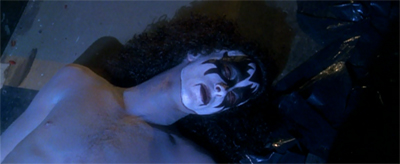
There are a lot of details that would seem to weigh against … Thirteen Years Later. It is the show’s first attempt at comedy since Darin Morgan left the staff at the end of the second season; any episode will suffer in comparison to Jose Chung’s “Doomsday Defense” or Somehow, Satan Got Behind Me. It is an episode built around a guest appearance from the rock band KISS to promote the release of their latest album, Psycho Circus. It is also an attempt to do wry self-aware meta-commentary and Hollywood satire, which could easily become indulgent.

KISS was 'ere...

KISS was ‘ere…

To be quite frank, … Thirteen Years Later doesn’t really work. It is messy and convoluted. A lot of the gags are obvious, and a lot of its satire of Hollywood feels somewhat stock. The framing device builds to a pretty lame (and entirely predictable) punchline. Some of the best gags in … Thirteen Years Later are shamelessly poached from better second season episodes – the idea of Frank Black in Hawaiian shirt comes from Jose Chung’s “Doomsday Defense” while the idea of Frank Black critiquing serial killer movies was hilarious in Midnight of the Century.

However, in spite of all that, … Thirteen Years Later has an energy and momentum that is sorely missing from much of the season around it. The third season has seen a return to the mood and aesthetic of the first season, which occasionally wallowed in gloom and self-importance. … Thirteen Years Later completely skewers that sense of self-importance. Its best jokes seem to be affectionate jabs at Millennium itself, demonstrating that the show still has a great sense of humour; even if it has gotten quite effective at hiding it.

The camera never lies...

The camera never lies…

Continue reading

John Rozum and Alex Saviuk/Charles Adlard/Gordon Purcell’s Run on The X-Files (Topps) (Review)

This May and June, we’re taking a trip back in time to review the fifth season of The X-Files and the second season of Millennium.

It is amazing to think that Topps’ licensed comic book tie-in to The X-Files lasted three-and-a-half years, let alone that it was such a success that it spawned a second on-going series, a miniseries and a considerable volume of one-shots and digests and annuals. If anything, Topps enjoyed greater success exploiting the license than even IDW has – despite the fact that Topps was a relatively young company with minimal experience in comic book publishing while IDW has a reputation for (and a lot of experience at) skilfully leveraging these sorts of tie-in properties.

This success would be remarkable in any context, but the comic book succeeded at a time of turmoil for the entire comic book industry. The late nineties were not a good time for comics, with the speculation bubble imploding and Marvel filing for bankruptcy. The success of Topps’ X-Files comic book is in many way a triumph of the brand, yet another reminder of how the series was on top of the world. There were lots of others – the ratings, the film, the tie-in video game – but the success of the comic was part of the narrative of The X-Files at this stage of its life.

xfiles-remotecontrol10

The comics themselves are actually surprisingly good. There is a reason that one of the first things that IDW did upon receiving the license was to publish “classic” collections of these comics. One of the more interesting aspects of the monthly series was the way that it managed to feel like The X-Files while still seeming suited to the medium in question. Stefan Petrucha and Charles Adlard pitched their run as something akin to a Vertigo comic, feeling like a crossover between The X-Files and the work of Grant Morrison or Neil Gaiman.

The influences on John Rozum’s run are a lot less ambitious. Time and time again, Rozum seems to position his run on The X-Files as a rather strange hybrid between the first season of the television series and pulpy fifties horror comics. There are quite a few stories in Rozum’s run that might easily be read alongside Fantagraphics’ E.C. Comics archives, albeit guest starring Mulder and Scully. (And modern fashions. And phones. And so on.) It is a perfectly reasonable and legitimate way to approach the idea of “X-Files comic books.”

xfiles-beprepared3

Indeed, it seems especially reasonable given the existing tensions between Ten Thirteen and Topps over the comics. The relationship had been fraught since the early days of the comic, with Ten Thirteen objecting to both Petrucha’s dense and ambitious plotting and Adlard’s moody and atmospheric art. Petrucha was fired from the title after sixteen issues, while Adlard was phased out in favour of better likeness artists like Gordon Purcell or Alex Saviuk. Ten Thirteen wanted a safer and more conventional comic book under Rozum’s pen, and they got it.

While it is easy to understand why these creative decisions were made, it does not make them any more palatable. Rozum’s work on The X-Files is generally quite consistent and occasionally even impressive. But it seldom seems ambitious or exciting. Under Petrucha, the tie-in comic carved out its own space that intersected with the parent show. Under Rozum, the comic book seems to do nothing but skirt the margins.

xfiles-cropduster2

Continue reading

Non-Review Review: The X-Files – Fight the Future

The X-Files: Fight the Future is often described as the mythology episode that somehow got released into theatres. In her review, Joyce Millman teased that Fight the Future was little more than “a two-hour episode of the show, except with better production values and a nicer wardrobe for Scully.” It is a fair point. It is not too hard to imagine a slightly cheaper version of Fight the Future split into two parts and replacing The End and The Beginning as the two-parter bridging the fifth and sixth seasons of the show.

Certainly, Fight the Future retains the late-stage mythology’s reluctance to provide any real sense of closure to the long-running plot about alien invasion and colonisation. Writers Chris Carter and Frank Spotnitz increase the stakes by using some of that sweet blockbuster money to pay for a gestating alien fetus, but what do Mulder and Scully actually accomplish? What would a viewer jumping from The End to The Beginning miss, except for the fact that the Well-Manicured Man has left the mortal plane to visit that great Somerset estate in the sky?

What you've all been waiting for, admit it...

What you’ve all been waiting for, admit it…

The answer is nothing, but that is not the point. As much as Fight the Future enjoys playing with the trappings of the mythology (black oil! bees! tanker trucks! space ships! Oklahoma City!), the film is only interested in the idea of alien colonisation as a vehicle to explore the show’s central relationship. Carter and Spotnitz have shrewdly realised that Fight the Future will have the largest possible audience for the show, and has decided to give the general public what they want.

As a two-hour mythology episode, Fight the Future leaves a lot to be desired. As a two-hour Mulder and Scully ship tease, it is right on the money.

Buried secrets...

Buried secrets…

Continue reading

Millennium – A Room With No View (Review)

This May and June, we’re taking a trip back in time to review the fifth season of The X-Files and the second season of Millennium.

“This is how it will all end,” Jose Chung idly speculated half-way through Jose Chung’s “Doomsday Defense.” He advised Frank that the end of the world will not begin “with floods, earthquakes, falling comets or gigantic crabs roaming the earth. No, doomsday will start simply out of indifference.” He may have been correct. It is one thing to kill a person; it is quite another to destroy their spirit, hollowing out the shell before slotting them comfortably back into a functioning society.

A Room With No View plays Chung’s observation and plays it straight. Well, mostly – there is something darkly comical about Landon’s reaction to discovering that he is being abducted into Oregon. Appropriately enough, Lucy Butler’s hideout in Hood County is relatively close to the town of Boring, Oregon. A Room With No View is a bleak and cynical piece of work, an existential apocalyptic horror story perfectly suited to Millennium. It is an episode that would seem strange or unusual in any circumstances, but fits quite comfortably here.

Here's Lucy!

Here’s Lucy!

On paper, A Room With No View could easily seem cynical or exploitative. It is the story about a sadistic kidnapper who abducts teenagers to torture and sexually abuse them in a dungeon. The basic plot elements of A Room With No View come from the pop culture serial killer playbook, to the point where it is not too hard to image the episode as a trashy instalment of CSI or Criminal Minds or – truth be told – the first season of this show. In basic structure, A Room With No View could seem as crude as Wide Open or Weeds or Loin Like a Hunting Flame.

However, it is the execution of A Room With No View that marks as a genuine classic. For all that the episode trades in the stock tropes of serial killer fiction, it is doing something unique and provocative with them. Writer Ken Horton and director Thomas J. Wright construct a potent allegory for abuse and under-achievement, a haunting horror story that is all the more unsettling for its refusal to conform to audience expectations for a story like this.

Blue is not always the warmest colour...

Blue is not always the warmest colour…

Continue reading