• Following Us

  • Categories

  • Check out the Archives


  • Awards & Nominations

75. Amadeus (#82)

Hosted by Andrew Quinn and Darren Mooney, and this week with special guest Phil Bagnall, The 250 is a trip through some of the best (and worst) movies ever made, as voted for by Internet Movie Database Users. New episodes are released Saturdays at 6pm GMT, with the occasional weekend off.

This time, Miloš Forman’s Amadeus.

Following a failed suicide attempt, ageing composer Antonio Salieri is consigned to psychiatric institution while babbling incoherently. When a young priest comes to visit, Salieri offers an account of his life. In particular, he elaborates upon a confession that he made on the night that he tried to take his life, that he murdered an illustrious young rival by the name of Wolfgang Amadeus Mozart.

At time of recording, it was ranked the 82nd best movie of all time on the Internet Movie Database.

Continue reading

Star Trek: Voyager – Blink of an Eye (Review)

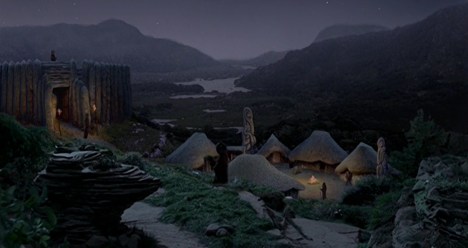
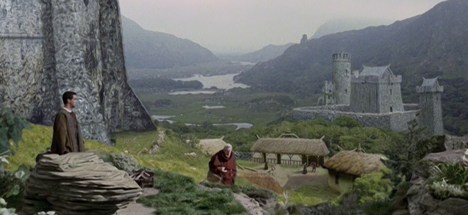
Blink of an Eye is perhaps the last truly great episode of Star Trek: Voyager.

There are good episodes that follow Blink of an Eye. There are solid comedy episodes like Renaissance Man. There are effective homage episodes like Author, Author. There are even well-constructed archetypal narratives that fit within the thematic framework of both the series and the franchise like Memorial. However, there isn’t a single episode as elegant as Blink of an Eye, a story which demonstrates the raw potential of Voyager as a narrative engine for telling these big and broad science-fiction narratives.
From the mountains of faith…

Indeed, it might even be possible to argue that Blink of an Eye is the last truly great episode of Berman era Star Trek.

There is a tendency to overlook Star Trek: Enterprise in discussions of the franchise’s history and legacy, no matter how quietly influential the prequel series has become in terms of Star Trek Beyond or Star Trek: Discovery. This does a disservice to the last series of the Berman era, particularly the final two seasons that grappled with the question of what it means to be Star Trek in the aftermath of 9/11. Nevertheless, the trauma of 9/11 exerted such a gravity that even the best episodes of Enterprise seemed to exist in its shadow; Judgment, Cogenitor, The Forgotten, Babel One, United.
… through the valley of fear…

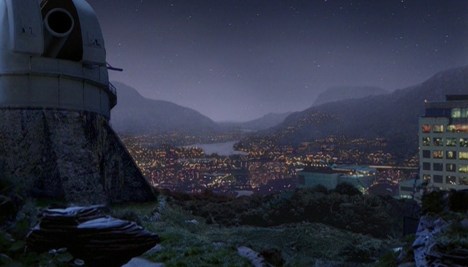
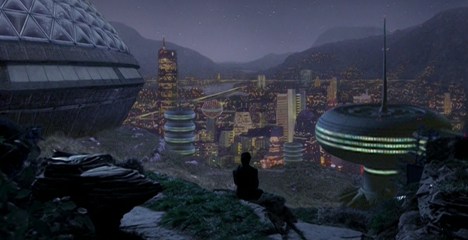
Even outside of hyperbole, Blink of an Eye is a beautifully constructed piece of television that speaks to the appeal and the potential of Star Trek. It is a lyrical allegory, a very simple and straightforward idea that is constructed in such a way as to invite the audience to ask profound and meaningful questions about the nature of human existence. What is it like to watch a civilisation rise up? What ideals drive it? Towards what values and ideals might it strive? More than that, what is it like to sit outside of time and watch those beholden to time? These are fascinating and enlightening ideas.

Blink of an Eye was developed from a story by Voyager writer Michael Taylor, one of the most ambitious writers to ever work on the series. Taylor had contributed the stories that would develop into The Visitor and In the Pale Moonlight, demonstrating a willingness to think outside the box. On Voyager, Taylor’s ambitions were frequently tempered and his scripts often compromised. Both Once Upon a Time and The Fight were much more generic and mediocre pieces of television than the original premise. Blink of an Eye is a rare Taylor concept that doesn’t feel watered down.
…. But the river is wide
And it’s too hard to cross…

It helps that the teleplay for Blink of an Eye was written by Star Trek veteran Joe Menosky. Menosky had a long association with the franchise and a deep understanding of how it worked, having cut his teeth on Star Trek: The Next Generation and Star Trek: Deep Space Nine. More than any other writer, Menosky understood the idea of Star Trek as a mythic framework, an avenue for exploring stories and what they mean. This theme plays through Menosky’s work on the franchise; Darmok, Masks, Dramatis Personae, Muse.

Blink of an Eye feels like an episode perfectly callibrated to the strengths of Taylor and Menosky, a high-concept episode that is fundamentally about the Star Trek mythos.
We all end in the ocean
We all start in the streams
We’re all carried along
By the river of dreams.

Continue reading

70. Barry Lyndon – St. Patrick’s Day 2018, w/ When Irish Eyes Are Watching (#225)

Hosted by Andrew Quinn and Darren Mooney, The 250 is a fortnightly trip through some of the best (and worst) movies ever made, as voted for by Internet Movie Database Users. New episodes are released Saturdays at 6pm GMT.

This week, a special crossover episode with When Irish Eyes Are Watching, an Irish film podcast wherein Alex, Clíona and Séan take at a look at films connected to the Emerald Isle.

The 250 and When Irish Eyes Are Watching are crossing over for a St. Patrick’s Day treat. Stanley Kubrick’s Barry Lyndon.

Barry Lyndon is the epic story of the eponymous character, a dashing Irish rogue who seems to bumble his way through the eighteenth century. Using nothing but his wits, Barry manages to manipulate his way to the fame and fortune that he so covets, only to discover a fortune won is not so easily kept.

At time of recording, it was ranked the 225th best movie of all time on the Internet Movie Database.

Continue reading

Non-Review Review: Dawson City – Frozen Time

This film was seen as part of the Audi Dublin International Film Festival 2018.

In 1978, the city of Dawson was demolishing an old ice rink to make room for a new recreational centre. During the demolition, the construction crews stumbled on something remarkable. Reels and canisters of films buried in the old swimming book, sealed away and forgotten about. This was a treasure trove for cinema historians, the unearthing of a collection that included films that had been presumed lost to history. It represented a tangible and literal connection to the rich history of cinema and – through that – to the history of American popular culture.

Bill Morrison’s Dawson City: Frozen Time is a documentary looking at this archeological discovery, but it is also so much more. Using footage taken from the recovered films, and from other contemporaneous materials, Morrison takes the audience on a trip through the cultural history of the eponymous settlement, from its origins at the end of the nineteenth century through to the unearthing of these nitrate film reels in the late seventies. The result is a beautiful and compelling exhumation of something much more than those invaluable and long-considered lost silent films.

Morrison weaves a fascinating and compelling narrative that seems to tie all of this together into a convincing and expansive social history. The result is a documentary with startling ambition and scope, in some ways reflecting the approach taken by those earliest of settlers panning for gold in the Yukon territory. Dawson City follows both the social evolution of the settlement and occasionally digresses to follow some of its most important inhabitants. Some of these digressions introduce players who will return to the narrative later in the film, both others suggest a broader social context for the film.

Dawson City is occasionally just a little bit too unfocused for its own good, casting its net just a little bit too wide to bring everything back together for an otherwise satisfying finale. Nevertheless, Dawson City is a powerful ode to a community and to cinematic history, one with big ideas and provocative insights.

Continue reading

Non-Review Review: Black ’47

This film was seen as part of the Audi Dublin International Film Festival 2018.

Black ’47 is a powerful piece of pulp storytelling, a bold and daring window into an under-served chapter of Irish history.

Directed by Lance Daly, working from a story derived by a variety of writers, Black ’47 is essentially a western set against the background of the Irish Famine. Of course, the reality is much more nuanced than that simple description would suggest, but it provides a suitable starting point for discussion. Indeed, all the genre elements are in place; a soldier returns home from war to discover the horrors that have befallen his family, and decides that there shall be no justice on earth save for that which he might exact by his own hand.

Black ’47 is a very sparse and rugged film. It would be a surprise if the nominal lead character, Feeney, speaks more than one hundred words. Indeed, at one point he explicitly rejects the English language as a tool of communication. The landscape of the film is rough and cold, the audience feeling the chill that runs through the film and almost smelling the decay in the air. Black ’47 reflects its rough and wild settings, and the characters who have been shaped and moulded by those surroundings.

Black ’47 is an effective piece of storytelling.

Continue reading

New Podcast! Primitive Culture #19 – Star Trek: Voyager, History and Nostalgia

Over the Christmas Break, I had the pleasure of sitting down with the wonderful Duncan Barrett and talking about Star Trek: Voyager. Duncan is a historian, and I’ve had the pleasure of quoting some of his work on the blog in the past. He hosts Primitive Culture, with Tony Black and Clara Cook, a show wherein the hosts discuss certain historical-related items of interest in the Star Trek canon.

Duncan was in Ireland for part of the break, and so we took the opportunity to have a sit down to talk about the unique approach that Voyager had to the ideas of history and nostalgia within the Star Trek canon, how it viewed both the past and the future. We particularly focused on episodes like Distant Origin and Living Witness, along with a broad discussion of particular themes. It was a fun discussion, and you can listen to it below or directly via Primitive Culture‘s homepage on trek.fm.

Star Trek: Voyager – 11:59 (Review)

The thing about experiments is that they don’t always work, but that doesn’t mean they should never be attempted.

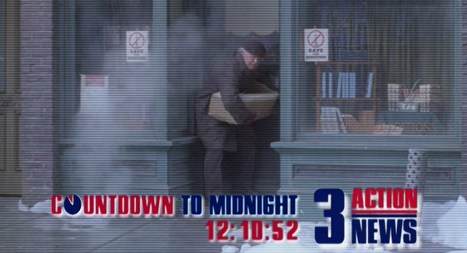
Much like Someone to Watch Over Me, 11:59 represents a new departure for Star Trek: Voyager. It is an episode unlike any other episode in the run of series, unfolding primarily on early twenty-first (or, as one character wryly points out, maybe late twentieth) century Earth. As with Someone to Watch Over Me, there is a sense that 11:59‘s closest spiritual companion is an episode of Star Trek: Deep Space Nine. There are any number of superficial similarities between 11:59 and Far Beyond the Stars, another time-travel-to-close-to-modern-day-Earth-episode-without-the-time-travel.

Countdown.

Sadly, the experiment does not quite work out. Someone to Watch Over Me is one of the most charming episodes in the seven-season run of Voyager, while 11:59 is more than a little dull. Far Beyond the Stars is one of the most powerful and evocative episodes of Star Trek ever produced, while 11:59 is a competent piece of television that is almost immediately dated. For all that 11:59 represents a bold departure for Voyager, there is a sense that the episode has very little to actually say. It exists, but it never seems to exist for a particular reason. 11:59 is a frustrating piece of television.

However, none of this matters too much. Voyager has been such a safe and conservative show that any creative risk feels worthwhile, that any departure from the established template feels worth of celebration on those terms alone. 11:59 is an unsuccessful experiment, but it is an experiment nonetheless. For a series as risk-adverse as Voyager, that is remarkable.

“Time’s up.”

Continue reading

Star Trek: Deep Space Nine – ‘Til Death Do Us Part (Review)

Perhaps more than any other Star Trek show, Star Trek: Deep Space Nine is an epic.

Sure, Star Trek: Voyager has more than a few characteristics of epic storytelling; it is a mythic journey, much like The Odyssey and The Iliad before it. In fact, several episodes of Voyager borrow quite heavily from those earliest of stories, with Favourite Son feature a planet for of sirens and Bliss finding the crew confronted with the deep space equivalent of lotus eaters. However, the storytelling on Voyager was always too small and too episodic to embrace the potential for a sprawling galactic epic.

Wedded bliss.

In contrast Deep Space Nine is a story with a lot of breadth. Of course, there are any number of isolated and standalone episodes within the seven-year run of Deep Space Nine, but there is also a strong sense that these one-hundred-and-seventy-plus episodes of television can be taken together and fashioned into a single cohesive narrative that runs from Emissary through to What You Leave Behind. There are undoubtedly bumps and inconsistencies along the way, strange shifts in direction and sharp left turns, but the series hangs together relatively well as a single narrative.

This is particularly true when it comes to the final ten episode of the series, which are very much intended to draw down the curtain on seven years of storytelling, while reinforcing the sense that this has truly been an epic narrative.

Feels like coming home…

Continue reading

Star Trek: Voyager – Dark Frontier, Part I (Review)

The fifth season of Star Trek: Voyager arrives at a point when the Rick Berman era of the Star Trek franchise has hit its midlife crisis.

Star Trek: Deep Space Nine is coming to an end, bring down the curtain on a seven-year period where there were always two franchise series boldly going simultaneously. Star Trek: Insurrection had been released into cinemas as a snapshot of that midlife crisis, where Michael Piller’s last script for the franchise found the cast of Star Trek: The Next Generation desperately chasing their own youth and vitality on a planet with a fountain of youth.

Seven gets back in touch with her roots.

On the fifth season of Voyager, it seemed like the show turned inwards. The scripts for the fifth season are surprisingly retro and nostalgic in tone; Janeway’s reflections on the events of Caretaker in Night, the return of the Maquis and the Cardassians in Nothing Human, the indulgence of retro thirties sci-fi in Bride of Chaotica!, Tuvok’s childhood flashbacks in Gravity, the “telepathic pitcher plant” in Bliss, Seven’s trip back to the launch of Voyager in Relativity, Janeway’s investigation of her ancestor in 11:59.

However, there was a fundamental problem with all of this introspection. Voyager was a television series that had long struggled to define a unique identity, too often feeling like a half-hearted reheat of the leftovers from The Next Generation. It was very hard to turn the focus inwards when there wasn’t a lot unique or distinctive about Voyager. This is a show that was much closer to its end than to its beginning, and it still lacked any true sense of identity or self.

There’s coffee… I mean transwarp coils in that there Borg Sphere.

Dark Frontier, Part I and Dark Frontier, Part II serve as an example of this nostalgic indulgence, both in form and plot. It is a two-parter consciously designed to recapture the success of broadcasting The Killing Game, Part I and The Killing Game, Part II on the same night in the late fourth season. It is also a television movie that is very clearly patterned off the story for Star Trek: First Contact, borrowing key story beats and clear characters from that memorable Next Generation film.

However, Dark Frontier, Part I and Dark Frontier, Part II also demonstrate the shallowness of Voyager‘s own internal memory. This is a story built around an act of narrative archeology within the larger Star Trek universe, touching on the secret history of humanity’s true first encounter of the Borg. However, that history is ultimately illusory, built around what feels like a misremembrance of one of the franchise’s most iconic alien species. As Voyager turns its gaze backwards, it discovers that it has no real history.

Drone warfare.

Continue reading

Star Trek: Voyager – Living Witness (Review)

Living Witness is a fantastic piece of television, and a great example of what Star Trek: Voyager does best.

Living Witness is in many ways archetypal Star Trek, a story that uses the franchise framework to construct a powerful allegorical story that comments upon contemporary anxiety. It is a story that could easily have been told on any of the other franchise series, especially Star Trek: The Next Generation or Star Trek: Enterprise, but it is a story told well. Living Witness is one of the highlights of the fourth season, and one of the strongest episodes from the seven-season run.

Command and conquer.

In many ways, Living Witness is the culmination of themes and ideas that have been bubbling through Voyager from the outset. Some of these elements are less than flattering, with the episode’s racial politics evoking the clumsiness with which the Kazon were handled. However, there is also a fascination with idea of history and how history functions in a world rooted in postmodernism and recnstruction. At the end of history, is the past up for grabs? Are facts anything more than pieces to be manoeuvred on a political chessboard?

Given this archetypal quality of Living Witness, how it reflects the themes and pet interests of Voyager, there is some irony in the fact that the episode does not actually feature a single regular character from Voyager. The regular cast appear as holographic representations of themselves, exaggerations and distortions. When the EMH appears almost half-way through the episode, he is explicitly identified as “a back-up programme”, and thus distinct from the version of the EMH who will appear in Demon or One.

Core principles.

In some ways, Living Witness confirms one of the more interesting aspects of Voyager, the fact that the characters are themselves largely irrelevant to the show and that the series is much more compelling as a framework to explore archetypal ideas. Living Witness is just one of several episodes that treat the regular characters as a secondary aspect of the show, almost as guest stars who have crossed over into a completely different series. Living Witness is very much of a piece with stories like Distant Origin or Course: Oblivion, or even Muse or Live Fast and Prosper.

Living Witness is a story about the thin line between history and mythology. In doing so, it consciously reframes Voyager as a story within a story, as concept more powerful as an archetype than as a material object. Living Witness images the ship and its crew as history elevated to mythology.

Any which Janeway but loose.

Continue reading