• Following Us

  • Categories

  • Check out the Archives


  • Awards & Nominations

Non-Review Review: Unbroken

The true story of Louis Zamperini is absolutely fascinating. It lends itself to this sort of big spectacle. It has everything you need for a movie that might clean up during awards season: a historical setting; a war; a sporting story about triumph of adversity; incredible physical transformations from the cast; a character enduring incredible hardship and coming out the other side. These are the sorts of ingredients that make a Best Picture contender. Unbroken just heaps more and more on top of these already alluring elements.

It isn’t the terrible and messy script that ultimately defeats Unbroken, with beloved filmmakers Joel and Ethan Cohen at the top of the bill. It isn’t the pedestrian unchallenging direction, either. It isn’t Alexandre Desplat’s condescending and patronising score, that doesn’t trust the audience to determine what they should be feeling from one moment to the next. It is not even the cynical Coldplay song playing over the closing credits, to put a pleasant life-affirming spin on events.

The Oscar race is on...

The Oscar race is on…

The detail that really shatter Unbroken is the fact that all of this has been very carefully and meticulously calibrated to check off the requisite items on the big Oscar check list. Unbroken is just as mechanical and lifeless a production as Transformers 4, but it happens to be built for a different purpose. There is no energy here, no enthusiasm, no emotion. It is just a bunch of things that have been successful in other stories heaped on top of one another, hoping to hit the high score on that fateful morning in January 2015.

Despite managing to eat up an incredible amount of attention and discussion in the larger Oscar race – taking attention off far more deserving contenders – Unbroken is a complete and utter misfire.
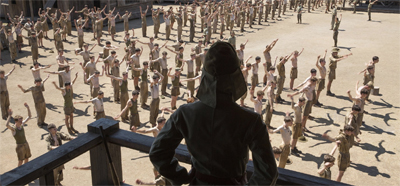
"This is what happens to anybody who suggests Merry Christmas Mister Lawrence is a better Japanese prisoner of war film."

“This is what happens to anybody who suggests Merry Christmas Mister Lawrence is a better Japanese prisoner of war film.”

Continue reading

Non-Review Review: The Hobbit – Battle of the Five Armies

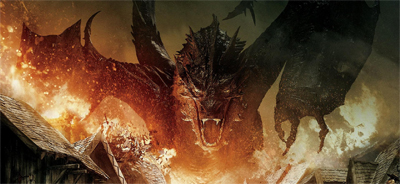
It has become a stock criticism to suggest that Peter Jackson did not need a full trilogy to adapt The Hobbit for the big screen. That said, The Hobbit: The Desolation of Smaug was an unexpected pleasure – a movie not all hindered by the pacing concerns of the trilogy and instead interested in its own central narrative. You could cut the opening scene from The Hobbit: Battle of the Five Armies onto the end of The Desolation of Smaug and you would have pretty much everything that you need.

While this approach benefited The Desolation of Smaug, it puts Battle of the Five Armies at something of a disadvantage. It is debatable whether there was enough material to support three full films based on The Hobbit – even drawing from other sources in the Tolkien canon – but this is clearly not the best way of structuring those three films. There is a sense that Battle of the Five Armies suffers from the decision to extend the planned duology into a full-blown trilogy.

The not-so-magic dragon...

The not-so-magic dragon…

To be fair to Peter Jackson, he does avoid the ending issues that haunted The Lord of the Rings: The Return of the King. However, he does that by editing Battle of the Five Armies as a brief epilogue to the previous two films, following by a massive battle sequence. This is quite impressive from a technical standpoint, but there is a sense of fatigue to it all. As the title implies, this is a five-way battle involving thousands of participants; both organic and computer-generated. A lot gets lost in the shuffle, and the plot – as it stands – could be explained in two sentences.

More than that, Battle of the Five Armies is hindered by its status as a prequel. The fact that everybody in the audience has likely seen The Lord of the Rings: The Fellowship of the Ring means that they know all this spectacle is really for nothing. The first two films in the trilogy largely avoided the problem by pitching the story as a working-class version of The Lord of the Rings, allowing characters to engage in quests that are deeply personal even as they ripple to larger events.

A messed-up character orc...

A messed-up character orc…

Continue reading

Non-Review Review: Foxcatcher

Foxcatcher is exhausting.

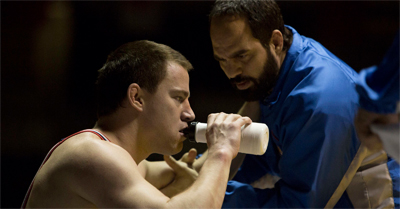
Director Bennett Miller’s account of the relationship between billionaire John “Eagle” DuPont and the Schultz brothers is a draining experience. Beautiful performances, stunning cinematography and a minimalist script create an uncomfortable and looming sense of dread. Even those unfamiliar with the story DuPont’s sponsorship of the United States Olympic Wrestling Team cannot help but feel tragedy bearing down. Foxcatcher is a heartbreaking and harrowing piece of work, an affecting and unsettling tale of power, desperation and loneliness.

Wrestling with demons...

Wrestling with demons…

Foxcatcher is beautifully crafted. Every element of the production is carefully and meticulously put together. Steve Carell transforms himself to play the role of DuPont, assisted by superb make-up overseen by Bill Corso and his team. Every frame of the movie looks crisp, the blues and reds and yellows popping out of the screen; Greig Fraser’s cinematography effectively captures the starkness of the Pennsylvanian landscape across the seasons. Miller is comfortable enough to let Foxcatcher unfold at its own pace, never rushing.

The result is a compelling and grimly fascinating story, told elegantly. There are points when Foxcatcher perhaps seems a little too distant and clinical, but the three lead performances help to keep the film firmly grounded.

To catch a fox...

To catch a fox…

Continue reading

Watch! Terminator Genisys Trailer!

Well, I guess Dawn of the Planet of the Apes demonstrated that Jason Clarke is the guy you go to for your post-apocalyptic franchise films.

To be fair, Terminator films not directed by James Cameron feel like a risky proposition – it feels like so much of the first two films was tied up in Cameron, that any subsequent attempt is imitation rather than innovation. It is, perhaps, quite telling that the most surreal sequences in the new trailer for Terminator: Genisys featured a version of the T-1000 not played by Robert Patrick.

And, nevertheless, there is something interesting here. A story about how time travel has muddled and muddied a narrative universe so much that the story seems to reboot and remix itself feels like a self-aware take on the contemporary fascination with reworking and retooling classic franchises. Terminator: Genisys looks like a self-aware cocktail of the most iconic bits and pieces of the first two Terminator films.

That self-awareness could be the key; after all, trying to mimic James Cameron feels like a fool’s errand. However, a more playful approach just might work. Terminator: Genisys probably has an uphill battle ahead of it, but this trailer’s not a bad start.

Non-Review Review: The Penguins of Madagascar

The Penguins of Madagascar is solid family entertainment. It does not rank among the best of Dreamworks’ animated output, nor among the year’s best animated films. However it is a fun adventure movie that moves along at just the right pace – allowing a number of action set-pieces and a solid cast carry most of the weight. The Penguins of Madagascar is fun and solid; it is arguably more fun and more solid than any of the three Madagascar movies that spawned this spin-off.

The Penguins of Madagascar is just what the doctor ordered with the holiday season approaching. It is a film that makes for a solid family diversion, a movie that will appeal to kids without pandering too heavily, and will acknowledge the adults in the audience without losing focus. It is an enjoyable romp, one that delivers almost perfectly on what it sets out to do. It isn’t transcendental or brilliant in the way that The Lego Movie was, but it is more than merely functional.

Cheesy? Sure.

Cheesy? Sure.

Continue reading

Non-Review Review: Woman in Black – Angel of Death

Horror sequels are notoriously difficult beasts. Much like comedy sequels, there’s the inevitable conflict between what the audience wants and what the audience has seen before. If you plan on replicating the jump scares too faithfully, why not watch the original? If you want to do something fresh, why bother sticking the name on the front? It is an interesting challenge facing film makers, and it’s something that shows. It is very hard to think of a horror sequel that competes on the same level as the original, let alone surpasses it.

Woman in Black: Angel of Death finds itself stuck in that trap. The original Woman in Black was very much a classic Hammer Horror film, a movie more about suggestion and scale than blood and guts. Never afraid to reinforce a jump scare with an orchestra string section, there was something quite endearing and old-fashioned about the way that Woman in Black conducted itself. It was an affectionate throwback to a style of horror largely forgotten in this day and age.

"Gee... I wonder what could possibly be in this creepy basement at this hour of the night..."

“Gee… I wonder what could possibly be in this creepy basement at this hour of the night…”

Given the success of Woman in Black, a sequel was inevitable. However, Angel of Death faces a lot of the issues that tend to plague horror sequels – cast attrition, a sense of familiarity, a sense that most of the best tricks have already been used. To be fair, Angel of Death holds itself together reasonably well for its first two acts. There are creaky moments, and a sense that the movie is trying to hit too many familiar notes. However, the script comes off the rails in the third act, as the film stops trying to imitate its predecessor and attempts to offer something new.

Sadly, the third act simply doesn’t work, bouncing between an air field and a supernatural hostage crisis. The result is that Angel of Death collapses in on itself – leading to the sense that this is a rather disappointing sequel.

Sadly, Chris deBurgh has yet to provide a theme song for the series. Maybe next time?

Sadly, Chris deBurgh has yet to provide a theme song for the series. Maybe next time?

Continue reading

Non-Review Review: Whiplash

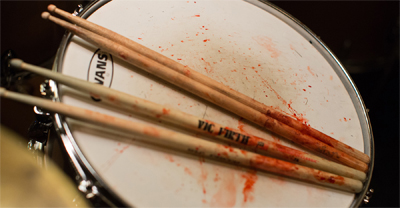
The joy of Whiplash is in how the film subverts so many of the conventions of the “unconventional teacher pushes promising young student” subgenre. A one-sentence plot summary for the film suggest an inspirational and life-affirming tale. Andrew heads to a prestigious music school to hone his skills on the drums, and encounters an obnoxious and confrontational teacher who pushed him to his limits. One can already hear the applause, see the inevitable hug, feel the radiating mutual respect.

Whiplash carefully and meticulously subverts these expectations, avoiding many of the familiar plot beats that one might expect from a story like this. There’s a raw, gruelling honesty to the story – Whiplash is not a story calibrated or tailored to make the audience feel particularly comfortable or happy. Indeed, it addresses its central themes with a refreshing candidness. It asks some very tough questions about honing talent and the responsibilities of a teacher. It doesn’t offer any easy answers.

Anchored in two compelling central performances and a beautiful soundtrack, Whiplash builds to a beautifully cathartic climax, one that refuses to wrap too tight a bow around an intriguing little film.

Stick around...

Stick around…

Continue reading

Non-Review Review: The Babadook

Monsters are real.

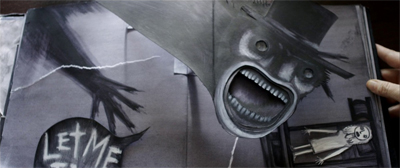
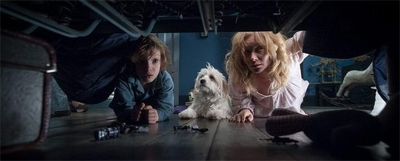
We all have our own monsters that we keep with us over our lives. “You can’t get rid of the Babadook,” a mysterious storybook threatens early in the runtime of The Babadook. Young Samuel tries to warn his mother Amelia about the monster lurking in the dark spaces – under the bed, in the closet, in the corner of his eye. He offers one rather sage bit of advice when it comes to such creatures. “You have to let it in.”

thebabadook1

Writer and director Jennifer Kent has crafted a superlative creature feature with The Babadook, acknowledging the metaphorical nature of monsters. These strange nightmares tend to stand in as expressions of guilt or anxiety. They give expression to thoughts and fear we could never properly articulate. The Babadook teases its audience with questions about the reality of the eponymous creature.

Is the strange “Mr. Babadook” something that truly exists, or is it something Samuel (and maybe Amelia) have created to cope with a horrific trauma?

thebabadook2 Continue reading

Non-Review Review: Fury

Fury is an apocalyptic glimpse of warfare.

Unfolding in the last days of the Second World War, as Allied forces pour into Germany from all sides, there’s a sense that this is the end. This is the abyss. As the introductory text explained, Hitler had declared a doctrine of “total war” against these invading forces. Every man woman and child was to be mobilised against the advancing armies, in the hope that it might somehow slow down the Allied war machine. If you throw enough people at it, you might do some damage – even if it is just clogging the gears.

He will strike down with Fury-ous anger...

He will strike down with Fury-ous anger…

A movie about a tank crew enduring these last few days, Fury gets considerable mileage out of that image – of human flesh falling before the unstoppable and inevitable machine. At a couple of points in the movie, characters die with their faces quite literally down in the mud. At other points, bodies are crushed beneath the tracks of the eponymous vehicle. Towards the climax, we encounter a body so thoroughly squashed beneath the weight of the Allied advanced that it seems like an empty uniform.

Fury is at its best when it captures the sheer unrelenting terror and horror of the advancing war machine – the nihilism of fighting a war that has already been decided, and the bleak inevitability of large-scale slaughter.

Fog of war...

Fog of war…

Continue reading

Non-Review Review: Nightcrawler

Nightcrawler features a tour de force performance from Jake Gyllenhaal.

Gyllenhaal plays Louie (“call me Lou”) Bloom, a wandering and lost soul who stalks late-night Los Angeles in search of a lucrative pay-day. He is just trying to get his foot on the ladder any way that an entrepreneurial young gentleman can – he’s introduced stealing construction supplies and scrap metal so he can sell them on, seguing effortlessly into a well-rehearsed job pitch applying for an unpaid internship.

nightcrawler

Bloom seems like a man who has watched people from a distance for years, almost through a filter. Gyllenhaal injects a haunting eccentricity into the character, his wide eyes and practised stillness almost edging Bloom into the uncanny valley. Though he seems to always know just what to say, there’s something distinctly inhuman about Lou Bloom. He watches people, but from the outside. He has got a pretty passable impersonation of a human being down, but there’s just something missing.

Nightcrawler is a fascinating, harrow and occasional wry look at desperation and ruthlessness – and the heady cocktail they make when blended together.

nightcrawler1

Continue reading