• Following Us

  • Categories

  • Check out the Archives


  • Awards & Nominations

Non-Review Review: Searching…

Searching… is an interesting fusion. It blends the innovative narrative style of Unfriended with the more convention cinematic language of thrillers like Kiss the Girls.

This cocktail is at once welcome and overdue. Unfriended was one of those rare genuinely innovative pieces of mainstream cinema; in form, if not necessarily in function. Unfriended built from a premise that was both incredibly simple and also formally daring, telling a fairly standard supernatural teenage revenge story entirely through a computer desktop. As with Searching…, all of Unfriended unfolded within a computer screen.

Windows ’95 into the soul…

In hindsight, it is surprising that it has taken other genres so long to embrace that formal experiment. Cinema has a long history of eagerly coopting the language and experiments of horror for more prestigious and high-brow fare. Consider, for example, how quickly other genres coopted the “found footage” revolution of the early twenty-first century for action movies, thrillers, comedies, and even monster movies and superhero films. (Then again, that embrace of the “found footage” aesthetic may have caught on for reasons beyond the success of The Blair Witch Project.)

Searching… takes the basic formal conceit of Unfriended and applies it to a more conventional genre film. The result is an abduction thriller told exclusively through screens, through video streams, search histories, web cameras and screenshots. It’s a provocative premise, effectively turning the bigger screen into a smaller one and changing the rules of how the audience processes the imagery in front of them. However, Searching… clearly aspires to bridge the gap between screens big and small.
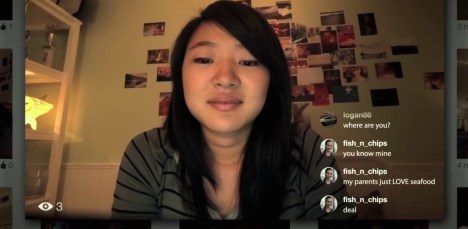
She needs to screen her fans better.

Continue reading

Non-Review Review: Skyscraper

Hollywood never really gives up on a genre that it loves, even when it might appear that the audience has moved on.

The perpetual reinvention of the western is one example, a genre that is constantly updated in terms of style and substance to reflect the times. The western has been reinvented and reimagined countless times over the past few decades, whether by combining it with other genres or by examining its underlying assumptions. The western survives in movies like The Hateful EightThe RevenantBone Tomahawk; films that are very clearly westerns even if audiences from the genre’s peak would struggle to recognise them.

Hanging on in there.

Disaster films are another example of Hollywood’s perpetual reinvention of a genre that has fallen out of style. While by no means as ubiquitous as they once were, disaster films still pop up from time to time. The attempts to update the disaster film often take the form of hybridisation, of tying the trappings of the genre into a more marketable template. In the nineties, Independence Day cleverly wed the disaster movie to an alien invasion narrative. More recently, Patriots’ Day tied the structure and rhythms of the disaster movie into a counter-terrorism epic.

Skyscraper hits upon what might be the ultimate genre fusion for the disaster movie template. At the very least, it feels like an inevitable hybrid in the modern cinematic climate. At its core, Skyscraper essentially asks… “what if a disaster movie, but also a superhero film?

The bed Rock of a stable marriage.

Continue reading

Non-Review Review: The Secret of Marrowbone

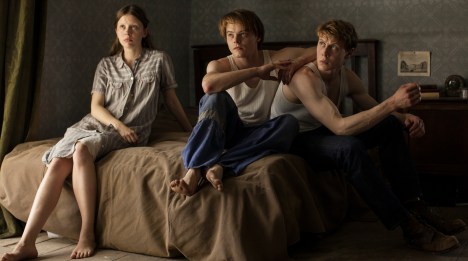
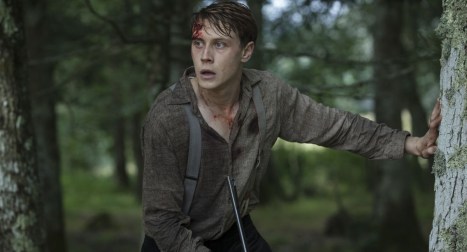
The Secret of Marrowbone is an interesting premise, albeit one told in the clumsiest manner possible.

The basic story is sound. The film has all the trappings of a gothic eastern seaboard horror, even borrowing several of its cues from the work of Edgar Allan Poe. There is a secretive family living in a rundown house, with a dark secret involving betrayal and violence. The central family, with the delightfully gothic name of “Marrowbone” have journeyed from England to the United States in the hope of a clean break, a fresh start. “No more memories,” the characters repeatedly assure one another. However, this is a ghost story. What are ghost stories but stories about memory?

Putting their secrets to bed.

However, the execution is severely underwhelming. The Secret of Marrowbone is a film with an incredibly tonal dissonance. Writer and director Sergio G. Sánchez veers wildly from gothic Jungian horror to exaggerated fifties melodrama and back again, the whiplash heightened by Fernando Velázquez’s heavy-handed score and Xavi Giménez’s inconsitantly saturated cinematography. The Secret of Marrowbone is half a semi-competent horror movie and half an overwrought trashy soap opera, neither element meshing cleanly with the other.

The result is dizzying and disorienting, but probably not in the way that Sánchez intended.

All Jacked up with nowhere to go.

Continue reading

Luke Cage – The Creator (Review)

Luke Cage has always been engaged with The Godfather.

This was obvious even during the first season. Outside of dialogue accepting The Godfather, Part II as “the sequel better than the original” in Step in the Arena, the portrayal of the Stokes family in flashback owed a lot to Francis Ford Coppola’s generation crime saga. Indeed the sequences of the Stokes family gathered around the family table, unaware of the chaos that would rain down upon them, evokes the closing flashback of The Godfather, Part II. It is an image rich with irony, bringing the tragedy something of a full circle.

This point of comparison makes a great deal of sense. The Godfather is a story about a minority community in America, trying to exist both inside and outside the law. It is an archetypal American fairy tale, one of the great cynical meditations on the American Dream. (After all, the opening line of The Godfather is “I believe in America.”) This fits neatly with what Luke Cage is, an exploration of a particularly distinct subculture within contemporary America that explores the sometimes tumultuous relationship that this community has with the law and with political structures.

The second season of Luke Cage commits to this idea even further, its narrative borrowing liberally from The Godfather and The Godfather, Part II in crafting a generational superhero crime epic.

Continue reading

Non-Review Review: Whitney

Celebrity documentaries can be tricky.

There are so many forces that pull narratives in so many directions; the attempts by those in the celebrity’s orbit to shift the story in order to favour their account of events, the yearning for a tabloid sensationalism to feed the impulses of the public, the difficulty separating personality from persona, and the fact that deceased celebrities cannot speak for themselves. Whitney has to contend with all of these challenges in its attempts to construct a portrait of one of the most vocal artists of the twentieth century.

Director Kevin MacDonald does a remarkably job in structuring his account of the troubled singer’s life and times, of capturing what it was that made Whitney Houston such a compelling figure for so long in the public consciousness, and the forces that contributed to her rise and her eventual implosion. Working with interviews of friends and family, and drawing from a variety of interviews both public and candid, MacDonald manages to sketch an outline of an intriguing figure and to explore a deeply harrowing story of fame and self-destruction.

Whitney is a deeply moving, sincerely soulful and truly heartbreaking piece of documentary cinema.

Continue reading

New Podcast! Scannain Podcast (2018) #19!

We’re continuing to work through a bit of a backlog on the Scannain podcast, this time jumping back in to cover the last week in May.

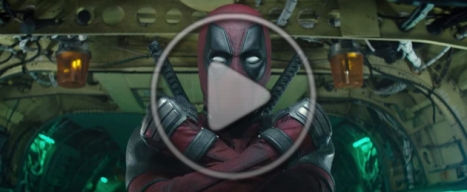
This week, I’m joining Luke Dunne from Film in Dublin, Ronan Doyle, Jay Coyle and Grace Duffy. It’s a free-form and rambling conversation, with topics including the secret screening of Citizen Jane at the IFI to mark the upcoming Irish abortion referendum, the receipt of career Oscars in competitive categories, the Netflix release of Cargo, the absurdity of building horror shared universes, and the act of fridging in Deadpool 2.

The podcast also contains what might be the best segue in the history of podcasting, and new releases include The Breadwinner, Solo: A Star Wars Story and the surprisingly controversial Show Dogs.

Give it a listen at the link, or check it out below.

New Podcast! Scannain Podcast (2018) #18!

We’re working through a bit of a backlog on the Scannain podcast, so expect a number of entries publishing today.

This week, I join Alex Towers and Graham Day to discuss a week of film news and new releases that include Deadpool 2, Filmworker and On Chesil Beach. Give it a listen at the link, or check it out below.

Non-Review Review: Tag

Tag is a charming comedy that largely coasts off star charisma and a surprisingly heartwarming premise.

The plot is a compelling hook of itself. Inspired by a true story, Tag is the tale of a bunch of male friends who take one month out of every year in order to participate in a game of tag. This game has been going, on and off, for the better part of three decades. As the players get older, the pranks get more elaborate – the ruses, the feints, the misdirections, the ambushes. However, throughout the movie, the characters repeatedly stress that the game has also kept them together and in one another’s lives.

Touching.

This is a familiar set-up. It is the stuff of “overgrown manchildren” comedy, the tale of adult (and often even middle-aged) men who have the emotional maturity of children. Stepbrothers is perhaps the gold standard of the increasingly common comedy subgenre, which arguably includes films as diverse as Old School, Bad Neighbours and Knocked Up. Even indie comedies have gotten in on the act with movies like The Skeleton Twins, Cyrus or Adult Beginners.

While not strong enough or smart enough to rank with the best examples of the genre, Tag flirts with something resembling self-awareness. The movie is just cognisant enough of its underlying immaturity to keep the audience onside. Tag also benefits from a strange bittersweet quality, its joyous celebration of hypermasculine friendship gently flavoured with something resembling melancholy. It’s never entirely clear how much of that melancholy is intentional, but it permeates and enriches the film.

Renner, Renner.

Continue reading

Non-Review Review: Escape Plan 2

Escape Plan was a rather disappointing exercise.

The first Escape Plan had a hell of a hook entirely separate to its central plot. Escape Plan brought together eighties action movie icons Sylvester Stallone and Arnold Schwarzenegger for the first time as equals; not one cameoing in the other’s movie, not a sly wink or a nod, but as leads in an action movie together. This was the b-movie equivalent to Heat, an opportunity to watch two titans square off against one another inside the framework of a vaguely defined science-fiction b-movie. The results were underwhelming, the film feeling too late and self-indulgent.

Escapes and scowls.

Escape Plan 2 is just a bad movie.

Escape Plan 2 seems to assume that the appeal of the original Escape Plan was not in its combination of two iconic action stars collaborating as equals, instead suggesting that the audience for the original Escape Plan was really there for the reheated prison movie clichés that had been handled much better in other movies. And so Escape Plan 2 drops Schwarzenegger for an even more complicated escape from an even more complicated prison. This feels like a fundamental misunderstanding of what the audience wanted. An unsatisfying prison movie without the Stallone/Schwarzenegger team is just an unsatisfying prison movie.

It’s all going according to plan.

Continue reading

85. Forrest Gump (#12)

Hosted by Andrew Quinn and Darren Mooney, The 250 is a (mostly) weekly trip through some of the best (and worst) movies ever made, as voted for by Internet Movie Database Users. New episodes are released every Saturday at 6pm GMT, with the occasional bonus episode thrown in.

This time, Robert Zemeckis’ Forrest Gump.

Forrest Gump is an unremarkable man who has lived the most remarkable of lives, a feather caught in the breeze of history. From his childhood in Mississippi through the turbulence of the sixties and seventies, Forrest Gump lives a life that intersects repeatedly with the biggest moments of the twentieth century, having a profound and unspoken effect upon the course of history.

At time of recording, it was ranked the 12th best movie of all time on the Internet Movie Database.

Continue reading