• Following Us

  • Categories

  • Check out the Archives


  • Awards & Nominations

Non-Review Review: Cinderella (2015)

This film was seen as part of the Jameson Dublin International Film Festival 2015.

Kenneth Branagh’s Cinderella is probably the safest and most down-the-middle live action remake of a classic Disney cartoon. It is not as heavily stylised or esoteric as Tim Burton’s Alice in Wonderland, but it is also not as deeply flawed as Maleficent. If anything, Cinderella suffers from a lack of its own identity or energy. It is a well-made and functional film that avoids any truly significant problems, but it also lacks any real edge that might help it stand out.

Cinderella looks lovely. Dante Ferretti’s production design and Sandy Powell’s costume designs are breathtakingly beautiful. Branagh’s direction is clean and crispy, avoiding excessive clutter and trusting the story to tell itself. The cast are great – with Cate Blanchett and Helena Bonham Carter doing wonderful work. Even the script does exactly what it needs to do, walking the line between traditional and self-aware with considerable grace. Cinderella does pretty much everything that you would expect a live action adaptation to do.
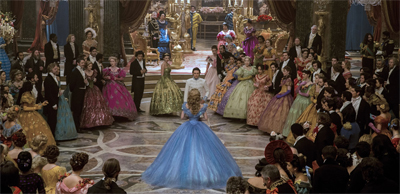
cinderella2

At the same time, it lacks any real sense of cinematic ambition. It is nowhere near as iconoclastic as Alice in Wonderland or as ambitious as Maleficent. This isn’t necessarily a bad thing – Alice in Wonderland attracted a lot of criticism for playing more as a Tim Burton movie than an Alice in Wonderland film, while Maleficent tripped over itself in its attempts to re-write the classing story of Sleeping Beauty as a feminist parable. Cinderella‘s problems are much less severe, but its accomplishments are also less noteworthy.

The result is probably the most solid and reliable live adaptation of a classic Disney cartoon, albeit one that never seems to have any real ambition or verve.
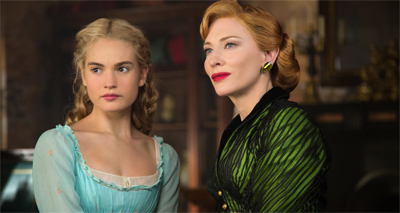
cinderella

Continue reading

Star Trek – Friday’s Child (Review)

The first Star Trek pilot, The Cage, was produced in 1964. To celebrate its fiftieth anniversary, this December we are reviewing the second season of the original Star Trek show. You can check out our first season reviews here. Check back daily for the latest review.

Errand of Mercy was a highlight of the first season. A wry script from producer Gene L. Coon introduced the Klingons as an antagonist for the Federation. Made up to look like space!Mongols, the Klingon Empire was presented as an imperial force hell-bent on expanding its sphere of influence. In case the parallels were a little too subtle, they were locked in a Cold War with the Federation. As such, they were the perfect stand-ins for Communist aggressors trying to undermine American foreign policy.

Of course, Errand of Mercy was brutally cynical in its depiction of the Federation. The episode suggested quite heavily that the Federation was just as imperialist and adversarial as the Klingons. They might couch their foreign policy in friendly language and polite overtures, but their end goals are quite similar. Smaller political entities are nothing but pieces shuffled around a board in a deadly game of chess. Errand of Mercy was not flattering in its portrayal of Kirk, presenting him as little more than a warmonger.

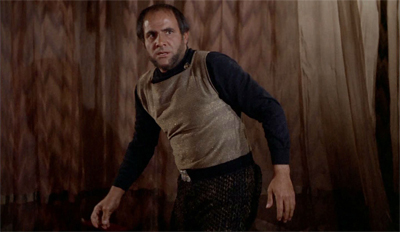
"Damn dirty Klingon!"

“Damn dirty Klingon!”

Errand of Mercy was a massive success. It remains a fan favourite to this day. In some respects, that is due to the introduction of the Klingons, but it is also an exceptional hour of scripted science fiction. So it makes sense that the show would return to the Klingons when it was renewed for a second season. Friday’s Child was the third episode produced during the second season, and returns to quite a few themes hit on by Errand of Mercy. Those themes would recur.

Friday’s Child demonstrates the obvious risks of an episode like Errand of Mercy. It’s an episode that essentially takes the “Klingons as space!Communists” seriously.

We come in peace...

We come in peace…

Continue reading

Star Trek: Voyager – Prime Factors (Review)

This September and October, we’re taking a look at the jam-packed 1994 to 1995 season of Star Trek, including Star Trek: Deep Space Nine and Star Trek: Voyager. Check back daily for the latest review.

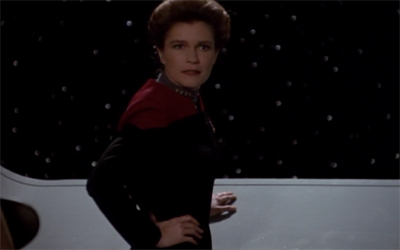
Prime Factors has some great ideas, but blunders awkwardly in the execution. In that respect, it genuinely feels like a first season episode of a new show in the same way that The Cloud did – there’s a sense that the series is trying to expand its own comfort zone in a way that offers potential for future storytelling opportunities. Prime Factors might make a few pretty serious missteps along the way, and often seems a little too timid to commit to its bolder ideas directly, but at least it feels more ambitious than Time and Again or Ex Post Facto.

Make way for Janeway...

Make way for Janeway…

Continue reading

Non-Review Review: Maleficent

As portrayed in the classic 1959 version of Sleeping Beauty, Maleficent is an absolutely fascinating character. Like so much in that film, she is woefully under-developed, but brilliant character design by Marc Davis and sterling voice work from Eleanor Audley helped to fashion an iconic characters. In spite (or perhaps because) of the fact that Sleeping Beauty establishes so little about her, Maleficent endures one of the most recognisable and memorable characters in the Disney animated canon.

So, if a live-action villain-centric feature film was going to tackle one of the classic villains from the studio’s rich history, it makes sense that Maleficent would be chosen. Angelina Jolie seems almost born to play the role, carrying herself with a regal grace, an icy detachment, an impeccable sense of comic timing and spot-on vocal impersonation of Eleanor Audley. The production design on Maleficent is absolutely stunning, with the movie occasionally seeming like an animated classic brought to life.

If only the same amount of enthusiasm had been invested in the script.

All fired up...

All fired up…

Continue reading

Non-Review Review: Maleficent

As portrayed in the classic 1959 version of Sleeping Beauty, Maleficent is an absolutely fascinating character. Like so much in that film, she is woefully under-developed, but brilliant character design by Marc Davis and sterling voice work from Eleanor Audley helped to fashion an iconic characters. In spite (or perhaps because) of the fact that Sleeping Beauty establishes so little about her, Maleficent endures one of the most recognisable and memorable characters in the Disney animated canon.

So, if a live-action villain-centric feature film was going to tackle one of the classic villains from the studio’s rich history, it makes sense that Maleficent would be chosen. Angelina Jolie seems almost born to play the role, carrying herself with a regal grace, an icy detachment, an impeccable sense of comic timing and spot-on vocal impersonation of Eleanor Audley. The production design on Maleficent is absolutely stunning, with the movie occasionally seeming like an animated classic brought to life.

If only the same amount of enthusiasm had been invested in the script.

All fired up...

All fired up…

Continue reading

Non-Review Review: Sleeping Beauty (1959)

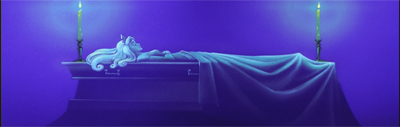
Sleeping Beauty is very much a product of the fifties, with the movie’s production spanning most of the decade. The story work commenced in 1951, with vocal performances recorded the following year. The movie was eventually released in 1959, to lukewarm critical and commercial success.

However, Sleeping Beauty reflects the fifties in other ways. The story about a young woman who needs to learn to do as her guardians instruct her, how marriage is really the ideal prospect for a woman of sixteen, and about how people we label as “evil” are unquestionably beyond redemption, Sleeping Beauty really plays to a very fifties mindset.

(Appropriately enough, the high budget and lacklustre box office performance of Sleeping Beauty would be a major part of the reason that Walt Disney would post its first annual loss in 1960.)

Sleep well...

Sleep well…

Continue reading

Star Trek: Deep Space Nine – Progress (Review)

Star Trek: Deep Space Nine is twenty years old this year. To celebrate, I’m taking a look at the first season. Check back daily for the latest review or retrospective.

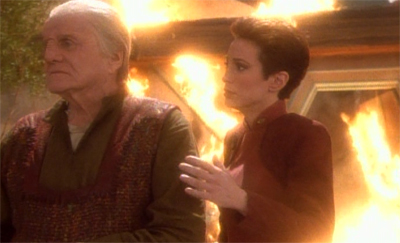
Progress is the best episode of Star Trek: Deep Space Nine‘s first season to date. Of course, there are better episodes ahead – two of them clustered at the end of the show’s truncated first year – but Progress still represents a considerable improvement over anything that has come before. It isn’t quite perfect, but it does have a nice character focus and takes advantage of the show’s unique perspective and position. It’s evidence that the writing staff were at least engaging with the show’s status quo and trying to work with it to tell interesting stories, with Progress offering an early pure example of what Deep Space Nine story should probably look like.

While the first season has been quite bumpy (although notably less bumpy than any of the opening seasons of the other three Star Trek spin-offs), Progress offers a demonstration that we are getting somewhere. The title might apply as much to the status of the show itself as to the themes of the episode.

Burning down the house...

Burning down the house…

Continue reading

Paul Cornell’s Run on Batman & Robin – The Sum of Her Parts (Review)

To celebrate the release of The Dark Knight Rises, July is “Batman month” here at the m0vie blog. Check back daily for comics, movies and television reviews and discussion of the Caped Crusader.

Today we’re taking a look at three of the authors who followed Grant Morrison’s groundbreaking Batman & Robin run. We’ll start with Paul Cornell.

I’m going to be entirely honest here. I am very disappointed that Paul Cornell hasn’t really got a shot at an on-going Batman book. The author has been something of a rising star at DC comics for what seems like years, and recently provided the best Superman run in recent memory with his wonderful Lex Luthor story in Action Comics. He’s a writer who is astutely aware of the genre conventions, while being shrewd enough to exploit them to his advantage. He writes distinctly “comic book!” comic books, but without following the standard plot patterns just for the sake of adhering to formula. His three-issue Batman & Robin fill-in arc might not be his best work, or the best work on the title, but I do admire Cornell’s willingness to provide a compelling criticism of the Batman mythos instead of merely offering a generic paint-by-numbers treading-water adventure. Even if it doesn’t quite stick the landing, Cornell’s story is certainly ambitious.

Drilling it into them…

Continue reading

Non-Review Review: Scream 4 (Scre4m)

Alright, Kirby, then it’s time for your last chance. Name the remake of the groundbreaking horror movie in which the vill…

Halloween, uh, Texas Chainsaw, Dawn of the Dead, The Hills Have Eyes, Amityville Horror, uh, Last House on the Left, Friday the 13th, A Nightmare On Elm Street, My Bloody Valentine, When A Stranger Calls, Prom Night, Black Christmas, House of Wax, The Fog, Piranha. It’s one of those, right? Right?

(beat)

I got it right. I was &@#!ing right.

– Ghostface and Kirby redefine the frame of reference

In many ways, Scream 4 feels like a fitting end to the Scream franchise. In fact, it feels like it has come something of a full circle from the first film, which was envisaged as something of an obituary for the dying slasher genre. In the years since, prompted in a large part by the success of the original Scream, the genre has been resurrected. Watching the grind of horror films released, it seems that Hollywood has been churning out nothing but empty roman-numeral-denoted sequels and hallow remakes, with very little thought or creativity. Scream 4 feels a like a reflection on the “success” that the first film wrought, and actually feelings like a fitting closing act.

It's going viral...

Continue reading

Non-Review Review: Alien

I had the pleasure of attending of the Jameson Cult Film Club’s screening of Ridley Scott’s 1979 Alien. It was a great evening for all concerned, and it was great to see a classic film like that projected on a huge screen, blasted out of a superb sound system. The screening seemed to coincide with the build-up to the release of next year’s Prometheus, a sci-fi thriller from Ridley Scott with “strands of Alien DNA”, but Scott’s film is one of those rare pieces of cinema that continues to give, even thirty years after the original release. It’s rare to point to a film that seems to offer new nuance and depth on each viewing, especially within the horror genre. Alien is a movie that’s absolutely fascinating in its complexity.

A bad egg…

Continue reading