• Following Us

  • Categories

  • Check out the Archives


  • Awards & Nominations

Star Trek: Voyager – Dark Frontier, Part II (Review)

Star Trek: Voyager has a morbid fascination with the Borg. Quite literally.

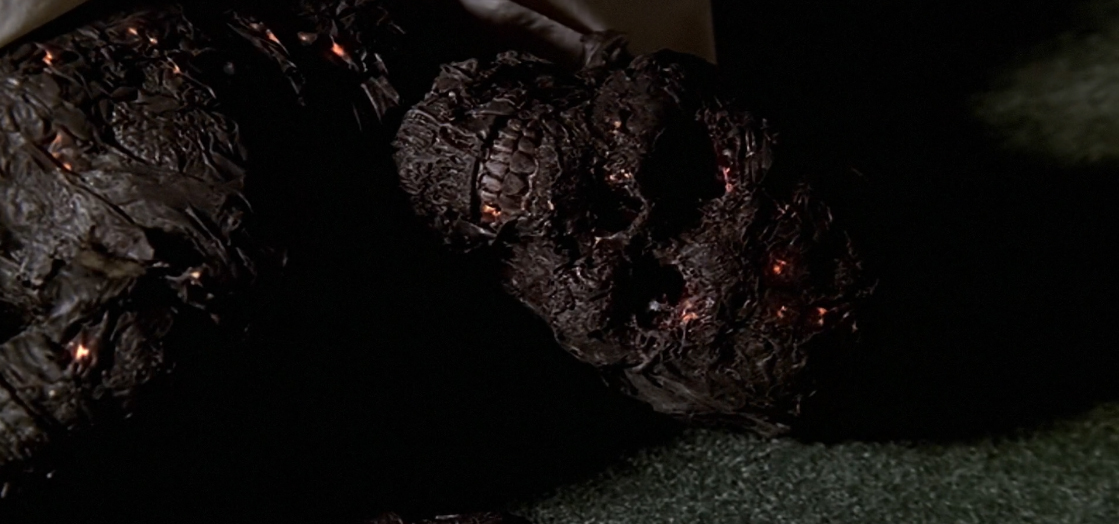
Time and time again, the series returns to the image of the Borg dead and dying. Blood Fever ends with the discovery of a Borg corpse. Unity features the extended autopsy of that corpse. In Scorpion, Part I, Kes is haunted by the image of a grotesque mound of Borg drones, torn apart and reassembled. In Unimatrix Zero, Part I, the Borg Queen tears the heads off her drones and mounts them on spikes. There is a very similar image in Dark Frontier, Part I, where Janeway wanders casually through the wreckage of a Borg ship.

Queen of minds.

Star Trek: The Next Generation worked hard to establish the Borg as a credible threat. If the Borg were associated with death, it was only because they delivered something akin to it. In The Neutral Zone, the Borg scooped an entire outpost off the surface of a planet. In Q Who?, Picard had to literally beg Q to save the Enterprise after the loss of eighteen crewmembers. In The Best of Both Worlds, Part I and The Best of Both Worlds, Part II, the Borg tore through the Federation like it was made of tissue paper. The trauma of that invasion informed Emissary.

In contrast, Voyager seems preoccupied with the destruction and desecration of the Borg Collective. This is an interesting creative choice on a number of levels. Most obviously, it severely undercuts the menace and threat posed by the Borg Collective. Janeway seems to travel through the Delta Quadrant leaving a trail of broken Borg bodies in her wake. It is hard to believe that the Borg are a big deal, when Janeway seems to decorate her ship with their remains. The Kazon, the Vidians and the Hirogen have all taken Voyager at some point. The Borg have never.
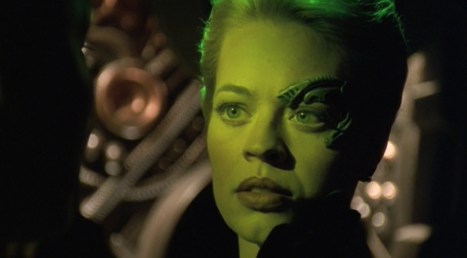
Green light for reassimilation.

Perhaps this fascination with Borg corpses and remains simply speaks to their visual aesthetic. With their pale skin and their lack of individual identity, the Borg have always evoked the walking dead; Star Trek: First Contact was essentially a zombie movie in deep space. However, perhaps this desecration of the Borg speaks to something buried deeper within the psyche of Voyager. The Borg are perhaps the most iconic aliens of the Berman era; they represent the moment that The Next Generation came into its own. Perhaps their decay mirrors that of the Berman era itself.

Dark Frontier, Part I and Dark Frontier, Part II represent something of a final frontier for the Borg Collective. While the Borg had been in decline for some time, Dark Frontier, Part I and Dark Frontier, Part II marked a point of no return. Regeneration is an underrated return to form for the iconic cyborgs, but it is too little and too late. Dark Frontier, Part I and Dark Frontier, Part II is effectively a funeral for the most iconic adversaries of the Berman era. However, they would remain shuffling lifeless for another two-and-a-half seasons.
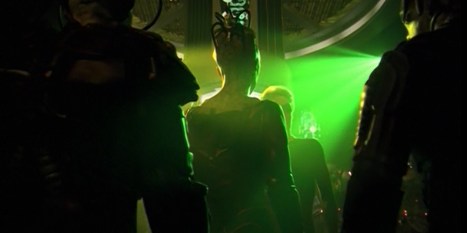
Subject to change.

Continue reading

Star Trek: Voyager – Real Life (Review)

Real Life is in some ways a departure for Star Trek: Voyager.

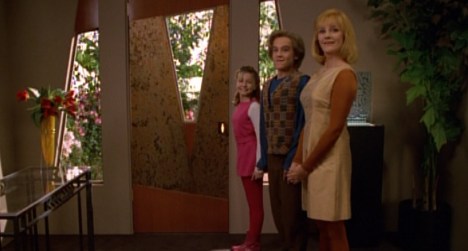
That much is obvious from the teaser, which introduces three new characters on a new set. More than that, the three characters comprise a nuclear family and the set is built to resemble the stereotypical American family home. It is a very strange image, even before the characters begin talking like they escaped from The Brady Bunch. In what might be the best teaser of the entire third season, it is revealed that the EMH has fashioned himself a holographic family and is “commuting” to work in sickbay from the holodeck.

Projections.

Projections.

It is certainly an interesting idea, one that consciously brushes up against the kinds of limitations and expectations that Voyager has faced. It feels experimental, quite removed from the broader third season attempts to position Voyager as the most generic of the Star Trek spin-offs. This does not look or feel like any other episode in the franchise’s history. Indeed, with its focus on family dynamics and conflict, it feels like an extension of Ronald D. Moore’s work on episodes like Family and Doctor Bashir, I Presume.

This makes the episode’s failure to follow through on any of that potential even more disappointing. The third season of Voyager has dramatically scaled down its ambition following the spectacular misfires of the second season. The show is no longer attempting to create long-form stories or introduce iconic new recurring alien species, instead setting more modest goals for itself. There is something disheartening in seeing Voyager set more modest challenges for itself in episodes like Macrocosm or Fair Trade, only to spectacularly bungle the handling of those challenges.

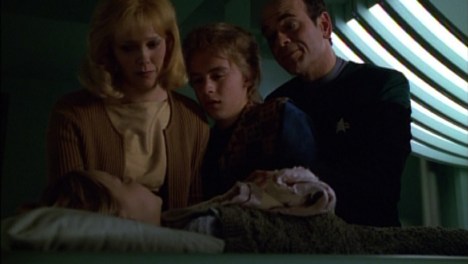
Family matters.

Family matters.

Real Life is another example of the trend. The premise is interesting, and the episode hits on any number of intriguing ideas. There is a great story to be told using this premise, exploring core themes about the human condition in a way that is quite different from the normal storytelling on Voyager. However, the episode flirts with the premise and then balks at it. Real Life is terrified of the implications of its story, padding out the plot with an unnecessary techno-babble-laden diversion and casually discarding the holographic family at the end of the script.

Real Life is an underwhelming story, rendered all the more disappointing for the promise that it squanders.

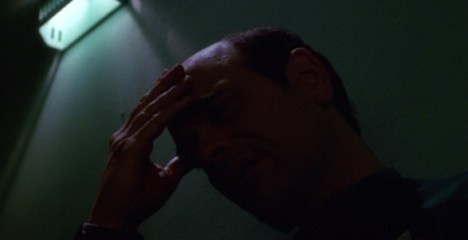
Photon father.

Photon father.

Continue reading

Star Trek: Deep Space Nine – Indiscretion (Review)

This February and March, we’re taking a look at the 1995 to 1996 season of Star Trek, including Star Trek: Deep Space Nine and Star Trek: Voyager. Check back daily Tuesday through Friday for the latest review.

Much like Hippocratic Oath before it, Indiscretion serves to set the baseline of quality for the fourth season of Star Trek: Deep Space Nine. While The Way of the Warrior and The Visitor were ambitious deviations from form, Hippocratic Oath and Indiscretion offer a much clearer vision of what the show will look like from this point forward. As with Hippocratic Oath, a heavy two-hander a-plot is paired with a lighter b-plot that explores the day-to-day life on the eponymous space station, a structure that allows for world-building with sacrificing momentum.

Indiscretion works very well on its own terms. It throws together two of the show’s more fascinating a well-defined characters, putting Major Kira and Gul Dukat on a road trip from hell that inevitably throws them headfirst into conflict with one another. Watching Nana Visitor and Marc Alaimo interact is worth the price of admission alone, and Indiscretion throws a fairly heated personal conflict into the mix to create some tense and compelling drama. Indiscretion works very well as forty-five minutes of television.

Road trip!

Road trip!

However, it also works quite well as an exercise in setting up a longer game. As with most of the episodes that end up rippling through the continuity of Deep Space Nine, it is hard to be sure if the writers knew exactly where they wanted to go with the plot threads stemming from this instalment. Some of the difficulties dealing with the episode’s biggest legacy suggest that more thought might have gone into it. Nevertheless, Indiscretion is an episode that is clearly written with one eye on the future of the show.

As much as it stands on its own two feet, the episode is clearly written with a view to drama that it might enable further down the line. It is a story that seems to be written so that its consequences might fuel further storytelling opportunity. Deep Space Nine had toyed with the idea of serialised storytelling before, but this marks the point where the show just rolls up its sleeves and jumps right on in.

"You know, I think she likes me."

“You know, I think she likes me.”

Continue reading

Non-Review Review: Joy

Joy is very much a showcase for David O. Russell’s interests, and his excesses.

Russell is a filmmaker with a particular sensibility in style. This is particularly obvious in the way that the director feels continuously drawn to the same performers and themes. As with many of Russell’s films, the cast of Joy is populated by actors who have worked with the director before. This is most apparent in the casting of Russell’s current creative ruse Jennifer Lawrence, who worked with Russell on Silver Linings Playbook and American Hustle. She is joined by Russell veterans like Bradley Cooper and Robert DeNiro.

Could the domestic cleaning industry use a shot in the arm?

Could the domestic cleaning industry use a shot in the arm?

Similarly, the film plays to Russell’s particular fascinations; Joy ties together the director’s engagement with Americana and his exploration of dysfunctional family dynamics. Joy places these two themes front-and-centre, but never quite synthesises them into a convincing whole. All too often, it feels like Joy is far more interested in the discordant home life of its female protagonist than all of the historical details it has to weave into her rags-to-riches tale. This causes problems when her journey takes her away from that home, and the film loses interest.

Joy is somewhat overstuffed, its attention wandering as the run-time goes on. For a story about a self-made millionaire whose rags-to-riches success embodies the ideal of the American Dream, Joy often feels quite rote; luxuriating in its depiction of her family life, the movie’s second half feels over extended as it clocks through all the beat expected in a story like this. Its final third is given over to a crisis that feels as obligatory as its resolution is convenient. For a movie about a woman with an ability to see innovation, Joy is trapped by its conventionality.

Talk about a mop top...

Talk about a mop top…

Continue reading

The X-Files – Sunshine Days (Review)

This December, we’re taking a trip back in time to review the ninth season of The X-Files.

Well, here’s hopin’ the TV stays off and he learns how to love the real world.

– Doggett stops just short of adding “… and that goes for you as well.”

The X-Files was always a more romantic show than it would readily admit.

The popular image of the show might be Mulder and Scully walking through darkness searching for a truth that may never be revealed or a hideous monster preying upon innocent victims. Chris Carter’s most successful work might be rooted in the dual betrayals of Watergate and Vietnam. The characters might stalk car parks late at night or explore the darkest corners of the urban landscape. Mulder and Scully might be abducted by forces beyond their control, and subjected to the cruel whims of uncaring fate. The show’s motto might be “trust no one.”

"Let's call it a day..."

“Let’s call it a day…”

Nevertheless, that cynicism is offset with a deep-seated romance. “Trust no one” is one of the defining mantras of The X-Files, but there are other more optimistic catchphrases; “I want to believe” and “the truth is out there.” Optimism outvotes cynicism by a two-to-one majority. It is not quite a decisive victory, but it is something in this cynical and chaotic world. While Mulder and Scully might never actually find the truth which they so desperately seek, they did find one another. That is more than either could have hoped and than some people can claim.

Sunshine Days is a staggeringly romantic and optimistic piece of television. Indeed, it suggests that the cynicism of The X-Files was really just a practiced veneer. As the title suggests, Sunshine Days allows the central cast to smile more frequently over forty-five minutes than most have in the course of their entire run on the show. As with the rest of the show, Sunshine Days is rooted in the culture of the seventies. However, there is something quite heartwarming in how Vince Gilligan eschews All the President’s Men for The Brady Bunch.

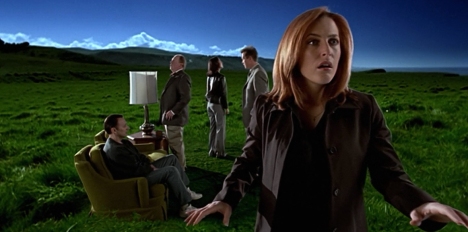
Out of this world...

Out of this world…

Continue reading

The X-Files – Existence (Review)

This October/November, we’re taking a trip back in time to review the eighth season of The X-Files and the first (and only) season of The Lone Gunmen.

This is not the end.

But it really should be. At least for Mulder and Scully.

There was no season nine. What are you talking about?

There was no season nine.
What are you talking about?

Continue reading

The X-Files – Empedocles (Review)

This October/November, we’re taking a trip back in time to review the eighth season of The X-Files and the first (and only) season of The Lone Gunmen.

Empedocles returns to one of the most enduring Ten Thirteen themes: the idea of evil as contagion.

Both The X-Files and Millennium have touched upon this theme. On The X-Files, episodes like Aubrey and Grotesque suggested that evil was something that could be passed from person to person. Despite the fact that Millennium was based around a forensic profiler, Chris Carter described it as a show about “the limits of psychology”; it seemed like evil could often be traced to sinister forces at work in the world. Looking at Ten Thirteen’s output as a whole, it seems that Carter believes wholeheartedly in the idea of evil as an external force.

Man on fire...

Man on fire…

Empedocles offers perhaps the most straightforward example of this recurring theme. Reyes describes the case as “a thread of evil… connecting through time, through men, through opportunity.” It is a narrative thread that connects from the murder of Luke Doggett in New York to a workplace shooting in New Orleans. Evil is at work in the world, in a way that is palpable and discernible. Empedocles is not a subtle episode of television, linking this contagion of evil images of hellfire and burning.

There is undoubtedly something just a little simplistic about all of this. One of the luxuries of conspiracy theory, as The X-Files has repeatedly suggested, is the way that it serves to impose a logical and linear narrative on trauma; to make sense of acts and events that would otherwise suggest a brutally random universe. The mythology running through the first six seasons of the show suggested a conspiracy of powerful men might provide such a nexus of causation, but Empedocles offers something a bit broader.

It burns...

Burn with me.

As with a lot of the eighth season mythology, Empedocles cuts out the middle-man. The eighth season largely eschews the blending of “self” and “other” that run through first seven seasons of the show, largely rejecting the narrative of collaboration and complicity implied by the Syndicate. The eighth season of The X-Files repeatedly suggests that evil is inhuman, presenting its antagonists as distinctly “other” forms that infiltrate and pervert the body in perhaps the purest distillation of the show’s many viral metaphors.

In its own way, Empedocles is just as much a mythology or conspiracy episode as Three Words or Vienen. Like those episodes, Empedocles posits a conspiracy theory based upon the subversion of human identity by something alien and external. Empedocles posits a conspiracy of evil.

Crispy...

Crispy…

Continue reading

Harsh Realm – Manus Domini (Review)

This November, we’re taking a trip back in time to review the seventh season of The X-Files and the first (and only) season of Harsh Realm.

Manus Domini continues the influx of assistance from the writing staff on The X-Files, with John Shiban contributing a script to the first season of Harsh Realm.

Manus Domini is a very strange episode. In a way, it feels more keenly aligned with the sensibilities of Chris Carter than those of John Shiban. It is the most overtly religious episode from the short run of Harsh Realm, with characters contemplating faith and spirituality in an otherwise cruel world. It is the logical continuation of themes seeded and developed across the rest of the season, bringing the religious subtext of the show to the fore so that it might be acknowledged and explored.

Florence in the machine...

Florence in the machine…

To be fair, there are elements that fit comfortably within Shiban’s oeuvre. Shiban is very much a fan of classic horror tropes, so it makes sense that his script should feature a monstrous supporting character whose complete moral decay is symbolised through grotesque facial deformities. (The element recurs in Camera Obscura, but is not as pronounced as it in this episode.) There are elements of Manus Domini that feel like they might have been lifted from classic seventies horror.

Nevertheless, Manus Domini is defined by its religious components, making it clear that the show retains the same core moral perspective that runs through Carter’s work; there is a recurring sense that faith and spirituality are essential to survive and endure in an increasingly faithless world.

A literal mine field...

A literal mine field…

Continue reading

The X-Files – One Son (Review)

This July, we’re taking a trip back in time to review the sixth season of The X-Files and the third (and final) season of Millennium.

Two Fathers and One Son are a mixed bag.

They are very messy and convoluted episodes of television, attempting to resolve a long-running plot without committing to a resolution. They swing wildly between clichéd ambiguity and b-movie exposition. They strain to stitch together half-a-decade of storytelling into a ninety-minute finalé, while trying to avoid drawing attention to any of the countless elements that might contradict or undermine the story that they are telling. They are both ambitious and efficient, energised and noncommittal.

They're here.

They’re here.

At the same time, Two Fathers and One Son make a valiant effort to bring the vast sprawling global conspiracy down to a more manageable level. Over the years, the conspiracy has evolved from a few alien abductions to a vast plot against the majority of mankind. Although they doesn’t always succeed, Two Fathers and One Son try to ground this crazy story about faceless rebels and looming colonisation in the trauma of a single family unit. The fate of mankind plays out against the backdrop of a family collapsing under its own weight.

While it doesn’t work as well as it might, it does help to draw attention to the larger themes that have played out across The X-Files as they relate to power and control, legacy and guilty, abuse and exploitation. It seems appropriate that Two Fathers and One Son should push these ideas to the fore as it attempts to close off the show’s long-running conspiracy thread, reminding viewers of what it was actually talking about.

Baby steps...

Baby steps…

Continue reading

Millennium – Antipas (Review)

This July, we’re taking a trip back in time to review the sixth season of The X-Files and the third (and final) season of Millennium.

Antipas is the second of three scripts written by Chris Carter and Frank Spotnitz over the third season of Millennium. It is also the first of Lucy Butler’s two appearances during the third season, although she has little more than a cameo in Saturn Dreaming of Mercury. This is actually the second time that Chris Carter has written for the character of Lucy Butler, having scripted her début back in Lamentation towards the end of the first season. Antipas feels like a conscious effort to connect back to that first appearance.

To be fair, Lucy Butler has been radically different in each appearance. It is difficult to get a read on the character or to suggest a “definitive” take. Finding the “real” Lucy Butler is as difficult as identifying the “real” Millennium Group or as arbitrary as naming the “real” version of Millennium. That said, there are thematic throughlines. Four of her five appearances are tied into children, for example; the show fairly consistently portrays Lucy as a demonic mother figure in contrast to Frank as a loving father.

Here's Lucy!

Here’s Lucy!

While the idea of Lucy as a creepy mother ties Antipas into A Room With No View just as much as Lamentation, the script seems to hark more firmly back to Lucy’s character motivation in Lamentation than to her scheming in A Room With No View. In Antipas, Lucy is once again obsessed with biological motherhood, trying desperately to conceive – and even to claim another child as her own. In Lamentation, she sought to mother a child with Doctor Ephraim Fabricant; in Antipas, she seems to aspire towards Frank Black.

Along the way, Antipas is packed with fevered dream imagery and uncanny visuals. As with a lot of the episodes around it, Antipas feels like a very odd piece of television. When Carter wrote Lamentation, this oddness was enough of a break from the norm to power an entire episode. Antipas lacks the sort of strong centre that a piece of television like this needs to ground it. The result is an intriguing and unsettling, if not quite compelling and engrossing, episode of television.

A-mazing nanny...

A-mazing nanny…

Continue reading