• Following Us

  • Categories

  • Check out the Archives


  • Awards & Nominations

Millennium – The Pest House (Review)

This May and June, we’re taking a trip back in time to review the fifth season of The X-Files and the second season of Millennium.

Millennium is largely a show about the nature of evil.

It feels a little redundant to point that out more than halfway through the second of three seasons, but it is worth repeating. When Chris Carter created Millennium, he designed the show to explore the many faces of evil in a variety of ways. It could be argued that Millennium was largely spawned from episodes of The X-Files like Irresistible or Grotesque, stories fascinated by very human forms of evil that almost become supernatural. Carter and his writers played with that idea over the course of the first season, particularly in episodes like The Pilot and Lamentation.
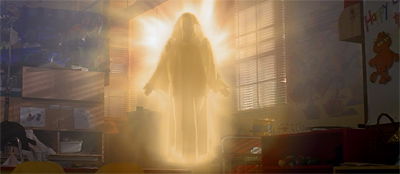
A pointed commentary?

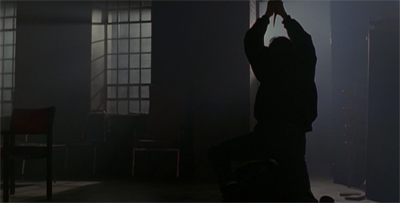
A pointed commentary?

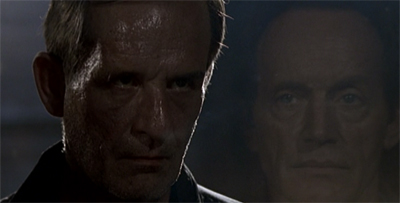
However, Carter was not the guiding visionary for all of Millennium‘s run. He remained involved in the production of the show, but the day-to-day running of the series was handed over to Glen Morgan and James Wong, who immediately reinvented it from the ground up. One of the more interesting aspects of this transition is watching the differences in how the two creative teams approach various aspects of Millennium. In many ways, The Pest House would be read as an exploration and critique of Carter’s approach towards the concept of evil by Morgan and Wong.

Carter’s work seems to suggest that evil is an external and infectious force – a contagion or pathogen that can be passed from one person (or generation) to another. In contrast, Morgan and Wong seem to argue that evil must be rooted in a person, that it must come from inside rather than outside. The Pest House contrasts these two different visions of evil, finding Morgan and Wong playing with the recurring Ten Thirteen trope of evil as a transferable quantity that can be moved and reallocated. And The Pest House seems horrified by such a concept.
A bloody mess...

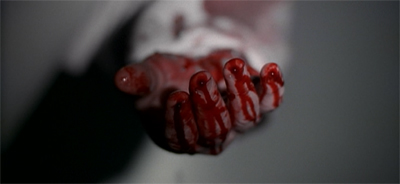
A bloody mess…

Continue reading

Millennium – Monster (Review)

This May and June, we’re taking a trip back in time to review the fifth season of The X-Files and the second season of Millennium.

Monster continues the process of laying the groundwork for the second season of Millennium. Glen Morgan and James Wong had very consciously shaken things up with The Beginning and the End, and the first third of the second season is clearly intended to construct a solid foundation for the rest of the year. Looking at the plot points and character beats from the various episodes, they read almost like a checklist of things to address or introduce before the series can really start moving under its own power again.

Even outside of the dramatic changes wrought by The Beginning and the End, the other episodes in this stretch of the season each have their own purpose. Beware of the Dog introduces us to the Old Man, affectionately riffs on the first season format, and outlines the refactored Millennium Group. In turn, Sense and Antisense riffs on The X-Files and helps to identify areas of overlap with Millennium. A Single Blade of Grass gives Frank back his psychic powers, albeit in a more powerful and abstract form. The Curse of Frank Black is a character-driven vehicle. 19:19 and The Hand of St. Sebastian get well and truly biblical.

Fire and brimstone...

Fire and brimstone…

The most dramatic aspect of Monster is the introduction of the character of Lara Means. Means becomes a pretty vital part of the second season of Millennium, and is introduced in Monster with an eye to her inevitable role in The Time is Now. Means is a vital cog in the workings of the second season, perhaps the most important part of the mythology explicitly created by Morgan and Wong, instead of simply repurposed and reinvented. Means is a fantastic creation, wonderfully brought to life by actor Kristen Cloke and well-realised by Morgan and Wong’s scripting.

However, even outside of the important introduction of Lara Means to Millennium, Monster feels like an episode that exists to set up and outline the larger themes and ideas of the season in a way that foreshadows the larger arc. Like A Single Blade of Grass, it reiterates themes that will become a lot more important as the year goes on. Like Beware of the Dog, it uses the familiar template of a first-season Millennium episode to do this.

I believe in angels...

I believe in angels…

Continue reading

The X-Files – Elegy (Review)

This February and March, we’re taking a trip back in time to review the fourth season of The X-Files and the first season of Millennium.

The first two-thirds of Elegy count as the best episode of The X-Files that John Shiban has written at this point of his tenure on the writing staff. Elegy starts out as an episode that leans into Shiban’s strengths. It is a very traditional and old-fashioned horror story, the first tried-and-tested ghost story that The X-Files has told in a while. The idea of a haunted bowling alley is so wonderfully weird and so quintessentially American that it fits The X-Files perfectly. For its first thirty minutes, Elegy is funereal and sombre, haunting and enchanting.

Elegy is a story packed with potentially interesting concepts. It is overflowing with clever ideas and memorable images. Shiban is a writer who has a great deal of affection for classic horror, and that affection shines through into Elegy. There is a slow and sorrowful atmosphere to the early stretches of the episode. Transparent grey spectres are a staple of the horror genre, but they work very well in this context. The X-Files has been quite reluctant to handle traditional monsters, so there is something rather strange and affecting about seeing such a classic depiction here.

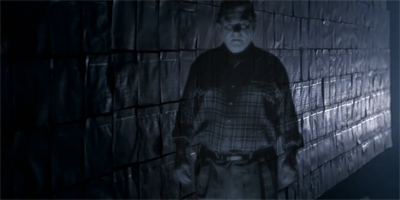
Here there be ghosts...

Here there be ghosts…

Then things go to hell. To be fair, the problems with the last fifteen of Elegy are very much suggested from the start; they are just pushed to the fore. It becomes quite clear that Elegy has no idea how to resolve a “haunted bowling alley” story, so the script hastily and clumsily transitions to an “abusive care home” plot. The first two thirds of Elegy are not that interested in the character of Harold Spuller beyond his use as a plot device; a fact that becomes quite apparent in how the final third callously disposes of him.

Elegy is an episode that brushes against greatness. Its best ideas rank with the highlights of the fourth season. Unfortunately, all of that is undercut by a truly terrible final act.

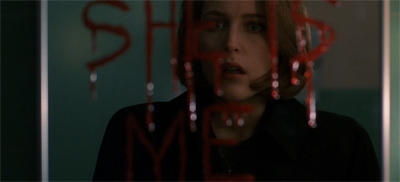
Blood on the mirror...

Blood on the mirror…

Continue reading

Millennium – Lamentation (Review)

This February and March, we’re taking a trip back in time to review the fourth season of The X-Files and the first season of Millennium.

Taken together, Lamentation and Powers, Principalities, Thrones and Dominions represent something of a loose mythology two-parter for Millennium. The episodes are not linked by an explicit “to be continued…”, but they feed into one another in a very clear and structured manner. Each of the two episodes exists as a clear and independent entity, but – taken together – they exist as a story that shakes Millennium to its foundation. This is the point at which Millennium seems to know what it is and what it wants to be.

The first season of any show is a difficult time. Everybody working on the series struggles to find the right voice for the series. The goal is to figure out what the show is before the audience loses interest. Lamentation comes quite late in the first season – only four episodes from here to Paper Dove – but it does represent a very clear and dynamic shift. It follows through on a lot of the horror implied throughout the first season, suggesting that Frank Black might be facing something far more sinister and insidious than mere serial killers.

On top of the world...

On top of the world…

In fact, Lamentation exists as a fiendish subversion. It is a story that is very clearly set-up as the sort of procedural serial-killer-of-the-week story that the show was churning out towards the middle of the season. Doctor Ephraim Fabricant is released from prison so he can offer a kidney transplant to his sister; however, while he is recuperating, somebody helps him to escape police custody. Having profiled Fabricant during the initial manhunt, Frank is drafted in to track down Ephraim Fabricant before he inevitably starts killing again. The clock is ticking.

Then everything just explodes. Something from the dark heart of Millennium breaks loose; this more primal evil devours the serial-killer-of-the-week structure. It even leaves his second kidney on a plate in the fridge.

Everybody has their demons...

Everybody has their demons…

Continue reading

Millennium – Weeds (Review)

This February and March, we’re taking a trip back in time to review the fourth season of The X-Files and the first season of Millennium.

Weeds concludes the loose “suburban trilogy” running through the first season of Millennium. In fact, Weeds was filmed directly after Wide Open, but was pushed back in the broadcast schedule so as to air after The Wild and the Innocent. While this change in broadcast and production order is nowhere near as confusing as the scheduling hijinx happening with The X-Files at the same time, it does give an indication that the production team recognised the potential similarities between Weeds and Wide Open.

Both episodes are about the violation of a supposedly “safe” space, bypassing and subverting all the potential security put in place to keep the home secure. In Wide Open, the killer visits open houses and hides in wardrobes until the family go to sleep that night; in doing so, he avoids setting off any alarms. In Weeds, a secure and gated community discovers that they cannot keep their children safe; someone within the community is preying on the residents’ children. As with The Well-Worn Lock, there is a sense that families are not safe, even when they think that they are.

Community watch...

Community watch…

As with Wide Open, Weeds feels just a little bit sensationalist. It is the kind of episode that attracts criticisms about gratuitous violence or exploitation. Millennium was never quite as excessive or as sadomasochistic as its critics would suggest, but there are definite tendencies towards those extremes on display at certain points in the run. While Millennium is very clearly driven by a core moral philosophy, it can occasionally seem a little too comfortable with its brutality or depravity.

Indeed, Weeds hits on quite a few of the stock fears that run through the first season of Millennium: children are victimised by a person in a position of trust and authority; there is biblical quotation; there is sadistic (and disturbing) torture filmed in a heavily stylised manner. There is something almost cynical and calculated about how Weeds hits these familiar buttons; these impulses towards excess haunt the first season of Millennium, and are building to something of a catharsis in Loin Like a Hunting Flame.

There will be blood...

There will be blood…

Continue reading

The X-Files – Musings of a Cigarette-Smoking Man (Review)

This February and March, we’re taking a trip back in time to review the fourth season of The X-Files and the first season of Millennium.

“No great man lives in vain. The history of the world is but the biography of great men.”

– Thomas Carlyle, On Heroes, Hero-Worship, and the Heroic in History

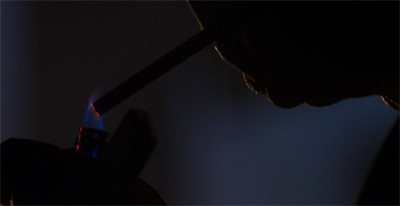
Light 'em up...

Light ’em up…

Continue reading

Millennium – Gehenna (Review)

This February and March, we’re taking a trip back in time to review the fourth season of The X-Files and the first season of Millennium.

Written by Chris Carter and directed by David Nutter, Gehenna feels very much like a continuation of The Pilot.

More to the point, it feels like a restatement of many of the key themes of The Pilot, an attempt to reinforce many of the core ideas in that first episode, and hint at something larger. In many ways, it is about ensuring that Millennium retains its identity as it transitions from a pilot that had a relatively relaxed schedule and high budget into a weekly (well, eight-day) production schedule. Gehenna is about Carter and Nutter proving that Millennium can do what it wants and needs to do week-in and week-out, while also indicating towards larger threads.

Touching (or, at least, seeing) evil...

Touching (or, at least, seeing) evil…

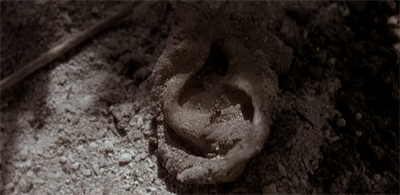
This isn’t a bad way to approach the first regular episode of a television series. Indeed, Carter had done something similar with The Pilot and Deep Throat on The X-Files, structuring the episodes as a one-two punch of reinforced themes and world-building. Gehenna is very much about convincing the audience that The Pilot was not just a flash in the pan, and that the series has a long clear arc ahead of it. Much like Deep Throat really sketched the outline of the alien conspiracy only hinted at in The Pilot, Gehenna features more than a few nods towards a larger evil at work in Frank’s world.

There are points where Gehenna feels a little bit too forced, and a little bit too eager to restate and repeat the themes and ideas of The Pilot. However, it is an interesting episode that does hint towards the show’s future in a number of interesting ways.

Ear today...

Ear today…

Continue reading

Star Trek (DC Comics, 1984) #9-16 – New Frontiers (aka The Mirror Universe Saga) (Review)

The first Star Trek pilot, The Cage, was produced in 1964. To celebrate its fiftieth anniversary, this December we are reviewing the second season of the original Star Trek show. You can check out our first season reviews here. Check back daily for the latest review.

Eight issues is a long time in the world of comic books, even by the standards of modern storytelling. Committing to the same story arc for two-thirds of a calendar year is a big decision, even moreso in December 1984. Nevertheless, DC comics committed to an eight-issue Star Trek story arc in the wake of Star Trek III: The Search for Spock, on throwing Kirk and the crew into a truly epic adventure with the fate of the Federation hanging on the line. It is no wonder that The Mirror Universe Saga remains the gold standard for Star Trek comic books, reprinted and repackaged repeatedly over the years.

The Mirror Universe Saga is an epic in just about every sense of the word, spanning two universes and eight issues. Not only do writer Mike Barr and artist Tom Sutton find themselves handling the fallout from the last feature film, but they also dabble in an iconic piece of Star Trek history. The Mirror Universe Saga takes full advantage of its format to offer a spectacular and impressive adventure that would have been impossible to realise on film in 1984 – indeed, it is hard to imagine television or cinema doing justice to the scale of the adventure now.

Meeting of minds...

Meeting of minds…

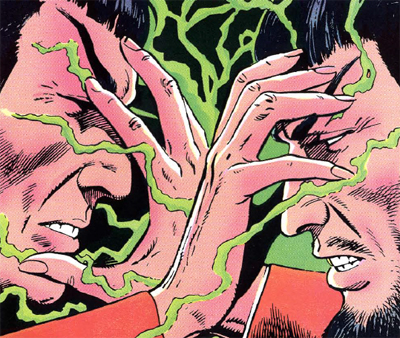
However, The Mirror Universe Saga succeeds on more than simply epic scale and meticulous attention to detail – although Barr and Sutton provide those with gusto. Despite everything going on around it, The Mirror Universe Saga largely works because it never loses track of the characters at the heart of the story. While the Terran Empire might be plotting an invasion in the midst of an internal revolution, the more powerful moments of The Mirror Universe Saga come from throwing the characters into contact with their alternate selves.

In 1984, it seems like The Mirror Universe Saga had figured out what would be the core ingredients for the most successful follow-ups to Mirror, Mirror. It deduced that the mirror universe could not just be playground where everything is gloriously and campily evil; it had to retain some level of emotional reality or connection. What good is a mirror if it is not reflecting anything?

Set course... for eeeevil!

Set course… for eeeevil!

Continue reading

Non-Review Review: Unbroken

The true story of Louis Zamperini is absolutely fascinating. It lends itself to this sort of big spectacle. It has everything you need for a movie that might clean up during awards season: a historical setting; a war; a sporting story about triumph of adversity; incredible physical transformations from the cast; a character enduring incredible hardship and coming out the other side. These are the sorts of ingredients that make a Best Picture contender. Unbroken just heaps more and more on top of these already alluring elements.

It isn’t the terrible and messy script that ultimately defeats Unbroken, with beloved filmmakers Joel and Ethan Cohen at the top of the bill. It isn’t the pedestrian unchallenging direction, either. It isn’t Alexandre Desplat’s condescending and patronising score, that doesn’t trust the audience to determine what they should be feeling from one moment to the next. It is not even the cynical Coldplay song playing over the closing credits, to put a pleasant life-affirming spin on events.

The Oscar race is on...

The Oscar race is on…

The detail that really shatter Unbroken is the fact that all of this has been very carefully and meticulously calibrated to check off the requisite items on the big Oscar check list. Unbroken is just as mechanical and lifeless a production as Transformers 4, but it happens to be built for a different purpose. There is no energy here, no enthusiasm, no emotion. It is just a bunch of things that have been successful in other stories heaped on top of one another, hoping to hit the high score on that fateful morning in January 2015.

Despite managing to eat up an incredible amount of attention and discussion in the larger Oscar race – taking attention off far more deserving contenders – Unbroken is a complete and utter misfire.

"This is what happens to anybody who suggests Merry Christmas Mister Lawrence is a better Japanese prisoner of war film."

“This is what happens to anybody who suggests Merry Christmas Mister Lawrence is a better Japanese prisoner of war film.”

Continue reading

The X-Files (Topps) #13 – One Player Only (Review)

This November (and a little of December), we’re taking a trip back in time to review the third season of The X-Files and the first (and only) season of Space: Above and Beyond.

After a twelve-issue opening mega-arc of interconnected stories about conspiracies-within-conspiracies and wheels-within-wheels, author Stefan Petrucha and artist Charles Adlard step back a little bit to close out their run with a series of standalone stories. The four issues (and three stories) that make up the rest of their run on Topps’ X-Files comic stand alone. They are connected by themes and subtext, but very clearly stand apart from what came before. Indeed, they play out almost like a postscript to the main body of work, a series of smaller bite-sized chunks.

In that light, it is interesting that One Player Only feels – superficially, at least – a lot more in step with the television show. The early issues of the comic had seen Petrucha and Adlard creating their own supporting cast and their own conspiracy, so as to avoid stepping on the toes of the production company. The Cigarette-Smoking Man was largely reduced to a number of cameos, with Skinner popping up once or twice along the way.

Ghosts in the machines?

Ghosts in the machines?

Not only does One Player Only feature a guest appearance from supporting characters like Mr. X or yhe Lone Gunmen, it also harks back to the structure and format of the first season of the show. On the most basic of levels, One Player Only feels like a more cyberpunk take on Ghost in the Machine, right down to the fact that Mulder is drawn into a murder at a tech company by an acquaintance from his days in the Violent Crimes Division. At one point, Mulder and Scully stumble on a ransacked house, for Mulder to deadpan, “Hm. Nothing new.”

However, if one peels back the layers, One Player Only is a fascinating piece that sets the tone for Petrucha and Adlard’s last three issues on the series, while infusing the comic with a host of fascinating cyberpunk stylings and body horror that seem to call forward to William Gibson’s future writing for the show.

Coding out...

Coding out…

Continue reading