• Following Us

  • Categories

  • Check out the Archives


  • Awards & Nominations

The Lone Gunmen – All About Yves (Review)

This October/November, we’re taking a trip back in time to review the eighth season of The X-Files and the first (and only) season of The Lone Gunmen.

The broad consensus would seem to suggest that All About Yves is the best episode of The Lone Gunmen.

While this is perhaps unfair to Madam, I’m Adam and Tango de los Pistoleros, it is certainly a defensible position. All About Yves is one of the tightest shows of the season, and marks the first time since The Pilot that a plot has managed to actually build momentum and tension across its run-time. As effective as the climaxes of Madam, I’m Adam and Tango de los Pistoleros might have been, the first season of The Lone Gunmen doesn’t really offer much in the way of dramatic stakes.
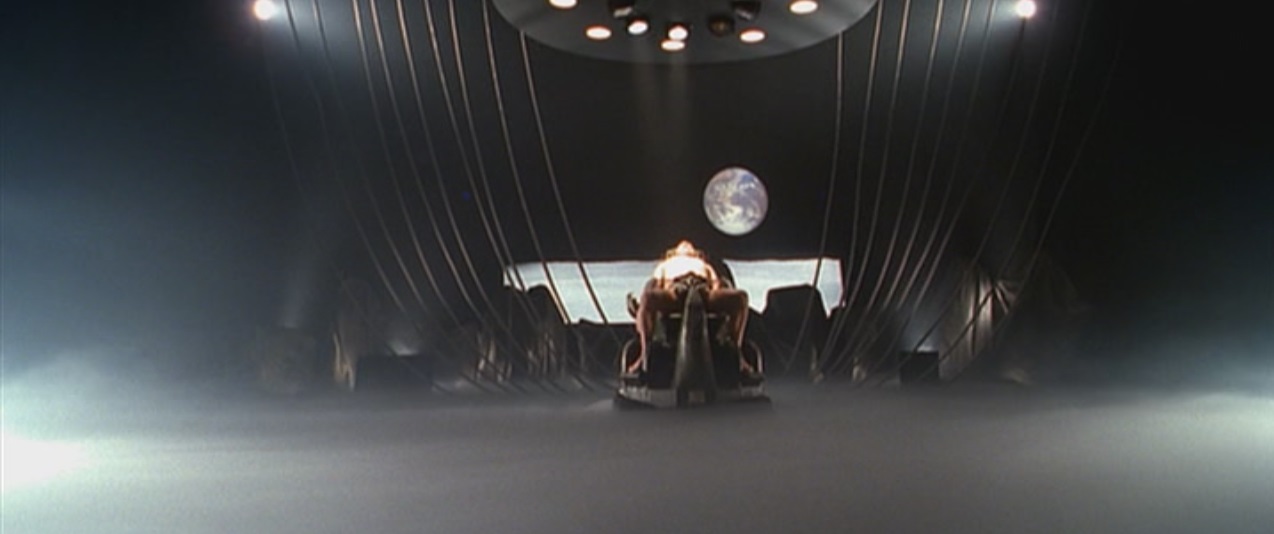
"This looks familiar..."

“This looks familiar…”

In a way, that is to be expected. The Lone Gunmen is, first and foremost, a comedy. There are points in the first season where it feels like The Lone Gunmen exists primarily as a silo to store all the displaced comedy that the production team stripped out of the sombre eighth season of The X-Files. (Cynics might suggest that there wasn’t quite thirteen episodes’ worth of comedy to be re-homed.) It is hard to feel too stressed when Langly is threatened in Bond, Jimmy Bond or when a poacher points a gun at Byers in Diagnosis: Jimmy.

That is the beauty of All About Yves, managing to create a growing sense of tension and unease without sacrificing any of the show’s humour. Indeed, with the addition of guest star Michael McKean to the cast, All About Yves winds up funnier than about half of the preceding season.
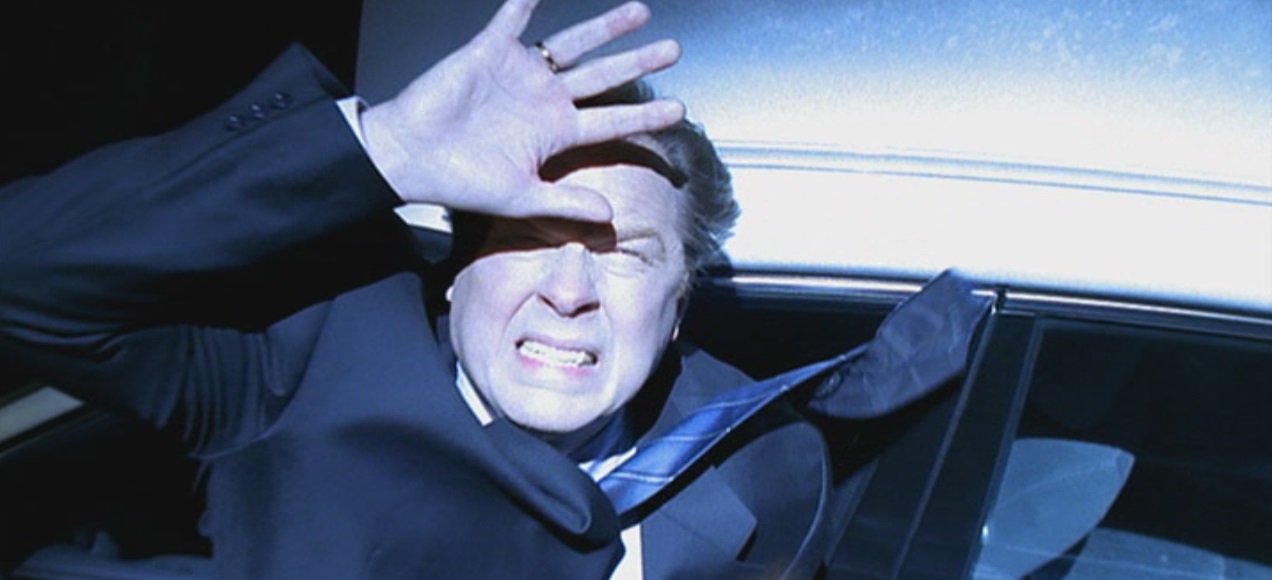
The truth is out there...

The truth is out there…

Continue reading

The X-Files – Empedocles (Review)

This October/November, we’re taking a trip back in time to review the eighth season of The X-Files and the first (and only) season of The Lone Gunmen.

Empedocles returns to one of the most enduring Ten Thirteen themes: the idea of evil as contagion.

Both The X-Files and Millennium have touched upon this theme. On The X-Files, episodes like Aubrey and Grotesque suggested that evil was something that could be passed from person to person. Despite the fact that Millennium was based around a forensic profiler, Chris Carter described it as a show about “the limits of psychology”; it seemed like evil could often be traced to sinister forces at work in the world. Looking at Ten Thirteen’s output as a whole, it seems that Carter believes wholeheartedly in the idea of evil as an external force.

Man on fire...

Man on fire…

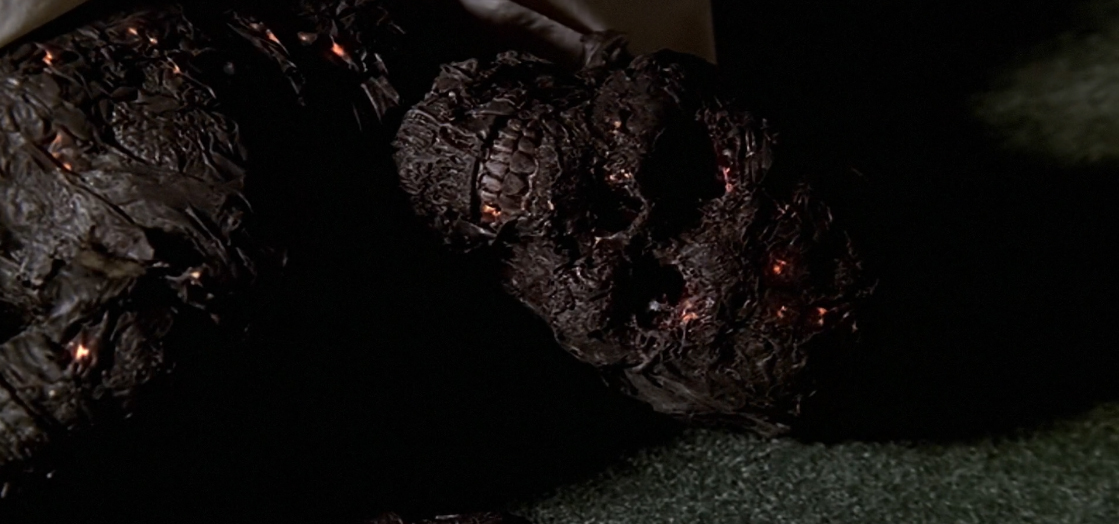
Empedocles offers perhaps the most straightforward example of this recurring theme. Reyes describes the case as “a thread of evil… connecting through time, through men, through opportunity.” It is a narrative thread that connects from the murder of Luke Doggett in New York to a workplace shooting in New Orleans. Evil is at work in the world, in a way that is palpable and discernible. Empedocles is not a subtle episode of television, linking this contagion of evil images of hellfire and burning.

There is undoubtedly something just a little simplistic about all of this. One of the luxuries of conspiracy theory, as The X-Files has repeatedly suggested, is the way that it serves to impose a logical and linear narrative on trauma; to make sense of acts and events that would otherwise suggest a brutally random universe. The mythology running through the first six seasons of the show suggested a conspiracy of powerful men might provide such a nexus of causation, but Empedocles offers something a bit broader.

It burns...

Burn with me.

As with a lot of the eighth season mythology, Empedocles cuts out the middle-man. The eighth season largely eschews the blending of “self” and “other” that run through first seven seasons of the show, largely rejecting the narrative of collaboration and complicity implied by the Syndicate. The eighth season of The X-Files repeatedly suggests that evil is inhuman, presenting its antagonists as distinctly “other” forms that infiltrate and pervert the body in perhaps the purest distillation of the show’s many viral metaphors.

In its own way, Empedocles is just as much a mythology or conspiracy episode as Three Words or Vienen. Like those episodes, Empedocles posits a conspiracy theory based upon the subversion of human identity by something alien and external. Empedocles posits a conspiracy of evil.

Crispy...

Crispy…

Continue reading

The X-Files – Three Words (Review)

This October/November, we’re taking a trip back in time to review the eighth season of The X-Files and the first (and only) season of The Lone Gunmen.

There is no “to be continued…” explicitly linking DeadAlive to Three Words, but there doesn’t have to be.

In this final stretch of the eighth season, The X-Files adapts a somewhat serialised narrative model. Although stories like Empedocles and Vienen technically serve as “monster of the week” stories that stand alone, they feel very particular to this moment in the show’s history. Mulder’s return to the land of the living in DeadAlive does not mark a return to the status quo, despite his best efforts. Instead, it creates a highly volatile (and, by its nature, transitory) set-up that cannot be maintained over an extended period.

Howard Salt was willing to go to any lengths to return the President's copy of The X-Files film.

Howard Salt was willing to go to any lengths to return the President’s copy of The X-Files film.

This is not a sustainable status quo. This is not “business as usual.” This is not what the ninth season will look like. This is not like those other changes to the status quo that occurred at the start of the second and sixth seasons, when Mulder and Scully were taken off the X-files but continued to investigate cases that were X-files in all but name. Episodes like Blood or How the Ghosts Stole Christmas could be transitioned into a regular season order with a minimum of changes, but these episodes all feel uniquely tailored to this point in the show’s history.

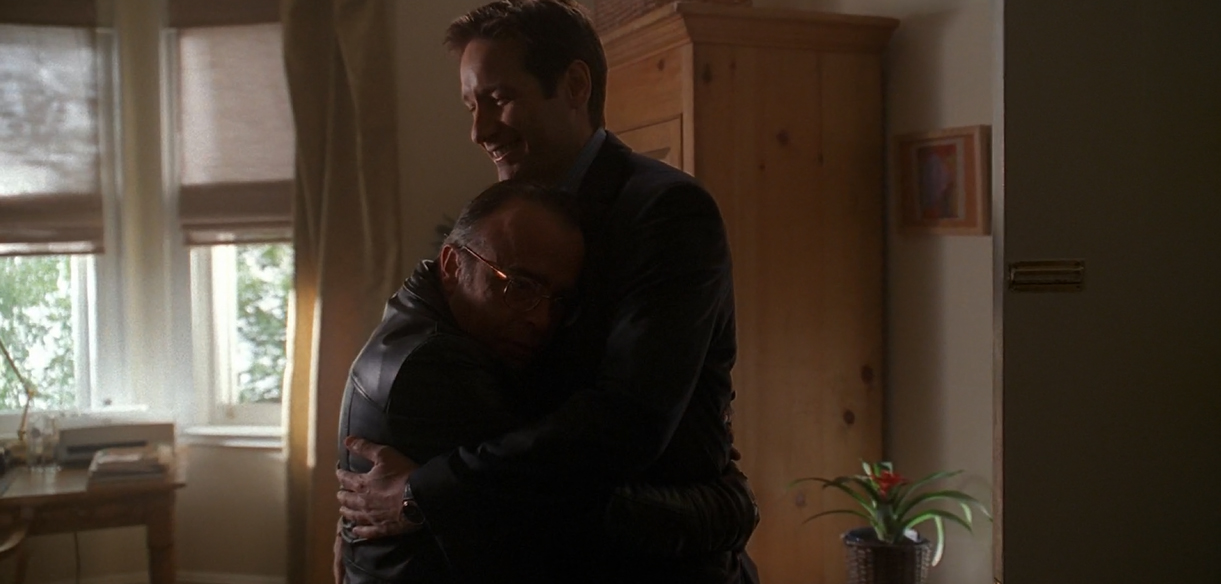
As such, the end of the eighth season takes on a loosely serialised quality, and not just in the story of the new mythology or the so-called “super soldiers.” The character dynamics evolve and grow, with the individual episodes seeding character development leading the season finalé. Episodes like Three Words and Vienen make it increasingly clear that Mulder is not back in an permanent sense by first pushing him away from the X-files and then firing him from the FBI. Scully’s pregnancy is actually allowed to progress at this point in the season.

He's back!

He’s back!

This serialisation is apparent in the discrepancies between the production and broadcast order. As with extended sections of the fourth season, the final stretch of the eighth season was produced in a different order than it was broadcast. Unlike the fourth season, however, this shift does not create any dissonance as significant as the conflict between the version of Never Again that was filmed and the one that was broadcast. Despite being produced in a different order, these stories could not work in any order other than the broadcast order.

Although The X-Files frequently gets credit for pioneering and popularising (or, at the very least, re-popularising) serialised narratives on prime-time television, the final stretch of the eighth season is perhaps the serialised stretch of the entire nine-year run.

A touching reunion...

A touching reunion…

Continue reading

The X-Files – This is Not Happening (Review)

This October/November, we’re taking a trip back in time to review the eighth season of The X-Files and the first (and only) season of The Lone Gunmen.

The eighth season of The X-Files is remarkable in a number of ways.

It accomplishes a lot of things, and does them in a very logical and linear way. The departure of David Duchovny at the end of the seventh season set an agenda for the season ahead, and gave the production team a very clear set of goals. The eighth season required more discipline and planning than any of the previous seven seasons, with less room for improvisation or error. If Chris Carter and his team were to succeed at bringing the eighth season to life, it would require even more care and discipline than the show usually required.

"Nooooo!"

“Nooooo!”

One of the least discussed aspects of the eighth season is the care that the production team took to structure it. The eighth season of The X-Files is the most meticulously and carefully structured season of The X-Files, clearly adhering to an internal three act structure. The first seven or eight episodes (Within to Via Negativa or Per Manum) are all set-up. The next five (Surekill to Medusa) explored that new set-up. The final eight (This is Not Happening to Existence) closed out the plots and threads of the season, leaving the show in a very different place.

The decision to shift Per Manum around in the broadcast order changes things slightly, but there is still a sense that the eighth season was entering its end game in late February 2001. Positioned at the start of the season’s third act, This is Not Happening offers perhaps the bleakest cliffhanger and puts our heroes at their lowest possible point. Adhering to the classic three-act structure, This is Not Happening serves as the emotional climax of the season. With a five week gap between the broadcast of This is Not Happening and DeadAlive, this is one hell of a cliffhanger.

"Have you seen this devilishly handsome man?"

“Have you seen this devilishly handsome man?”

Continue reading

The X-Files – Without (Review)

This October/November, we’re taking a trip back in time to review the eighth season of The X-Files and the first (and only) season of The Lone Gunmen.

Taken as a whole, the eighth season of The X-Files is remarkable.

It is not a perfect season of television, by any stretch. The eighth season doesn’t hit as many highs as the fourth, fifth or sixth seasons. As great as Robert Patrick is as John Doggett, and as skilfully as he is introduced, it is impossible to replace the easy dynamic between Mulder and Scully. The actual mythology of the season feels overcrowded and convoluted, with “supersoldiers” feeling a tad cliché and Mulder’s terminal illness going nowhere of note. The season’s recurring motifs of darkness, death and body horror are not for everybody.

I bet David Duchovny really missed working on The X-Files...

I bet David Duchovny really missed working on The X-Files

At the same time, there is a staggering consistency and reliability to the season. From the outset, the eighth season seems to know what it wants to be and where it wants to go. There is a stronger sense of purpose to the eighth season than to any other season of the show, with the possible exception of the third. Even the lead-up to the release of The X-Files: Fight the Future did not feel this single-minded and focused. In terms of consistency of theme and imagery, this is the closest the show ever came to pulling off a season-long arc.

It is tempting to credit this renewed vigour and energy to the absence of David Duchovny; the search for Mulder provides a solid and compelling hook for the season ahead. However, there is more to it than that. Mulder’s disappearance is a part of it, but the big thematic bow wrapped around the eighth season is Scully’s pregnancy. After all, David Duchovny returns to the show two-thirds of way through the season; it is Scully’s pregnancy that provides the season’s finalé.

"Thank goodness we all wore different ties. That might have been awkward."

“Thank goodness we all wore different ties. That might have been awkward.”

Continue reading

The X-Files – Within (Review)

This October/November, we’re taking a trip back in time to review the eighth season of The X-Files and the first (and only) season of The Lone Gunmen.

What is The X-Files without Mulder? Can it even exist without Mulder?

The show entered its eighth season facing an existential dilemma. David Duchovny had renewed his contract with Fox at the last possible minute, three days before Requiem consigned his character to limbo. However, it was not necessarily the renewal that Fox would have wanted. Duchovny had agreed to reprise the role of Mulder in the eighth season of The X-Files, but only for eleven of the season’s twenty-one episodes. This meant that the character of Mulder could only actually appear in just over half of the season’s episodes.

Eye see...

Eye see…

This was a pretty significant blow to The X-Files. The title of the show referred to the procedural cases investigated by Mulder and Scully, but the series had long abandoned any pretense of focusing on those cases ahead of Mulder and Scully. David Duchovny and Gillian Anderson had elevated the characters to pop culture icons, with any pop savvy person capable of easily slipping a reference to Mulder and/or Scully into casual conversation. The chemistry between the two was so strong it forced the global conspiracy to second billing in The X-Files: Fight the Future.

Attempting The X-Files without Mulder (or with “just under fifty percent less Mulder”) was perhaps the most daring and ambitious decision of the show’s entire nine-season run.

"And introducing Robert Patrick."

“And introducing Robert Patrick.”

Continue reading

The X-Files – Season 7 (Review)

This September, we’re taking a trip back in time to review the seventh season of The X-Files and the first (and only) season of Harsh Realm.

The seventh season of The X-Files feels like the end.

Indeed, going into the season, the production team were quite certain that it was going to be the end. Chris Carter and David Duchovny had signed two-year extensions to their initial five-year contracts that would expire at the end of the season. David Duchovny had signalled that he was unlikely to return for an eighth season. Frank Spotnitz suggested that the writing staff were approaching the seventh season like it was their last time working with these characters on this show.

xfiles-requiem37

Gradually, however, things changed. As the seventh season continued, it became more and more likely that it wouldn’t be the seventh season of the show. Most obviously, Fox endured one of its worst seasons on record; there was simply no show that could hope to replace The X-Files in the network’s line-up. As a result, there was a clear urge to continue the show into an eighth season. However, the production team could not commit to the possibility because David Duchovny was in the midst of an on-going lawsuit against Fox.

As a result, the entire seventh season occupies a hazily-defined realm between life and death. As the season goes on, it feels more and more like the seventh season is hedging its bets; that the production team might be happy to move on to other projects, but are not entirely ready to give up on The X-Files yet. Watching the season in hindsight feels weird; it often feels like the production team want to bring the curtain down, but are unwilling to definitively or conclusive wrap up all the threads.

xfiles-xcops8a

If the sixth season of The X-Files fixated on the show’s immortality and timelessness, the seventh season plays as a reaction against that. The seventh season is very keenly aware that everything must end and that The X-Files‘ cultural moment might be fading. There is something mournful and morose about the seventh season, as if The X-Files is watching itself slip away into history. After all, this was the point where the show became readily available on DVD and where Duchovny was engaged in a lawsuit over syndication; The X-Files was becoming a legacy concern.

The seventh season is about death and undeath.

xfiles-theamazingmaleeni15a

Continue reading

The X-Files – Requiem (Review)

This September, we’re taking a trip back in time to review the seventh season of The X-Files and the first (and only) season of Harsh Realm.

As with a lot of the seventh season, Requiem is an oddity.

It is an episode that exists in a weird limbo state, carefully designed and calibrated so that it might serve two – if not three – very different purposes. Requiem was written and filmed at a point where nobody knew what was going to happen next. Requiem could have been either a season or a series finalé; it could have been the last episode of the seventh season, the last episode of the series before the launch of a movie franchise, or even just the last episode ever. That is a lot of weight to put on a single episode.

"X" marks the spot where it all began...

“X” marks the spot where it all began…

In essence, Requiem existed in a state of ambiguity and flux. It was never entirely sure what Requiem would be when Chris Carter wrote it or when Kim Manners directed it. Requiem had to be designed to be fluid and malleable; it had to support any context that might be heaped upon it in the editing suite or on broadcast. Stories like Jose Chung’s “From Outer Space” and Bad Blood had explored the blurred boundaries of reality and perception; Requiem is perhaps that idea applied to the show itself.

Chris Carter could tell you what happened in Requiem as it went through production. He could explain plot details and character motivation; he could outline the chain of events that bind Requiem together. However, it was impossible for anybody working on Requiem to actually assert what the episode was until three days before the episode aired. Until that point, Requiem was a shadow or a blur, just waiting for some larger context to bring it into proper focus.

Things are looking up...

Things are looking up…

Continue reading

The X-Files – Fight Club (Review)

This September, we’re taking a trip back in time to review the seventh season of The X-Files and the first (and only) season of Harsh Realm.

Fight Club is an unpleasant episode of The X-Files.

It’s not “unpleasant” in a good way, like (arguably) Signs and Wonders or (definitely) Theef. It is “unpleasant” in a way that feels ill-judged and tone-deaf. Following on the charm and whimsy of Hollywood A.D., the script for Fight Club seems packed with forced charm and staged whimsy. At its most basic level, Fight Club is a comedy episode that simply isn’t funny. More than that, it’s an episode that isn’t particularly funny or clever to begin with, but then spends forty-five minutes insisting upon its own wit.

"Some of us are looking at the stars..."

“Some of us are looking at the stars…”

There is also a sense of unpleasantness about the themes and content of the episode in the context of the late seventh season. After all, it is no secret that the production team were facing considerable internal and external pressure. These pressures included a lawsuit involving the show’s lead actor and the show’s creator (not to mention the show’s network) and the fact that everybody on the production team was waiting for David Duchovny to determine if they would have a job the following season.

With all of this going on in the background, maybe an episode the implicitly features the show’s two lead actors knocking the stuffing out of each other for no good reason is not the best idea in the world.

"Hm..."

“Hm…”

Continue reading

The X-Files – Hollywood A.D. (Review)

This September, we’re taking a trip back in time to review the seventh season of The X-Files and the first (and only) season of Harsh Realm.

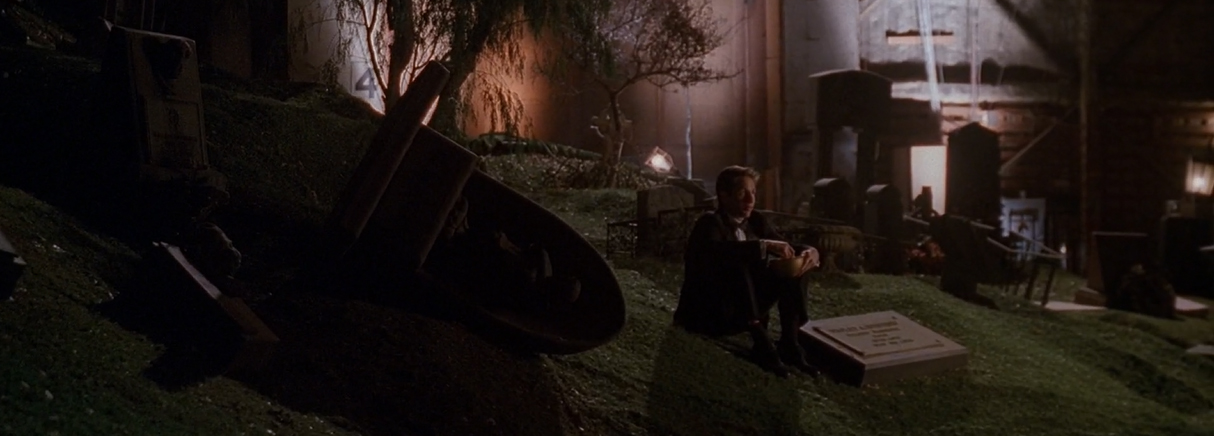
And now as we drift off the laughing agents and back to the graveyard , we see the Lazarus Bowl lying discarded beneath a tree.

A SWITCH, a broken tipped branch of the tree gets blown by the fan’s wind force down toward the plastic grooves of the replica as we move down toward it, we can read a “MADE IN ISRAEL” sticker on its bottom – the branch reaching toward the plastic,  like a woman’s arms to her lover —

Close on the splintered wood making contact on the colored plastic like a phonograph needle on vinyl —

And now MUSIC COMES UP – scratchy like an old record, the fourth track from BUENA VISTA SOCIAL CLUB, in a superior interpretation rendered by Mark Snow, called “PUEBLO NUEVO” – a beautiful stately cha cha instrumental —

We pull back wide as APPARITIONS appear to rise from their graves, rotting, but standing at atte ntion and then —

When the music kicks in, they begin to dance, all of them, in the round – dignified, changing partners… we hear the bones creaking, we see the gentlemanly half skulls smiling…

And now by the magic of Bill Millar & Co., the GREEN SCREEN becomes the rest of a HUGE GRAVEYARD with corpses dancing  stately and dignified upon it as we begin a slow pull out to a heavenly perspective…

This is what life’s about. This is what the dead would do if only they could. As we slowly fade to black, the band plays on.

And we end.

 – David Duchovny takes his bow

Everything ends.

Everything ends.

Continue reading