• Following Us

  • Categories

  • Check out the Archives


  • Awards & Nominations

The X-Files – Brand X (Review)

This September, we’re taking a trip back in time to review the seventh season of The X-Files and the first (and only) season of Harsh Realm.

Watching the seventh season of The X-Files only reinforces the sense that the production team got extremely lucky with the casting of David Duchovny and Gillian Anderson. The chemistry between the two actors has carried more than a few weak scripts across the seventh season. Lighter shows like Rush, The Goldberg Variation and The Amazing Maleeni were all able to coast off the charm of the pair. It doesn’t matter that the plot resolution in an exposition dump from Mulder when you end on Scully attempting a magic trick. However, this works both ways.

It the seventh season coasts of the charisma of David Duchovny and Gillian Anderson, this means that their inevitable absences are keenly felt. As The X-Files had become more popular, the demand upon Duchovny and Anderson had grown greater; most obviously, the show had dropped its production order from twenty-four to twenty-two episodes. Even allowing for that, the show could no longer make the same demands of Duchovny and Anderson that it had made in the first four seasons. Nor could they simply produce less television.
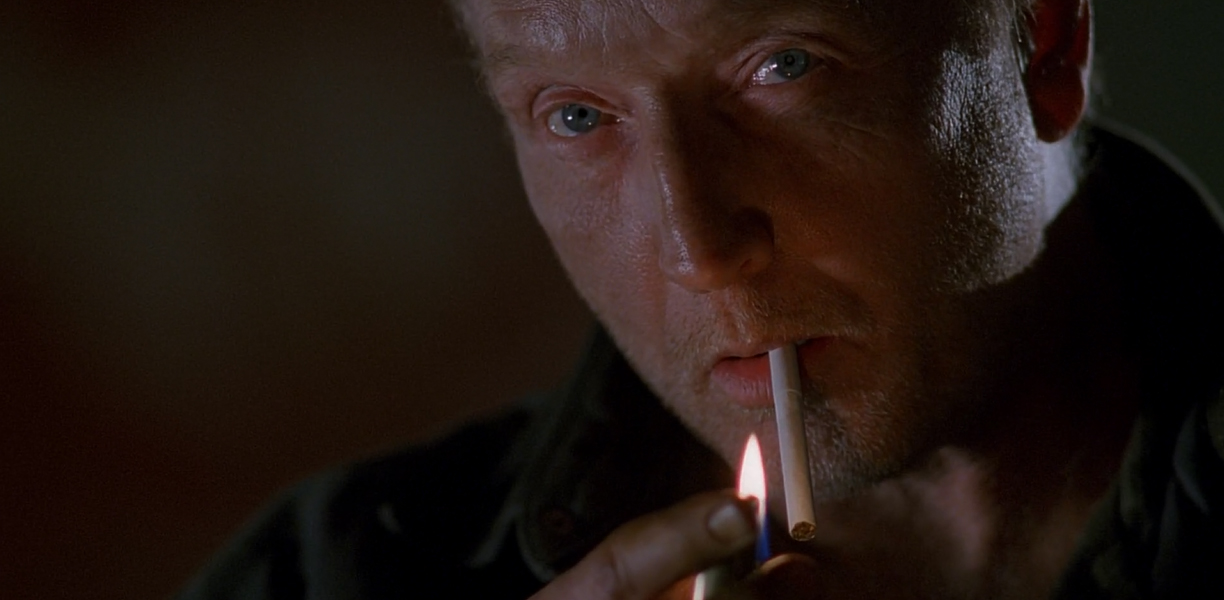
Smoke 'em if you got 'em...

Smoke ’em if you got ’em…

As a result, there are points in the show’s run when either (or both) David Duchovny and Gillian Anderson are unavailable. There are extended periods of the final two seasons that do not feature David Duchovny in any significant capacity. However, even within the seventh season, there are episodes where both leads are unable to fill the narrative space allocated to the lead characters. Gillian Anderson was largely absent from Chimera while working on all things; David Duchovny was largely absent from all things while working on Hollywood A.D.

It is these absences which suggest an uncomfortable truth about The X-Files. The show might have its own chemical dependencies. In a metaphor stretched in an effort to tie it all back to Brand X, the audience might rely on Duchovny and Anderson as surely as a smoker relies on their quick nicotine fix. Any attempt to genetically reengineer the show to ensure a healthier and longer life could easily end up creating a monster.
Talk about a looming legal face-off...

Talk about a looming legal face-off…

Continue reading

The X-Files – First Person Shooter (Review)

This November, we’re taking a trip back in time to review the seventh season of The X-Files and the first (and only) season of Harsh Realm.

On paper, this should be a slam dunk.

X-Cops was an incredibly risky and experimental episode of The X-Files that really pushed the show in an unexpected direction. The idea of crossing over into Cops was strange and surreal; it seemed like a gimmick that could backfire spectacularly. How could an episode of The X-Files adopt many of the identifiers and signifiers of Cops while still managing to tell its own story? It was a risky proposition, but writer Vince Gilligan and director Michael Watkins managed to pull it off, producing a definite highlight of the seventh season. (If not the final three seasons.)

Game on.

Game on.

First Person Shooter is a similarly ambitious episode, but one that should be a much safer bet. While it pushes the show outside its comfort zone in terms of setting and concept, it does not stray too far from the basic X-Files template. It is written by outsider writers William Gibson and Tom Maddox, but could logically be seen an extension of their superlative script for Kill Switch. In fact, Kill Switch wasn’t even the show’s first “killer artificial intelligence” story; Howard Gordon and Alex Gansa had written Ghost in the Machine as the series’ eighth episode.

On paper, First Person Shooter is ambitious without being entirely unprecedented. Still, the script bends the show too far out of shape. The episode seems to warp and distort the series around it. Despite the fact that First Person Shooter contains far more of the trappings and structures of The X-Files than X-Cops, the episode feels far less comfortable in its own skin. First Person Shooter plays almost like an episode of The X-Files filtered through a lens of unreality; it feels like a textured wireframe model of an X-Files episode, wandering lost in the uncanny valley.

Game over.

Game over.

Continue reading

The X-Files – The Sixth Extinction II: Amor Fati (Review)

This November, we’re taking a trip back in time to review the seventh season of The X-Files and the first (and only) season of Harsh Realm.

My formula for greatness in a human being is amor fati: that one wants nothing to be different, not forward, not backward, not in all eternity. Not merely bear what is necessary, still less conceal it—all idealism is mendacity in the face of what is necessary—but love it.

– Friedrich Nietzsche, Ecce Homo

Everything burns...

Everything burns…

Continue reading

The X-Files – Season 6 (Review)

This July, we’re taking a trip back in time to review the sixth season of The X-Files and the third (and final) season of Millennium.

The sixth season of The X-Files is notable for many different reasons. It was the first season after the release of The X-Files: Fight the Future. It was the first season following the move to Los Angeles. It saw the “end” (at least nominally) of the show’s conspiracy mythology in the massive Two Fathers and One Son two-parter. It was the first season to begin closer to the end of the show’s nine-year run than to the beginning. It was also the first season to open past the hundred-episode mark.

That last landmark is important, because it marks the point at which The X-Files could effectively be sold into syndication. One hundred episodes meant that a network could air the show five nights a week for twenty weeks, filling up almost half a year’s worth of broadcasting slots. Reaching the one hundred episode mark meant that a show was a bona fides success, and that anything else was really just gravy on top. The bulk of the work had been done. The X-Files would be a rare prime-time drama to pass two hundred episodes.

xfiles-howtheghostsstolechristmas2a

Of course, times have changed. By 2011, the number of episodes required for a syndication deal had slipped from one hundred to a mere eighty-eight, with the goal being four seasons of twenty-two episodes. (This trend happened while The X-Files was on the air, with the show dropping from twenty-four or twenty-five episodes in a season at the start of its run to twenty-two or twenty towards the end.) Even then, streaming has changed the media landscape, making it more possible than ever to syndicate show with shorter runs, like Community.

So syndication beckoned for The X-Files. In fact, syndication would pose no shortage of trouble for the show in the years ahead. During the seventh season, David Duchovny would file a lawsuit against Fox alleging that the company’s syndication policy had cost him financially. After the show went off the air, Carter would find himself embroiled in a similar lawsuit over syndication rights, delaying production of The X-Files: I Want to Believe. There are worse ways to argue that The X-Files was a victim of its own success than to look at the syndication of the show.

xfiles-arcadia7

Nevertheless, it was clear that The X-Files had accomplished everything that it could ever want by the start of the sixth season. Chris Carter had his five seasons and a movie. Fox had a show they could syndicate. David Duchovny had forced the production to move to Los Angeles so that he could spend time with his family. Although nobody knew it at the time, the fifth season secured the highest rankings that a season of The X-Files would enjoy in the Nielsen Ratings. So going into the sixth season of The X-Files, there was only one question hanging in the air.

What now?

xfiles-therainking25

Continue reading

The X-Files – The Unnatural (Review)

This July, we’re taking a trip back in time to review the sixth season of The X-Files and the third (and final) season of Millennium.

Let me get this straight: a free-spirited alien fell in love with baseball and ran away from the other non-fun-having aliens and made himself black, because that would prevent him from getting to the majors where his unspeakable secret might be discovered by an intrusive press and public and you’re also implying that…

You certainly have a knack for turning chicken salad into chicken spit.

– Fox Mulder and Arthur Dales discuss the merits of The Unnatural

Swing and a hit...

Swing and a hit…

Continue reading

The X-Files – Season 5 (Review)

This May and June, we’re taking a trip back in time to review the fifth season of The X-Files and the second season of Millennium.

The fifth season of The X-Files represents the height of the show’s popularity.

Bookended by the production and release of the motion picture, the fifth season also earned the highest overall Neilsen ratings of any of the show’s nine seasons. The X-Files was a cultural force to be reckoned with, and had come a long way from its origins as little-seen cult television show. In the late nineties, it seemed like it wasn’t just aliens conspiring to colonise the planet; Chris Carter and his team were doing a pretty good job of it themselves. The fifth season has all the swagger and confidence of a show enjoying the view as it stands on top of the world.

xfiles-postmodernprometheus33

The fifth season might not be able to match the third season for consistency from episode to episode. The fifth season might also struggle to match the breathless ambition of the fourth season’s best (and wildest) episodes. However, it is a highly enjoyable season of television on its own terms. The season feels a little more relaxed and organised than the fourth season, and more confident in itself than the third. The fifth season even makes better use of its own internal themes and motifs than any of the previous seasons, with most of the staff seemingly on the same page.

Oddly enough, this thematic consistency does not translate into clear or fully-formed arcs. Unlike the second season of Millennium, it seems like the fifth season of The X-Files has no real idea of where it is going or how it wants to get there. This is slight problem when the fifth season needs to build to a feature film that was shot in the gap between the fourth and fifth seasons. The X-Files gets a lot of credit for popularising serialised storytelling on prime-time television, but the fifth season demonstrates just how sloppy the show could sometimes be in that regard.

xfiles-badblood10

Still, this is a minor problem. With only twenty episodes, the fifth season is the shortest season of The X-Files produced at this point in the show’s history. The ninth season would run the same length, but there is an argument to be made that it is technically the shorter season; The Truth was written and broadcast as a single feature-length episode rather than two individual episodes. However, production necessities required a lot of innovation and experimentation in the fifth season, leading to a very playful and very off-format season of television.

While it is probably very difficult to argue that the fifth season of The X-Files was the show’s best run of episodes, it is a highly enjoyable collection of shows that brings together a lot of what was so much fun about The X-Files. The last season to be filmed in Vancouver, and the season that moves us closer to the end of the series than the beginning. Although certain segments of fandom would argue that it is the last truly great season of The X-Files, that feels unduly harsh to both the sixth and eighth seasons. Nevertheless, it is thrilling to watch a show so thoroughly enjoying its moment in the sun.

xfiles-theend32

Continue reading

The X-Files – The Pine Bluff Variant (Review)

This May and June, we’re taking a trip back in time to review the fifth season of The X-Files and the second season of Millennium.

The Pine Bluff Variant is probably John Shiban’s best solo script for The X-Files.

It is the kind of story that the show does very well, a taut conspiracy thriller packed with sharp twists and turns. Not all of those twists and turns make a great deal of sense, but there is an incredible momentum to the episode that keeps it moving forward. John Shiban’s script is beautifully brought to life by Rob Bowman’s direction, with Bowman demonstrating once again why he was the perfect choice to direct The X-Files: Fight the Future. The Pine Bluff Variant is a well-constructed piece of television.

He who hunts monsters...

He who hunts monsters…

It also fits quite comfortably in the context of where the show is at this point in time. The fourth and fifth seasons of The X-Files saw the show really engaging with the dark underbelly of conspiracy culture just as Mulder when through his own dark midnight of the soul. After three seasons of endorsing paranoia and skepticism, The X-Files was ready to deal with the sorts of organised groups that believed in such conspiracies. The Pine Bluff Variant has Mulder infiltrating a militia a few months before the release of Fight the Future would recreate the Oklahoma City Bombing.

It is a thread with which the show had been playing since The Field Where I Died early in the fourth season. The Pine Bluff Variant is the last time that the series pushes these sorts of militia groups to the fore, with Mulder reaffirming and regaining his faith at the climax of Fight the Future. It is a suitably satisfying farewell to this recurring thematic motif.

Fleshing out the threat...

Fleshing out the threat…

Continue reading

The X-Files – Bad Blood (Review)

This May and June, we’re taking a trip back in time to review the fifth season of The X-Files and the second season of Millennium.

Despite a notable absence of Darin Morgan, Bad Blood makes a much more convincing case for Vince Gilligan as the heir apparent to Darin Morgan than Small Potatoes did at the end of the fourth season.

Bad Blood finds Gilligan touching on some of the same broad ideas as Small Potatoes – how Mulder is perceived and how he perceives himself, a sly awareness of the show’s tropes and conventions. However, Bad Blood feels a lot more honed and focused than Small Potatoes. It felt like Small Potatoes only got to the meat of the story it wanted to tell in its final third, while Bad Blood is shrewd enough to put its core concepts front-and-centre. While Bad Blood has the same broad humour of Small Potatoes, it feels a lot more convincing when it comes to characters.

The tooth is out there...

The tooth is out there…

It could be argued that Gilligan drew quite heavily on the work of Darin Morgan in some of his scripts. There is no shame in this. After all, Darin Morgan is perhaps the most widely-praised writer to work on The X-Files. In this context, Bad Blood is something of a spiritual successor to Jose Chung’s “From Outer Space.” Gilligan’s script is not quite as structurally or philosophically ambitious as Darin Morgan’s final credited script for the series, but it does hit on the same fundamental idea that truth is an inherently subjective construct.

Bad Blood is essentially an episode that is not only about how Mulder and Scully see each other, but how they see themselves.

Mulder knows what's at stake...

Mulder knows what’s at stake…

Continue reading

The X-Files – Small Potatoes (Review)

This February and March, we’re taking a trip back in time to review the fourth season of The X-Files and the first season of Millennium.

Darin Morgan’s absence haunts the fourth season of The X-Files.

According to Frank Spotnitz, Darin Morgan had originally hoped to contribute a script in the middle of the season. Unfortunately, that idea fell through. The scramble to fill that gap in the schedule led to Memento Mori, which ultimately became the centre of the fourth season’s mythology arc, for better or worse. Scully’s cancer arc was just one result of the Darin-Morgan-shaped hole in the fourth season. Small Potatoes is another, the show’s first real “comedy” episode since Morgan departed the staff at the end of the third season.

A sting in the tale...

A sting in the tail…

Darin Morgan often gets credit for introducing the concept of comedy to The X-Files. That is not entirely fair; Glen Morgan and James Wong wrote Die Hand Die Verletzt shortly before Darin Morgan wrote Humbug. However, Morgan did refine the idea of comedy on The X-Files. Darin Morgan won an Emmy for writing Clyde Bruckman’s Final Repose, and he still considers Jose Chung’s “From Outer Space” to be among the best things that he has ever written.

Despite Morgan’s departure, it was clear that The X-Files could not completely avoid comedy. Once a show has demonstrated that it can do something particularly well, it becomes very difficult to stop doing that thing. Comedy episodes became something of a staple on The X-Files, with the show regularly churning out light-hearted and funny episodes (with varying degrees of success) until the show was finally cancelled after its ninth season. However, there was a long stretch after Morgan departed where the series seemed quite grim. Somebody would have to go first.

The inside, looking out...

The inside, looking out…

So Vince Gilligan stepped up to bat. Gilligan had been on staff for a bout a year at this point. He had quickly established himself as one of the most promising young writers in the room. While his first script for the show – Soft Light – was arguably more interesting than successful, Gilligan enjoyed an incredible hot streak when he joined the staff. Pusher, Unruhe and Paper Hearts are among the best scripts of the third and fourth seasons. With Small Potatoes, he seemed to position himself as the logical successor to Darin Morgan.

Darin Morgan even appears in Small Potatoes to pass the metaphorical baton.

"Here's Mulder!"

“Here’s Mulder!”

Continue reading

The X-Files – Memento Mori (Review)

This February and March, we’re taking a trip back in time to review the fourth season of The X-Files and the first season of Millennium.

It is easy to see why Scully’s cancer arc is so fondly remembered.

It arrived at a point where the show was at the very top of its game. Scully’s cancer arc comes amid a slew of beloved and classic episodes, in the middle of a season that contains Home, Unruhe, Paper Hearts and many more. It is the defining mythology plot point for the show’s fourth season, which was the point at which The X-Files just exploded into the centre of popular consciousness. More than that, the episode introducing Scully’s cancer – Leonard Betts – was the most-watched episode of The X-Files ever broadcast.

What's in your head?

What’s in your head?

Memento Mori has its own endearing aspects. If Leonard Betts was the show’s highest profile and most populist success, Memento Mori counts as one of the show’s biggest critical successes. The episode is largely responsible for winning Gillian Anderson her Primetime Emmy Award for Outstanding Lead Actress in a Drama Series. It also took home the Primetime Emmy Award for Outstanding Art Direction for a Series and received a nomination for Outstanding Writing for a Drama Series. It is perhaps the most prestigious episode of the fourth season.

However, in spite of all of that, Memento Mori remains something of a mess. It feels like a clumsy retread of One Breath, a story that worked much better in the show’s second season.

Send in the clones...

Send in the clones…

Continue reading