• Following Us

  • Categories

  • Check out the Archives


  • Awards & Nominations

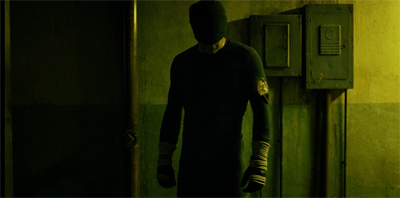
Daredevil – In the Blood (Review)

To celebrate the launch of Marvel’s Daredevil and the release of Avengers: Age of Ultron, we are reviewing all thirteen episodes of the first season of Marvel and Netflix’s Daredevil. Check back daily for the latest review.

There is something very functional and formulaic about stretch of the season running from Rabbit in a Snowstorm through to Condemned.

After a great opening set of episodes, it feels like the show stalls a little. It pulls back, taking the time run through some stock superhero origin plot elements before pressing ahead. This might just be a result of the thirteen-episodes-in-one-go format of the series, or it could be a result of the transition from original showrunner Drew Goddard to new showrunner Steven DeKnight. Whatever the reason, it feels like the first season slows down its plotting for Matt Murdock so that it can catch up on developing Wilson Fisk – a character who spent the first two episodes of the season as a phantom.

daredevil-intheblood18

As a result, it is rather unsurprising that Fisk’s plot should be the most interesting part of In the Blood. This is the audience’s first extended encounter with the new crime boss of Hell’s Kitchen, as we join him on an awkward first date right before we are reminded of just how violence he can be. As ever, Daredevil provides a nice sense of contrast with its characters, offering a striking juxtaposition between the well-meaning and innocent version of Wilson Fisk presented to Vanessa Marianna and the brutal and violent version of Wilson Fisk who decapitates Anatoly Ranskahov with a car door.

The problem, then, is the plotting as it relates to Matt Murdock. While the show is making up for lost time by developing Wilson Fisk, it seems like Matt is relegated to level-grinding against the Russian mob. These are villains so generic that it seems like everybody in Hell’s Kitchen just refers to them as “the Russians.” To be fair, the teaser to In the Blood does give us some sense of back story for Vladimir and Anatoly Ranskahov, but they feel rather transparently like a stalling tactic designed to eat up time before the show can get to the interesting stuff.

daredevil-intheblood6

The situation is not aided by the decision to play out the cliché “attack the hero by targeting a female acquaintance” plot as the centrepiece of Matt’s arc in the episode. In the Blood cleverly underscores the parallels between Wilson Fisk and Matt Murdock by juxtaposing their relationships with Vanessa and Claire respectively, but this structural cleverness is undercut by the decision to reduce Claire to emotional leverage. Victimising a female character to drive a male character to action is also a risky plotting decision, but particularly so when it feels like the show is just marking time.

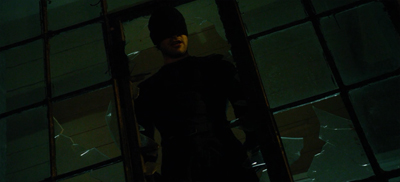
In the Blood is a perfectly functional episode, albeit one that works much better when it focuses on its villain than when it focuses on its hero.
daredevil-intheblood1

Continue reading

Daredevil – Rabbit in a Snowstorm (Review)

To celebrate the launch of Marvel’s Daredevil and the release of Avengers: Age of Ultron, we are reviewing all thirteen episodes of the first season of Marvel and Netflix’s Daredevil. Check back daily for the latest review.

One of the more interesting aspects of Daredevil is the way that it wears its influences so confidently on its sleeve. As if aware that the stock comparison for the show will be Batman Begins, the series goes out of its way to hit a number of key points from that particular film – introducing its masked vigilante during an atmospheric attack at a dockland smuggling operation, stopping the import of superweapon into the city by a secret society of ninjas. The show returns to the work of Frank Miller time and time again, knowing that he is the defining Daredevil writer.

In terms of televisual influences, it feels like producer Steven DeKnight was heavily influenced by a lot of prestigious contemporary drama. In particular, Rabbit in a Snowstorm features sequences that feel like they might have been lifted from Breaking Bad and The Wire. This makes a certain amount of sense; those are two very well-respected shows that lend themselves to “binge” watching of (relatively) short seasons. Netflix has even found great success as a distributor of Breaking Bad in Europe. There are worse influences for Daredevil.

daredevil-rabbitinasnowstorm16

To be fair to Daredevil, the show never loses sight of itself. This is a superhero story about a masked vigilante who cleans up Hell’s Kitchen and comes face-to-face with honest-to-goodness ninjas and other possibly supernatural events. Nuance and subtlety have their place, but Daredevil arguably works best when it revels in its theatricality – grand sweeping statements, bold imagery, heightened drama. For all that Rabbit in a Snowstorm tries to expand and ground the world of Daredevil, it is marked by two acts of over-the-top violence at the open and close of the hour.

At the same time, this underscores the biggest problem with Rabbit in a Snowstorm. Daredevil is not a show that lends itself to the same sort of aesthetic as The Wire, and some of the attempts to ground the show feel clumsy and awkward; the show works best when it is big and bold and operatic, stumbling a bit when it tries to present a grounded real-world setting.

daredevil-rabbitinasnowstorm12

Continue reading

Daredevil – Cut Man (Review)

To celebrate the launch of Marvel’s Daredevil and the release of Avengers: Age of Ultron, we are reviewing all thirteen episodes of the first season of Marvel and Netflix’s Daredevil. Check back daily for the latest review.

If Into the Ring skilfully sets its tone in the opening teaser, telling the audience everything that they need to know about Daredevil before the first roll of the opening credits, then Cut Man saves its biggest and most defining moment for the closing seven minutes of the episode. It is almost impossible to talk about Cut Man without talking about the superb action sequence that closes out the episode – a single-take piece of stunt work that sees Matt Murdock tearing through an army of Russian mobsters in a way reminiscent of Oldboy.

That sequence is jaw-dropping, and possibly the visceral highlight of the thirteen-episode season. It is a very visceral demonstration of just what Daredevil can do. The technical skill on display in that seven-minute sequence rivals anything in the big-budget blockbuster Marvel movies. It eschews the clean-cut violence of something like the (also superb) elevator fight scene from Captain America: The Winter Soldier in favour of a more low-key and naturalistic vibe. Daredevil might not have the budget for monsters or armour suits, but it has a great stunt team.

daredevil-cutman11

In a way, the fact that Into the Ring is defined by its opening scene and Cut Man is defined by its closing scene feels appropriate. These are the only two episodes of the first season to be scripted by Drew Goddard, before he left the production and was replaced by Steven DeKnight. As such, these two episode have a tone that feels slightly distinct and removed from the episodes following on from this point. Although there is a very clear through line running from one end of the season to the other, Into the Ring and Cut Man feel like their own little part of the season.

These two episodes tidy away the broad strokes outline of Matt Murdock’s origin, to the point where the audience knows what they need to know before the actually story can kick in. The show will return to Matt’s early years in both Stick and Nelson v. Murdock, but Into the Ring and Cut Man represent the foundations of a superhero origin that will span the season.

daredevil-cutman13

Continue reading

Daredevil – Into the Ring (Review)

To celebrate the launch of Marvel’s Daredevil and the release of Avengers: Age of Ultron, we are reviewing all thirteen episodes of the first season of Marvel and Netflix’s Daredevil. Check back daily for the latest review.

Daredevil is an ambitious piece of work.

It represents an astonishing commitment from both Marvel and Netflix to realise a thirteen-episode run on a superhero character that will be produced and released in one big chunk. One of the unsung features of Netflix’s “full season” model is the fact that there is minimal room for course correction or reevaluation; there is no time for audience feedback or retooling. The model is all or nothing. Before the first episode has been released to the public, the last episode has already been cut and gone through post-production.

daredevil-intothering12

That is an impressive gamble, even in this day and age when Marvel has demonstrated that it can pull off almost anything that it wants to accomplish. Daredevil is part of the tapestry of interconnected continuity that forms the Marvel Cinematic Universe, a single unfolding narrative space that dates back to Jon Favreau’s Iron Man back in 2008. In the seven years once, one of the resounding (and effective) criticisms of Marvel’s creative model has been the sense that their projects are drowned in a “house style”, as if the individual works feel obligated to fit together.

These criticisms date back to the sense that Jon Favreau’s Iron Man 2 was smothered by its obligations to a shared universe, and was only fuelled by the high-profile departure of respected film-makers like Edgar Wright and Patty Jenkins from Marvel projects, citing a irreconcilable differences. To be fair, recent efforts like Iron Man 3, Captain America: The Winter Soldier and Guardians of the Galaxy have helped to add a great deal of diversity to the tapestry of the shared Marvel universe.

daredevil-intothering16

Into the Ring works hard to establish a clear and distinct mood for its own hero. Released on Netflix, it is not bound by the same set of constraints that hem in Agents of S.H.I.E.L.D. or Peggy Carter. The brutality on display in the teaser and at the climax is utterly unlike anything else produced under the banner of this shared universe; the montage at the end of the episode makes it clear that Matt Murdock exists in very different corner of the same universe. Child abductions and drug rings and white collar crime aren’t quite covered by Tony Stark or Steve Rogers.

Although there are a few bumps along the way, Into the Ring does a good job at setting the tone for what is to come.

daredevil-intothering6

Continue reading

Mark Waid, Chris Samnee, Paolo Rivera et al’s Run on Daredevil (Vol. 3) (Review/Retrospective)

This April, to celebrate the release of The Amazing Spider-Man 2, we are taking a look at some classic and modern comics featuring Spider-Man (and friends). Check back daily for the latest review.

Daredevil had been one of the most consistently reliable books at a major comic book publisher over the last decade or so. Under creative teams from Kevin Smith to David Mack to Brian Michael Bendis to Ed Brubaker, the gritty street level superhero has enduring a whole host of twists and shifts that have made the book a compelling read. Indeed, the only real problem with the run was that Andy Diggle couldn’t quite stick the landing and so we ended up closing out that incredibly run with a bland and generic crossover like Shadowland.

Still, Daredevil remains an exciting book – a comic that affords the writers and artists a bit more freedom than they’d enjoy working on a more high-profile or major character. When Spider-Man’s identity was revealed by J. Michael Straczynski during Civil War, the publisher almost immediately hit a reset button in the form of One More Day to tidy up everything. When Brian Michael Bendis revealed Matthew Murdock’s secret identity to the world, there was no attempt to stuff the genie back in the bottle. That radical shift remained in play for the rest of Ed Brubaker and Andy Diggle’s run, casting a shadow over Mark Waid’s as well.

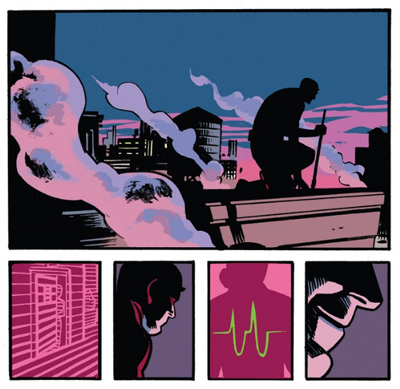
The big smoke...

The big smoke…

However, reading Andy Diggle’s Daredevil, it’s easy to get a sense that the character was suffocating under the influence of Frank Miller. Frank Miller and Klaus Jansen enjoyed a character-defining run in the mid-eighties. For Miller, it paved the way to The Dark Knight Returns, and it really shook the foundations of the superhero genre. Suddenly superheroes weren’t infallible; suddenly fights could get genuinely dirty; suddenly dressing up in a silly costume to fight crime was treated as something that might be deemed a little eccentric.

This had a dramatic impact across the superhero genre. At the same time, however, it really defined the character of Daredevil. In his year years, Daredevil often seemed like a cheap knock-off of Spider-Man; an imitation of a far more popular hero. With the work of Frank Miller, Matthew Murdock become more conflicted and more complex. He became a hero who could make mistakes, a hero who didn’t have the best judgement, a hero who could fail. This pushed the character of Daredevil more towards gritty urban crime and film noir conventions, and further away from superhero conventions.

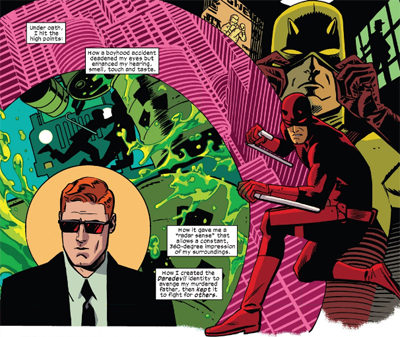
Radar love...

Radar love…

Decades after Born Again, writers are still drawing on that iconic take on Matthew Murdock. The Kingpin is still considered one of the – if not the – greatest foe of the Man Without Fear. Kevin Smith killed off Karen Page, the character who betrayed Matthew Murdock in Born Again. Brian Michael Bendis wrote a story featuring the character who planted the bomb in Born Again, two decades after that story was published. Miller cast a long shadow over the character. One of the (many) problems with Andy Diggle’s Daredevil was the way that it demonstrating that riffing on Frank Miller was getting old.

And so, Mark Waid’s run on Daredevil is absolutely fascinating. It’s a clear departure from the grounded urban realism that came to define the character, often feeling like an attempt to reconnect with the character’s Silver Age roots. Brought to life by some of the best artists in the business, the run just pops off the page. At the same time, Waid doesn’t ignore or avoid or overlook what has come before. He just seems to realise that there are other ways of approaching the character.

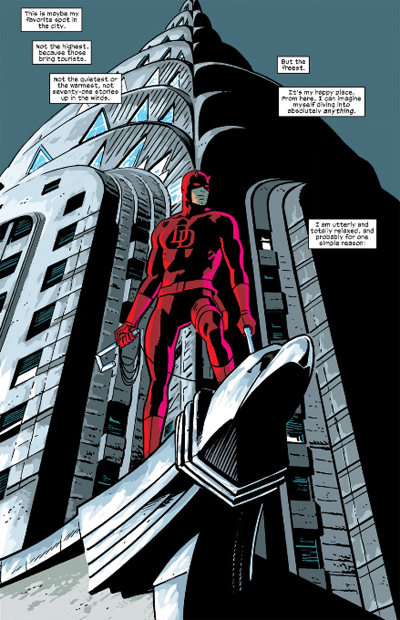
On top of the world...

On top of the world…

Continue reading

The Amazing Spider-Man – Grim Hunt (Review)

This April, to celebrate the release of The Amazing Spider-Man 2, we are taking a look at some classic and modern comics featuring Spider-Man (and friends). Check back daily for the latest review.

Although not technically part of The Gauntlet, Grim Hunt serves as a climax to eight months of stories in The Amazing Spider-Man. It comes at the end of what has been a pretty tough slog for the wall-crawling web-slinging superhero, after a string of pyrrhic victories and out-and-out losses. In essence, Grim Hunt is the culmination of all the plot threads running through The Gauntlet, as the sinister plot against the iconic superhero enters its end game.

It also comes towards the end of the Brand New Day era of The Amazing Spider-Man, only two story arcs before regular writer Dan Slott would take over the series for the next stage of the character’s development. Brand New Day was a controversial era for Spider-Man fans, building off a clumsy continuity reset in One More Day and trying to balance the weight of the character’s history against bold new directions.

As such, Grim Hunt also serves as something of a meditation on the history of The Amazing Spider-Man, a reflection on editorial attitudes to continuity and character development – an astonishingly self-aware and reflexive story arc that feels like a commentary on the character and the way that comic book storytelling tends to work.

A shot in the arm...

A shot in the arm…

Continue reading

Andy Diggle’s Daredevil – Reborn (Review/Retrospective)

This April, to celebrate the release of The Amazing Spider-Man 2, we are taking a look at some classic and modern comics featuring Spider-Man (and friends). Check back daily for the latest review.

Well, by the end of Daredevil: Reborn, it is certainly time for a change.

Radar love...

Radar love…

Continue reading

Andy Diggle’s Run on Daredevil – Shadowland (Review/Retrospective)

This April, to celebrate the release of The Amazing Spider-Man 2, we are taking a look at some classic and modern comics featuring Spider-Man (and friends). Check back daily for the latest review.

Shadowland is a disappointing climax to a wonderful decade of Daredevil. From the moment that Kevin Smith launched the second volume of the character through to the end of Ed Brubaker’s run, the Man Without Fear enjoyed a wonderfully consistent run of stories including runs from some of the best writers and artists working in comics, pushing the character in bold new directions and well outside his comfort zone.

Shadowland has a lot of problems, but the most obvious is that it betrays its central character. Matt Murdock is one of the most fascinating protagonists in comics, a proud (and occasionally arrogant) individual who might have the best of intentions but isn’t always able to make the right choices. Watching Murdock deal with his own mistakes and setbacks was a pretty compelling hook, as the comic pushed its protagonist into increasingly uncomfortable positions.

Unfortunately, the same cannot be said for Shadowland. Despite an interesting premise, it all falls apart when it decides that “a demon did it” is an acceptable explanation for Murdock’s latest errors in judgement.

Devilish delight?

Devilish delight?

Continue reading

Andy Diggle’s Run on Daredevil (Review/Retrospective)

This April, to celebrate the release of The Amazing Spider-Man 2, we are taking a look at some classic and modern comics featuring Spider-Man (and friends). Check back daily for the latest review.

One of the most remarkable things about Daredevil was how consistent the quality of the title had been. Andy Diggle inherited Daredevil at the height of its popularity. Ed Brubaker’s Daredevil was well-loved and enjoyed, climaxing on a celebratory 500th issue. Brubaker had come on after Brian Michael Bendis’ much-lauded run on the title. The two are considered among the best writers to work on the character since Frank Miller redefined the Man Without Fear. Diggle was succeeded by Mark Waid, who has made a reinvigoured and nostalgic Daredevil into one of Marvel’s best-reviewed and best loved books.

These are all great runs. Andy Diggle’s Daredevil run is not well-remembered. Diggle essentially wrote twelve issues of the main title, and almost the same number of crossover tie-ins, miniseries and one-shots. Whereas those other successful runs of Daredevil existed with their own space and freedom, Diggle’s Daredevil was very much event-driven. The big moment in all of Diggle’s Daredevil writing is the street-level crossover event Shadowland. It’s a problematic event, and quite a few of those problems reverberate back into Diggle’s work on the main title.

And yet, despite that, what’s most frustrating about Diggle’s Daredevil run is that it really could (and should) have been so much better.

The Devil you know...

The Devil you know…

Continue reading

Brian Michael Bendis and Alex Maleev’s Moon Knight (Review/Retrospective)

This March, to celebrate the release of Captain America: The Winter Soldier, we’ll be taking a look at some classic and not-so-classic Avengers comic books. Check back daily for the latest updates!

One of the more endearing aspects of comic book publishing is the way that the “little guys” occasionally get a shot. There are mountains of titles published each month featuring iconic characters like Batman or Wolverine, but the major companies are occasionally willing to check chances on more quirky and unknown characters using top-tier talent. One of the big surprises of DC’s “new 52” relaunch was the decision to put superstar writer Geoff Johns on pop culture joke Aquaman.

Despite the fact that he has never quite set the world on fire, Marvel seems willing to invest in repeated attempts to launch the character of Moon Knight. Most recently, writer Warren Ellis has launched a new volume of the comic with artist Declan Shalvey. However, before the latest relaunch, Marvel tried another high-profile take on Moon Knight written by Brian Michael Bendis and illustrated by Alex Maleev, the duo responsible for one of the best-loved runs ever published on Daredevil.

The series made it to twelve issues, before Marvel cancelled it due to disappointing sales. Bendis has insisted that it was always the plan to end the series after twelve issues, but it seems strange that the series was not announced as a miniseries. Still, it’s easy to understand why Moon Knight struggled to find an audience. It’s great to have Bendis and Maleev crafting an on-going street-level comic book, but the series seems almost at war with itself, struggling with the difficulties of fitting this character in this particular role.

Oh what a knight...

Oh what a knight…

Continue reading